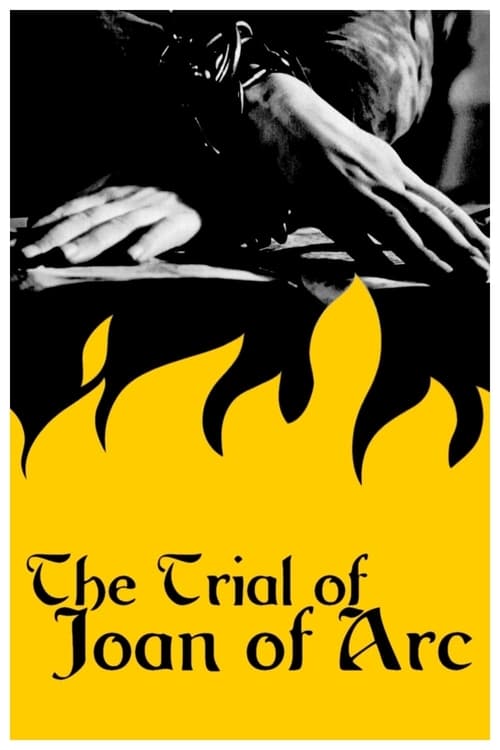
The Trial of Joan of Arc
1963 · Robert Bresson
For when you want something severe and purifying rather than comforting — a short, concentrated film that treats you like an adult and leaves a mark. Not a casual watch; it asks for your full attention and repays it.
What it's about
Rouen, 1431. Joan of Arc — the nineteen-year-old who led French armies claiming God spoke to her — has been captured and handed to a church court that serves her English enemies. The film stays almost entirely inside her interrogation: a chained young woman answering a room of learned men who have already decided her fate, drawn from the actual words of the surviving trial records. It follows her from cell to courtroom and back as the questions tighten toward the stake.
The experience
Stark, quiet, and compressed — barely over an hour, with no music swelling and no speeches, just question and answer landing like hammer taps. The plainness becomes its own kind of intensity; you lean in, and the ending arrives with a force the restraint has been storing up the whole time.
Performances
Florence Delay (billed as Florence Carrez) plays Joan with almost no outward emotion — eyes down, voice level — and that refusal to perform makes her defiance land harder than any big dramatic turn could.
The craft
Bresson strips away everything most historical dramas depend on: sets are bare, faces are framed in tight repetitive close-ups, and the dialogue comes straight from the 1431 court transcripts, so history speaks in its own words. The soundtrack is footsteps, chains, scratching pens — small sounds carrying enormous weight. It rewards a quiet room and undivided attention more than a big screen.
Why it matters
A touchstone of minimalist filmmaking, it showed how much drama could survive — even intensify — when spectacle is removed, and it stands at the heart of Bresson's most influential run of films, studied by generations of directors who prize restraint.
Snapshot
The Trial of Joan of Arc (French: Procès de Jeanne d'Arc) is Robert Bresson's austere, roughly hour-long dramatization of the 1431 ecclesiastical trial that condemned Joan to the stake at Rouen. Premiered at the 1962 Cannes Film Festival and released generally in 1963, the film reconstructs Joan's interrogation almost entirely from the surviving trial and rehabilitation records, staging it as a series of terse question-and-answer exchanges between the captured Maid and the churchmen — presided over by Bishop Pierre Cauchon — who serve English political interests. It is among the most concentrated and formally radical works in Bresson's mature period, made between Pickpocket (1959) and Au hasard Balthazar (1966). Where most treatments of Joan reach for spectacle or ecstasy, Bresson strips the story to voice, document, and gesture, producing a film that reads less as historical epic than as a spiritual procedural. It stands, deliberately, in the long shadow of Carl Theodor Dreyer's The Passion of Joan of Arc (1928), against which Bresson defined his own approach by negation.
Industry & production
The film was produced in France in the early 1960s within the orbit of French art-cinema production that supported Bresson's uncommercial, meticulously controlled projects. Bresson worked on a small scale and a short running time — the finished film runs only around 65 minutes — with a spare set-bound production centered on the courtroom and Joan's cell rather than elaborate period reconstruction. This economy was aesthetic as much as budgetary: Bresson consistently refused the expensive apparatus of the historical genre, and Trial is one of his most confined and least "produced-looking" films.
Precise financing details, budget figures, and box-office returns for the film are not something I can state reliably, and I will not invent numbers. What is securely established is the film's festival trajectory: it competed at Cannes in 1962, where it was recognized with a jury award (commonly cited as the Special Jury Prize, alongside an OCIC/Catholic-office prize). This placed Bresson's stripped-down chamber film within the international festival economy that was, by the early 1960s, the principal marketplace and validation system for European auteur cinema.
Technology
Technically the film is conventional for its moment — 35mm, black-and-white, standard Academy-ratio framing, and synchronous-sound production — and Bresson used that conventional apparatus in a deliberately anti-spectacular way. There is no widescreen, no color, no technological flourish; the period was one in which many prestige historical films embraced CinemaScope and color, and Bresson's refusal of both is itself a statement. His use of the tools is subtractive: the camera is largely static or minimally mobile, lighting is even and undramatic rather than expressionist, and the recording of the human voice — the trial's testimony — is treated as the film's central "technology." The most consequential technical choice is less a matter of equipment than of discipline: Bresson uses ordinary means to eliminate the theatrical and the picturesque.
Technique
Cinematography
The cinematography is by Léonce-Henri Burel, Bresson's regular director of photography across this central stretch of his career (Diary of a Country Priest, A Man Escaped, Pickpocket). Burel's work here is defined by restraint: flat, legible lighting; frontal or near-frontal framing of faces during interrogation; and a persistent attention to fragments — hands, feet, chains, doors, the shackle on Joan's ankle. The camera repeatedly isolates Joan and her judges in tight, plain compositions during the Q&A, cutting between speaker and listener with an almost documentary evenness. Crucially, Bresson and Burel refuse the emotive close-up that Dreyer had made the very grammar of the Joan story. Faces are observed rather than dramatized; the image withholds the expressive intensity a viewer expects, forcing attention onto words and small physical actions.
Editing
Bresson's editing is the film's engine. The interrogation is built from short shots and clipped reverse angles, a rhythm of question and answer that gives the film a metronomic, almost liturgical pulse. Bresson's characteristic ellipsis governs the structure: transitions between sessions are abrupt, and the film moves through the trial's stages — abjuration, relapse, sentence, execution — with a compression that treats the historical record as a score to be cut to time. The recurrent inserts of feet crossing thresholds and doors opening and closing are not decorative; they are load-bearing edits that carry the sense of movement, confinement, and procedure. I cannot confirm the credited editor with certainty and will not guess a name, but the montage sensibility is unmistakably Bresson's own.
Mise-en-scène / staging
The staging is deliberately impoverished in the theatrical sense: bare rooms, a table for the judges, a stool for the accused, the cell. Bresson organizes space around thresholds and sightlines — most memorably the peephole through which English observers spy on Joan in her cell, a device that literalizes surveillance and the political machinery behind the ostensibly religious trial. Costume and setting are period-appropriate but unglamorous; there is no crowd spectacle until the execution. The mise-en-scène concentrates the drama into the confrontation between a seated woman and the men who question her, so that the film's physical world is essentially a geometry of interrogation.
Sound
Sound is central to Bresson's method, and here the recorded voice — the reading of the trial's questions and answers — carries the film. Bresson typically favored a heightened, precise soundtrack of small concrete noises (footsteps, doors, chains, the scrape of a stool), and Trial is built on this fabric of plain diegetic sound rather than an orchestral underscore. Music is used sparingly, largely at framing moments; a drum-based cue is associated with the film's ceremonial passages, and the score is commonly attributed to Francis Seyrig, though I flag that I cannot fully verify the attribution. What is certain is the aesthetic principle: Bresson treats sound not as accompaniment but as an equal partner to the image, sometimes substituting for it.
Performance
The performances embody Bresson's theory of the "model" (modèle) rather than the actor. He cast non-professionals and directed them toward a flattened, affectless delivery, stripping out theatrical inflection so that speech becomes a kind of neutral utterance. Joan is played by Florence Delay — credited as Florence Carrez — who would later become a distinguished novelist and a member of the Académie française; her Joan is grave, plain, and unemphatic, her conviction registered through steadiness rather than emotion. The churchmen, including Jean-Claude Fourneau as Cauchon, are similarly held to a level, procedural register. The effect is anti-psychological: Bresson believed that suppressing performed emotion allowed something truer — grace, interiority, the soul under pressure — to surface. This is the opposite pole from Maria Falconetti's celebrated, anguished performance for Dreyer.
Narrative & dramatic mode
The film's dramatic mode is documentary-derived and processual. Its narrative is not invented but transcribed: Bresson draws the dialogue from the historical minutes of Joan's condemnation trial and the later rehabilitation inquiry, so that the "script" is substantially the testimony itself. This yields a courtroom drama purified to its essence — accusation, interrogation, answer, sentence — with almost no conventional exposition, backstory, or psychological scene-building. There is no arc of romance or battle; the film begins near the end of Joan's story, with her already captured, and proceeds inexorably to the stake. The dramatic tension is generated by the asymmetry between Joan's plain, often shrewd replies and the theological traps set for her, and by the audience's foreknowledge of the outcome. Bresson's mode is thus closer to a recorded rite or a legal transcript brought to austere life than to dramatized biography.
Genre & cycle
Nominally the film belongs to two prestige genres — historical drama and the religious/hagiographic film — but Bresson works against both. It is a "Joan of Arc" film, part of a durable cycle of cinematic treatments running from early silent versions through Dreyer (1928), later Hollywood and European renderings, and beyond. Within that cycle Bresson's entry is the anti-spectacular extreme: no coronation at Reims, no battlefield, minimal martyr's ecstasy. It also sits within Bresson's own auteur "cycle" of confinement-and-grace films — most directly A Man Escaped (the prisoner's discipline) and Diary of a Country Priest (spiritual trial) — sharing their preoccupation with a soul tested within enclosing walls. The film can equally be read as a courtroom drama denuded of courtroom-drama theatrics.
Authorship & method
Trial is a paradigmatic Bresson film and a clear expression of the ideas he would later codify in Notes on the Cinematograph (published 1975): the distinction between "cinema" (filmed theater) and "cinematography" (a new writing in movement and sound); the use of models rather than actors; the primacy of fragmentation, ellipsis, and the automatic gesture. Bresson wrote the film himself, adapting the trial documents, and directed with total control over rhythm and tone. His key collaborator on the image was cinematographer Léonce-Henri Burel, whose plain, frontal lighting realized Bresson's refusal of expressionism. The music is commonly credited to Francis Seyrig, used sparingly (I note this attribution with due caution). On performance, Bresson's method — the non-professional Florence Delay/Carrez as Joan — is inseparable from his authorship, since his direction of models is arguably his signature technique. Specific credited names for editing are ones I cannot confirm and will not fabricate; the montage philosophy, however, is entirely Bresson's. The result is one of the purest demonstrations of Bressonian method: authorship expressed through subtraction.
Movement / national cinema
Bresson is a foundational figure of French cinema and a lodestar for the critics-turned-directors of the French New Wave, though he belongs to no movement and predates the nouvelle vague in his career. By 1962–63 he was the exemplary French auteur of spiritual austerity, admired by Cahiers du Cinéma and championed within André Bazin's realist-inflected criticism as a director whose style disclosed reality and grace. Trial thus stands within French national cinema at the moment the New Wave was cresting, offered by an older master who shared the New Wave's esteem for personal authorship while pursuing an ascetic path entirely his own. His influence on French and world "slow" or contemplative cinema is disproportionate to his small, deliberate output.
Era / period
The film sits in the early 1960s, a fertile period for European art cinema and for Bresson personally. It follows Pickpocket (1959) and precedes Au hasard Balthazar (1966) and Mouchette (1967), the works in which his mature style reached its fullest expression. In the broader industrial context, it was made as widescreen color spectacle dominated commercial historical filmmaking and as the New Wave was transforming French production; Bresson's black-and-white, hour-long chamber piece is pointedly out of step with both, a work of concentration in an era of expansion. The subject — a fifteenth-century trial staged during the Hundred Years' War — is treated with a modern documentary sensibility rather than period romance.
Themes
The film's governing themes are Bresson's lifelong ones: grace under confinement, the imprisoned soul, and martyrdom as spiritual liberation. Joan's physical captivity — the cell, the chains, the surveilling peephole — externalizes a drama of interior freedom: she is bodily powerless yet spiritually unbroken, and her plain answers become acts of faith. The trial dramatizes the collision of institutional, political power (an ecclesiastical court doing English work) with individual conscience and divine vocation, raising the recurring Bressonian question of how the sacred survives within worldly machinery. Truth and testimony are foregrounded — the film's fidelity to the record makes Joan's words themselves the site of her sanctity. And, as throughout Bresson, the theme of transcendence emerges precisely through material means: hands, doors, footsteps, and the fire, from which the final images of the stake carry the sense of a passage beyond the physical.
Reception, canon & influence
Critically, the film was received as a rigorous, demanding, major Bresson work and honored at Cannes in 1962 with a jury prize (widely cited as the Special Jury Prize), confirming his festival stature; its severity also divided viewers who found it forbiddingly ascetic. Over time it has been absorbed into the Bresson canon as an essential, if not always his single most celebrated, film — overshadowed in popular reputation by A Man Escaped, Pickpocket, and Au hasard Balthazar, but recognized by scholars as a concentrated demonstration of his aesthetic.
Influences on the film (backward): the decisive precursor is Dreyer's The Passion of Joan of Arc (1928), against which Bresson consciously reacted — replacing Dreyer's expressionist close-ups and emotional intensity with documentary evenness and affectlessness. The deeper source is the historical archive itself: the surviving records of the 1431 condemnation trial and the 1450s rehabilitation proceedings, which Bresson mined for dialogue and structure, making the film in part an act of adaptation from legal document. His own earlier films — the prison discipline of A Man Escaped, the spiritual ordeal of Diary of a Country Priest — are the immediate stylistic antecedents within his oeuvre.
Legacy (forward): the film's influence flows through Bresson's outsized effect on later filmmakers who pursued austerity, ellipsis, and the anti-psychological. Directors associated with slow, contemplative, and spiritually inflected cinema — the lineage that includes figures such as the Dardenne brothers, Michael Haneke, and other heirs to Bressonian minimalism frequently cited in that context — draw on the method Trial exemplifies. Within the specific tradition of Joan of Arc films, Bresson's version stands as the canonical austere counter-model to Dreyer, a reference point for every subsequent filmmaker deciding whether to render Joan through spectacle or through restraint. Its reputation rests less on box office or mass popularity — for which I have no figures to cite — than on its standing as a pure statement of Bresson's cinematographic ideals.
A Deleuzian reading
Feet cross a stone floor.
The full Deleuzian reading of The Trial of Joan of Arc →
Reception
Booed by parts of the Cannes crowd in 1962 yet handed the Special Jury Prize the same week, it was long filed under 'minor Bresson' — now it's a favorite rediscovery, with fans arguing his most austere hour is also one of his most piercing.
How The Trial of Joan of Arc was received, from release to now →
How to watch The Trial of Joan of Arc: what to notice on a first viewing
- Notice feet crossing stone floors between scenes. Bresson cuts from session to session with no dissolve, no caption, just footsteps and a door opening or closing, over and over through the film. These plain transitions carry the film's sense of movement and confinement instead of any dramatic bridge between scenes.
- Watch Joan's face for what it refuses to show. Burel frames Joan and the judges frontally, in flat, even light, without the anguished close-up that earlier Joan films had made the norm. When a face declines to tell you what it feels, you are pushed onto her words instead, weighing them as answers.
- Listen for footsteps, doors, and the scrape of a stool. Bresson builds the soundtrack from plain concrete noise rather than orchestral score, so these small sounds carry as much weight as the dialogue. Sound here is not accompaniment; it is treated as equal to the image, sometimes standing in for what you cannot see.
- Notice Joan seated on a stool, the judges standing. The trial rooms are bare: a table for the judges, one stool for Joan. Bresson repeats this arrangement without ever stating what it means. The seating alone tells you who holds power here; no one has to argue the imbalance out loud.
- Watch how level and unshowy every voice stays. Bresson directs his non-professional cast, his models, toward flattened, affectless delivery, draining out theatrical inflection from Joan and the judges alike. Suppressing performed emotion is meant to let something truer surface: steadiness instead of a show of feeling.
The whole guide to watching The Trial of Joan of Arc, with the keys for a rewatch →
Influences: the films it descends from and the films it influenced
- The Passion of Joan of Arc (1928) — Draws dialogue from the same surviving 1431 condemnation-trial transcript, but Bresson inverts Dreyer's expressionist close-ups and tear-streaked emotional intensity into frontal, affectless framing—an explicit against-Dreyer counter-model.
- Diary of a Country Priest (1951) — Establishes Bresson's primacy of the recorded voice and the written document (the diary) as text that governs image, the same document-as-structure logic he applies to the legal record here.
- A Man Escaped (1956) — Perfects the fragment insert of hands at patient work and the use of diegetic concrete noise (scraping, footsteps, keys) to carry suspense in place of dramatization, both carried directly into the cell-and-courtroom rhythm of Trial.
- Pickpocket (1959) — Codifies the direction of non-professional 'models' drained of expression and the isolating close-up on gesture, the exact performance method he imposes on Florence Delay's Joan.
- Day of Wrath (1943) — A pared-down interrogation drama of a condemned woman built from the face and the spoken word, distilling the Joan/Anne tribunal scene to its essence.
- Au hasard Balthazar (1966) — Extends the ellipsis-driven martyrdom structure and affectless model performance, staging grace-under-suffering through elided scenes and averted faces rather than psychology.
- Mouchette (1967) — Continues the subtraction method—concrete-sound design and blank-faced non-professional lead—to render a passion and death without hagiographic spectacle.
- Chronicle of Anna Magdalena Bach (1968) — Radicalizes Bresson's documentary-transcript method: non-professional performers frontally recite historical documents in static long takes with direct-sound primacy, treating the archive as the film's spine.
- Jeanne Dielman, 23 quai du Commerce, 1080 Bruxelles (1975) — Inherits the fixed frontal frame and the insert on repeated everyday gesture as the unit of meaning, withholding psychological interiority exactly as Bresson does.
- In Vanda's Room (2000) — Takes the non-professional-model principle to its limit—subjects enacting versions of themselves—with fragmentary framing and concrete ambient sound replacing dramatic scoring.
- Rosetta (1999) — Applies Bressonian ellipsis and scoreless, close-bodied realism to a grace-under-confinement ordeal, cutting away from climaxes and refusing musical cues, per their self-declared Bresson debt.
- Caché (2005) — Builds its form on the surveillance-peephole stare and static frontal observation with withheld affect, extending Bresson's geometry-of-watching into a cinema of the flat, judging gaze.
- First Reformed (2017) — A direct application of the 'transcendental style' Schrader theorized from Bresson—diary-voice narration, boxed frontal compositions, and withheld emotion released only in a final rupture.
- Jeannette, the Childhood of Joan of Arc (2017) — Reworks the Joan subject through non-professional bodies and anti-spectacle staging, self-consciously choosing restraint-over-pageant within the very Dreyer-versus-Bresson choice Trial defined.
- The Ascent (1977) — Bresson's structuring of martyrdom as an interrogation transcript — flat, unadorned exchanges between captor and captive as a moral trial — is the narrative spine of the Sotnikov/Portnov cellar scenes.
- Gett: The Trial of Viviane Amsalem (2014) — Austere, transcript-faithful courtroom staging built on flat reverse-shot cutting between the accused and her interrogators, dialogue-driven and scoreless — the same evidentiary minimalism Gett uses for its rabbinical hearings.
- A Hidden Life (2019) — Dramatizes martyrdom by reconstructing the surviving trial/interrogation record almost verbatim, the same fidelity-to-the-historical-document method Malick applies to Jägerstätter's case.
- Gertrud (1964) — Shares the flattened, near-monotone line delivery and characters who speak past one another with averted gaze, an austere anti-expressive front that parallels Bresson's recorded-voice primacy.
- Winter Light (1963) — Contemporaneous chamber austerity that strips a crisis of grace to bare interiors and unadorned faces, refusing musical or dramatic underlining in the same early-1960s ascetic register.
- Ordet (1955) — Renders faith and miracle through slow, frontal, undecorated staging and flat performance, the ascetic religious-cinema register against which Bresson measured his own severity.
Similar films
- The Passion of Joan of Arc (1928) — influence & lineage
- A Man Escaped (1956) — influence & lineage
- Mouchette (1967) — influence & lineage
- Diary of a Country Priest (1951) — influence & lineage
- Au Hasard Balthazar (1966) — influence & lineage
- Pickpocket (1959) — influence & lineage
- Mother Joan of the Angels (1961) — shared sensibility
- L'Argent (1983) — shared sensibility