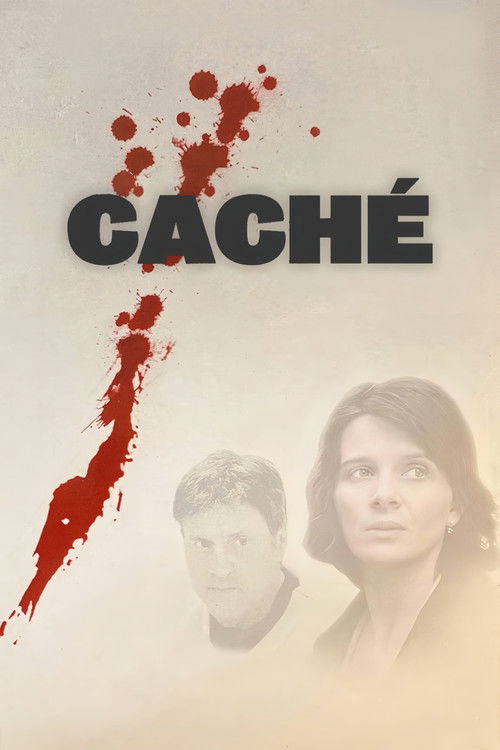
Caché
2005 · Michael Haneke
For when you want to be genuinely unsettled and made to think at the same time — a film you'll be arguing about at breakfast. Pure challenge; save the cozy night for something else.
What it's about
Georges, a comfortable Parisian TV host, starts receiving anonymous videotapes of his own house filmed from the street — hours of nothing, wrapped in childlike drawings that only he seems to understand. As the tapes grow more personal, they point back toward something he did as a boy, and toward an Algerian family history he has spent forty years not thinking about. His marriage, his poise, and his story about himself all start to crack.
The experience
Cold, controlled, and quietly terrifying — the scares come from stillness, not shocks, and one moment will take your breath away. It leaves you uneasy in a way that outlasts the credits, partly because it makes you complicit in the watching.
Performances
Daniel Auteuil is superb as a man whose civilized surface peels away millimeter by millimeter, and Juliette Binoche matches him as a wife discovering how much of her marriage was built on his silence.
The craft
Haneke strips out music entirely and shoots in long, fixed takes that look exactly like the surveillance footage inside the story — so you're constantly unsure whether you're watching the film or watching a tape. That formal trick turns the whole movie into an instrument of paranoia. It demands your full attention: no phones, no pausing.
Why it matters
Won Best Director at Cannes and became one of the defining films of the 2000s — a touchstone for how a thriller can carry a nation's buried history, and the peak of Haneke's confrontational style.
Snapshot
A Parisian television host receives anonymous videotapes showing his house under surveillance; the tapes gradually implicate a childhood act of cruelty that he has spent forty years refusing to remember. Formally and thematically one of the defining films of the early twenty-first century, Caché binds the mechanics of the psychological thriller to an excavation of French colonial amnesia, weaponizing cinema's own apparatus — the fixed camera, the long take, the image stripped of musical commentary — against a bourgeois subject who believes he controls the means of representation. The mystery of who sent the tapes is never resolved. The question Haneke wants answered is why that question feels more urgent than the history it displaces.
Industry & production
Caché is a French-language European co-production assembled through the network of art-house partners Michael Haneke had cultivated across his career. The lead French producer was Les Films du Losange — the company founded by Barbet Schroeder and Eric Rohmer and historically associated with the Nouvelle Vague and its aftermath — with Haneke's long-standing Austrian partner Wega Film joining alongside Bavaria Film (Germany) and BIM Distribuzione (Italy) and further support from French and Austrian public broadcasters. The producer of record on the French side was Margaret Ménégoz, who had produced Haneke's two preceding French-language films; on the Austrian side, Veit Heiduschka, his anchor through the German-language films of the 1990s.
The casting placed two of the most bankable names in contemporary French cinema — Daniel Auteuil and Juliette Binoche — in the lead roles, a decision that anchored the film's art-house credentials in genuine star power and eased its path into competition. The supporting cast was assembled with precision: Maurice Bénichou as Majid, the Algerian man whose life Georges's childhood lie destroyed, brought the weight of a long stage and screen career to a role requiring immense economy. Annie Girardot appeared as Georges's elderly mother.
By art-house standards the film was a commercial success, performing strongly in France and across European markets and achieving a broader theatrical release in North America and the United Kingdom than most of Haneke's earlier work. It was selected for competition at the 2005 Cannes Film Festival, where it won the Prize for Best Director; Haneke also received the FIPRESCI Prize from the international critics' jury.
Technology
The film was shot on 35mm photochemical film. The surveillance tapes within the diegesis, however, were recorded on consumer-grade digital video — a distinction that becomes one of the film's central formal gambits. Haneke and cinematographer Christian Berger calibrated the "filmic" image to be flat, static, and high in depth of field, closely mimicking the visual character of the DV footage that makes up the tapes. The practical result is that on first viewing the spectator frequently cannot determine whether a given shot belongs to the film's own register or to the surveillance material — the ontological boundary the medium normally guarantees is deliberately eroded.
This instability is most acute in the film's opening sequence, which holds for an extended period on a Paris street and a bourgeois townhouse before the image is interrupted by rewinding and fast-forwarding, revealing retroactively that we have been watching a videotape. The device is not a twist but a declaration of method: the machinery of cinema and the machinery of surveillance are revealed to share a grammar. That equivalence is the film's argument in condensed form.
Technique
Cinematography
Christian Berger's work on Caché operates through studied suppression. The dominant mode is the frontal static shot — camera on a tripod, no camera movement, deep focus across a rectilinear interior or a long Parisian façade. This is not austerity for its own sake: the denial of the subjective camera position (point-of-view, tracking shot, zoom) refuses to align the spectator with any character's consciousness. The image watches, impersonally, the way a surveillance system watches. Haneke and Berger also made deliberate decisions around exposure and color grading to flatten and cool the image, pulling it toward the gray-blue neutrality of security footage. The visual strategy ensures that no shot, however conventionally framed, can be read as innocent or "natural."
Editing
The film was edited by Michael Hudecek and Nadine Muse. The editing rhythm is slow by commercial standards, with long takes and infrequent cuts, and the formal economy is especially severe in sequences of high dramatic intensity — most notoriously the scene of Majid's suicide, which is presented in a single uninterrupted static take. The sudden violence happens without preparation, reverse shot, or reaction cut; the camera simply continues to hold as Georges stands in the room. Haneke has consistently argued that the formal refusal to aestheticize or to editorially "manage" violence is an ethical stance, a refusal to give the spectator the absorptive mechanisms of genre entertainment. The editing elsewhere conspires with the premise by presenting cuts to surveillance footage without any formal marker distinguishing it from the film's own continuity — no telltale timecode, no image-quality shift in several key instances.
Mise-en-scène / staging
The Laurent apartment — well-appointed, lined with books, a high-ceilinged Parisian salon — functions as a stage for class confidence. Haneke's staging consistently places Georges at the center of his domestic and professional world as an orchestrating presence: he is the host, the interlocutor, the man who controls the discourse. The progression of the narrative erodes that centrality. The apartment is also established as surveilled space from without — the external static shots that open the film return repeatedly, making the domestic interior readable as an exhibit. The confrontations between Georges and Majid, staged in Majid's bare, underlit suburban flat, enforce the contrast in material conditions that the film treats as a structural consequence of the history Georges has suppressed.
Sound
The sound design is almost entirely diegetic. Haneke does not use a non-diegetic musical score. Ambient sound — street noise, the murmur of a television, the background presence of Georges's literary talk show — fills the space that orchestral scoring would otherwise claim. The absence of musical cue means the spectator receives no emotional instruction; there is no sonic apparatus guiding sympathy or dread. The silence around certain moments — the surveillance tapes play without music, as does the suicide — is not suspenseful silence but analytical silence, the score withheld as a form of implication directed at the viewer.
Performance
Auteuil's performance is built around a specific, studied form of defensiveness — the performance of a man performing reasonableness, whose reasonableness is itself a technique of evasion. He is good at dinner parties; he is calm in ways that read as control rather than innocence. Binoche, in a less central role than her billing might suggest, tracks the erosion of a marriage by a secret her husband refuses to share; her performance is subtler for being reactive. Bénichou as Majid is quietly devastating — a man who has lived with the consequences of another person's lie and who retains, improbably, something like dignity. The suicide scene derives much of its force from the flat affectlessness with which Bénichou prepares and executes the act; there is no melodrama, no speech, no reaching for the camera's sympathy.
Narrative & dramatic mode
Caché adopts the surface architecture of the psychological thriller — the mystery, the escalating threat, the investigation — and systematically refuses its satisfactions. The genre conventions are instrumentalised: they give the spectator something to want (the revelation of the sender's identity) while Haneke redirects attention to what the protagonist is not doing, namely reckoning with the history the tapes reference. The film's climax, from a genre standpoint, is Majid's suicide — which dissolves the thriller's tension without resolving its mystery and leaves Georges's guilt not adjudicated but simply present. The final shot — a long take of school steps that, on scrutiny, shows Pierrot, Georges's teenage son, in conversation with Majid's son — suggests a second-generation transaction is underway, the significance of which the film declines to specify. Many first-time viewers do not notice it. The film essentially teaches you how to watch it only after it is over.
Genre & cycle
The film operates at the intersection of the psychological thriller and the European art-cinema tradition of ambiguous, politically inflected drama. Its nearest generic neighbors are perhaps Antonioni's L'Avventura (1960) and Blow-Up (1966) — films that use the genre mechanism of a hidden truth as a means of interrogating the social position of their protagonists rather than delivering the promised revelation. Within Haneke's own filmography it belongs to a loose trilogy of French-language films that examine the violence concealed within bourgeois European domestic life, alongside Code Unknown (2000) and The Piano Teacher (2001). It also participates in a distinct cycle of early-2000s films preoccupied with surveillance culture and the image as instrument of power — a cycle that includes Minority Report, Elephant, and various works of European art cinema — though Haneke's approach is distinguished by its historical specificity and its refusal of the paranoid-thriller mode.
Authorship & method
Haneke wrote and directed the film, as is invariant in his practice; he does not take assignments or adapt material he has not chosen. His screenwriting method favours precisely notated action and sparse dialogue, with the camera positions often implied by the nature of the described event. He has described his filmmaking as a response to what he regards as the emotional manipulation endemic to mainstream cinema: the deployment of music, editing, and performance to short-circuit the spectator's critical intelligence. His alternative is not Brechtian in a programmatic sense, but it draws on Brechtian instincts — the estrangement of familiar conventions, the refusal of identification, the implication of the audience as complicit.
Christian Berger had been Haneke's cinematographer since Benny's Video (1992) and would continue through The White Ribbon (2009). Their collaboration is characterized by an unusual degree of shared conceptual preparation: the visual strategy for each film is developed in extended pre-production conversation, not improvised on set. Haneke's approach to actors is exacting; he typically does not explain character psychology to performers but stages situations and expects them to inhabit rather than interpret.
Movement / national cinema
Haneke is Austrian, born in Munich, raised in Vienna, trained in philosophy, psychology, and drama at the University of Vienna. His German-language work is properly situated within Austrian cinema and the related tradition of Austrian literary and theatrical culture — a tradition marked by Kraus, Musil, Bernhard, and a certain satirical violence directed at bourgeois self-satisfaction. His French-language films from Code Unknown onward are formally continuous with that tradition while engaging directly with French social and political material. Caché is perhaps his most French film in subject — the 1961 Paris massacre of Algerian demonstrators, the suppression of that event within French collective memory, the specific sociology of the Parisian intellectual left — while remaining distinctly Hanekan in method. It occupies a productive ambiguity: too European in form for the French mainstream, too French in subject for the Austrian art-cinema frame.
Era / period
The film was released at a specific historical moment in France's reckoning with its colonial past. The October 17, 1961 massacre — in which Paris police under the command of Maurice Papon killed an as-yet undetermined number of Algerian protesters and disposed of bodies in the Seine — had been the subject of official denial for decades. A plaque commemorating the event was only affixed to the Pont Saint-Michel by the city of Paris in 2001, four years before the film. Debates about the official memory of the Algerian War were ongoing and politically charged. Haneke's film inserted itself into this contested terrain without being a historical film or a documentary; its method was to embed the political history in a domestic thriller and force its bourgeois spectator to register what had been suppressed.
The film also arrived at the height of widespread anxiety about surveillance, CCTV proliferation, and the data-gathering capacities of governments following the post-2001 security legislation across Western democracies. Haneke's use of the surveillance tape as the film's central object gave it a contemporary resonance that the historical substrate alone might not have generated.
Themes
Guilt and its avoidance — specifically the mechanisms by which a comfortable subject manages, metabolizes, and refuses historical responsibility — is the film's organizing preoccupation. Georges's childhood lie (he told his parents that Majid, the Algerian orphan they had taken in, was coughing blood and killing chickens, fabrications designed to prevent Majid from displacing him in parental affection) is a private act, but the film insists on its structural relationship to a public history: Majid's parents were killed, the film implies, in the 1961 massacre, and the entire condition of possibility for Georges's cruelty was the colonial situation that produced Majid's orphaning. The personal and the political are not analogs of each other; they are the same system operating at different scales.
The film is equally concerned with the image as a technology of power, and with the question of who controls the apparatus of representation. Georges is a professional mediator of culture — a television host, a man whose livelihood is the selective presentation and framing of discourse. The tapes invert this arrangement: someone else controls what he sees, when, and in what order. The experience of being surveilled is unfamiliar and intolerable to him in ways it is not for Majid, who has lived under the conditions of surveillance and social discipline that French colonial modernity imposed on its Algerian subjects.
Reception, canon & influence
The critical reception at Cannes and in international release was overwhelmingly positive, with consistent emphasis on the film's formal rigor, its political intelligence, and Auteuil's performance. A minority of critics found the withholding of resolution unsatisfying or detected a coldness in Haneke's method that precluded genuine engagement; these objections track the recurrent complaint about Haneke's work generally. The film entered canonical discussion quickly. It has appeared prominently in retrospective polls of significant films of the twenty-first century, including the BBC's 2016 survey of international critics, where it ranked among the most cited titles from the decade.
The films that bear on Caché most directly as influences include the Hitchcockian thriller tradition — the voyeurism of Rear Window (1954), the obsessive investigation of Vertigo (1958) — redeployed against their own ideological assumptions. Antonioni's model of the bourgeois subject adrift in a social reality he cannot fully perceive is equally present. Within French cinema, the political tradition of the Nouvelle Vague, particularly Godard's willingness to interrupt fiction with historical argument, is a recognizable antecedent, though Haneke's approach is less visible and more corrosive. Chris Marker's interrogation of image-making and memory, especially in La Jetée (1962) and Sans Soleil (1983), offers another relevant precedent for the film's interrogation of the tape as historical document.
Caché's influence on subsequent filmmaking has operated along several axes. Its treatment of the surveillance image as formally and epistemically indistinguishable from the cinematic image has been taken up by a range of filmmakers working with questions of mediation and documentation. Its method of embedding political history in genre architecture — using the thriller's demand for resolution to expose a protagonist who cannot afford resolution — has been influential in European art cinema. More broadly, it demonstrated that a film could refuse its own genre's central promise without losing an audience, a formal gambit that has encouraged subsequent directors to think more carefully about what the promise of resolution costs. It remains among the most debated film endings of the contemporary period, which is itself a form of influence: the final shot of the school steps continues to generate scholarly and critical attention as a test case for the politics of the off-screen, the unacknowledged, and the seen-but-not-registered.
A Deleuzian reading
The street holds.
The full Deleuzian reading of Caché →
Reception
Acclaimed from the moment it won Haneke Best Director at Cannes in 2005, and its stature has only climbed since — it's become a fixture near the top of best-of-the-2000s critics' polls, one of the few films of its decade whose canonization happened in real time.
How Caché was received, from release to now →
Influences: the films it descends from and the films it influenced
- Blow-Up (1966) — Establishes the recording apparatus (the enlarged photograph) as a failed detective instrument whose obsessive scrutiny displaces rather than solves the crime — the template for Caché's mystery that dissolves the closer the image is examined.
- The Conversation (1974) — Turns the surveillance professional into the surveilled, building dread from diegetic recorded media replayed and rewound rather than score — Caché inherits the replayed-tape structure and the watcher's collapse into guilt.
- Peeping Tom (1960) — Implicates the act of filming itself as aggression, equating camera and weapon and forcing the spectator into complicity with the watching apparatus — Haneke's flat surveilling frame is the ethical descendant.
- Jeanne Dielman, 23 quai du Commerce (1975) — Frontal, locked-off, real-time long takes of bourgeois domestic ritual with no musical score, climaxing in a single unmanaged take of sudden violence — the exact formal grammar Caché applies to Majid's suicide.
- L'Argent (1983) — Models performing without psychological inflection, diegetic-only sound, and violence presented with flat economy as an ethical refusal to aestheticize — the Bressonian restraint underwriting Haneke's affectless mise-en-scène.
- Muriel, ou le temps d'un retour (1963) — Lodges unresolved Algerian-war guilt inside present-tense bourgeois domestic surfaces through elliptical editing that refuses catharsis — the colonial-amnesia structure Caché formalizes four decades later.
- The Battle of Algiers (1966) — Its documentary-grammar flatness and its dramatization of French-Algerian repression supply the buried historical referent (the 1961 Paris massacre) that Caché's neutral image deliberately evokes without staging.
- The Seventh Continent (1989) — Haneke's own founding method: frontal static framing of bourgeois objects, diegetic sound with no consoling score, and dread accreted through duration rather than incident.
- Code Unknown (2000) — Long single-take staging in postcolonial Paris with Binoche, dramatizing immigration and class friction in fragments that refuse narrative resolution — the immediate French-language precursor to Caché's method.
- Three Colors: Red (1994) — Adopts the surveillance-as-moral-premise — a protagonist defined by his relationship to others' hidden lives — and fuses thriller-genre vocabulary with psychological interiority, the dual inheritance Red passes through the judge's wiretapping figure.
- Three Colors: Blue (1993) — Haneke radicalizes Kieślowski's withheld-spectacle principle by filming the film's central act of violence as surveillance footage from maximum distance, the camera refusing close-up access to the dramatic peak on the same formal logic as Blue's car crash observed from across the road.
- The Celebration (1998) — The bourgeois family drama whose domestic comfort is menaced by a repressed past crime, refusing non-diegetic score as emotional manipulation and using static long-take observation of domestic space without orchestral cueing — The Celebration's suppressed-guilt architecture extended into a surveillance aesthetic.
- The White Ribbon (2009) — Extends the Christian Berger collaboration into austere, rigorously composed static frames and a community's collective guilt whose perpetrator is never named — the unresolved-culpability structure repeated in monochrome.
- Red Road (2006) — Builds its entire narrative engine from CCTV surveillance footage, implicating the female watcher in what she observes — the surveilled-image-as-story device taken directly from Caché's opening gambit.
- 4 Months, 3 Weeks and 2 Days (2007) — Sustains scenes in static long takes with no score, generating unbearable tension purely through real-time duration and off-center framing of dramatic violence — the Romanian New Wave inheritance of Haneke's editing economy.
- Force Majeure (2014) — Locks the camera into frontal, surveillance-like framings of an affluent family whose performed reasonableness masks moral cowardice, eroding bourgeois class comfort through duration — Caché's staging method applied to marital guilt.
- A Separation (2011) — Constructs a forensic moral mystery left deliberately unresolved, driven by characters whose articulate, performed reasonableness conceals culpability across a class divide — the genre-subverting ethics of Caché in a domestic-thriller key.
- Tokyo Sonata (2008) — Haneke's surveillance-cinema grammar — static deep-focus frames where background space carries latent threat, narrative structured around withheld information, domestic middle-class guilt accumulating without dramatic release — is the direct structural template for Tokyo Sonata's mechanics of family concealment and Kurosawa's systematic refusal to grant explanatory closure.
- Dogtooth (2009) — Haneke's deployment of static surveillance-identical framings — camera placed where a camera should not comfortably be — to generate dread in a comfortable bourgeois home directly precedes Lanthimos's fixed exterior shots of the compound perimeter as panopticon architecture.
- Creepy (2016) — Surveillance-distance cinematography — static, long-lens frames observing domestic space from outside its threshold — as a technique that implicates the viewer in the protagonist's failure to interpret visible evidence; Ashizawa's exterior framings in Creepy are in direct dialogue with this mode.
- The Killing of a Sacred Deer (2017) — Caché's returning-guilt mechanism — a bourgeois professional's suppressed culpability materializing as an external force that dismantles domestic order without resolution — is the nearest narrative-mechanical predecessor to Sacred Deer's debt-and-retribution engine.
- You Were Never Really Here (2017) — Haneke's formal insertion of surveillance-video footage — technically indistinguishable from the film's own image quality — as a destabilizing device that undermines the viewer's trust in what constitutes observed versus mediated reality is the direct precursor to Ramsay's use of CCTV footage as both plot mechanism and ontological disturbance.
- Loveless (2017) — Haneke's bourgeois domestic thriller structure — comfortable middle-class life shown to rest on suppressed violence, the uninflected camera positioning viewer as moral judge of characters too self-absorbed to perceive their own guilt — provides the direct formal template for Loveless's diagnostic-thriller mode and its refusal to exonerate.
- Triangle of Sadness (2022) — The formally impassive static camera used as an ethical instrument that refuses to editorialize or assign viewer sympathy, forcing the audience to be present with class behavior without directorial absolution.
- Benny's Video (1992) — Establishes Haneke's video-apparatus argument — a consumer camera both commits and records violence inside a wealthy family, the screen serving simultaneously as crime and evidence, prefiguring Caché's tapes.
- Funny Games (1997) — Presents violence in unbroken static takes that withhold reaction shots and absorptive cutting, explicitly indicting the spectator's appetite for genre catharsis — the ethical editing logic carried into Majid's death scene.
- Cure (1997) — Generates dread through affectless performance and static long takes that hold on violence without managing it, refusing the reaction cuts of conventional thriller grammar — a contemporaneous parallel to Haneke's withholding camera.
- The Lives of Others (2006) — Haneke builds his film around unattributed long static shots that mimic the patience of surveillance-camera footage, forcing the viewer into the same act of observation-as-complicity that The Lives of Others foregrounds; both films withhold the identity and motive of the surveillance apparatus and use delayed disclosure as the structural mechanism through which audience watching becomes an ethical question.
- Mulholland Drive (2001) — Haneke uses ambiguous surveillance footage as a structural device that permanently refuses to resolve its ontological status — diegetic? fantasized? accusatory? — applying the puzzle-film's semantic instability to political guilt with the same formal rigor Lynch applies to erotic fantasy.
- The Game (1997) — Surveillance footage deployed as epistemological trap — Haneke refuses to identify who sent the tapes, positioning the viewer as unable to distinguish evidence from coincidence or guilt from anxiety, extending the paranoia-thriller's strategy of implicating the audience in its own hermeneutic failure.
- Funny Games (2008) — Editor Monika Willi applies the same long-take discipline in both films — sustained static holds that extend past comfort to prevent the viewer from metabolizing unease through the relief of a cut; both films also withhold the resolution genre convention promises and end with a final frame that explicitly refuses cathartic closure, punishing the viewer for expecting narrative satisfaction.
- Unbreakable (2000) — Haneke's fixed surveillance frame — held beyond comfort so that the stillness of observed domestic space becomes structurally menacing — and his closing moral reframing that implicates the protagonist in the violence the film has been recording are exact structural parallels to Unbreakable's observational camera posture and epilogue twist.
- We Need to Talk About Kevin (2011) — A bourgeois domestic interior becomes a site of paranoid guilt rendered through a withheld originating violence and a protagonist whose interiority is inaccessible — Haneke's contemporaneous formal strategy for making audience complicity and the withheld act the film's true subject.
- Ex Machina (2015) — Haneke uses surveillance footage as a formal device that implicates the viewer in the act of observation and retroactively re-reads every domestic scene as potentially watched; Ex Machina's revelation that Nathan's cameras record everything — including Caleb's ostensibly private moments — performs the same retroactive gesture, making the audience complicit in a surveillance apparatus they did not realize they were inside.
- Forgotten (2017) — Develops paranoid fiction through ambient heightening: the domestic interior filmed as if under surveillance, with a sound design that generates pressure exceeding any visible source and refuses to deliver the explanatory revelation the genre conventionally provides.
- Dear Comrades! (2020) — Haneke structures a search thriller around a protagonist whose investigation curves back toward revelation of their own historical complicity, systematically withholding genre catharsis—the same subversion of the search-thriller form Konchalovsky uses to expose Lyudmila's ideological guilt.
Similar films
- The Conversation (1974) — influence & lineage · often watched together
- Code Unknown (2000) — influence & lineage
- Funny Games (1997) — influence & lineage
- L'Argent (1983) — influence & lineage
- The White Ribbon (2009) — influence & lineage
- The Seventh Continent (1989) — influence & lineage
- Certified Copy (2010) — often watched together
- La Cérémonie (1995) — shared sensibility
All the films related to Caché →
Film essays and courses that include it
- Pixels and Presence: How Digital Cameras Rewrote Cinema's Grammar
- The Grammar of Dread: Twelve Films That Built Cinema's Language of Unease
- Watched: Ten Landmarks of the Paranoia Thriller
- The Game and Those Outside It: A Century of Class on Film
- Last Acts: Cinema's Confrontations with Self-Destruction
- The French Invention: From Grand Illusion to Caché
- What the Frame Cannot Hold: Cinema's Long Reckoning with Off-Screen Atrocity
- The Film That Watches You Back
- The Film That Accuses You
- Watching and Being Watched
- The Network as Fate