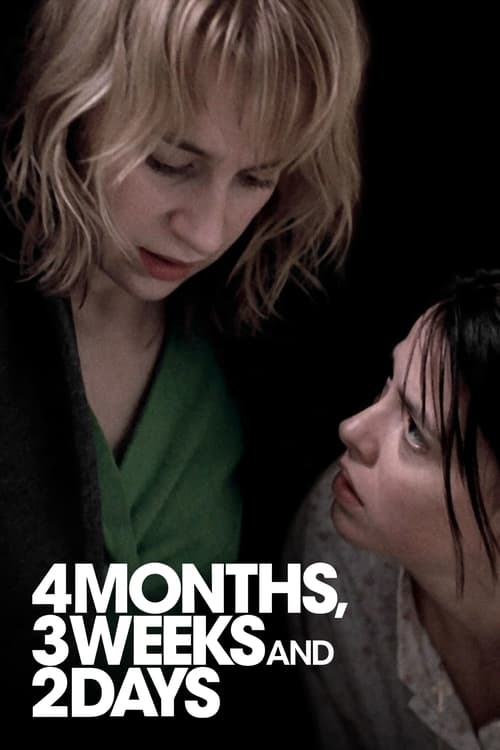
4 Months, 3 Weeks and 2 Days
2007 · Cristian Mungiu
For when you want to be pinned to your seat by something real — a demanding, unforgettable watch, absolutely not comfort viewing. Reach for it when you're ready to feel something serious and talk about it after.
What it's about
Romania, 1987, under a regime where abortion is a crime. Over one day, a college student arranges an illegal procedure for her roommate — finding money, booking a hotel room, negotiating with a menacing back-alley fixer — while still expected to show up smiling at her boyfriend's family dinner. It follows the friend who takes the risks, not the one in trouble, and watches what that loyalty costs her.
The experience
A thriller with no chases and almost no music, just mounting dread that never lets up — long unbroken scenes where you're afraid to look away. It's harrowing, gripping, and it stays with you for a long time.
Performances
Anamaria Marinca is astonishing as Otilia, carrying nearly every scene with a watchful, coiled resolve; a long single-take dinner scene, where she must sit silent amid oblivious chatter, is one of the great sustained pieces of screen acting.
The craft
Mungiu builds the film from long, unblinking takes and natural light, with no score at all — the camera simply refuses to cut away, and the tension comes from duration itself. It's a masterclass in how restraint can be more gripping than spectacle.
Why it matters
The first Romanian film to win the Palme d'Or at Cannes, it announced the Romanian New Wave to the world and reshaped what a decade of realist filmmaking looked like.
Snapshot
A single day in the life of two college roommates in late-communist Romania. Otilia (Anamaria Marinca) orchestrates an illegal abortion for her friend Găbița (Laura Vasiliu), navigating bribery, sexual coercion, a stranger's hotel room, and a birthday dinner she cannot leave early. Set in 1987, two years before the fall of Nicolae Ceaușescu, the film is a masterpiece of sustained dread — a thriller whose violence is almost entirely moral. It won the Palme d'Or at Cannes in 2007, the first Romanian film to achieve that distinction, and established the Romanian New Wave as one of the most vital forces in world cinema.
Industry & production
Mungiu developed the project through his own production company, Mobra Films, with co-production support from Mobra's French partner and funding from the Romanian National Centre for Cinematography (CNC). The modest budget was characteristic of the Romanian New Wave infrastructure: state cultural funding supplemented by European co-production arrangements, with the bulk of financial risk carried by the director's production entity. Shooting took place in Bacău, a mid-sized city in northeastern Romania that could plausibly stand in for an unnamed provincial city of the period. Period-accurate set dressing was required throughout — communist-era signage, institutional furnishings, Dacia automobiles — yet the production did not lean on nostalgia; the décor functions as oppressive environment rather than period spectacle. The film was completed without a conventional distributor in place, relying on festival exposure at Cannes to catalyze international sales, a model common to the New Wave films. Internationally it was distributed by IFC Films in North America and by Artificial Eye in the United Kingdom, among others. Romania controversially did not submit it as its Academy Award entry for Best Foreign Language Film; the decision generated significant debate within the Romanian film community and in the international press.
Technology
Shot on 35mm film, a deliberate choice that distinguishes the film from the digital-video aesthetic that had become common in low-budget European social realism by the mid-2000s. Cinematographer Oleg Mutu and Mungiu retained the grain structure and tonal depth of photochemical film to achieve a look that feels at once archival and immediate — not the degraded texture of Super 16 grittiness, but a restrained, muted palette grounded in available and practical light. Camera movement was primarily handheld, though the handheld work is disciplined rather than agitated: Mutu's frame is almost always purposeful, tracking Otilia at a careful distance rather than pressing into her face. The production used no artificial lighting rigs where practical light could serve, preserving the authentic dimness of 1980s Romanian interiors — bare bulbs, weak fluorescent strips, the flat gray of overcast exteriors. Post-production was minimal; the film was cut on a digital editing system but the color grade retains the cool, slightly desaturated character of the photography rather than imposing a stylized look.
Technique
Cinematography
Oleg Mutu's camera work is the film's structural spine. The dominant strategy is the long uninterrupted take in which the camera shadows Otilia at close range, maintaining a steady proximity that refuses both emotional distance and melodramatic intrusion. Mutu's handheld movement is subtle — a slight breathing quality rather than expressive shaking — which paradoxically intensifies the sense of surveillance: we are always close to Otilia, watching her navigate, but never quite inside her interiority. The most discussed set-piece is the hotel-room negotiation with the abortionist Bebe (Vlad Ivanov): a long take in which the camera holds on participants across a small room, the off-screen action during Găbița and Bebe's private conversation almost unbearable precisely because we must wait with Otilia, excluded. The famous dinner-table sequence — Otilia stranded at her boyfriend's mother's birthday party while Găbița is alone in the hotel room — is shot in a single, locked-off or nearly static framing around the table, the camera patient and impartial as a prosecutor while the chatter of strangers fills the soundtrack. Available-light discipline means that nighttime exteriors, including Otilia's walk through the city to dispose of the fetal remains, are shot in genuine urban darkness, the figure briefly illuminated by streetlight — one of the film's most austere and haunting images.
Editing
Editor Dana Bunescu, a central figure across multiple Romanian New Wave productions, constructs the film from an exceptionally small number of cuts. The edit's logic is ellipsis and omission: narrative pressure accumulates not from montage but from what is withheld. The abortion itself is not shown; the discovery of its success is not dramatized in the conventional sense. Bunescu's choices enforce Mungiu's rule that the camera may not cut away from an uncomfortable situation — duration is the film's moral instrument. The overall effect is less like classical continuity editing than like the observational logic of documentary, in which scenes run until they are exhausted rather than trimmed to their expressive peak.
Mise-en-scène / staging
The hotel — drab, institutional, its corridors lit by failing bulbs — functions as the film's central architectural metaphor: a space that should be anonymous but becomes freighted with shame, complicity, and danger. Mungiu's staging within rooms is precise. In the negotiation scene, body positioning communicates power relations without recourse to shot/reverse-shot: who stands, who sits, where the door is, how much physical space Bebe occupies. The film makes almost no use of expressive camera angles; the lens stays at roughly eye level, maintaining a documentary neutrality that refuses to editorialize. Props are significant — the ID card, the hotel registration form, the money changing hands — and their handling is always specific and unhurried, grounding the film's abstracted moral drama in the concrete texture of bureaucratic transaction.
Sound
There is no non-diegetic score. The decision is absolute and constitutive: the film's tension is generated entirely from ambient sound — the clatter of the birthday dinner, the ambient noise of the hotel corridors, the silence in the hotel room after the procedure. Direct sound, recorded on location, preserves the acoustic character of each space. The contrast between the cacophony of the dinner party and the silence that Otilia carries internally is the film's most potent sound edit — achieved not through music but through the collision of two sonic environments. This sonic restraint places the film in a tradition of score-free European social realism and links it, however indirectly, to the aural asceticism of Robert Bresson and the Dardenne brothers.
Performance
Anamaria Marinca's work as Otilia is the film's moral center and its greatest performance. Marinca plays almost entirely through withholding — the face that processes information without releasing it, the body that continues functioning while the person inside it is somewhere else entirely. The performance is grounded in physical specificity: the way Otilia moves through corridors, manages objects, navigates strangers. Laura Vasiliu as Găbița is deliberately opaque in a different register — passive, selfish, dependent — and the film resists making her sympathetic in any easy way. Vlad Ivanov as Bebe deploys a quiet, bureaucratic menace that is more disturbing than theatrical villainy would have been; he became internationally known through this role. All three lead performances reflect Mungiu's commitment to performance-through-behavior rather than performance-through-emotional-display, a methodology consistent with the New Wave's general skepticism toward theatrical affect.
Narrative & dramatic mode
The film adopts strict unity of time and place in each of its major sequences, approximating real-time duration. The narrative perspective is almost exclusively Otilia's, though crucially the film never grants us access to her interiority through voiceover or subjective camera; we observe her from just outside. This position — close but not inside — is the film's ethical stance toward its subject. The narrative structure is classical in its compression (a single day, a single crisis) but anti-classical in its refusal of catharsis or resolution. The final scene, in which Otilia and Găbița sit in a restaurant and Otilia says, in effect, that they will never speak of this again, denies the viewer any emotional processing that the film has not already earned through duration and restraint. Dramatic tension is generated not by plot surprise but by the gap between what we know is happening and what the characters around Otilia do not know — a dramatic irony that makes the birthday dinner scene close to unbearable.
Genre & cycle
Formally, the film belongs to the international tradition of social-realist drama that runs from Italian Neorealism through the French New Wave's political strand and into contemporary Belgian, Romanian, and Iranian cinema. It draws on the aesthetic of the "crisis film" — a narrative compressed around a single ordeal — that the Dardenne brothers had developed through Rosetta (1999) and The Son (2002). It is also generically adjacent to the thriller: sustained dread, time pressure, the possibility of catastrophic discovery at any moment. The abortion subject places it in a small lineage of films dealing directly with reproductive rights and bodily autonomy under state control, including Vera Chytilová's work in Czechoslovakia and, retrospectively, Audrey Diwan's Happening (2021), which cites Mungiu as a direct reference point. It is not melodrama: the film systematically refuses the emotional amplification that melodrama requires.
Authorship & method
Cristian Mungiu (b. 1968) studied literature at the University of Iași before training at the Ion Luca Caragiale National University of Theater and Film in Bucharest. His debut feature Occident (2002) demonstrated an interest in fragmented, overlapping narratives set in post-communist Romania; 4 Months marks a decisive turn toward austerity and temporal compression. His subsequent films — Beyond the Hills (2012, again with Marinca), Graduation (2016), and R.M.N. (2022) — sustain the formal commitments of the New Wave while extending its social range. Mungiu operates as his own screenwriter, and the scripts for his films are typically grounded in documented social realities or reported cases; the scenario for 4 Months reportedly drew on accounts of how illegal abortions were actually arranged under Ceaușescu's Decree 770 (1966), which criminalized abortion and contraception in an attempt to increase the national birth rate. Oleg Mutu, the Moldovan-Romanian cinematographer, worked across multiple key Romanian New Wave films, including Cristi Puiu's The Death of Mr. Lazarescu (2005), and his long-take, available-light methodology is as constitutive of the movement's visual identity as Mungiu's direction. Dana Bunescu as editor brought the same aesthetic discipline to the cut that Mutu brought to the image. There is no credited composer — the absence of music is itself a creative decision attributed to Mungiu.
Movement / national cinema
4 Months is the most widely seen and awarded film of the Romanian New Wave (Noul Val românesc), the loose movement of filmmakers who emerged in the early 2000s and collectively redirected Romanian cinema toward austere social realism, long takes, and engagement with the communist past and its legacies. Key antecedents within the movement include Cristi Puiu's The Death of Mr. Lazarescu (2005), the movement's widely cited inaugural statement, and Corneliu Porumboiu's 12:08 East of Bucharest (2006). The New Wave is not a coordinated manifesto-driven movement but a generational and institutional convergence: filmmakers trained at the same Bucharest school, using the same CNC funding mechanisms, sharing cinematographers and editors, and sharing a set of formal commitments — duration, restraint, social specificity, refusal of sentimentality — that cohered into a recognizable aesthetic. Mungiu's Palme d'Or brought unprecedented international visibility to this cinema.
Era / period
The film is set in 1987, during the final, most economically austere and politically repressive phase of Ceaușescu's rule, and is made in 2007, nearly two decades after the 1989 revolution. This gap is meaningful: the New Wave filmmakers were themselves young adults in the late communist period, and their films process that experience from a position of retrospective distance that prevents both nostalgia and simple denunciation. The 2000s in Romanian cinema are defined by this retrospective reckoning alongside engagement with post-communist transition; 4 Months addresses the former while its formal mode — an international art-cinema language shaped partly by the Dardennes, partly by Bresson, partly by Cassavetes — is thoroughly contemporary to its moment of production.
Themes
The film's central subject is the machinery of complicity under authoritarian rule: how systems of surveillance and prohibition force private suffering into bureaucratic transaction, degrading all parties. Abortion is not treated primarily as a political symbol but as a concrete, bodily crisis — and yet the film insists that the personal is inextricably political under Ceaușescu's natalist state. Female solidarity is another major theme, though the film complicates easy readings: the relationship between Otilia and Găbița is unequal, strained by Găbița's passivity and deceptions, and Otilia's heroism is never acknowledged by its beneficiary. Power and its exercise through bureaucratic routine run through every scene: Bebe's demand for sexual favors in lieu of full payment is the film's most explicit dramatization of how formal prohibitions create informal markets of coercion. The film also meditates on complicity itself — Otilia is implicated in every transaction, morally tainted by every arrangement she makes on Găbița's behalf — and refuses to offer her absolution.
Reception, canon & influence
Critical reception. The film received near-universal acclaim on its Cannes premiere and has sustained that reputation in critical consensus. It appeared on numerous decade-end and decade-spanning "best films" lists and in the 2022 Sight & Sound poll it ranked among the top films of the 2000s. The Palme d'Or was received as both an aesthetic judgment and, implicitly, a political one — recognition that European social realism of this uncompromising kind merited the festival's highest honor.
Influences on the film (backward). The Dardenne brothers (Rosetta, The Son, L'Enfant) are the most frequently cited influence on the film's formal language: the unbroken takes, the camera that follows the protagonist at the back of the neck, the refusal of non-diegetic music, the moral weight carried by physical action. Italian Neorealism provides a deeper structural precedent — location shooting, non-professional or semi-professional performance, social subject matter. Bresson's influence is audible in the sonic asceticism and in the discipline of the cut. Hungarian director Béla Tarr's long-take practice is a plausible influence, though the films are temperamentally distinct. Within Romanian cinema, Puiu's Lazarescu is the immediate precursor. The specific subject of illegal abortion under Ceaușescu connects the film to documentary accounts and to the investigative journalism that emerged in post-1989 Romania about the consequences of Decree 770.
Legacy / what it shaped (forward). 4 Months consolidated the international profile of the Romanian New Wave and drew sustained critical and curatorial attention to the broader movement, retrospectively elevating earlier films by Puiu and Porumboiu. Its influence on subsequent European social realism is difficult to quantify precisely but widely acknowledged: the commitment to duration and restraint as moral instruments became more available as a formal option after this film demonstrated their efficacy at the highest level of festival recognition. Audrey Diwan's Happening (L'Événement, 2021), which deals with illegal abortion in 1960s France and won the Golden Lion at Venice, cites the film as a direct reference; the comparison is instructive in showing how Mungiu's approach — close focus on the protagonist's physical ordeal, refusal of editorializing — could be adopted and inflected differently. More broadly, the film is now taught regularly in university film programs as a case study in long-take aesthetics, political cinema, and feminist film theory, and Mungiu's formal approach can be felt in numerous subsequent films from Eastern and Central Europe that deal with state repression through the lens of private crisis.
A Deleuzian reading
Start with the dinner.
The full Deleuzian reading of 4 Months, 3 Weeks and 2 Days →
Reception
It arrived already crowned — the 2007 Palme d'Or made it the flagship of the Romanian New Wave overnight — and unlike most festival winners it never dipped: it's since climbed onto best-of-the-century lists (BBC's 2016 critics' poll among them) and found grim new relevance in post-Roe abortion-rights discourse.
How 4 Months, 3 Weeks and 2 Days was received, from release to now →
Influences: the films it descends from and the films it influenced
- Rosetta (1999) — Mungiu explicitly modeled his formal grammar on Rosetta: the handheld camera locked at the protagonist's shoulder-height through unbroken crisis sequences, the total elimination of non-diegetic music, and the ellipsis that skips emotional peaks to preserve behavioral truth — the same three decisions Oleg Mutu and Dana Bunescu applied to Otilia's ordeal.
- Le Fils (2002) — The Dardennes' technique of positioning the camera close behind the protagonist's neck — producing surveillance-style observation that withholds reaction shots and denies the viewer emotional anchorage — is the direct precedent for Mutu's method of following Otilia through the hotel corridors.
- La Promesse (1996) — The structural commitment to moral complicity as the film's unresolvable core — a protagonist who cannot undo what she has participated in, offered no cathartic absolution — is the narrative architecture Mungiu inherits directly for Otilia's guilt at the film's wordless ending.
- The Death of Mr. Lazarescu (2005) — Shot by Oleg Mutu — 4 Months' own cinematographer — Puiu's real-time traversal of institutional dehumanization established the Romanian grammar of available-light long takes, no non-diegetic score, and behavioral non-resolution that Mutu then brought directly to Mungiu's production.
- Jeanne Dielman, 23 quai du Commerce, 1080 Bruxelles (1975) — Akerman's eye-level, frontally-locked staging of a woman's body in constrained domestic space — where duration itself is the instrument through which subjugation is felt — is the formal precedent for Mungiu's dinner-table sequence and his systematic refusal of expressive camera angles throughout.
- Umberto D. (1952) — De Sica's extended real-time behavioral sequences — the famous morning-routine scene that refuses to compress or dramatize — establish the neorealist discipline of observational duration as a vehicle for social crisis without melodramatic punctuation, the discipline Romanian New Wave films, including 4 Months, descend from.
- Sátántangó (1994) — Tarr's extended long takes in communist-era Eastern European locations — available and practical light, genuinely deteriorated environments, duration functioning as a form of moral witness — establish the aesthetic vocabulary of filmed endurance that Mungiu inherits for his 1987 Romania, particularly the nighttime exterior walks shot in authentic urban darkness.
- Caché (2005) — Haneke's static long-take framing positions the viewer as a complicit surveillant who watches without being able to intervene; the formal argument that spectatorship itself carries moral weight is the ethical framework Mungiu applies to the hotel-room sequences, where the camera waits with Otilia while Bebe and Găbița are alone off-screen.
- Young Mothers (2025) — Long unbroken handheld takes tracking a young woman through a single moral crisis, scoreless and shot in available light — the Dardenne grammar transposed to Ceaușescu's Romania.
- The Piano Teacher (2001) — Mungiu's long unbroken takes that hold characters in extremity without cutting away for emotional management, and his zero-score sound discipline leaving only diegetic ambient sound, descend directly from Haneke's clinical duration and diegetic-only sound practice.
- Cries and Whispers (1972) — Mungiu's long-lens available-light cinematography of a female body navigating institutional duress extends Nykvist's technical approach to recording physical extremity without expressionist augmentation; the unbroken dinner-table duration-hold directly applies Bergman's patient editing ethics to a new political register.
- Werckmeister Harmonies (2001) — The Romanian New Wave's key formal device — sustained real-time long takes accumulating dread without dramatic punctuation, most nakedly in the apartment dinner scene — channels the post-socialist Eastern European political sensibility and accumulation-not-causation narrative logic that Tarr's work made available to the movement.
- Police, Adjective (2009) — Edited by Dana Bunescu (4 Months' own editor), the film extends the Romanian New Wave's moral-duration grammar: the climactic dictionary sequence in which a police captain forces a detective to look up words literalizes Mungiu's anti-cathartic ethics as explicit philosophical argument, institutional language itself the instrument of coercion.
- Beyond the Hills (2012) — Mungiu's own extension with the same core collaborators — Mutu's cinematography, Bunescu's editing — applies the 4 Months craft vocabulary (long take, available light, ellipsis, behavioral withholding) to religious institutional coercion and female bodily autonomy in contemporary Romania, the craft logic now codified into a recognizable directorial method.
- Son of Saul (2015) — Nemes adopts the 35mm shoulder-locked handheld strategy — camera inseparable from the protagonist, horror kept at the frame's shallow-focus edge rather than confronted directly — to maintain ethical proximity without panoramic aestheticization, extending 4 Months' formal argument that what stays off-screen can be more unbearable than anything shown.
- Never Rarely Sometimes Always (2020) — The most direct American heir to 4 Months: handheld available-light cinematography, no non-diegetic score, behavioral withholding in performance, and compressed real-time crisis structure all drawn from Mungiu's formal model and applied to a teenager navigating abortion access across state lines — the bureaucratic coercion made formal through the same duration-as-dread technique.
- Happening (2021) — Diwan draws directly from 4 Months for her French period film about illegal abortion: handheld close-range framing that refuses to aestheticize bodily crisis, real-time compression of a few desperate days, and an anti-cathartic refusal to let the ending release tension — the craft lineage running from Dardenne through Mungiu to Diwan's Palme d'Or winner.
- Fish Tank (2009) — Arnold's handheld available-light tracking of a female protagonist through crisis deploys the same formal restraint — no non-diegetic score, behavioral performance from a non-professional lead, ellipsis that omits dramatic peaks — extending the Dardenne-via-Mungiu grammar into British social realism with the same ethical refusal to aestheticize suffering.
- Sorry, Baby (2025) — The long-take static frame that stages trauma by keeping the violence off-screen and the camera fixed — elision-as-form rather than depiction.
- Kontinental '25 (2025) — Codifies the frontal, fixed-frame long take under natural light, withholding cutaways so that a two-person crisis plays out in unbroken, morally implicating real time.
- Two Prosecutors (2025) — Mutu's desaturated palette and static, unbroken long takes generating dread under a totalitarian state — the precise cinematographic method reused in the seed.
- Toni Erdmann (2016) — Mungiu's long-take static camera recording social discomfort in real time during his dinner party sequence directly anticipates Toni Erdmann's own party scenes; his diegetic-only interior sound design in crowded Romanian spaces is a technique the dossier explicitly identifies as inherited by Ade.
- Beanpole (2019) — Long-take static camera paired with anti-redemption narrative structure — trauma the film refuses to resolve through catharsis or moral legibility — establishing the Romanian new wave template Balagov applies to post-WWII female experience.
- Honeyland (2019) — Mungiu's unsentimental, duration-respecting refusal of expository affect — moral weight conveyed through staging and held duration rather than score or commentary — transmits the Romanian New Wave's formal ethics into the Balkan region, where Honeyland absorbs them as an anti-sentimentality constraint on its observational practice.
- 12:08 East of Bucharest (2006) — The immediate sibling text of the Romanian New Wave, made within the same CNC public-funding infrastructure: deadpan anti-cathartic structure, institutional critique of communist-era mythology rendered through behavioral performance, and a climactic non-resolution that refuses every dramatic expectation the genre would otherwise satisfy.
- Tuesday, After Christmas (2010) — Muntean extends the 4 Months long-take grammar into domestic adultery: the climactic hotel-room confrontation runs nearly ten minutes without a cut, using the same eye-level staging and behavioral withholding to force moral discomfort through duration rather than through editing rhythm or musical cue.
- The Lives of Others (2006) — Oleg Mutu's photography deploys the same bureaucratic-realism palette — Communist-era institutional grays, de-saturated domestic interiors, harsh overhead fluorescents — that Bogdanski uses for the GDR, and both films give characters a suppressed-interiority performance challenge identical in source: navigating state surveillance while concealing the true content of their actions from every institutional observer.
- Gone Baby Gone (2007) — Mungiu's static wide-angle long takes—holding scenes to their uncomfortable duration without coverage cutaways—generate ethical weight through spatial accountability and real time, the same principle underlying Affleck's refusal to cut away from morally difficult conversations before they reach their full pressure.
- Tokyo Sonata (2008) — Mungiu's commitment to sustained observational takes, ambient sound texture without scored music, and a concealment narrative whose full emotional weight arrives only retrospectively parallels Tokyo Sonata's formal restraint — dread built from withheld information and behavioral observation rather than dramatic incident or emotional scoring.
- Oslo, August 31st (2011) — Mungiu's long-take real-time dinner scene — camera holding on a face during social crisis, refusing cutaways that would release pressure — is a sibling formal solution to Oslo's withholding-performance strategy and commitment to environmental realism over expressionist emphasis.
- The Girl with the Needle (2024) — Mungiu's long-take restraint tracking a female protagonist through a social system designed to destroy her body — the camera as ethical witness rather than dramatic shaper, the descent structured through bureaucratic and institutional obstruction rather than psychological interiority — is the Eastern European formal template the film extends into Nordic historical space.
- Maria Full of Grace (2004) — Mungiu builds suspense-through-realism around a woman's imperiled body in long-take restraint, the same tension-from-the-quotidian and body-as-locus that drives María's pellet-swallowing ordeal.
- Vera Drake (2004) — Renders clandestine abortion under a punitive legal regime through procedural, near-real-time realism and withheld tension rather than moral debate — the same law-as-tragedy treatment.
- Poetry (2010) — Rigorous real-time realism forces the viewer to sit inside complicity and consequence without editorial relief, a parallel to Lee's ethics of witnessing.
- An Elephant Sitting Still (2018) — Compresses its social-realist dread into a single grim day of long unbroken takes, the same time-unity-plus-duration device Hu Bo builds his structure on.
- Love Letters (2025) — Prototype of the bureaucratic-engine realist thriller, where the drama is entirely the logistics of getting an illicit/official thing done under time pressure.
Similar films
- The Death of Mr. Lazarescu (2005) — influence & lineage · same viewing thread
- Beyond the Hills (2012) — influence & lineage
- Happening (2021) — influence & lineage
- Satantango (1994) — influence & lineage
- Interrogation (1989) — same viewing thread · often watched together
- Kontinental '25 (2025) — influence & lineage · same viewing thread
- Police, Adjective (2010) — same viewing thread
- Do Not Expect Too Much from the End of the World (2023) — same viewing thread
All the films related to 4 Months, 3 Weeks and 2 Days →
Watch it with: curated runs of related films
- Behind the Iron Curtain — A run of Eastern Bloc films where one ordinary person — a hobbyist filmmaker, a cabaret singer, a drifter, a student — is quietly ground down by the machinery of the communist state.
Film essays and courses that include it
- What the Censor Invented: Forbidden Cinema from Stalin to Tehran
- The Vow of Chastity: Dogme 95 and the Handheld Revolution
- The Unblinking Camera: Social Realism from the Dardennes to the Romanian New Wave
- Camera on the Street: Italian Neorealism and the World It Made
- No Vacancy: A Century of Rooms
- The Camera That Would Not Cut Away