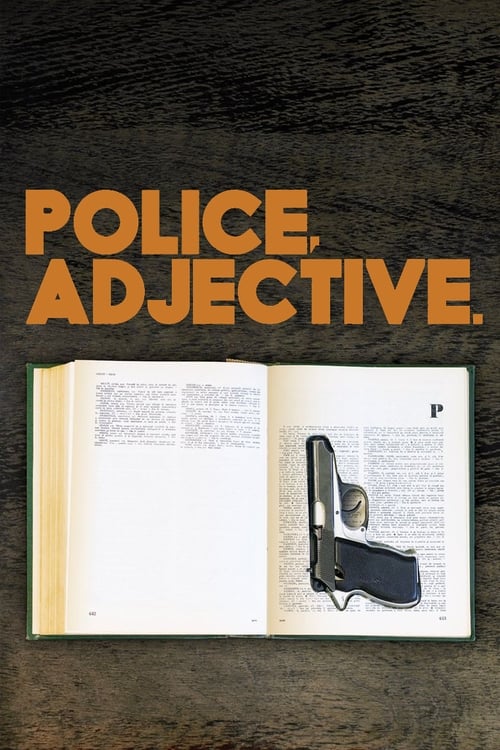
Police, Adjective
2010 · Corneliu Porumboiu
When you want something quiet and rigorous that gives you a real question to argue over dinner — attentive viewing, firmly on the challenge end of the dial.
What it's about
In a drab provincial Romanian town, a young plainclothes cop spends his days shadowing a teenager suspected of sharing hashish with schoolmates. The stakeouts are tedious, the paperwork endless, the offense petty — but pressing charges would wreck the boy's life, and Cristi's conscience starts grinding against the letter of the law. It all builds toward a showdown fought not with guns but with words.
The experience
Deadpan and patient, with stretches of real-time waiting that become oddly gripping — then a final movement that lands like a slow-motion knockout. The comedy is bone-dry; the aftertaste is moral.
Performances
Dragoș Bucur carries the film with slouched, watchful stubbornness, and Vlad Ivanov is quietly terrifying as a superior whose weapon of choice is a dictionary.
The craft
Long static takes and real-time pacing make surveillance the film's own form: you wait with Cristi, so the boredom becomes evidence. The script hoards its power for a few conversations in which language itself goes on trial — minimalism where every dead moment pays off.
Why it matters
A prizewinner in Cannes' Un Certain Regard and one of the defining films of the Romanian New Wave, it showed how far rigorous minimalism could stretch the police procedural.
Snapshot
Police, Adjective (Polițist, adjectiv) is the second feature by Corneliu Porumboiu, a procedural stripped of procedure: a young plainclothes officer, Cristi, spends his days tailing a teenager suspected of sharing hashish with two schoolmates in the provincial Moldavian city of Vaslui. Almost nothing "happens" in the conventional sense — Cristi waits on street corners, watches a doorway, files reports, eats dinner, argues with his wife about the lyrics of a pop song — and then the film detonates its argument in a single seated conversation. Summoned by his captain, Cristi is made to read aloud from a dictionary the definitions of conscience, law, moral, and police until his refusal to entrap the boy collapses under the weight of the words themselves. The picture is at once a deadpan comedy of bureaucratic tedium, a moral thriller about a man's conscience, and a treatise on how language — grammar, definition, the fixed meaning of a word — operates as an instrument of state power. It stands among the defining works of the Romanian New Wave and is the most rigorous expression of that movement's interest in the gap between official language and lived reality.
Industry & production
The film was produced through Porumboiu's own company, 42 Km Film, the outfit he had established for his 2006 debut 12:08 East of Bucharest, in the modest, auteur-driven production ecology that defined Romanian cinema in the 2000s. That ecology was shaped by the country's National Center for Cinematography (CNC) competition-grant system, by the prestige and foreign-sales leverage that Cannes recognition conferred, and by a generation of filmmakers who worked with small crews, real locations, and minimal budgets out of both aesthetic conviction and economic necessity. Police, Adjective is a Romanian production made for a sum that, by Western standards, would barely cover a single department on a studio film; the precise figure is not something I can confirm reliably, and I won't invent one.
The film premiered in the Un Certain Regard section at the 2009 Cannes Film Festival, where it won the section's Jury Prize and the FIPRESCI critics' prize — the kind of festival validation that, for Romanian cinema of this period, functioned as the principal route to international distribution. It was released theatrically in 2010, including a U.S. release handled by IFC Films, which had become a reliable conduit for the Romanian New Wave to American art houses. The festival-to-art-house pipeline was, in practical terms, the film's entire commercial existence; like most of its national-cinema cohort, it was never built for, nor did it find, a wide audience.
Technology
Police, Adjective was shot on 35mm film, a choice consistent with the Romanian New Wave's general preference for the format over the digital tools that were beginning to dominate low-budget production by the late 2000s. The celluloid grain and the naturalistic, available-light palette are integral to the film's documentary surface — the muted grays and browns of an overcast provincial autumn, interiors lit as they would actually be lit. The technology is, deliberately, invisible: there are no opticals, no digital intermediates calling attention to themselves, no apparatus that would betray the constructed nature of the image. This effacement of technique is itself a technological-aesthetic decision, aligning the film with a realist tradition that treats the camera as a recording instrument rather than an expressive one.
Technique
Cinematography
The cinematography, by Marius Panduru — Porumboiu's regular collaborator, who had also shot 12:08 East of Bucharest — is built almost entirely on long takes, locked-off or minimally mobile framing, and real durations. Panduru holds shots well past the point of conventional narrative usefulness: we watch Cristi watch, in real time, as a suspect walks to a corner, loiters, disperses with friends. The camera frequently observes from a fixed middle distance, refusing close-ups that would editorialize emotion, and favors deep, unglamorous compositions that situate the human figure within drab streets and institutional corridors. Vaslui — Porumboiu's own hometown and the setting, too, of his debut — becomes a character: a depopulated, post-industrial provincial townscape whose blankness mirrors the film's withholding of incident. The surveillance sequences derive their tension and their comedy from duration itself; we are made to experience the boredom of police work rather than be told about it.
Editing
The editing, credited to Roxana Szel, is the film's most counterintuitive achievement: a movie about waiting that refuses to cut waiting short. Where a conventional procedural would compress surveillance into a brisk montage, Police, Adjective preserves the full, uncut span of Cristi's observations, then doubles down by showing us the handwritten reports he files afterward, read in close-up, so that we re-experience in flat bureaucratic prose what we have just watched unfold. The cutting rhythm is patient to the point of provocation, withholding the relief of pace. This durational strategy is precisely what sets up the final act: by the time the dictionary scene arrives, the audience has been so thoroughly drilled in the texture of dead time that the sudden eruption of pure verbal combat lands with disproportionate force.
Mise-en-scène / staging
Porumboiu stages action in continuous, theatrically precise long takes that depend on exact blocking within a fixed frame. The climactic confrontation in the captain's office is the supreme example: three men around a desk, a dictionary as the central prop, the staging organized so that physical position and the act of reading aloud carry the entire moral drama. Earlier, a long domestic scene between Cristi and his wife — she playing and re-playing a sentimental pop song, the two of them parsing its illogical lyrics — is staged in a single cramped room, the song's contested meaning rhyming forward to the dictionary's fixed meanings. The mise-en-scène is anti-spectacular: institutional interiors, a shabby police station, a modest apartment, all rendered with an exactness that makes the ordinary feel scrutinized.
Sound
The film uses no non-diegetic score whatsoever, in keeping with the Romanian New Wave's near-doctrinal commitment to naturalistic sound. There is no music to cue feeling; the soundtrack consists of footsteps, traffic, the hum of fluorescent-lit rooms, the scratch of a pen. The single significant piece of music is diegetic — the pop ballad Cristi's wife plays at home, which becomes the subject of a debate about whether its lyrics make sense. That absence of score is structurally meaningful: with no music to tell us how to feel, the audience is left, like Cristi, alone with words and their literal weight. Sound design here is a form of restraint that throws the spoken word into relief.
Performance
Dragoș Bucur plays Cristi with a deliberately recessive, interiorized performance — a man whose moral crisis registers in stubbornness, silence, and small physical fatigue rather than in dramatic display. The film's acting style is anti-theatrical, built on underplaying and on the credible rhythms of ordinary speech. The decisive performance is Vlad Ivanov's as the captain, Anghelache: controlled, reasonable, and chilling, he conducts the dictionary interrogation with the patience of a man who knows the language is on his side. Ivanov — already indelible to international audiences as the abortionist in Cristian Mungiu's 4 Months, 3 Weeks and 2 Days — again embodies institutional menace through perfect calm. The supporting players, including Ion Stoica as the colleague Nelu and Irina Săulescu as Cristi's wife Anca, sustain the same naturalism, making the film's world feel observed rather than acted.
Narrative & dramatic mode
The film's dramatic mode is anti-suspense: it takes the genetic material of the police procedural — surveillance, the stakeout, the moral choice — and systematically denies the genre's payoffs. There is no chase, no violence, no revelation of guilt; the "crime" is a teenager smoking hashish, and the central question is not whodunit but whether Cristi will participate in arresting him. Narrative information is delivered in real time and through the deadening medium of paperwork. The structure is essentially two-part: a long, dilated first movement of procedural observation, and a concentrated final movement of verbal confrontation that retroactively reveals the whole film to have been an argument about conscience and law. It is a drama of ethics conducted at the level of vocabulary, where the climax is not an action but a definition.
Genre & cycle
Police, Adjective belongs to the police procedural by negation — it is a procedural that refuses procedure's excitements, closer in spirit to a philosophical dialogue than to a crime film. Within the Romanian New Wave it forms part of a loose cycle of films that turn institutional encounters into moral and political theater: the hospital bureaucracy of Cristi Puiu's The Death of Mr. Lăzărescu, the clandestine logistics of Mungiu's 4 Months, 3 Weeks and 2 Days, the courtroom-of-memory of Porumboiu's own 12:08 East of Bucharest. Its kinship is also with a broader international lineage of "slow cinema" and observational realism. The film's drug-law premise locates it specifically in the cycle's preoccupation with the lag between Romanian law and European norms — Cristi's wager that the harsh statute will soon be liberalized is the genre's social conscience made literal.
Authorship & method
Porumboiu wrote, directed, and produced the film, and it is the clearest statement of his governing obsession: language. Where his debut anatomized how a small town narrates its own role in the 1989 revolution — testing whether a "revolution" occurred by interrogating the meaning of the word — Police, Adjective extends the inquiry to the dictionary itself, asking what happens when the state owns the definitions. His method is one of extreme economy and patience: real locations (his native Vaslui), long takes, naturalistic sound, non-professional rhythms, and a refusal of music or montage. He works repeatedly with the same collaborators, and the continuity matters: cinematographer Marius Panduru supplies the unhurried, document-like image; editor Roxana Szel sustains the provocative durations; actor Vlad Ivanov lends the institutional antagonist his calm authority. The absence of a composer is itself an authorial signature. The result is a cinema of conceptual rigor in which form — duration, silence, the held frame — is inseparable from the film's idea about how power speaks.
Movement / national cinema
The film is a central document of the Romanian New Wave, the loose movement of filmmakers — Puiu, Mungiu, Porumboiu, Radu Muntean, Cristian Nemescu and others — whose work in the 2000s brought Romanian cinema to sudden international prominence through Cannes. The movement's shared traits are unmistakable here: minimalist realism, long takes, available light, naturalistic sound without score, an unflinching attention to the residue of the Ceaușescu era and the absurdities of post-communist bureaucracy, and a dark, deadpan humor. Police, Adjective is among the movement's most self-conscious works, because it makes explicit what the others imply — that the New Wave's true subject is language: the official discourse of a former police state and the slippage between what is said and what is true.
Era / period
Made two decades after the 1989 revolution, the film is set firmly in the contemporary moment of a Romania newly inside the European Union (which it joined in 2007), and its central conflict is generational and historical. The captain reasons like a functionary formed under the old order, for whom the law is the law and conscience is a category to be looked up and dismissed; Cristi reasons like a younger European who anticipates that the statute criminalizing the teenager is an anachronism the country will soon discard. The drug-law subplot is thus a precise period marker — a snapshot of a transitional society whose legal code has not yet caught up to its aspirations. The provincial setting underscores the point: in Vaslui, far from Bucharest, the post-communist hangover lingers in the architecture, the institutions, and the habits of mind.
Themes
The film's master theme is language as power — the idea that whoever controls the definition of a word controls the moral and legal reality it names. The dictionary scene literalizes this: conscience, law, moral, and police are read aloud, and the captain demonstrates that Cristi's private scruple has no standing against the fixed, authorized meaning of the terms. The title's grammatical conceit — police as an adjective, as in "police state" — points to how the noun of an institution becomes a modifier that colors everything. Adjacent themes radiate outward: the conflict between individual conscience and institutional duty; the texture of boredom and the moral weight of "dead time"; the persistence of authoritarian habits of thought into a nominally democratic era; and the recurring New Wave concern with how meaning is negotiated, whether in a pop song's nonsensical lyrics or a legal code's binding clauses. Comedy and dread are held in the same frame: the film is genuinely funny about bureaucratic absurdity and genuinely frightening about where that absurdity leads.
Reception, canon & influence
Police, Adjective was met with strong critical acclaim on the international festival and art-house circuit, building on the prestige of its Cannes Un Certain Regard awards. Critics singled out the audacity of its durational structure — the willingness to test an audience's patience as a deliberate aesthetic and political strategy — and the bravura of its dictionary climax, widely read as one of the most striking scenes in recent European cinema for the way it converts a grammar lesson into an instrument of coercion. The film consolidated Porumboiu's standing, alongside Mungiu and Puiu, as a leading figure of the Romanian New Wave, and it has retained a secure place in critical assessments of that movement and of 2000s world cinema.
Looking backward, the film's influences are legible in the realist and observational traditions — the long-take, real-duration ethic associated with international "slow cinema" and the everyday-bureaucracy realism that Cristi Puiu's The Death of Mr. Lăzărescu had crystallized for Romanian filmmakers — and in Porumboiu's own 12:08 East of Bucharest, which first established his fixation on the slipperiness and authority of words. Looking forward, its legacy is twofold. Within Porumboiu's filmography it is a clear waypoint toward later works that continue to probe language, rules, and games — most directly The Treasure and The Whistlers, and the documentary-essay Infinite Football, all of which extend his interest in systems and their absurd internal logics. More broadly, it became a touchstone in critical debates about slow cinema and durational realism, frequently cited as a limit case for how far a narrative film can withhold conventional incident while remaining gripping. Its precise downstream influence on other filmmakers is harder to document with certainty than its critical canonization, and I won't overstate it; what is clear is that Police, Adjective endures as the Romanian New Wave's sharpest meditation on the politics of meaning.
A Deleuzian reading
Start with the doorway.
The full Deleuzian reading of Police, Adjective →
Reception
It arrived as a critical darling — Un Certain Regard Jury Prize at Cannes 2009 — and has only solidified since, now cited as one of the defining films of the Romanian New Wave and a set text in any 'slow cinema' conversation.
How Police, Adjective was received, from release to now →
Influences: the films it descends from and the films it influenced
- The Death of Mr. Lăzărescu (2005) — Crystallized the Romanian template Porumboiu inherits: real-time observation of institutional procedure (intake, paperwork, waiting) shot in unhurried handheld-but-patient takes that let bureaucratic process itself become the drama.
- 12:08 East of Bucharest (2006) — Porumboiu's own debut establishes the fixed-camera, real-duration interrogation of what a single word ('revolution') means, the exact method later turned on the dictionary climax.
- Jeanne Dielman, 23 quai du Commerce, 1080 Bruxelles (1975) — The founding grammar of durational realism: fixed frontal frames held through real-time mundane labor with no score, training the viewer to read withheld incident as meaning.
- Umberto D. (1952) — Neorealism's 'dead time' (the maid waking, the boy waiting) on real locations with available light and non-professional rhythms — the ethic of filming uneventful duration that Porumboiu's stakeout scenes extend.
- Pickpocket (1959) — Anti-theatrical underplaying — models drained of expression — wedded to obsessive attention to procedural gesture, the craft behind Police, Adjective's flat surveillance of routine.
- L'Avventura (1960) — The original police-procedural-by-negation: a missing-person investigation is set up and then deliberately dissolved, prioritizing anti-suspense duration over resolution.
- Close-Up (1990) — Long-take real-duration scrutiny of language, law and ethics — a trial/identity case observed rather than dramatized — modeling how slow cinema can make talk itself the suspense.
- Sátántangó (1994) — The extreme limit-case of the held shot and walking-in-real-time take that Police, Adjective cites in its minutes-long unbroken pursuit of a cop down empty streets.
- 4 Months, 3 Weeks and 2 Days (2007) — Shares actor Vlad Ivanov as the calm institutional antagonist and the same real-time, fixed-middle-distance long takes that build dread by refusing montage and music.
- The Death of Mr. Lazarescu (2005) — Pushes the procedural anatomy of bureaucracy to its limit, dwelling in real-time surveillance and the literal parsing of official language as dramatic substance.
- Infinite Football (2018) — Extends Porumboiu's fixation on rules and systems — a man's absurd attempt to rewrite football's laws — observed in patient static takes as a study of bureaucratic logic.
- The Treasure (2015) — Continues the deadpan, real-duration anatomy of legal/procedural absurdity (a metal-detector treasure hunt governed by paperwork and rules) in unhurried fixed frames.
- The Whistlers (2019) — Directly resumes the language-as-power theme — a coded whistled tongue used to evade and wield authority — refracting Police, Adjective's idea that controlling meaning controls people.
- Sieranevada (2016) — Sustains durational realism into the next decade: a near-real-time family gathering staged in long takes with roving fixed-distance framing, conversation as the only event.
- Kontinental '25 (2025) — Builds a conscience drama almost entirely from talk and the parsing of language and definitions, proving the talk-driven moral fable as a Romanian form Jude here refines.
- Do Not Expect Too Much from the End of the World (2023) — Its deadpan static long takes and interrogation of language and bureaucracy as a dialectic (the dictionary scene) model the Romanian New Wave essayistic realism Jude pushes toward outright essay-film.
- Case 137 (2025) — Procedure filmed at its real duration — stakeouts and report-writing in long static takes — so that the moral question is finally settled by the wording of a text; the tactic of letting a definition or a form carry the ethical argument.
- Fjord (2026) — Porumboiu ends on a dictionary read aloud in a static office two-shot: the case decided by the definition of a word rather than by evidence, the same moral-procedural move Fjord makes when its case turns on how a phrase is translated.
- Aurora (2010) — Pushes durational realism to a near-wordless three-hour procedural of an ordinary man, withholding motive and incident in the same Romanian anti-suspense register.
- Tuesday, After Christmas (2010) — Romanian New Wave long-take blocking — extended unbroken two-shots in available light with no score — letting moral reckoning play out in real time without cutting.
- Once Upon a Time in Anatolia (2011) — A police procedural deliberately drained of incident: a real-time night investigation of waiting, talk and bureaucracy, conscience versus institution, that withholds genre catharsis.
- Graduation (2016) — Extends the same moral-realist duration, dramatizing conscience versus institutional procedure with patient, near-uncut observation and no scoring.
- Hukkle (2002) — Dedramatized crime that empties the genre of payoff and lets procedure dissolve into duration — the same flattening of the whodunit Hukkle performs through buried plotting.
- Beyond the Hills (2012) — Runs the same experiment in procedural duration — surveillance and dictionary-reading held past the point of narrative usefulness — so that the institution's language, not the plot, becomes the antagonist; Mungiu's police interview and death report are the religious variant.
Similar films
- 4 Months, 3 Weeks and 2 Days (2007) — influence & lineage · same viewing thread
- 12:08 East of Bucharest (2006) — influence & lineage
- Once Upon a Time in Anatolia (2011) — influence & lineage
- Kontinental '25 (2025) — influence & lineage · same viewing thread
- The Death of Mr. Lazarescu (2005) — same viewing thread
- A Short Film About Killing (1988) — same viewing thread
- Graduation (2016) — shared sensibility
- Humanité (1999) — shared sensibility
All the films related to Police, Adjective →
Watch it with: curated runs of related films
- Behind the Iron Curtain — A run of Eastern Bloc films where one ordinary person — a hobbyist filmmaker, a cabaret singer, a drifter, a student — is quietly ground down by the machinery of the communist state.