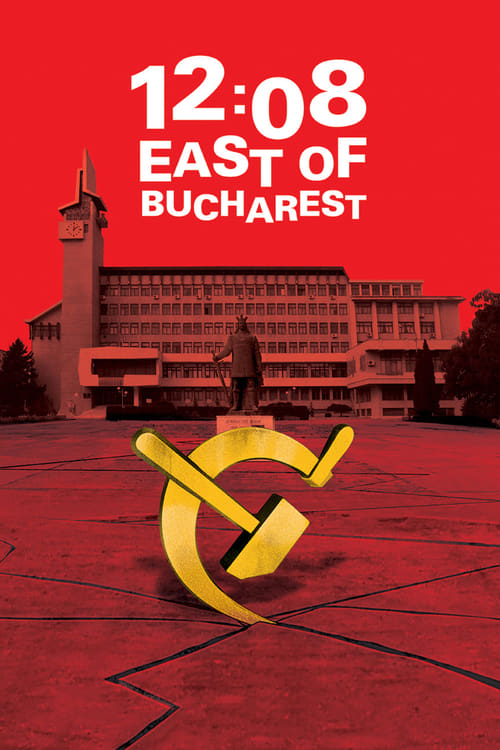
12:08 East of Bucharest
2006 · Corneliu Porumboiu
For when you want a smart, low-key comedy that respects your patience — something to chuckle at, then argue about over a drink. More a slow-burn pleasure than a comfort watch, but a warm one.
What it's about
Sixteen years after the fall of Ceaușescu, a small-town Romanian TV host convenes a live talk show to settle one question: did their town actually have a revolution, or did people only fill the square after the dictator had already fled? His panel is a debt-ridden history teacher and a lonely retiree preparing for another Christmas alone, and the whole argument comes down to who stood where before 12:08 PM on one December day in 1989.
The experience
Dry, deadpan, and quietly hilarious — long takes where the comedy comes from a wobbly camera, a hostile caller, or a man refusing to concede a point. It ambles at small-town pace, then sneaks up on you with real melancholy about how memory works and who gets to claim courage after the fact.
Performances
The three central men — the pompous host, the defensive teacher, the gently absurd pensioner — play off each other like a chamber trio, and the teacher's slow-crumbling dignity under phone-in interrogation is a small masterclass in embarrassed persistence.
The craft
Porumboiu builds the second half almost entirely as the talk show itself, shot by a fictional cameraman who can barely hold a frame — a joke that doubles as the film's whole method, letting amateurish local television expose how shaky official memory is. It's modest to look at by design; the payoff is in the writing and timing, not spectacle.
Why it matters
One of the debuts that announced the Romanian New Wave to the world, proving that a tiny film about an argument in a provincial studio could carry the weight of a nation's reckoning with 1989.
Snapshot
12:08 East of Bucharest — the Romanian title is A fost sau n-a fost?, literally "Was it or wasn't it?" — is Corneliu Porumboiu's debut feature, a 89-minute comedy of provincial memory that turns the December 1989 revolution into a quarrel over wording. On the sixteenth anniversary of Nicolae Ceaușescu's fall, the host of a small-town cable station convenes a live talk show to settle a deceptively simple question: did their town have a revolution? The test he proposes is brutally precise — did anyone come out into the central square before 12:08 PM on 22 December 1989, the minute Ceaușescu's helicopter lifted off the Central Committee roof in Bucharest? To have demonstrated before that instant was to have risked something; to have come out after was merely to celebrate a fait accompli. From this hair-splitting premise Porumboiu builds a film that is at once a slapstick of provincial vanity and a serious essay on how history is narrated, contested, and quietly falsified by the people who lived it. It won the Caméra d'Or at Cannes in 2006 and stands, alongside Cristi Puiu's The Death of Mr. Lazarescu (2005) and Cristian Mungiu's 4 Months, 3 Weeks and 2 Days (2007), as a cornerstone of the Romanian New Wave.
Industry & production
The film is a product of the lean, auteur-driven Romanian production model that crystallized in the mid-2000s. Porumboiu produced through his own company, 42 Km Film, founded in his native Vaslui — the unnamed town of the film is plainly modeled on it. Romanian cinema in this period operated on small budgets, partial state support through the Centrul Național al Cinematografiei (CNC), and a reliance on festival exposure rather than domestic box office, since the country's exhibition infrastructure had largely collapsed after 1989. 12:08 was a modestly scaled production: a small ensemble, a handful of interiors and provincial exteriors, and a long climactic sequence confined to a single television studio set. Precise budget figures are not well documented in English-language sources, and I will not invent them; what is clear is that the film exemplifies the New Wave's economy of means, where constraint is converted into aesthetic principle. Its real launchpad was Cannes 2006, where it screened in the Directors' Fortnight (Quinzaine des Réalisateurs) and took the Caméra d'Or for best first feature — an award that, following Puiu's Un Certain Regard prize the year before, helped consolidate the international perception of a Romanian "wave" and opened the festival and arthouse distribution circuit to Porumboiu's subsequent work.
Technology
The film was shot on 35mm, in keeping with the New Wave's prevailing preference for the format's tonal restraint over the digital cameras that were beginning to enter low-budget production elsewhere. The technological imagination of the film, however, is most alive in its subject: provincial television. The climactic talk show is staged as an amateur live broadcast, and Porumboiu makes the technology's limitations the engine of his comedy and his meaning. The single studio camera, operated by an inexperienced cameraman, drifts, mis-frames, wanders to a window, loses its subjects — a running joke about the threadbare apparatus of post-communist local media, but also a sly statement about the inadequacy of any recording device to capture or adjudicate the truth of an event. The film is acutely aware that 1989 was itself the first revolution staged for and partly by television; Romania's was broadcast live, and the studio became the symbolic seat of the new power. 12:08 miniaturizes that history into a shabby small-town set with a phone-in line and a malfunctioning camera.
Technique
Cinematography
Marius Panduru, who would become Porumboiu's regular collaborator and one of the New Wave's signature cinematographers, shot the film. The visual strategy divides cleanly with the narrative. The first half — the three men's separate morning routines — favors a cool, observational palette and largely static or minimally mobile framings of cramped apartments, drab streets, and wintry exteriors, the December light flat and gray. The second half, the broadcast, is the formal coup: it is rendered largely through the diegetic studio camera's own point of view, a fixed long take of the three men seated at a table, in which the "errors" of the amateur operator (slow drifts, awkward reframings, an unmotivated pan to the snow outside) become the film's dominant visual rhythm. The decision to let an incompetent camera "shoot" the climax is a radical subordination of authorial cinematography to in-world apparatus — and one of the film's most discussed gestures.
Editing
The editing is deliberately spare, matching the New Wave's anti-montage ethos. The first half is built from discrete, observational scenes; the second half all but abandons cutting altogether, surrendering to real-time duration within the broadcast. The comedy is timed not through cutting but through performance and the slow accretion of contradiction as callers phone in to dispute the guests' accounts. English-language sources are thin on the specific below-the-line editing credit, so I will not assert a name I cannot verify; what matters technically is the strategic withholding of the cut, which forces the viewer to sit inside the broadcast's discomfort and watch the official story disintegrate in real time.
Mise-en-scène / staging
Staging is the film's true medium. The talk-show table — host flanked by his two guests, a national map or station logo behind them — is a deadpan tableau of provincial self-importance, and Porumboiu mines it for sustained physical comedy: the fidgeting, the paper boats the old man Piscoci folds out of boredom, the host's pompous framing speeches. The pre-broadcast halves are staged with documentary plainness, emphasizing dead time, debt, hangover, and routine. Throughout, Porumboiu's compositions trap his characters in modest, cluttered, low-ceilinged spaces that visually rhyme the smallness of the town with the smallness of the men's ambitions.
Sound
The soundtrack is predominantly diegetic and naturalistic — street noise, the hum of the studio, the tinny audio of phone callers. Non-diegetic music is used very sparingly, in line with the New Wave's general austerity; the film does not lean on a score to cue emotion. A recurring sound motif is the ceremonial: the film opens and is punctuated by the daily ritual of streetlamps switching on at dusk, and it closes on this image, with sound and light standing in for the passage of ordinary, anticlimactic time. (I am not confident of a credited composer of substance and will not invent one; the film's sparseness of scoring is itself the salient point.)
Performance
The performances are the film's great pleasure, pitched in a register of utterly straight-faced realism that lets the absurdity emerge unforced. Teodor Corban plays Jderescu, the vain station owner turned amateur historian, with a wonderful self-regard. Ion Sapdaru is Manescu, the indebted, drink-prone history teacher whose claim to revolutionary heroism is steadily demolished by callers. And Mircea Andreescu, as the retired Piscoci — the old man hired to fill the third chair, who would rather have played Santa Claus — gives the film its melancholy ballast and its biggest laughs, deflating every grand statement with weary common sense. The ensemble works in the New Wave's preferred mode: long takes that demand sustained, behaviorally exact playing rather than highlight-reel emoting.
Narrative & dramatic mode
The structure is bipartite and self-consciously schematic. The first movement is a low-key, near-plotless observation of three men on the morning of 22 December — establishing their debts, vanities, and solitudes. The second movement collapses into the near-real-time television broadcast, a chamber piece in which the abstract question of the town's revolution is litigated by phone-in. The dramatic mode is anti-climactic by design: there is no resolution, no verdict, no catharsis. Callers contradict the guests, memory proves unreliable and self-serving, and the "truth" of the local revolution dissolves into a fog of competing testimony, wounded pride, and small-town score-settling. Porumboiu's mode is Socratic comedy — a single insistent question pressed until it reveals that the people asking it have a stake in not answering it honestly.
Genre & cycle
Generically the film is a deadpan comedy-drama, but it belongs more precisely to a regional cycle: the post-communist "reckoning" film, and within that, the talk-show or media-satire variant. Its comedy descends from a Central and Eastern European tradition of absurdist, bureaucratic humor while remaining grounded in a realist surface. As part of the Romanian New Wave it shares that cycle's defining traits — long takes, real time, provincial or domestic settings, moral ambiguity, dry humor — and it is among the wave's most explicitly comic entries, where Puiu's and Mungiu's contemporaneous films lean toward tragedy and dread.
Authorship & method
12:08 is the founding statement of Porumboiu's authorship, and almost every preoccupation of his later career is present in embryo: an obsession with language, semantics, and the gap between words and reality; a fascination with closed argumentative systems and the comedy of people reasoning toward self-serving conclusions; and a fixation on time and duration. His subsequent Police, Adjective (2009) would literalize the language theme by ending on a dictionary; When Evening Falls on Bucharest, or Metabolism (2013) and The Treasure (2015) extend his deadpan inquiries into art and history. The key collaborator here is cinematographer Marius Panduru, whose willingness to surrender the climactic sequence to an in-world amateur camera is central to the film's method. Porumboiu wrote the screenplay himself, drawing on the texture of his hometown and on a child-of-the-revolution's skepticism toward official memory (his father was a noted football referee, an autobiographical thread he would later pursue in Infinite Football and The Second Game). On the music, editing, and certain craft credits the English-language record is genuinely sparse, and I have declined to fill those gaps with invention.
Movement / national cinema
The film is a defining work of the Romanian New Wave (Noul Val Românesc), the cluster of films and filmmakers that brought Romanian cinema to sudden international prominence between roughly 2005 and 2010. Its hallmarks — minimalist realism, long takes, naturalistic performance, dark provincial humor, and an unflinching engagement with the legacy of the Ceaușescu era and the chaotic 1989 transition — are all present here in concentrated form. Porumboiu, Puiu, and Mungiu form the movement's central triumvirate, and 12:08 is frequently cited as the wave's purest comic distillation of its shared theme: that the Romanian present cannot stop relitigating its founding event.
Era / period
The film is double-dated by design. It is set in December 2005, the sixteenth anniversary, but its entire subject is December 1989 — the days when Ceaușescu fled, was captured, and was executed on Christmas Day, and when a televised revolution gave way almost immediately to a murky, contested transfer of power widely suspected of being a managed coup by second-tier party figures. The exact minute of 12:08 PM, 22 December — the moment the helicopter left — is the film's hinge precisely because Romania's revolution has never fully resolved whether it was a popular uprising or a palace coup dressed as one. The film thus speaks directly to the long Romanian "transition" of the 1990s and 2000s, in which that ambiguity festered.
Themes
At its core the film is about memory and its falsification — how a society and its individuals reconstruct the past to flatter themselves, and how heroism is claimed retroactively by those who, in the moment, risked little. The 12:08 test dramatizes the moral difference between courage and opportunism, between acting before the outcome is known and cheering once it is safe. Layered onto this is a sustained meditation on language and truth: the comedy turns on definitions — what counts as a revolution, what the word means in this town. A third theme is provinciality and marginality, encoded in the English title's "East of Bucharest" — the sense of a small place watching history happen elsewhere and straining to claim a piece of it. Finally there is the theme of media as the arena of history: the shabby television studio as the site where collective memory is performed, disputed, and, inevitably, distorted.
Reception, canon & influence
Critically the film was warmly received, and the Caméra d'Or at Cannes 2006 certified its arrival; reviewers consistently praised its dry wit, its formal audacity in the broadcast sequence, and its sharp political intelligence, while noting that its slow, talky construction demanded patience. Over time it has settled into the canon as one of the essential Romanian New Wave films and as the work that established Porumboiu as a major voice. Backward, its influences are legible: the observational realism and long-take ethics shared with Puiu's Lazarescu; the Eastern European absurdist-bureaucratic comic tradition; and the self-reflexive use of television that recalls a broader lineage of media satire — though Porumboiu's specific debt is less to any single film than to the lived absurdity of post-communist provincial life and to the televised character of 1989 itself. Forward, the film helped define the international template of the New Wave and shaped Porumboiu's own subsequent career, with Police, Adjective extending its language-and-definition obsession to acclaim. Its larger influence lies in demonstrating that the reckoning with communism and revolution could be conducted in the key of comedy — patient, deadpan, and merciless — rather than tragedy, and that a single static long take of three men arguing could carry the full weight of a nation's unfinished history. Where the documentary record on individual craft credits is thin, the film's place in cinema history is not: it is a small, exact, enduring work about the impossibility of ever quite knowing what happened.
A Deleuzian reading
The town's one television camera gets bored.
The full Deleuzian reading of 12:08 East of Bucharest →
Reception
It won the Caméra d'Or at Cannes 2006 and, arriving between The Death of Mr. Lazarescu and 4 Months, 3 Weeks and 2 Days, helped announce the Romanian New Wave to the world; today it's settled in as the wave's great comedy, even if Porumboiu's own Police, Adjective now overshadows it in reputation.
How 12:08 East of Bucharest was received, from release to now →
Influences: the films it descends from and the films it influenced
- The Death of Mr. Lazarescu (2005) — Established the Romanian New Wave's long-take observational ethic and real-time clinical duration that Porumboiu adopts — the camera patiently witnessing process and bureaucratic stalling without editorial montage.
- Stuff and Dough (2001) — The proto-New-Wave template of provincial Romanian deadpan and unadorned naturalistic sound that Porumboiu inherits, treating ordinary post-communist textures with unhurried diegetic realism.
- A Day in the Death of Joe Egg-era talk format aside — Play Time (1967) — Tati's static-frame architectural comedy of human folly observed at distance, with gags built into composition and duration rather than cut-driven punchlines, prefigures Porumboiu's deadpan long-take staging.
- Closely Watched Trains (1966) — The Czech absurdist-bureaucratic comic tradition of small-town provincial farce against a backdrop of historical upheaval, a deadpan irony toward official narrative that Porumboiu channels.
- The Fireman's Ball (1967) — Forman's amateur-cast, real-time provincial-ceremony-collapses-into-chaos structure and the comedy of people reasoning toward self-serving conclusions in a closed room, a direct Eastern-bloc model for the talk-show debate.
- Man with a Movie Camera (1929) — The self-reflexive foregrounding of the apparatus — the camera filming itself filming — inverted by Porumboiu into the in-world amateur TV camera whose wandering frame becomes the subject of the climax.
- Symbiopsychotaxiplasm: Take One (1968) — The recursive documentary that turns the filming process and its arguments into the film's content, anticipating the talk-show set where the act of reconstructing testimony is itself the drama.
- My Dinner with Andre (1981) — The proof that a single sustained conversation among static talkers, captured with minimal cutting, can carry a film's full weight — the talk-as-cinema model behind the broadcast debate.
- Police, Adjective (2009) — Porumboiu literalizes 12:08's language-and-truth obsession, ending on a dictionary reading — extending the same deadpan, semantically pedantic long-take inquiry into the gap between words and reality.
- When Evening Falls on Bucharest, or Metabolism (2013) — Continues his fixation on time, duration, and self-reflexive talk — long static dialogues about filmmaking itself, the deadpan argumentative closed system carried directly forward.
- The Treasure (2015) — Extends the merciless-comedy reckoning with Romania's communist past into an anti-climactic, patiently observed treasure hunt, the same deadpan irony toward history and excavation of buried truth.
- Aferim! (2015) — Carries the New Wave's interrogation of Romanian historical memory and official narrative forward, deploying deadpan irony and the gap between spoken language and moral truth that 12:08 pioneered.
- Graduation (2016) — Pioneers the deadpan cinema-of-moral-anxiety register in static, fixed-frame long takes that interrogate post-communist self-deception.
- 12:08-Infinite Football (2018) — Develops the autobiographical referee/football thread and the comedy of a man reasoning obsessively within a closed rule-system toward absurd ends, the same talky deadpan documentary patience.
- The Paper Will Be Blue (2006) — A fellow Romanian New Wave reckoning with the night of the 1989 revolution rendered through long-take naturalism and confusion-on-the-ground realism rather than heroic montage.
- 12:08 East of — California Dreamin' (2007) — Shares the New Wave's deadpan provincial-Romania satire and the comedy of small-town authority figures' self-serving logic colliding with larger historical events.
- Tales from the Golden Age (2009) — Anthologizes the same merciless deadpan comedy about lived absurdity under and after communism, conducting the reckoning in the key of dry irony rather than tragedy.
- 4 Months, 3 Weeks and 2 Days (2007) — The international flagship of the same movement, sharing 12:08's long-take real-time ethics, 35mm naturalistic diegetic sound, and refusal of non-diegetic scoring or montage manipulation.
Similar films
- The Death of Mr. Lazarescu (2005) — influence & lineage
- 4 Months, 3 Weeks and 2 Days (2007) — influence & lineage
- Police, Adjective (2010) — shared sensibility
- Graduation (2016) — shared sensibility
- La Commune (Paris, 1871) (2003) — shared sensibility
- Do Not Expect Too Much from the End of the World (2023) — shared sensibility
- Chronicle of a Summer (1961) — shared sensibility
- Time of the Gypsies (1988) — shared sensibility
All the films related to 12:08 East of Bucharest →