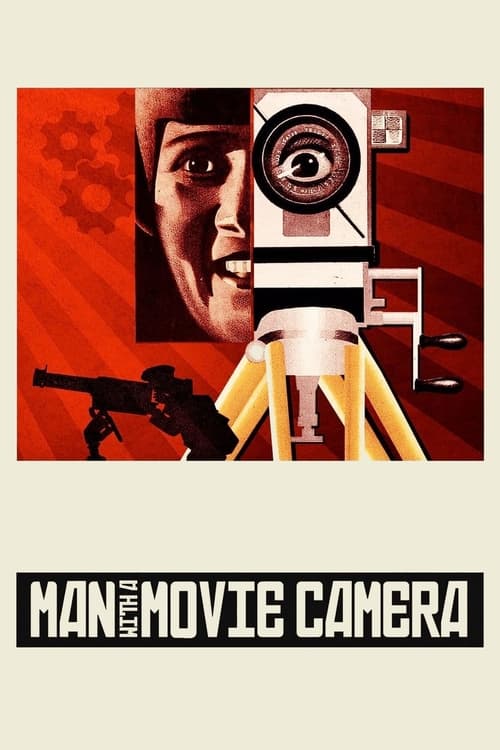
Man with a Movie Camera
1929 · Dziga Vertov
For when you want pure visual energy with zero plot to follow — put on a good score, let it wash over you, and feel your eyes recalibrate. More an espresso shot than a comfort watch.
What it's about
A cameraman roams Soviet cities from dawn to nightfall, filming everything: trams, weddings, factories, athletes, crowds, machines. There's no story and no characters — just one day of urban life caught on the fly, and the man with the camera weaving through it. The real subject is the camera itself, and what it can see that we can't.
The experience
Exhilarating and fast — a rush of images cut to a rhythm that feels closer to music than to storytelling. It's playful, showy, sometimes dizzying, and it keeps surprising you with tricks that still look impossible a century later.
The craft
Roughly 1,700 shots in under seventy minutes — split screens, superimpositions, freeze frames, stop motion, the film literally showing you its own editing as it happens. Dziga Vertov invented or perfected half the visual grammar editors still use, and with live or well-chosen music it plays like a concert. It rewards a big screen, where the sheer density of imagery becomes physical.
Why it matters
Regularly voted the greatest documentary ever made, it shaped everything from music videos to city films to experimental cinema, and it remains the purest case ever made for editing as an art in itself.
Snapshot
Man with a Movie Camera is a silent Soviet documentary in which a single day of urban life — observed across multiple cities of Soviet Ukraine — becomes the occasion for an encyclopedic demonstration of what cinema can do that no other art form can. There is no narrative, no characters in any conventional sense, no intertitles, no literary source. What the film offers instead is a sustained argument in moving images: that the camera, freed from theatrical convention and literary dependence, can perceive the world more truthfully and more vividly than the unaided human eye. Its central subject is, finally, cinema itself — the apparatus of filming, editing, and projection rendered visible as the film unfolds. Running approximately sixty-eight minutes and containing an estimated 1,700 shots, it remains one of the most formally radical films ever commercially exhibited, and one of the most influential documents in the history of the medium.
Industry & production
The film was produced by VUFKU (the All-Ukrainian Photo Cinema Administration), the state studio based in Kharkiv that operated largely independently of Moscow's Sovkino. Vertov's move to Ukraine was partly pragmatic: his relationship with Sovkino had grown strained through the mid-1920s, with Soviet cultural bureaucrats increasingly skeptical of his experimental work and its limited appeal to mass audiences. VUFKU proved a more tolerant patron and allowed Vertov to pursue a project he had been conceptualizing for years — a film without script, without actors, without intertitles, constituting what his preface-card calls "an experiment in the cinematic communication of visible events." The film was shot across at least three cities — Kyiv, Kharkiv, and Odessa — though some scholars have identified Dnipro (then Ekaterinoslav) as an additional location. Production extended across roughly 1927–1928, with the crew accumulating footage over many months before editing commenced. The film received its premiere in January 1929. Budget figures and precise box-office returns are not reliably documented in the scholarly record.
Technology
The film was shot on 35mm film stock using handheld and tripod-mounted cameras, often modified or improvised to achieve the shots Vertov and Mikhail Kaufman required. Kaufman mounted cameras on motorcycles, automobiles, and a moving trolley to achieve tracking shots; he shot from below street level, from inside moving vehicles, from rooftops, and — in one of the film's most striking sequences — from a camera position perched on a motorcycle alongside a racing carriage. The use of a variable-speed camera motor permitted slow-motion and fast-motion capture in-camera, while a stop-motion technique (animating static objects frame by frame) allowed the tripod to appear to walk and the camera to seem autonomous. Multiple exposure — the superimposition of two or more images in the optical printer or in-camera — creates layered, composite images that literalize Vertov's claim that the kino-eye perceives what human vision cannot. The film was silent by production design, made in the final year of the sound transition but explicitly conceived as an experiment in pure visual cinema without sonic accompaniment.
Technique
Cinematography
Mikhail Kaufman's camera work is strikingly heterodox for 1929. He achieves images from positions and angles that would have required considerable improvisation: a shot from inside a beer glass looking up at the drinker; the camera submerged to film swimmers from below the surface; extreme close-ups of machinery, eyes, and faces that transform the familiar into the abstract. The lens frequently catches its own reflection — in shop windows, in the eye of the woman being filmed — making visible the act of looking. Depth of field is manipulated to shift compositional emphasis. Where contemporaries in the Soviet montage tradition — Eisenstein, Pudovkin — generally shot for editorial combination, Kaufman's images are designed to carry graphic weight individually: diagonal compositions, vertiginous angles, and hard geometric contrasts that owe a debt to Constructivist graphic design.
Editing
Elizaveta Svilova, Vertov's wife and lifelong collaborator, edited the film, and her contribution is structural and intellectual as much as technical. The editing operates on several registers simultaneously. At the most visible level, it is rhyme-based: shots are linked by graphic similarity (circular shapes recurring across different contexts), by movement direction, by tempo. A spinning machine rhymes with a spinning dancer; factory wheels echo bicycle wheels; a woman washing her hair rhymes with a car wash. The rhythm accelerates through the film's second half, reaching a near-stroboscopic tempo in the finale. Svilova also introduces a film-within-the-film structure: sequences in which we see the raw footage, then Svilova editing it, then the edited sequence projected — a three-part epistemological loop that insists on cinema as construction rather than transparent window. The freeze frame and reverse motion are deployed as explicit disruptions of cinematic illusion. Split-screen divides the frame to show simultaneous actions across the city.
Mise-en-scène / staging
The film's preface declares that it contains "no intertitles," "no scenario," and "no sets" — a manifesto against theatrical staging. And yet the film is not purely unstaged. Certain sequences — the woman waking in what appears to be a park or public space, the eye under the lens — have the quality of arranged observation. Kaufman was present with a camera, but his presence in certain shots was itself a performance of the kino-eye ideal: the camera as active agent seeking truth rather than passive recorder. The city itself functions as mise-en-scène, its architecture, machinery, and crowds organized by the editing rather than by pre-production arrangement. The film does not pretend the camera is invisible; it insists on its visibility.
Sound
Man with a Movie Camera was released as a silent film. Vertov's preface explicitly positions it as such, and the absence of a synchronized soundtrack was a conceptual choice — the film's language was to be exclusively visual. Over the decades, numerous scores have been composed and performed for the film. The most widely heard in contemporary screenings are Michael Nyman's 1002 Strings score (1998) and the score by The Cinematic Orchestra (2003). The Ukrainian Dziga Vertov Group, a loosely affiliated ensemble of musicians, has also contributed to the film's live-performance tradition. The Alloy Orchestra's score is another well-regarded option in the repertory. None of these is authoritative; Vertov left no instructions for musical accompaniment.
Performance
The film contains no actors and no fictional characters, but it does have subjects — the workers, the women at the beauty salon, the couple being married, the beach-goers, the factory laborers — who range from apparently candid to clearly aware of the camera. Mikhail Kaufman is the eponymous man with the movie camera, and he appears throughout as both the agent of filming and, paradoxically, as a subject filmed by some other camera. Elizaveta Svilova appears in the editing sequences. The question of performance is dissolved by the film's epistemology: if the kino-eye records truth, then being filmed cannot be acting, only existence observed.
Narrative & dramatic mode
Man with a Movie Camera has no story and no characters in the classical sense, but it has structure. The film follows a loose diurnal arc — the city waking, the working day, leisure activities, nightlife — that provides temporal scaffolding without constituting a narrative. Within this arc, the film operates by accumulation and rhyme rather than causation: units of meaning are generated by juxtaposition, repetition, and contrast. The dramatic mode is lyric-argumentative: each sequence advances a thesis about cinema, perception, or Soviet modernity through the emotional force of images in collision. The birth sequence, the death sequence, and the marriage-and-divorce sequence introduce human drama but resist sentimentality; they are folded into the film's rhythm as material facts rather than narrative climaxes.
Genre & cycle
The film belongs to the city symphony genre, a loose international cycle of the late silent era that includes Walter Ruttmann's Berlin: Symphony of a Great City (1927), Alberto Cavalcanti's Rien que les heures (1926), and Jean Vigo's À propos de Nice (1930). City symphonies observe urban life through a musical analogy — structured movement, tempo, rhythm, contrapuntal organization — rather than through narrative. Vertov was aware of Ruttmann's film, and critics noted the resemblance; Vertov, characteristically, argued for the superiority of his own method, insisting that the Kinoks' engagement with actuality went deeper than the aestheticized formalism of Ruttmann. The city symphony label, while useful, only partially captures Man with a Movie Camera, which is also a film essay, a self-reflexive document, and a political manifesto.
Authorship & method
Dziga Vertov (born Denis Kaufman, 1896–1954) was the film's director and presiding theoretical intelligence. He had developed his Kino-Eye (Kino-Glaz) theory through the early 1920s in a series of newsreel compilations called Kino-Pravda (Cinema Truth, 1922–1925) and published polemical manifestos in LEF (Left Front of the Arts) and elsewhere. The Kino-Eye theory held that the camera, unlike the human eye, is free from biological limitation, social conditioning, and temporal constraint; montage allows the filmmaker to assemble a higher-order reality from fragments of actuality. Vertov's Kinoks collective — a loose group of like-minded filmmakers — was his primary institutional identity.
Mikhail Kaufman (1897–1980), Vertov's younger brother, is the cinematographer and the figure behind the camera visible in the film. His technical inventiveness was essential to realizing Vertov's theory, and his physical daring — filming from moving vehicles, from confined spaces, from extreme angles — gave the film its kinetic variety. Mikhail and Dziga had a significant falling-out after Man with a Movie Camera and did not collaborate again; the precise nature and terms of their estrangement are documented incompletely.
Elizaveta Svilova (1900–1975) was Vertov's wife, his editor on nearly all his films, and a creative partner whose contribution to Man with a Movie Camera is structural and conceptual. The film's self-reflexive editing sequences make her work visible: she is shown at the editing table, splicing and reviewing strips of film. Her analytical intelligence in organizing Vertov's footage — across multiple cities, across many months of shooting — is inseparable from what the film means.
Movement / national cinema
The film is a central document of Soviet montage cinema, the school of filmmaking theory and practice that flourished in the USSR during the 1920s and included Sergei Eisenstein, Vsevolod Pudovkin, and Lev Kuleshov. Soviet montage held that meaning in cinema is generated primarily in the cut — the collision of images — rather than in the content of individual shots. Vertov's version was the most radical and the most adversarial: he rejected theatrical performance, literary adaptation, and fictional narrative root and branch, positions that put him in direct polemical conflict with Eisenstein (who used actors and scripts) and Pudovkin. The film was produced under Ukrainian auspices and in some respects belongs to a distinct VUFKU tradition of Soviet-era Ukrainian cinema, though Vertov's theoretical work was pan-Soviet in ambition.
Era / period
The film arrives at the precise end of the silent era, in 1929, when sound cinema was already transforming production in the United States and Western Europe and beginning to penetrate Soviet studios. Vertov's explicit rejection of sound synchronization in this film is therefore both a theoretical statement and, arguably, a rearguard action; his subsequent sound films would grapple with how to extend Kino-Eye theory into the new medium. The late 1920s in the USSR were also a period of intensifying ideological pressure: the First Five-Year Plan began in 1928, and the cultural latitude of the early Soviet period was contracting. Man with a Movie Camera captures a moment of relative formal freedom just before Socialist Realism hardened into official doctrine.
Themes
The film's governing theme is perception itself — the question of how we see and how cinema can expand or transform ordinary seeing. This is expressed through the recurring motif of the eye: the woman's eye matched against the camera lens in superimposition is the film's most explicit statement, but the theme ramifies through every sequence. Related to this is the theme of labor and the machine: the film treats the movie camera as one instrument among many in the industrial city, and the act of filmmaking as a form of skilled labor continuous with factory work, athletic performance, and urban management. Soviet modernity — the new society of workers, collective organization, rational planning — is both subject and implicit argument. Finally, the film meditates on cinema as illusion and revelation simultaneously: the freeze frame, the reverse motion, and the editing-room sequences all insist that cinema is construction, while the accumulated footage insists that it captures something real about the world.
Reception, canon & influence
Influences on the film. Vertov drew on the Lumière actuality tradition, the street photography of the late nineteenth century, and the formal experiments of Futurism and Russian Constructivism. His Kino-Pravda newsreels (1922–1925) were direct predecessors: shorter, less self-conscious exercises in the same observational method. Lev Kuleshov's montage experiments at the State Film School provided the theoretical framework within which Vertov's own, more extreme positions developed through argument and opposition. The city symphony films of Cavalcanti and Ruttmann offered a generic precedent, however much Vertov resisted the comparison.
Critical reception. The film's initial reception in the Soviet Union was lukewarm to hostile. Soviet critics and ideologues, including figures aligned with RAPP (the Russian Association of Proletarian Writers), found it formalist and inaccessible — more interested in cinematic gymnastics than in serving the proletarian audience. This criticism would intensify through the early 1930s, as Socialist Realism became official doctrine and Vertov's standing declined precipitously. He made relatively few films after 1929 and spent his final years in comparative obscurity. Western critical reception was more admiring from an early date, though the film was seen primarily by specialists and cinephiles rather than general audiences until much later in the twentieth century.
Canon. Man with a Movie Camera's canonical ascent was gradual and decisive. By the 1960s and 1970s it was being taught in film schools and cited by avant-garde filmmakers as a foundational text. In the 2012 Sight & Sound decennial poll of the greatest films ever made, it was voted by critics to eighth place overall, and first in the directors' poll — extraordinary for a silent documentary with no narrative. It consistently appears on lists of essential films in university curricula across film studies, media studies, and visual arts programs.
Legacy and influence forward. The film's influence operates on several distinct levels. For the direct cinema and cinéma vérité movements of the 1950s and 1960s — represented by Jean Rouch, Chris Marker, the Maysles brothers, and Frederick Wiseman — Vertov was a theoretical ancestor, though the practitioners were divided on how directly to acknowledge the debt. Jean-Luc Godard's engagement with Vertov was explicit and sustained: the Dziga Vertov Group (1968–1972), which Godard co-founded with Jean-Pierre Gorin, took Vertov's name as a political and aesthetic declaration of intent, and Godard's essay films — Tout va bien, Ici et ailleurs, the Histoire(s) du cinéma series — are unthinkable without Vertov's precedent. Chris Marker's montage essays similarly carry Vertovian DNA. In experimental and structural filmmaking, the film's self-reflexive turn — cinema examining its own apparatus — anticipates the structural film movement of the 1960s and 1970s (Michael Snow, Hollis Frampton). In contemporary practice, the film's sensibility has been absorbed into music video aesthetics, documentary filmmaking, and visual art video installation to a degree that makes its specific influence difficult to trace. What is clear is that nearly every argument made since 1929 for the camera as a privileged, non-theatrical instrument of perception takes Man with a Movie Camera as its origin point or must reckon with the fact that Vertov made the argument first, and made it with unequalled formal force.
A Deleuzian reading
Start with the eye.
The full Deleuzian reading of Man with a Movie Camera →
Reception
In 1929 even fellow Soviet avant-gardists balked — Eisenstein famously dismissed its tricks as 'unmotivated camera hooliganism' — and it puzzled audiences at home and abroad. Now it's the establishment: Sight & Sound's 2014 critics' poll named it the greatest documentary ever made, and it cracked the top ten of the magazine's 2012 all-time list.
How Man with a Movie Camera was received, from release to now →
Influences: the films it descends from and the films it influenced
- Rien que les heures (1926) — Cavalcanti's single-day-in-Paris non-narrative structure — dawn through night, machine and human rhythms intercut without story or protagonist — established the city-symphony scaffold Vertov adopted as his organizational template and then exceeded by making the camera apparatus itself a visible subject.
- Nanook of the North (1922) — Flaherty's observational practice — the non-actor filmed in his actual environment, the camera watching labor without theatrical staging — established the ethnographic actuality tradition Vertov radicalized by exposing everything Flaherty kept invisible: the tripod, the film reel, the editor at her bench.
- Berlin: Symphony of a Great City (1927) — Ruttmann's synchronization of urban visual patterns to musical meter through metric editing, and his parallel cutting between machine motion and human gesture as formal equivalents, provided the precise city-symphony grammar Vertov quoted in direct competition, then exceeded by inserting the camera mechanism as a visible co-subject.
- Intolerance (1916) — Griffith's parallel montage across four storylines, analyzed and taught by Kuleshov at the State Film School, provided the technical substrate for Soviet collision-montage; Vertov's graphic-rhyme cut — matching formally similar images across discontinuous spaces — is an extreme extension of Griffith's intercutting logic, stripped of narrative causality.
- La Roue (1923) — Vertov's flicker passages and machine-tempo cutting drop frame counts until motion registers as pulse rather than movement, making Gance's accelerando the organizing principle of a whole film, camera again riding moving rolling stock.
- Primary (1960) — The lightweight sync-sound 16mm rig Drew developed with Leacock and Pennebaker mechanically realized Vertov's programmatic aspiration for a fully mobile camera freed from tripod and studio; the handheld shot pursuing Kennedy through corridors — unsteady, intimate, unobtrusive — fulfilled what the Kino-Eye manifesto had only theorized.
- Chronicle of a Summer (1961) — Rouch and Morin coined cinéma vérité as a direct citation of Vertov's Kino-Pravda; the film's core method — camera as social provocateur whose presence is then interrogated in subsequent review sequences — is the Kino-Eye premise applied to ethnographic interview, with the camera's role in generating its own subject made explicitly visible.
- Wavelength (1967) — Snow's structural film strips away every element except the camera's own optical transformation — a 45-minute zoom across a loft — making the mechanism's spatial-temporal capacity the sole subject, the logical terminus of Vertov's axiom that cinema's truth lies in what the apparatus can do rather than what it depicts.
- Nostalgia (1971) — Frampton makes the film's own temporal mechanism visible by offsetting narration from image — describing the next photograph while the current one burns in real time — extending Vertov's strategy of inserting the editing table and film reel into the film's body as a technique of apparatus exposure.
- Tout va bien (1972) — Made under the banner of the Dziga Vertov Group, the film breaks the fourth wall to recite its own production budget and expose its shooting conditions as set, enacting Vertov's imperative to reveal cinema's material and economic apparatus rather than sustain the theatrical illusion of a transparent window onto reality.
- Koyaanisqatsi (1982) — Reggio and cinematographer Ron Fricke deploy time-lapse and slow-motion — variable-speed cinematography Vertov pioneered — to construct a non-narrative city-and-landscape symphony arguing through pure visual rhythm without dialogue, plot, or protagonist, directly extending the Vertovian lyric-documentary tradition into ecological subject matter.
- Sans Soleil (1983) — Marker's film-essay extends Vertov's self-reflexive camera into a philosophical instrument: the letter-form allows the voiceover to interrogate what the camera sees and cannot see, making the act of documentary looking — across cultures, time zones, and memory — the film's explicit subject rather than its invisible method.
- Histoire(s) du cinéma (1988) — Godard's video superimposition — images, text fragments, and sounds from different films layered into palimpsest — is the electronic equivalent of Vertov's multiple exposure and split-screen: montage as material density, making the film strip's simultaneous registers visible as a method of historical and critical thought.
- The Gleaners and I (2000) — Varda turns the digital video camera on her own filming hands, on the battery indicator, on the apparatus's physical limitations, making the technology of image-making a co-subject alongside her documentary material — the most direct transposition of Vertov's apparatus-exposure into the digital era.
- Contempt (1963) — Vertov's systematic inscription of the filming apparatus into the film itself — camera, cameraman, and editing table made visible — is the formal ancestor of the Contempt opening shot in which Coutard's camera pans to face its own audience, naming the film's artifice and implicating the spectator before the story begins.
- Persona (1966) — Vertov's opening sequence showing the projectionist, the empty theater, and the cameraman loading his equipment establishes the apparatus-revealing prologue as a formal possibility that Persona's opening sequence of sprocket holes, silent-era animation fragments, and burning celluloid directly quotes and extends.
- Peeping Tom (1960) — Vertov integrates the camera operator's body into the film's own image and makes the editing apparatus visible within the film itself, establishing the reflexive self-consciousness about the act of filming that Powell inherits as a structural — not merely thematic — principle.
- Battleship Potemkin (1925) — Working within the same Soviet montage discourse and in direct theoretical debate with Vertov, Eisenstein codified the graphic-collision cut — two shots whose formal properties (shape, direction, contrast) generate a third meaning — a technique Vertov employed simultaneously while insisting it required 'life-caught-unawares' rather than staged performance.
- Earth (1930) — Dovzhenko constructed lyric non-narrative sequences through rhythmic editing of human bodies, agricultural machinery, and Ukrainian landscape without dialogue or story causality — the same structural principle as Vertov, though Dovzhenko's register is pastoral-ecstatic where Vertov's is mechanical-analytical.
- Meshes of the Afternoon (1943) — Deren and Hammid used slow motion, extreme angles, and spatial discontinuity through editorial cuts to render subjective perceptual states, extending Vertov's premise that the camera-eye discloses what the biological eye cannot, though toward psychoanalytic rather than constructivist ends.
- Strike (1925) — Vertov extended Strike's constructivist compositional vocabulary — extreme angles, graphic matching, accelerating collision cutting — into a self-reflexive formal essay that presents the urban working collective as cinema's proper subject.
- The Cranes Are Flying (1957) — Pioneers the unchained, athletic camera and in-camera superimposition that Urusevsky industrializes into custom rigs, circular tracks and the rotating-canopy/spiral-staircase shots.
- Sherlock Jr. (1924) — Shares the self-reflexive apparatus: a film that foregrounds its own projection, editing, and screen, turning the mechanics of cinema into the subject the way Keaton's projectionist literalizes the act of watching.
- The Crowd (1928) — A sibling city-film built from associative montage and candid/hidden-camera street footage of urban anonymity — the documentary-of-the-crowd impulse Vidor smuggled into fiction.
- Napoleon (1927) — Vertov's Kino-Eye kinetic camera and dense superimpositions pursue the same liberation of the lens from fixed vantage that drives Gance's mobile and multiple-exposure work.
- The Man Who Sleeps (1974) — Establishes the camera as an instrument that itemizes the city's ordinary textures and mechanisms; the seed borrows this observational cataloging of urban matter but subordinates the single human figure to it rather than reveling in the apparatus.
Similar films
- Battleship Potemkin (1925) — influence & lineage · often watched together
- Earth (1930) — influence & lineage
- Wavelength (1967) — influence & lineage
- Chronicle of a Summer (1961) — influence & lineage
- Primary (1960) — influence & lineage
- Koyaanisqatsi (1983) — same viewing thread · often watched together
- The Cranes Are Flying (1957) — often watched together
- The Last Laugh (1924) — often watched together
All the films related to Man with a Movie Camera →
Watch it with: curated runs of related films
- Cinema Without Words — Watch these as one run of pure image and music — the city symphony reborn, from Vertov's roaming cameras to 70mm temples, disaster zones, and Apollo footage, each the whole world edited into rhythm without a line of dialogue.