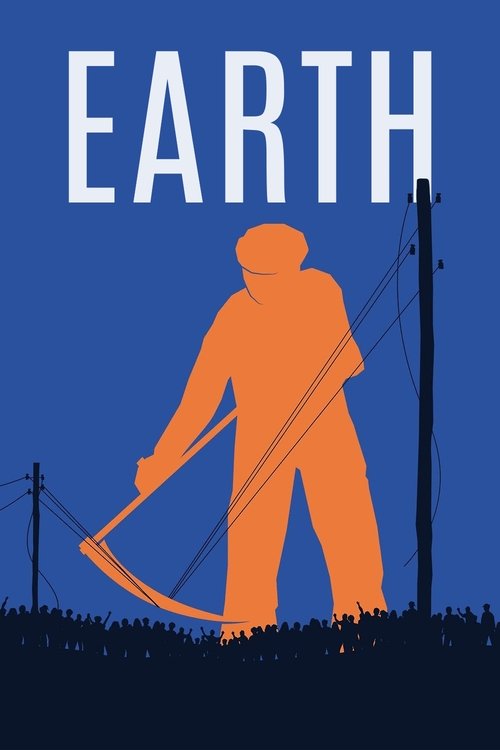
Earth
1930 · Oleksandr Dovzhenko
For a quiet, contemplative evening when you want cinema as pure image — something closer to a visual poem than a plot, best watched with your phone in another room.
What it's about
In a Ukrainian village at the dawn of Soviet collectivization, a young peasant named Vasyl brings the community its first tractor and drives it straight across the boundary lines of the wealthy landowners' fields. The film follows the collision that act sets off — between the young Communists and the old order, and between one family's grief and joy. Around the politics, it keeps returning to the land itself: harvests, weddings, funerals, rain on ripening apples.
The experience
Slow, hushed, and strangely rapturous — less a story than a series of held breaths. Faces, wheat, and fruit fill the frame until ordinary village life starts to feel sacred, and the moments of violence land harder for how much stillness surrounds them.
The craft
This is silent cinema at its most painterly: compositions of faces against sky, bodies among sunflowers, a moonlit lane, that photographers and directors have been stealing from for nearly a century. The rhythm is built in the editing — long meditative passages broken by sudden bursts of montage — and it rewards the biggest, sharpest presentation you can give it.
Why it matters
Made at the very end of the silent era, it became one of the most revered films of Soviet cinema and the peak of Dovzhenko's Ukraine trilogy, routinely cited among the greatest films ever made and a touchstone for lyrical, nature-steeped filmmaking ever since.
Snapshot
Earth (Zemlia) is the culminating film of Oleksandr Dovzhenko's so-called "Ukraine trilogy," following Zvenyhora (1928) and Arsenal (1929), and it stands as the fullest expression of a strain of Soviet silent cinema that is lyric rather than dialectical. Nominally a work of agitation for agricultural collectivization — a young peasant Communist, Vasyl, brings a tractor to his village, plows across the boundary strips of the kulaks' land, and is murdered for it — the film is in practice a pantheist meditation on the cycle of birth, labor, death, and renewal. It opens with an old man's serene death among ripe fruit and closes with rain falling on apples and a new child, framing a political program inside a vision of nature's indifferent continuity. Made at the very end of the silent era and on the eve of the catastrophic famine that collectivization would help produce, Earth is at once a period document and a work that transcends its immediate ideological occasion. It runs roughly 75 minutes and is routinely counted among the greatest films of the silent period.
Industry & production
Earth was produced by VUFKU, the All-Ukrainian Photo-Cinema Administration, the state cinema organization of Soviet Ukraine, and was made through the Kyiv film studio where Dovzhenko had established himself after Zvenyhora and Arsenal. The production sits inside the specific institutional moment of Ukrainian cinema's brief flourishing in the 1920s, before centralization and Russification of the Soviet film industry curtailed the republic's relative autonomy. Dovzhenko, who had come to filmmaking late — after work as a teacher, diplomat, and cartoonist — was by 1930 VUFKU's most prestigious director, and Earth was mounted as a major statement rather than a routine assignment.
The film was conceived and shot against the backdrop of the First Five-Year Plan and the forced collectivization drive launched in 1929–30, which the film was meant to endorse. That timing is the central fact of its production history and its afterlife: the "dekulakization" campaign the film dramatizes as heroic modernization was, within two to three years, bound up with the man-made famine (the Holodomor) that devastated the Ukrainian countryside. Nothing in the film anticipates that catastrophe, but the historical proximity gives its imagery of soil, grain, and fruit a tragic charge unavailable to its first audiences.
Upon release in April 1930 the film met sharp official hostility. The most cited episode is an attack in Izvestia by the establishment poet Demyan Bedny, whose satirical verse denounced the film as defeatist and ideologically suspect, objecting in particular to its "biologism," its frank nudity, and its dwelling on death rather than triumphant construction. The film was subjected to cuts, and Dovzhenko later wrote of the wounding effect of the campaign against it. The precise extent and content of the censored footage is not documented with full reliability in the surviving record, and different restorations reflect different states of the film; claims about exactly which shots were removed should be treated with caution.
Technology
Earth was made as a silent film on 35mm black-and-white stock, at the exact hinge point when synchronized sound was arriving in Soviet cinema. It carries no synchronized dialogue or recorded score; like other late silents it was meant to be shown with intertitles (which Dovzhenko uses sparingly) and live or supplied musical accompaniment. The film's technical achievement lies not in novel apparatus but in the expressive control of conventional silent-era tools — orthochromatic-era cinematography, natural light, and location shooting in the Ukrainian countryside — pushed toward a luminous, almost tactile rendering of skin, sky, grain, and fruit. The documentation of the original 1930 musical accompaniment is thin; later Soviet re-releases and modern restorations have carried added scores, and the film is now most often encountered in a restored version with newly commissioned or reconstructed music rather than in any authoritative "original" sound form.
Technique
Cinematography
The photography, by Danylo Demutsky, is central to the film's reputation and to Dovzhenko's method. Demutsky favors a soft, glowing image, frequently composing single figures against low horizons and vast skies so that peasants, oxen, and sunflowers stand as near-sculptural forms. Faces are photographed in tight, sustained close-up — weathered, monumental, held long enough to become the film's primary landscape. The imagery of harvest is sensuous and specific: heavy heads of wheat, apples in the rain, horses and cattle, the physical textures of the agrarian world rendered with an attention that borders on the devotional. Demutsky's work here is a touchstone of the idea that Soviet montage cinema could be a cinema of the beautiful, luminous shot as much as of the collision of shots.
Editing
Dovzhenko cut Earth himself, and the editing is the clearest measure of his distance from his celebrated contemporaries. Where Eisenstein builds meaning through dialectical collision and Vertov through kinetic acceleration, Dovzhenko edits toward stillness, ellipsis, and rhyme. Sequences are organized associatively and by visual parallel — bodies and soil, ripeness and decay, sleep and death — rather than by continuous action. The film is famous for passages of suspended, contemplative montage: the opening death of the grandfather; a becalmed village standing motionless in the moonlit heat before catastrophe; the funeral procession in which apple branches brush the dead man's face as he is carried through the orchard. Time is frequently arrested rather than propelled, and cause and effect are elided in favor of an incantatory rhythm. It is montage repurposed for elegy.
Mise-en-scène / staging
Dovzhenko stages Earth in and of the land. The dominant compositional strategy places human figures within the horizontal expanse of the fields, or isolates them against sky, so that the drama reads as an event within nature rather than against a social backdrop. Recurring motifs — sunflowers, fruit trees, grazing oxen, the tractor as an intruding machine — are treated as near-ritual objects. The most discussed set piece is Vasyl's return home at night: he walks and then dances alone down a moonlit road in an ecstasy of youthful joy, and is shot dead mid-motion by an unseen kulak, collapsing without warning. The staging of grief that follows — including the widely noted image of his grieving fiancée in her stripped, keening despair — pushes the film toward a frankness of body and emotion that scandalized official critics.
Sound
Earth is a silent film and contains no diegetic sound or synchronized score as made. Its "sound" is entirely visual and rhythmic — the implied noise of the tractor, the wind in the wheat, the silence of the stunned village — conveyed through image and cutting. Because the film survives in multiple restored states with various added musical tracks, any account of its "soundtrack" describes a later accretion rather than an authorial original.
Performance
Performance is stylized toward the emblematic. Dovzhenko draws his cast — a mix of professional actors and faces chosen for their sculptural weathering — toward stillness, gesture, and held expression rather than psychological naturalism. Semen Svashenko, who had appeared in Arsenal, plays Vasyl as an icon of buoyant youth, his death made shocking precisely because his dance had been so alive. Stepan Shkurat as the father Opanas and Mykola Nademsky as the dying grandfather anchor the film's generational frame with grave, monumental faces. Pyotr Masokha plays the kulak son Khoma, whose act of murder and later frenzied self-exposure carry the film's political antagonism. Dovzhenko's future wife and collaborator Yuliya Solntseva appears among the ensemble. Throughout, acting is subordinated to the tableau: bodies are composed, not psychologized.
Narrative & dramatic mode
The narrative is spare and would fit on a page — machine comes to village, boundary lines are plowed under, a young activist is murdered, the community buries him and affirms the collective future — but Dovzhenko treats plot as almost incidental. The dramatic mode is lyric and cyclical rather than causal: the film is bracketed by a death and a birth, and its emotional logic runs through parallel and repetition rather than suspense. Human events are continually dissolved into natural process, so that political conflict registers less as melodrama than as one more turn in an organic cycle. This ellipticism is deliberate; Dovzhenko withholds conventional connective tissue and lets images stand as statements. The result is closer to poetry than to storytelling — a mode that later commentators would call "cinematic poem" and that Dovzhenko's own writings encouraged.
Genre & cycle
Earth belongs to the cycle of Soviet silent films commissioned to celebrate the transformation of the countryside under collectivization, a genre that also produced Eisenstein's The Old and the New (The General Line). Within that propaganda remit, however, it functions as something more idiosyncratic: a work of "poetic cinema," the label most durably attached to Dovzhenko. It is the third and final panel of his Ukraine trilogy, and it consolidates the trilogy's movement away from the historical-revolutionary subject matter of Arsenal toward the mythic, agrarian, and pantheist. As genre, it is simultaneously agit-film and pastoral elegy, and its lasting identity is the second, not the first.
Authorship & method
Earth is a signature auteur work in an industry not yet organized around auteurism. Dovzhenko wrote, directed, and edited it, and his method — associative montage, monumental close-ups, the subordination of narrative to image, the pantheist blurring of human and natural — is fully legible here. He worked in close partnership with cinematographer Danylo Demutsky, whose luminous photography is inseparable from the film's identity; the two had collaborated on Dovzhenko's earlier work, and Demutsky is the essential co-author of Earth's look. Dovzhenko's actor and life partner Yuliya Solntseva was a lasting collaborator who would, after his death in 1956, complete and direct several of his unrealized projects, becoming a keeper of his method. Because the film was made silent, there is no original composer of record; attributions of music belong to later re-releases and restorations and should be stated as such rather than as part of the 1930 authorship.
Movement / national cinema
The film is a landmark of two overlapping formations. It belongs to the broad movement of Soviet silent montage cinema of the 1920s, alongside Eisenstein, Pudovkin, Vertov, and Kuleshov — but it is habitually set apart as its "poet," the figure who used montage for lyric contemplation rather than dialectic or documentary. Equally, Earth is the foundational monument of Ukrainian national cinema. Rooted in the Ukrainian countryside, its rhythms, its agrarian imagery, and its folk sense of death and renewal, it established a distinctly Ukrainian lyric-poetic tradition. That tradition would be revived a generation later in the "Ukrainian poetic cinema" school associated with Sergei Parajanov's Shadows of Forgotten Ancestors (1965) and the films of Yuri Ilyenko, and the Kyiv studio that later bore Dovzhenko's name became the institutional home of that legacy.
Era / period
Earth is precisely a film of 1930: the terminal moment of Soviet silent cinema, the first years of the Five-Year Plan, and the height of the collectivization drive. It arrives just as sound is transforming the medium, making it one of the last major statements of pure silent-cinema visual language. Its ideological brief — the modernization of the peasantry, the liquidation of the kulaks as a class — places it at the center of a period whose human cost the film could not foresee. Reading it now requires holding two frames at once: the film as an artifact of revolutionary optimism, and the film as a window onto the eve of one of the twentieth century's great man-made catastrophes.
Themes
The film's governing theme is the continuity of life through the cycle of nature, into which human labor, love, politics, and death are all absorbed. Its structural bracket — the "good death" of the grandfather among ripe fruit at the start, the rain and the new life at the end — asserts renewal as the deepest law. Bound to this pantheism are the themes of the body and the soil, treated with a frankness (fertility, grief, physicality) that unsettled censors; the collective versus the individual holding, dramatized in the plowed-under boundary strips; the machine entering the organic world, ambivalently a bringer of both progress and rupture; and generational succession, the passing of the land from the old to the young. The political thesis of collectivization is genuinely present, but it is continually reframed as a moment in a cycle far larger than any Five-Year Plan.
Reception, canon & influence
Contemporary Soviet reception was sharply divided. Officialdom, voiced most memorably by Demyan Bedny's Izvestia attack, found the film defeatist, morbid, and improperly preoccupied with death and the body, and it was cut and its reputation officially bruised. Among filmmakers and the international avant-garde, however, its stature was high; Dovzhenko's peers recognized in Earth a masterwork of the medium's lyric possibilities. Its canonical standing was durably confirmed at the 1958 Brussels World's Fair, where an international poll of critics named Earth among the greatest films ever made — a judgment that has been sustained through subsequent critical generations, and the film remains a fixture of the silent-cinema canon.
Its influences run backward into the wider Soviet montage culture of the late 1920s — the same milieu that produced Eisenstein and Pudovkin — and into Dovzhenko's own Ukrainian folk sensibility and pantheist worldview, refined across Zvenyhora and Arsenal. Its legacy runs forward with unusual reach. Domestically, it is the fountainhead of Ukrainian poetic cinema, the tradition later carried by Parajanov and Ilyenko, and its custodianship passed in part to Solntseva. Internationally, its model of a contemplative, image-led, nature-suffused cinema became a reference point for directors seeking an alternative to narrative-driven filmmaking — most often invoked in discussions of Andrei Tarkovsky's spiritualized long-form imagery and, in American cinema, of Terrence Malick, whose fields, skies, luminous close-ups, and cyclical sense of nature descend recognizably from Dovzhenko's example. As both the summit of a national cinema and a permanent argument for film as lyric poetry, Earth has outlived the political occasion that produced it.
A Deleuzian reading
An old man lies down in the grass among his own apples and pears, takes one last bite, and dies.
The full Deleuzian reading of Earth →
Reception
On release it was savaged in the Soviet press — Demyan Bedny denounced it in Izvestia as defeatist, and censors cut it — yet by 1958 a jury of historians at the Brussels World's Fair named it one of the twelve greatest films ever made.
How Earth was received, from release to now →
How to watch Earth: what to notice on a first viewing
- Watch how long the camera holds on a single weathered face. Demutsky photographs faces in tight, sustained close-up, held long enough that they become the film's real landscape. A face here carries as much meaning as any line of dialogue would.
- Watch a single figure set low against an enormous sky. Dovzhenko repeatedly composes people, oxen, and sunflowers as near-sculptural forms against low horizons and vast open air. The staging reads every human event as something happening inside nature, not against a backdrop of it.
- Notice ripe fruit, rain, and bodies set side by side. Dovzhenko joins apples, soil, rain, and faces by likeness across scenes, not by cause and effect. The images read as one cycle before the plot starts.
- Watch the tractor's first arrival among the older tools and animals. The machine enters a world of oxen and hand tools, staged as neither simple triumph nor simple threat. The tractor sits in the frame as an open question about what it will cost this village.
- Notice how rarely the film explains why one image follows another. Dovzhenko edits by rhyme and parallel, bodies and soil, ripeness and decay, rather than by cause and effect. The cuts start to feel like verses instead of like a chain of events.
The whole guide to watching Earth, with the keys for a rewatch →
Influences: the films it descends from and the films it influenced
- Battleship Potemkin (1925) — Establishes the collision-montage grammar and the ecstatic close-up of the anonymous crowd that Earth inherits but softens from dialectical shock into lyric association.
- Mother (1926) — Pioneers the associative intercut of human feeling with nature — thawing river ice standing for revolutionary awakening — the exact pantheist parallel-editing Earth pushes to the harvest-and-death cycle.
- The General Line (Old and New) (1929) — Shares Earth's agrarian-collectivization subject and the arrival of the tractor as machine-in-nature, rendered through rapturous luminous close-ups of peasant faces and gleaming apparatus.
- Zvenyhora (1928) — Dovzhenko's own folk-mythic template of associative montage and elliptical, legend-driven structure that Earth distills into pure lyric cyclical form.
- Arsenal (1929) — Refines the emblematic frozen tableau, the low-horizon staging of figures against sky, and the elliptical suppression of plot that become Earth's signature.
- Poem of the Sea (1958) — Directed from Dovzhenko's own script by his life-partner and method-keeper, it literally continues his associative montage and monumental landscape lyricism after his death.
- Shadows of Forgotten Ancestors (1965) — Fountainhead-heir of Ukrainian poetic cinema: figures dwarfed in Carpathian landscape, ethnographic ritual, and image-over-narrative construction descend directly from Earth.
- The Color of Pomegranates (1969) — Extends Earth's emblematic-tableau performance into static, frontal, quasi-liturgical compositions where meaning is carried by arranged bodies and objects rather than plot.
- A Spring for the Thirsty (1965) — Ilyenko carries the luminous close-up and low-horizon Ukrainian landscape into a village-cycle-of-life film built on Dovzhenko's contemplative suspension.
- The Stone Cross (1968) — Ukrainian poetic-cinema descendant staging peasant attachment to soil through elliptical structure and emblematic figures-in-landscape tableaux.
- Ivan's Childhood (1962) — Nature-suffused luminous close-ups and dream-associative editing that critics trace to Dovzhenko's model of spiritualized, image-led long-form imagery.
- Mirror (1975) — Wind moving through fields, contemplative suspension of narrative, and associative editing of memory and landscape are the mature realization of Dovzhenko's lyric-cyclical method.
- Days of Heaven (1978) — Magic-hour luminous cinematography of wheat fields, figures against a low prairie horizon, and an agrarian cycle of harvest and death descend recognizably from Earth.
- The Tree of Life (2011) — Cyclical pantheist blurring of human and cosmic nature, with narrative wholly subordinated to associative, image-led montage — Dovzhenko's argument for film as lyric poetry extended to the whole of creation.
- Andrei Rublev (1966) — Dovzhenko's lyrical landscape cinema — wide-angle compositions placing figures within Ukrainian earth and sky, with contemplative duration replacing Eisenstein's collision-montage — gives Tarkovsky the model for treating elemental material (mud, water, fog) as metaphysical substance rather than atmospheric decoration.
- Stalker (1979) — Dovzhenko's pantheist cinematography — the camera dwelling on grass, soil, and water as sacred material rather than setting — establishes the Soviet poetic-cinema tradition of landscape-as-spiritual-terrain that Tarkovsky inherits and radicalizes in the Zone's long contemplative tracking shots.
- La Terra Trema (1949) — Dovzhenko's lyrical, near-religious tableaux of peasants and the land fused agrarian-class struggle with operatic pictorial composition — the same marriage of political conviction and visual grandeur Aldo achieves for Visconti.
- Turksib (1929) — A parallel late-silent lyricism of the machine entering the landscape — the railway cutting through steppe — sharing Earth's contemplative montage of technology and land.
- Man with a Movie Camera (1929) — Contemporary associative montage of labor, land, and rhythm; kino-eye materialism running alongside Dovzhenko's pantheist lyricism as the two poles of 1929 Soviet image-led cinema.
- The Cranes Are Flying (1957) — Bequeaths the Soviet 'poetic cinema' lyricism — landscape, faces and bodies shot as ecstatic plastic forms — that underlies Cranes' superimpositions and elegiac lyric register.
- City Girl (1930) — Contemporary agrarian lyricism organized around wheat and harvest, using rhythmic editing and reverent framing of rural labor as poetry — the same year's parallel to City Girl's harvest sequences.
Similar films
- Battleship Potemkin (1925) — influence & lineage
- Mirror (1975) — influence & lineage
- Man with a Movie Camera (1929) — influence & lineage
- Shadows of Forgotten Ancestors (1965) — influence & lineage
- Days of Heaven (1978) — influence & lineage
- The Tree of Life (2011) — influence & lineage
- Ivan's Childhood (1962) — influence & lineage
- All Quiet on the Western Front (1930) — shared sensibility