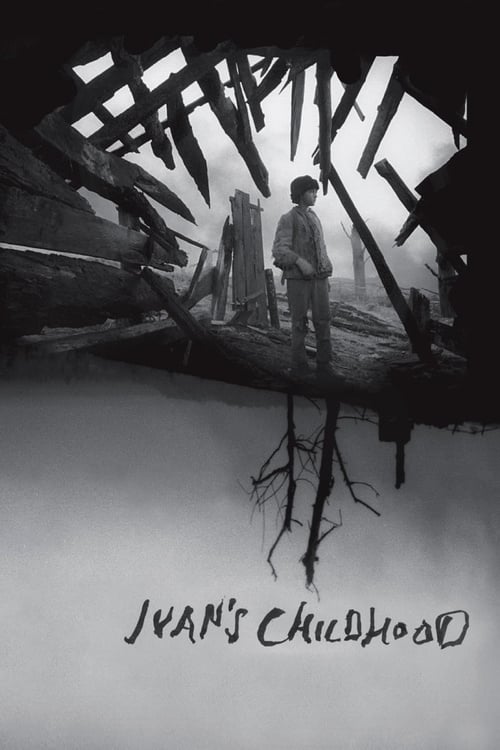
Ivan's Childhood
1962 · Andrei Tarkovsky
For a night when you want something beautiful and sad that stays with you — a serious, contemplative watch, not comfort viewing. Reach for it when you're ready to be moved rather than entertained.
What it's about
Twelve-year-old Ivan has lost his family to the German occupation, and now he crosses the front lines as a scout for the Red Army, slipping through swamps and ruined villages to bring back intelligence. Three Soviet officers take him under their wing and try, gently, to pull him back from the war he refuses to leave. Between missions, his dreams return him to the sunlit childhood the war destroyed — a mother, an apple cart, a beach — before reality drags him back to the mud.
The experience
Haunting and quiet, with sudden passages of pure radiance. The dream sequences glow while the waking world sits in shadow and damp, and the contrast wears at you — this is a war film with almost no combat that still leaves a bruise. It moves slowly, but the images hold you.
Performances
Nikolai Burlyayev, still a child himself, plays Ivan with a hardness that's genuinely unnerving — tender in dreams, cold and driven awake, an adult's rage in a boy's body.
The craft
Tarkovsky's first feature already looks like nothing else: stark black-and-white nocturnes cut against slow, luminous dreams, with birch forests, flooded landscapes and flares turned into images you don't forget. The camera moves like memory itself. It absolutely rewards a big screen and a dark room.
Why it matters
It announced Tarkovsky to the world, winning top honors at Venice and proving a Soviet war film could be personal and poetic rather than propagandistic. Everything he made afterward grows from the visual grammar invented here.
Snapshot
Andrei Tarkovsky's debut feature is at once a Soviet war film and a sustained lyrical argument about the nature of cinema itself. Twelve-year-old Ivan Bondarev, orphaned and hollowed out by the German occupation, works as a scout for a Red Army unit near the front; the film's formal structure alternates between the documentary grit of those missions and a series of incandescent dream sequences in which Ivan's destroyed childhood is restored, briefly, as paradise. The tension between those two registers — grainy, nocturnal reality against radiant, slow-motion memory — established the grammar Tarkovsky would spend the rest of his career elaborating. The film arrived fully formed: personal, technically audacious, and resistant to the socialist-realist conventions that Soviet cinema was still only beginning to shake. Its Golden Lion at Venice in 1962 announced a director of global significance.
Industry & production
The film began life as a rescue operation. The novella Ivan by Vladimir Bogomolov, published in the journal Znamya in 1957, had been assigned to director Eduard Abalov, who shot some preliminary footage before Mosfilm removed him from the project. Tarkovsky, twenty-nine years old and having just completed his VGIK diploma short The Steamroller and the Violin (1960–61), was brought in to take over. He and co-screenwriter Mikhail Papava substantially reworked the adaptation, retaining Bogomolov's central situation while radicalizing its formal ambition: the dreams, marginal in the source novella, became structural pillars. The production was thus shaped by institutional contingency as much as directorial vision — a salvage job that became a manifesto. Mosfilm provided standard studio resources for a modest black-and-white war picture; the real budget was imaginative rather than material.
Technology
The film was shot on Soviet black-and-white panchromatic film stock of the early 1960s, standard Mosfilm issue. Cinematographer Vadim Yusov, who would become Tarkovsky's primary visual collaborator through Andrei Rublev and Solaris, used the tonal range of black-and-white to maximum expressive effect — a technique that required precise control over exposure, since the contrast between the pitch-dark exteriors of the wartime sequences and the flooded, high-key luminosity of the dreams had to be built photochemically rather than in post. No surviving production documentation specifies the exact camera package, which is typical for Mosfilm productions of the period. The use of crane and tracking rigs is evident in the river sequences and the final Berlin documentary montage, the latter incorporating actual archival footage of the fall of Berlin grafted onto the drama.
Technique
Cinematography
Yusov's work here is among the most visually inventive in early-1960s Soviet cinema. The wartime scenes are characterized by deep-focus night photography, low angles that press Ivan's small figure against vast, threatening skies, and a preference for the textured horizontal bands of reeds, water, and mist that the river crossings required. The dreams are photographed in diametric opposition: overexposed, with blown highlights that turn birch forests and Black Sea beaches into near-abstract white fields. The famous sequence of Ivan and a girl riding a truck bed through an apple orchard — apples raining down around them in slow motion — uses a high-key, nearly silent treatment that has the quality of a daguerreotype come to life. Yusov's control of depth in the wartime bunker scenes, meanwhile, plays characters against labyrinthine earthwork geometry, making enclosed spaces feel both claustrophobic and monumental.
Editing
Editor Lyudmila Feiginova cut the film to preserve the jarring disjunction between registers rather than smooth it. The transitions between dream and reality are deliberately abrupt — Ivan jolts awake, or the film simply cuts, without preparatory dissolves or sound bridges. This refusal of soft passage forces the viewer to do the work of re-orientation each time, which is part of the film's argument: the dreams are not escapism but a form of truth that the waking world has annihilated. Within the dream sequences themselves, Feiginova allows extended duration, resisting the conventional rhythms of Soviet montage tradition and letting Tarkovsky's images breathe to the point of suspension.
Mise-en-scène / staging
Tarkovsky's staging consistently isolates Ivan as a category apart from the adults around him. In the bunker scenes, the officers — Kholin, Galtsev, Gryaznov — occupy a social and moral space defined by professional duty, male camaraderie, and a faintly absurd courtship of the nurse Masha; Ivan moves through these scenes like a fragment of a different film, tightly wound, preternaturally concentrated, his body language carrying none of the soldiers' ease. The destroyed church where Ivan waits is staged as a Gothic ruin, its shattered frescoes presiding over the boy's preparations for a mission that may kill him; Tarkovsky frames him within the wreckage of sacred imagery without commentary, letting the juxtaposition do the theological work. The birch forest, recurring across dream and reality, functions as the film's central spatial symbol: ordered, vertical, lit from within, it connotes both the Russian landscape and the structural geometry of loss.
Sound
Composer Vyacheslav Ovchinnikov, in his first major film score, employed orchestral music sparingly and strategically — reserving its fullest weight for the dream sequences, where it amplifies the oneiric charge, while leaving the wartime episodes largely to diegetic sound: water, mud, distant artillery, the particular silence of concealment. This asymmetry reinforces the formal binary at the film's heart. The sound design of the river crossings is notable: the rowers move in near-silence, and when sound does intrude — a branch, a human breath — it carries enormous threat. Tarkovsky would continue developing this principle of meaningful silence throughout his career, but Ivan's Childhood establishes the template.
Performance
Nikolai Burlyaev, approximately fourteen during production, delivers one of the most demanding child performances in world cinema of the period. The role requires Ivan to project traumatized intensity without the psychological vocabulary adults deploy, and Burlyaev achieves this through physical concentration rather than expressive sentiment: clenched jaw, obsessive physical activity, an almost feral alertness. Tarkovsky reportedly worked closely with him to prevent any softening of the character's driven, unchildlike quality. The adult cast — Valentin Zubkov as the roguish Kholin, Yevgeni Zharikov as Galtsev, through whose narrating consciousness much of the film passes, and Nikolai Grinko in the smaller role of Colonel Gryaznov — play against Ivan's intensity with a grounded, unglamorous realism that keeps the film from tipping into sentimentality.
Narrative & dramatic mode
The film's narrative logic is dual: a relatively linear account of Ivan's missions and the relationships he forms at headquarters, and a recursive, non-chronological dream structure that delivers his backstory in fragments. Neither track explains the other; the dreams do not function as flashback exposition but as an emotional counter-current, showing what the war has consumed. The ending — Galtsev discovering Ivan's execution record in a captured German file, followed by a final dream of Ivan as a living child racing into the sea — refuses consolation while refusing nihilism. It is a structure borrowed partly from classical tragedy (the catastrophe reported after the fact) and partly from the lyric poem (the image that refuses to close). Bogomolov's novella ends with similar material, but Tarkovsky's arrangement of the dream finale against the documentary archival footage of Berlin's ruins gives it a different temporal weight: history as ruin, and the image as the only space where the dead remain alive.
Genre & cycle
The film belongs to the Soviet "war film" genre but marks a decisive break within it. The dominant mode through the Stalin era had been heroic: sacrifice ennobled, loss redeemed by collective triumph, the individual meaningful only as an expression of Soviet will. The post-Stalin thaw had begun to permit more ambiguous treatments — The Cranes Are Flying (Kalatozov, 1957) and Ballad of a Soldier (Chukhrai, 1959) both introduced subjective, lyrical elements and a greater attention to private grief. Ivan's Childhood radicalizes this tendency to the point where genre convention becomes almost a container the film strains against: the war setting provides the conditions of extremity but the film's real subject is the irreversibility of loss and the formal question of how cinema can approach what has been destroyed. It is less interested in the war as military event than as ontological fact — a condition of the real.
Authorship & method
Tarkovsky's authorial presence is overwhelming for a first feature, which both testifies to his confidence and reflects the degree to which the salvage situation allowed him unusual creative latitude. His stated influences, documented in later interviews and the published diary Time Within Time (known in English as Martyrolog), include Kurosawa — particularly the way Rashomon and Ikiru handled subjective reality — as well as Bresson's ascetic economy, and Dovzhenko's Ukrainian poetic cinema, whose rurally inflected, lyrical handling of landscape and death can be felt in Ivan's dream sequences. Tarkovsky would later articulate his theory of cinema as "sculpting in time," and Ivan's Childhood is the first full demonstration of what he meant: duration, rhythm, and the materiality of the image as the primary bearers of meaning.
Vadim Yusov's contribution was fundamental. The film's visual extremity — its willingness to pursue whiteness and darkness far past conventional limits — required a cinematographer equally committed to the conceptual stakes. Yusov's collaboration with Tarkovsky on the subsequent Andrei Rublev would extend and deepen this partnership, though the two eventually parted ways before Solaris. Vyacheslav Ovchinnikov's score, while less celebrated than Eduard Artemyev's later electronic work for Tarkovsky, is precisely calibrated to the film's emotional logic. Mikhail Papava's role in the screenplay is harder to disaggregate; Tarkovsky is generally credited with the structural innovation of foregrounding the dreams, and Bogomolov himself expressed reservations about the adaptation, though he ultimately acknowledged its power.
Movement / national cinema
Ivan's Childhood is a product of the Soviet Thaw cinema, the period following Khrushchev's 1956 Secret Speech in which Soviet cultural life tentatively reopened to subjectivity, experimentation, and moral complexity. Mosfilm under this thaw produced a remarkable run of formally adventurous films — alongside the works of Kalatozov and Chukhrai, one might cite Mikhail Romm's Nine Days in One Year (1962). Tarkovsky's film is the most formally radical of these, and the one that most clearly anticipates the direction international art cinema would take in the 1960s. It sits in productive tension with the poetic traditions of Ukrainian cinema (Dovzhenko's legacy) and the documentary realism that had been the dominant Soviet mode; it uses both against each other.
Era / period
The film was made in 1961–62 and released in the Soviet Union in 1962, placing it at the height of the Thaw and in the same year as the Cuban Missile Crisis — a period of renewed anxiety about nuclear war that lent war-themed cinema particular urgency across the Eastern and Western blocs. Internationally, 1962 is the year of L'Eclisse, The Exterminating Angel, Lawrence of Arabia, and Jules and Jim: a moment of sustained ambition in world cinema that Ivan's Childhood, despite its modest budget and national-cinema origins, fully inhabits.
Themes
The film's central thematic preoccupation is the theft of childhood by historical violence — but it pursues this without sentimentality, because Ivan himself has foreclosed sentimentality, replacing it with a will to action that the adults around him find both admirable and disturbing. His insistence on returning to the front is not courage in any conventional military sense; it is closer to a death drive, a refusal to survive a world that has unmade him. The dreams do not represent what Ivan wants but what no longer exists — paradise as the tense of the irretrievably lost. Memory in Tarkovsky's world is not therapeutic but ontological: it attests to a reality that the present cannot contain.
Alongside this, the film explores the uneasy coexistence of war and ordinary human desire — Kholin's flirtation with Masha, conducted in absurd counterpoint to the front — and the impossibility of protecting childhood within an institution built for killing. The three officers who care for Ivan cannot save him, not because they fail in their duty but because the war has already done its damage before they arrived.
Reception, canon & influence
Backward (influences on the film): Beyond Kurosawa, Bresson, and Dovzhenko already noted, the film's handling of ruins and sacred space shows the influence of Italian neorealism's attention to postwar physical devastation, filtered through Tarkovsky's very different metaphysical concerns. The dream sequences' luminous treatment of natural landscape — water, birch, light through leaves — connects to a broader tradition of Russian lyric poetry and to the visual culture of pre-revolutionary Russian painting, particularly the landscape painting of the Wanderers school. These are diffuse influences, not direct sources; the record of Tarkovsky's specific viewing during his VGIK years is not comprehensively documented.
Reception: The film won the Golden Lion at Venice in 1962, an extraordinary outcome for a directorial debut, and secured immediate international attention. Jean-Paul Sartre wrote a celebrated essay about the film — published in the Italian communist newspaper L'Unità and subsequently translated widely — defending it against Soviet critics who had condemned its "formalism," particularly the film critic Mikhail Bleiman. Sartre's essay argued that the film's subjective, non-realist treatment of Ivan's interiority was not formalism but a more profound realism, one that honored the truth of subjective experience. This public defense from the West's most prominent intellectual amplified the film's global profile considerably. Within the Soviet Union, the film was critically respected, if contentious among more orthodox voices, and its Venice triumph gave it official standing that protected Tarkovsky through the early stages of the more politically fraught Andrei Rublev.
Forward (legacy): The film's influence flows in several directions. Within Tarkovsky's own work, it established nearly every technique and thematic preoccupation he would develop: the dream as formal structure, the lyric long take, the privileged role of water and birch, the child as figure of metaphysical intensity, the binary of light and dark as moral register. His subsequent films — Andrei Rublev, Solaris, Mirror, Stalker, The Sacrifice — are legible as an extended elaboration of premises stated here. More broadly, the film helped establish the idiom of European art cinema's engagement with war trauma as a subjective, anti-heroic experience; its refusal of military ideology influenced subsequent Eastern European directors working in state-cinema contexts, where the pressure toward affirmative narratives was institutional rather than optional. The specific technique of interweaving dream and waking reality — with no smoothing of the seams — became a standard resource of international art cinema in subsequent decades, and Tarkovsky's handling of it here is among the most rigorous early examples. The film is now securely canonical, appearing in critical surveys of world cinema, included in retrospectives of 1960s international cinema, and regularly cited in discussions of the war film, the lyric film, and the cinema of childhood.
A Deleuzian reading
A boy drifts up the white trunk of a birch, light falling through the leaves like water, and finds his mother at the lip of a well.
The full Deleuzian reading of Ivan's Childhood →
Reception
It announced Tarkovsky to the world overnight — winning the Golden Lion at Venice in 1962 and even drawing a published defense from Jean-Paul Sartre when Italian leftist critics sniffed at it. Today it's oddly underrated within his own filmography: the 'accessible one' that cinephiles keep rediscovering and insisting deserves more than debut-footnote status.
How Ivan's Childhood was received, from release to now →
Influences: the films it descends from and the films it influenced
- Earth (1930) — Tarkovsky directly cites Dovzhenko's lyric montage of Ukrainian rural landscape — earth, grain, light through foliage — as spiritual substance; Ivan's birch-and-water dream sequences inherit exactly this grammar of elevation, where the natural world becomes a sacred register rather than setting.
- Rashomon (1950) — Tarkovsky cites Rashomon as a formal model for fragmenting reality into competing subjective versions; he transforms this into Ivan's dream-waking alternation, where truth is distributed across traumatized consciousness rather than anchored in any single authoritative point of view.
- Diary of a Country Priest (1951) — Tarkovsky cites Bresson's ascetic economy as a direct influence; the stripping of performance to physical concentration and inward stillness — Bresson's 'model' rather than actor — is precisely what Burlyaev achieves as Ivan, whose intensity never becomes theatrical gesture.
- Ikiru (1952) — Tarkovsky cites Ikiru alongside Rashomon for its elliptical flashback structure — the protagonist's interiority rendered through time-shifts that arrive without optical announcement, refusing to mark memory as separate from present-tense experience.
- Night and Fog (1956) — Resnais invents the formal device of integrating WWII archival documentary footage into a present-tense lyric meditation on atrocity; Tarkovsky's closing newsreel sequence — real war photographs erupting into the fiction — is structurally this move, applied to a feature narrative.
- The Cranes Are Flying (1957) — The immediate Soviet predecessor that broke the state war-film idiom by channeling Urusevsky's lyric handheld mobility and dream sequences into a female protagonist's swirling non-linear interiority — the formal vernacular Tarkovsky inherits and deepens through longer duration and harder cuts.
- Hiroshima mon amour (1959) — Resnais's structural principle of the abrupt, unmarked cut between traumatic memory and waking reality — no dissolve, no optical signal — is the direct formal precedent for Tarkovsky's dream-waking transitions: Ivan's luminous childhood arrives and vanishes with the same sudden authority as present-tense action.
- Forbidden Games (1952) — Extends the war-through-a-child's-eyes template by refracting the front lines entirely through a boy's perception, alternating documentary-hard combat with the child's interior world.
- The Bridge (1959) — Extends the youth-destroyed-by-war subject, contrasting a boy's remembered innocence against the front's ruin — the betrayal-of-youth theme rendered through observed character rather than spectacle.
- Kanal (1957) — Refracts war as poetic elegy of loss in low-key expressionist light, extending Kanal's insistence that the war film register grief and defeat rather than heroic triumph.
- Ballad of a Soldier (1959) — Refracts the whole war through a single youth's subjectivity, threading lyrical dream and nature imagery into a poetic camera — the Thaw boy's-eye humanism Ballad opened, pushed toward the elegiac-visionary.
- Andrei Rublev (1966) — Tarkovsky's next film extends the deep-focus ruin-landscape photography and Gothic framing into medieval Russia; the bell-casting sequence transplants Ivan's concentrated child performance — Boriska — into identical formal territory: a child under extreme historical pressure, rendered through physical intensity rather than psychological explanation.
- Mirror (1975) — Radicalises Ivan's dream-memory-waking structure into a film with no stable present tense, further embedding archival WWII footage as counterpoint to lyric personal memory, and reprising the high-key overexposed childhood landscapes Yusov established in Ivan's dreams as the visual signature of recovered time.
- Come and See (1985) — Klimov's direct extension of Tarkovsky's model: a Soviet war film structured entirely through a boy protagonist's traumatized subjectivity, using deep-focus photography and grotesquely amplified diegetic wartime sound — not score — to render atrocity as a sensorially overwhelming transformation of a child's face and consciousness.
- Landscape in the Mist (1988) — Two children moving through a desolate, fog-bound landscape are rendered through Tarkovskian extended-duration long takes and symbolic topography — border zones, ruins, abandoned machinery — with trauma left unnarativised, inheriting the formal refusal to explain child suffering through plot causality.
- The Thin Red Line (1998) — Malick's lyric long-take treatment of Pacific wartime landscape — slow-motion grass, light fracturing through jungle canopy, beauty and death in counterpoint — directly inherits Tarkovsky's grammar of extended duration and symbolic natural imagery as the medium through which war's metaphysical rupture is expressed rather than narrated.
- The Return (2003) — Zvyagintsev revives Russian lyric cinema through two child protagonists and deep-focus lake-and-forest photography that recalls Yusov's work in Ivan's Childhood directly, using extended-duration takes and the same moral binary of light and dark to render an authoritarian paternal presence as a force as implacable as landscape.
- Solaris (1972) — Vadim Yusov's cinematographic idiom — slow pans across water surfaces, protracted nature sequences functioning as duration rather than establishing shots, diffuse silvery-gray exterior light — was invented here with the same director-DP team and carried into Solaris unchanged.
- The Painted Bird (2019) — The monochrome boy-in-wartime film with available-light landscape photography and a passive child protagonist absorbed into the machinery of adult violence directly anticipates both the formal posture and the ethical refusal of heroism that define The Painted Bird.
- The Ascent (1977) — Tarkovsky's poetic, high-key monochrome of war — bare winter birches, water, faces held in silent duration — is the immediate Soviet precedent for Shepitko's lyrical treatment of the killing landscape.
- The Spirit of the Beehive (1973) — Filters war through a child's dream-logic using associative editing and contemplative long takes, prioritizing poetic image-resonance over narrative exposition.
- Farha (2021) — Pioneers framing the front line at a child's height and scale, using duration and stillness so that war is felt as an interruption of a young interior life rather than staged as spectacle.
- Empire of the Sun (1987) — Subjective dream-cutting that renders a boy's war as interior reverie, the fever-vision editing register Michael Kahn adopts for Jim's imagined flight and the atomic-flash mirage.
- Ashes and Diamonds (1958) — Working in parallel within the Eastern European state-cinema context, Wajda deploys high-contrast night photography — burning spirits, blinding light inside ruined interiors — as a moral register for wartime aftermath, establishing the visual grammar of ruin-as-symbol that Tarkovsky's Yusov extends into deep-focus darkness.
- Marketa Lazarová (1967) — Working independently, Vláčil applies the same tools — deep-focus winter landscape, Gothic ruin framing, fragmented non-causal episode structure — to render medieval Bohemian violence, arriving at a parallel formal solution to the problem that organizes Ivan's Childhood: historical trauma that cannot be assimilated into linear narrative order.
- Shadows of Forgotten Ancestors (1965) — Parallel Thaw breakthrough in image-first subjective cinema, where dream logic and lyric visual association override linear storytelling, the same license Parajanov claims.
Similar films
- Come and See (1985) — influence & lineage · often watched together
- Mirror (1975) — influence & lineage
- Andrei Rublev (1966) — influence & lineage
- The Cranes Are Flying (1957) — influence & lineage
- The Painted Bird (2019) — same viewing thread
- The President's Cake (2026) — same viewing thread
- Innocent Voices (2005) — same viewing thread
- The Tin Drum (1979) — same viewing thread
All the films related to Ivan's Childhood →
Watch it with: curated runs of related films
- War Through a Child's Eyes — Watch these in a run for how each sets a small, watchful child in front of a history far too big to understand — occupation, civil war, dictatorship, genocide — so the child's innocence throws the adult brutality into unbearable relief.