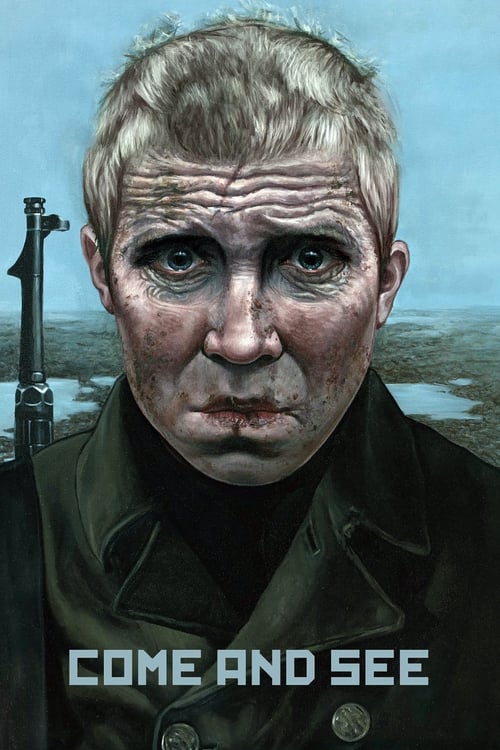
Come and See
1985 · Elem Klimov
For when you're ready to be shaken — a film you choose deliberately, with the evening cleared and nothing planned after. This is the far end of challenge, not comfort, and it's worth it.
What it's about
In Nazi-occupied Belarus in 1943, a village boy named Florya digs up a rifle and joins the partisans against his family's wishes, expecting adventure. What he finds instead, alongside a girl named Glasha, is the systematic destruction of the world he came from, witnessed at close range as the German campaign burns through the countryside. The film stays locked to his face as boyhood is stripped away hour by hour.
The experience
Overwhelming — immersive to the point of hallucination, with stretches that feel like a waking nightmare you can't look away from. It's frequently called the most harrowing war film ever made, and it earns that; it doesn't excite, it devastates.
Performances
Aleksei Kravchenko, a teenager at the time, gives one of cinema's great child performances as Florya — his face visibly ages across the film, and his direct stares into the camera are impossible to shake.
The craft
Klimov shoots with gliding long takes that pin you inside Florya's experience, and a sound design of ringing ears, drones, and distorted noise that puts you in his skull. The imagery swings between documentary rawness and fever-dream surrealism — mud, fog, fire — with faces looking straight down the lens. Big screen and good speakers turn it from powerful to physically overwhelming.
Why it matters
Widely ranked among the supreme achievements of world cinema, it reset the bar for how honestly a film could depict atrocity, and its immersive, subjective approach echoes through decades of later war movies.
Snapshot
A Soviet war film of almost unendurable intensity, Come and See follows Florya, a Belarusian adolescent who joins the partisan resistance in German-occupied Belarus, only to witness the systematic destruction of his world. Directed by Elem Klimov and co-written with Ales Adamovich — himself a former partisan and survivor of the Nazi occupation — the film reconstructs the annihilation of Belarusian villages with an immersive, near-hallucinatory force that places it apart from virtually all other war cinema. Its title is drawn from the Book of Revelation: the repeated cry that opens each of the first four seals and releases the horsemen upon the world. At once documentary in its historical grounding and expressionist in its formal strategies, Come and See is widely regarded as among the supreme achievements of world cinema and as the defining anti-war film in the Soviet canon.
Industry & production
The film's long road to production reflects both the political sensitivity of its subject and the personal intensity of its maker. Elem Klimov had been developing the project for years before cameras rolled, navigating the approval process that governed all productions at Belarusfilm, the Belarusian state film studio through which the film was primarily made. The screenplay, jointly authored by Klimov and Ales Adamovich, drew on two of Adamovich's prose works: The Khatyn Story (1972), a documentary novel fictionalizing the destruction of Belarusian villages, and I Am from the Fiery Village (1977), a testimonial documentary he co-authored with Yanka Bryl and Vladimir Kolesnik, gathering the spoken accounts of survivors of Nazi massacres. Adamovich had himself served as a teenager in the Belarusian partisan movement during the occupation, and his presence as co-writer lent the project an unusual proximity to lived experience.
Principal photography was demanding in the extreme. Filming took place in actual Belarusian landscapes — forests and marshes that mirrored the wartime settings — under conditions designed to generate genuine physiological and psychological stress in the cast. The selection of the young lead, Aleksei Kravchenko — an adolescent with no significant prior acting experience — was deliberate: Klimov sought an authentic face of stunned youth rather than a rehearsed performance. Reports from the production indicate that Klimov employed hypnosis on Kravchenko during some of the film's most harrowing sequences to produce states of shock and dissociation that could not be manufactured through conventional theatrical technique. Real explosions were detonated in close proximity to the cast, and the physical toll of months of shooting left visible traces on Kravchenko's face, contributing materially to the film's uncanny portrait of a boy aging into an old man.
Come and See was released in 1985, timed to the fortieth anniversary of the Soviet victory in the Second World War — a cultural milestone of enormous symbolic weight in the USSR. The occasion lent the film a degree of official sanction that likely helped it navigate a system historically ambivalent about unflinching representations of wartime trauma, especially in a register so far from heroic Soviet war film conventions.
Technology
The film was shot on 35mm by cinematographer Aleksei Rodionov, who brought to the production a willingness to work in conditions antithetical to studio control. Wide-angle and short-focal-length lenses are pressed uncomfortably close to the actors' faces, distorting the visual field at the edges — a formal choice that externalizes Florya's destabilized subjectivity rather than simply documenting events around him.
The sound design is a critical technological dimension. Following an artillery barrage that buries Florya alive and temporarily destroys his hearing, the film's audio shifts into a muffled, tinnitic register — Florya's subjective acoustic world replacing objective diegetic sound. This technique demanded careful attention to the sound mix in post-production and creates a disorientation that functions almost as a physiological assault on the viewer. The film also incorporates pre-existing choral and orchestral works alongside Oleg Yanchenko's original score, requiring a layered approach to the audio architecture that was ambitious within Soviet production contexts of the period.
Technique
Cinematography
Rodionov's cinematography refuses the war film's conventional visual grammar of epic geography and legible tactical action. The camera instead cleaves to Florya's face, tracking his point of view so intimately that the atrocities he witnesses often reach the viewer through his reactions before — or instead of — their direct depiction. Wide-angle lenses pressed within centimeters of Kravchenko's face produce images of almost grotesque emotional exposure: pores, tears, the gradual physiological ruin of a child into something that reads as ancient. The film does not aestheticize destruction; its images of burning and death are raw, often obscured, witnessed from ground level rather than surveyed from a position of overview. In key sequences the camera functions as a damaged consciousness — moving through smoke and chaos with the logic of nightmare rather than reportage.
Editing
The editing, credited to V. Belikova, favors duration over cutting: long takes that refuse to release the viewer from sustained confrontation. The film's most discussed formal gesture is the reverse-motion sequence near its conclusion, in which Florya fires a submachine gun at a reflection of Hitler's portrait in a muddy puddle, and the film then runs backward through archive photographs and newsreel stills tracing Hitler's history — from the war years through the rise of Nazism, back through his adolescence, and finally to a photograph of him as an infant. When the infant image appears, Florya cannot fire. The sequence — achieved through optical reversal of actual documentary materials — is among the most analyzed editorial gestures in cinema: a meditation on causality, the desire to annihilate evil at its origin, and the ethical impossibility of that wish.
Mise-en-scène / staging
Klimov's staging consistently refuses the spatial clarity that classical war films use to orient their audiences. Groups form and dissolve in fog and forest; figures appear and disappear without narrative explanation; the geography of atrocity is never fully mapped. This deliberate spatial ambiguity mirrors Florya's experience of war as a phenomenological catastrophe rather than a set of legible military events. The scene in which the inhabitants of a village are herded into a barn that is then set alight draws directly on the historical massacre at Khatyn on March 22, 1943, when the 118th Schutzmannschaft Battalion and associated Nazi units burned 149 villagers alive, including 75 children. Klimov does not reenact this event with the detachment of a historical chronicle; he places the viewer inside the crowd, in the heat and noise, with no vantage point from which the horror can be safely observed.
Sound
The film's sound design is inseparable from its central formal project. After the sequence that damages Florya's hearing, the film shifts into his subjective acoustic world — a muffled, ringing near-silence that gradually resolves back toward ordinary diegetic sound. This technique anticipates the immersive, physiologically aggressive sound design that would become central to later war cinema. Oleg Yanchenko's score operates contrapuntally throughout: lyrical or sacred music placed against images of burning and mass death creates an ironic dissonance that refuses any consolatory reading of the imagery. Where choral or orchestral works intrude upon scenes of atrocity, the effect is of civilization's forms persisting absurdly alongside civilization's destruction.
Performance
Aleksei Kravchenko's performance as Florya is one of the most demanding and physically consequential in Soviet film history. The role required the actor — who was approximately fourteen or fifteen years old during principal photography — to undergo genuine physical stress across months of shooting. Klimov's documented use of hypnosis on set was intended to access states of shock and dissociation that the young actor could not have reached through theatrical preparation. The result is a performance of documentary authenticity: the face that opens the film as eager and unguarded closes it as something ravaged, the eyes flattened by an exhaustion that registers as geological. Olga Mironova, as Glasha, provides a performance of complementary unreality — her affect tilted toward a feverish, dissociated quality that amplifies the film's sense of consciousness dismantled by catastrophe.
Narrative & dramatic mode
Come and See operates as an inverted Bildungsroman: the traditional arc of a young person discovering the world and growing toward selfhood is reversed into a story of self-dissolution. Florya does not mature; he is destroyed and then somehow compelled to continue. The film's narrative structure follows his movement through a series of escalating revelations — each one stripping away another layer of the world he had known — without providing the cathartic resolution war films typically offer. There is no redemption through sacrifice, no meaningful death, no triumphant survival. The ending's backward-motion sequence suggests that the only "resolution" available is the impossible one: the retroactive annihilation of the cause.
The film's dramatic mode is closer to nightmare logic than to conventional narrative realism. Time dilates; cause and effect grow uncertain; the human figures around Florya appear and disappear with the arbitrariness of dream-characters. This is war experienced as phenomenological rupture, not as historical narrative with a recoverable shape.
Genre & cycle
Come and See belongs formally to the Soviet war film tradition — a genre with deep institutional roots — while violating nearly all of its conventions. The heroic war film, exemplified by The Cranes Are Flying (Kalatozov, 1957) and Ballad of a Soldier (Chukhrai, 1959), typically preserved a redemptive arc: wartime ordeal produced meaning, and sacrifice was legible as a form of historical contribution. Klimov's film refuses this. In this respect it has more in common with the anti-war films emerging from American and European cinema in the late 1970s — Apocalypse Now (Coppola, 1979) foremost among them — though Come and See is considerably more austere and more willing to remain inside extreme experience without the mythological scaffolding Coppola borrowed from Conrad.
The film is also part of a specifically Belarusian cycle of war memory. The Nazi occupation of Belarus, in which approximately one in four of the population perished and hundreds of villages were razed, remained a central trauma in Soviet and post-Soviet cultural identity. Come and See drew on a preexisting tradition of Belarusian documentary prose — Adamovich's testimonial works in particular — and transformed it into the definitive cinematic reckoning with that history.
Authorship & method
Elem Klimov had established himself as a significant Soviet filmmaker before Come and See, with works including Adventures of a Dentist (1965) and Agony (shot in the mid-1970s, suppressed, and released only in 1985 with the advent of glasnost). His career was marked by persistent friction with the Soviet approval apparatus; several projects were delayed or modified under official pressure. The death of his wife, director Larisa Shepitko, in a road accident in 1979 was a shattering personal event; he completed her unfinished project Farewell (1983) as an act of dedication before turning fully to Come and See. In interviews he spoke of feeling that the film had exhausted something fundamental in him. He never completed another feature after it. In 1986, following the film's release, he was elected — in what was understood as a glasnost-era democratic break with Soviet norms — as head of the Soviet Filmmakers Union, a position from which he was instrumental in liberating a range of previously suppressed films and transforming the institutional conditions of Soviet cinema.
Ales Adamovich, co-screenwriter, brought the literary and documentary foundation without which the project could not have been made. His wartime experience as a Belarusian partisan — he was in his early teens during the occupation — and his subsequent decades of testimonial research gave Klimov's project its grounding in specific historical reality and its insistence on the primacy of survivor witness over dramatic convention.
Aleksei Rodionov, as cinematographer, developed an approach to handheld, close-range, wide-angle shooting that was both technically demanding and aesthetically central to the film's achievement. He subsequently worked on international productions across the following decades.
Oleg Yanchenko composed the original score.
Movement / national cinema
Come and See sits at the intersection of Soviet cinema and specifically Belarusian national cinema. Produced through Belarusfilm, it represents the most internationally visible work in the Belarusian cinematic tradition, drawing on the particular memory culture of a region whose wartime civilian losses were proportionally among the worst of any occupied territory in Europe. In the broader Soviet context, it arrived at the moment when glasnost was beginning to transform the space available to filmmakers, and it can be read as a harbinger of that opening — a film that refused consolations the system had previously required, made possible by the very commemorative apparatus that might otherwise have constrained it.
Era / period
Made and released in 1985, Come and See belongs to the late Soviet period, the last years before glasnost and perestroika restructured Soviet cultural life. Released at the moment of maximum institutional attention to the fortieth anniversary of the war's end, it achieved a degree of public legitimacy while remaining formally and emotionally anomalous within Soviet production contexts. It is a product of the Cold War era — the Soviet film apparatus, the commemorative culture around the Great Patriotic War — but its formal strategies and its refusal to offer ideological comfort connect it to an international cinema of the period that was renegotiating the terms on which war could be depicted.
Themes
The film's central concern is the destruction of a self: not heroic death, but the slow annihilation of a consciousness by what it is forced to witness. Loss of innocence is too gentle a formulation; Come and See depicts something closer to the erasure of the self's capacity to exist in a world it can no longer recognize as inhabitable.
The title's Revelation allusion structures the film's theological dimension: the world being witnessed is the world of apocalypse, and Florya is positioned not as hero but as witness to the end — the one commanded to look. The problem of evil — its origins, its continuation, its relationship to ordinary human beings who carry it out — runs through the film from its first frame to its impossible, retrograde conclusion. The reverse-motion finale asks whether evil can be annihilated before it occurs and refuses the answer: the infant Hitler cannot be killed, because killing children is precisely what the film has been documenting as the face of evil itself. The film turns on this paradox without resolving it.
Come and See is also, insistently, a meditation on the cost of continued existence after witnessing catastrophe — a question with obvious resonance in survivor testimony and in the broader cultural problem of how extreme trauma is carried and transmitted.
Reception, canon & influence
Critical reception: Come and See received immediate recognition upon its 1985 release, both within the Soviet Union — where it was seen in the context of anniversary commemorations — and internationally, where it circulated in festival and art cinema contexts. Its reputation has only grown in the decades since; it now appears consistently among the highest-ranked films in international critical surveys, and its status as a definitive anti-war film in world cinema has become something close to consensus. Where the detailed documentary record of its Soviet critical reception is thin, this is partly because Soviet film criticism of the period was itself constrained in ways that made the kind of formal analysis the film demands difficult to publish openly.
Influences on the film (backward): The most direct antecedent within Soviet cinema is Andrei Tarkovsky's Ivan's Childhood (1962), which shares the device of a child protagonist in wartime and a formal reliance on dream-states and sensory disorientation to render the interior experience of war. The broader Soviet wartime humanist tradition — The Cranes Are Flying, Ballad of a Soldier — forms the convention against which Come and See defines itself through refusal. Adamovich's literary documentary prose, with its testimonial method and insistence on the granular specificity of individual suffering, is the film's primary textual source and the model for its ethical stance. The expressionist tradition in European cinema provides a more distant but traceable formal lineage for the close-up distortions and spatial destabilization. Critics have also drawn comparisons to Francisco Goya's Disasters of War etchings as a visual and ethical analog, though this is a critical parallel rather than a documented influence on Klimov.
Legacy (forward): Come and See has exerted a widely acknowledged influence on how extreme violence and atrocity are depicted in cinema. Its formal strategies — the subjective camera pressed against human faces, sensory overwhelm as a narrative mode, the refusal of resolution or ideological comfort — anticipate approaches to war cinema that became common in the 1990s and 2000s. The immersive, physiologically aggressive quality of later war films has frequently been discussed in relation to it, though precise channels of influence are often difficult to document. It has been cited by filmmakers working across different national traditions as a formative encounter, and its specific achievement — forcing the viewer to inhabit a perspective so damaged by what it witnesses that cinematic detachment becomes impossible — has established it as a kind of limit case for what war cinema can demand of its audience. That status has, if anything, grown more secure as the decades have passed and the film has found successive generations of viewers unprepared for what it does to them.
A Deleuzian reading
Look at Florya's face in the last reel and try to find the boy from the opening.
The full Deleuzian reading of Come and See →
Reception
A genuine event in the USSR on release — millions of Soviet viewers and the top prize at the 1985 Moscow film festival — it stayed a critics'-circle secret in the West for decades until the 2020 restoration and Criterion release sent it rocketing up the Letterboxd charts.
How Come and See was received, from release to now →
Influences: the films it descends from and the films it influenced
- The Passion of Joan of Arc (1928) — Dreyer's sustained close-up on a traumatized face with no spatial context — Falconetti's expression alone carrying the entire weight of institutional violence — establishes the formal precedent for Come and See's use of Flyora's aging face as the film's primary temporal and moral instrument, divorced from any orienting geography.
- Night and Fog (1956) — Hanns Eisler's score running contrapuntally against atrocity images, combined with a tracking camera that refuses emotional closure over mass murder sites, establishes the ethical use of musical counterpoint as a mode of witnessing that Klimov's score-against-imagery approach directly inherits.
- The Cranes Are Flying (1957) — Kalatozov's Soviet war-humanist template — mobile Urusevsky camera, lyrical editing, individual sacrifice as transcendent meaning — is the precise formal-ideological convention against which Come and See defines itself through systematic refusal, stripping every element of its redemptive grammar.
- Fires on the Plain (1959) — Ichikawa places the degraded, starving Japanese soldier body in extreme close-up as the irreducible unit of war's cost, refusing heroism by insisting on the individual body's dissolution — prefiguring Klimov's inverted bildungsroman in which the protagonist's face physically ages as the film's structural content rather than its tragic conclusion.
- Ivan's Childhood (1962) — Tarkovsky's use of a child's sensory consciousness as the subjective frame for wartime experience — with dream-states cutting into actuality not as narrative flashback but as shifts in perceptual state — directly establishes the formal mode Come and See inherits and intensifies beyond the point of psychological recovery.
- I Am Cuba (1964) — Sergei Urusevsky's technique of holding ultra-wide-angle lenses close to moving human faces, distorting and elongating features in motion, is the direct technical precursor to Aleksei Rodionov's facial distortion cinematography, which Klimov radicalizes as a physiological register of traumatic damage.
- The Ascent (1977) — Shepitko's Belarusian wartime film — drawn from the same Vasil Bykov literary-documentary tradition as Adamovich's testimony — uses extreme facial close-ups and stark expressionist staging to render moral collapse under Nazi occupation, providing Come and See its closest formal-ethical antecedent within Soviet cinema; Klimov knew this work from inside the marriage.
- Apocalypse Now (1979) — Klimov and editor Valeriya Belkon treated editorial rhythm as a trauma-pacing device—compressing or elongating time according to the protagonist's dissociation—directly extending Murch's model of editing as psychological progression rather than narrative chronology.
- Andrei Rublev (1966) — Klimov inherits Rublev's witnessing mode and available-light technique — pushed here to extreme grain and deliberate tonal distortion — for a Soviet war film in which the protagonist watches atrocity without heroic agency; the German raid sequences use the same controlled visual chaos as Rublev's Tatar attack, registering trauma through the body and face rather than through action.
- Paths of Glory (1957) — Klimov radicalizes Kubrick's lateral trench tracking shot into a sustained follow-shot accompanying a deteriorating protagonist through atrocity — the camera holding eye-level proximity without cutting away, extending a formal device into a sustained method of traumatic witness.
- Throne of Blood (1957) — Klimov fires live ammunition around principal actor Aleksei Kravchenko throughout production, extending Throne of Blood's real-arrows technique — performance-through-actual-physical-jeopardy — from a single climactic moment into a sustained production method for registering extremity.
- Ashes and Diamonds (1958) — Klimov's Eastern European war-film-subversion extends the lost-generation-elegy grammar Wajda established: Aleksei Rodionov's deep-shadow expressionist cinematography inherits the Wójcik chiaroscuro tradition, while the ironic-finale logic—survival that renders the survivor unrecognizable—literalizes Maciek's fatal predicament.
- Saving Private Ryan (1998) — Gary Rydstrom's Omaha Beach sound design — the sudden plunge into muffled tinnitus following explosion, isolating Miller's subjective consciousness from the surrounding battle, then the traumatic return of full diegetic sound — is a direct application of Come and See's subjective tinnitus design, translating Klimov's sensory overwhelm method into Hollywood war spectacle.
- The Thin Red Line (1998) — John Toll's fluid, immersive cinematography and Malick's structural use of Hans Zimmer's score running philosophically against combat imagery inherit Come and See's formal strategy of placing musical and meditative counterpoint in direct tension with the physiological reality of the battlefield, extending the contrapuntal-score device across a full feature's duration.
- Son of Saul (2015) — Nemes's ethical constraint — keeping the protagonist's face in sharp focus while atrocity occupies out-of-focus background — is a direct formal response to Klimov's staging of horror at the edge of subjective perception; both films refuse the viewer the detachment of observational distance by binding vision to a single consciousness that cannot see what surrounds it.
- Beasts of No Nation (2015) — Fukunaga's use of non-professional child lead Abraham Attah and immersive handheld camera to render subjective induction into atrocity, with the inverted bildungsroman staging systematic moral destruction as the film's content rather than its endpoint, is the most direct contemporary heir to Come and See's formal-ethical strategy for the child-soldier subject.
- Dunkirk (2017) — Hans Zimmer's sound design incorporates subjective tinnitus — high-frequency tones and threshold-level oscillation used as physiological trauma markers — while Hoyte van Hoytema's 70mm close-ups pressed against faces during combat borrow the lens-proximity of Rodionov's approach, translating Come and See's sensory overwhelm method into a large-format formal experiment.
- 1917 (2019) — Roger Deakins extends Come and See's subjective tracking-shot-as-consciousness into a formally explicit continuous-take war film; where Klimov achieves physiological identification through editing rhythm and lens proximity, Mendes and Deakins make the unbroken camera movement itself the unit of subjective experience, transforming the mode into a structural conceit.
- Schindler's List (1993) — Klimov and Alexei Rodionov's extreme-wide-angle handheld camera placing the viewer inside wartime atrocity rather than above it — the subjective-witness position that refuses omniscient coverage — is the direct Soviet precursor to Kamiński's mobile camera in the ghetto liquidation; both films use lens distortion and unstable framing as an ethical position, not a stylistic flourish.
- Downfall (2004) — Klimov and Rodionov's strategy of locking the camera to a protagonist's face during extremity — the lens unable to pull back from atrocity, shallow focus trapping the viewer in one consciousness — established the close-camera anti-spectacular grammar that Klausmann extends to a perpetrator perspective.
- Oldboy (2003) — Kravchenko's performance documents bodily and psychological deterioration across the film's runtime — his face aging into trauma as a physical record of suffering — establishing the methodology of treating the actor's body as documentary evidence that Choi Min-sik inherits for his physicalized portrait of fifteen years of captivity.
- Children of Men (2006) — Alexei Rodionov keeps the camera within arm's reach of the protagonist's face as he physically and psychologically deteriorates through wartime atrocity, establishing the ethical grammar of handheld-proximity-as-witness that Lubezki systematically applies to Theo's guided passage through Bexhill.
- The Hurt Locker (2008) — Aleksei Rodionov's handheld immersion in a soldier's physiological experience of shellfire, and the sound design's use of post-explosion tinnitus and muffled hearing as sustained subjective point-of-view, is the direct template for The Hurt Locker's post-detonation silence sequences — treating the blast's auditory aftermath as drama rather than cutting away from it.
- All Quiet on the Western Front (2022) — Aleksei Kravchenko's performance of progressive physical and psychological depletion — rendered entirely through behavior, without voiceover or conventional emoting, the face aging visibly across a single shoot — is the direct formal model for Felix Kammerer's somatic deterioration; Berger's behaviorist no-voiceover approach descends directly from Klimov's decision to make the body the film's argument.
- Full Metal Jacket (1987) — Kubrick's contrapuntal score strategy — placing period pop songs against combat footage in direct ironic tension — echoes Come and See's use of formal counterpoint between score and atrocity, while his casting of non-professional Vincent D'Onofrio against professional actors mirrors Klimov's performance-texture strategy of placing a raw non-professional lead inside trained ensemble work.
- Grave of the Fireflies (1988) — Takahata's structural deployment of the inverted bildungsroman — wartime child experience staged as systematic physical and moral deterioration rather than growth — mirrors Come and See's formal-ethical inversion exactly, with Setsuko's body as temporal instrument in precisely the way Flyora's aged face measures the film's catastrophe.
- Au revoir les enfants (1987) — Malle casts non-professional Gaspard Manesse for reactive authenticity rather than trained expression and uses the child's face as the register of incomprehensible Nazi violence; the gap between what the boy's face can show and what the adult viewer must infer is the film's ethical mechanism, applying Come and See's non-professional-lead strategy at a restrained register.
- Ran (1985) — Released in the same year, Klimov's film formally denaturalizes cinematic violence through non-naturalistic sound design — alternating deafening assault with sudden silence — working the identical problem as Ran's diegetic-silence battle through opposite means; both films propose that atrocity requires sonic defamiliarization from conventional action-film sound design to register as morally real.
- Letters from Iwo Jima (2006) — Builds combat trauma through subjective enclosed sound — muffled, ringing, interiorized — the perceptual technique Letters uses to lock us inside one frightened soldier's head.
- Dead Man's Letters (1986) — A contemporaneous Soviet apocalypse rendered through bleached, trauma-frozen faces (Aleksei Kravchenko) and a saturated ringing/murmuring sound field — the same fusion of degraded image and overwhelming aural dread.
- Empire of the Sun (1987) — Uses immersive subjective sound design and a child's face as the film's atrocity barometer, the same strategy of measuring history through one young consciousness.
- Threads (1985) — Deploys a non-professional adolescent lead and unrelenting subjective degradation toward an anti-cathartic war climax, refusing redemption in the same year and register as Threads' hollowed-out survivor.
- Casualties of War (1989) — Fixes the camera on the face of an innocent forced to witness wartime atrocity, making powerless spectatorship the subject — the same cinema of complicit looking Casualties pursues in a Western key.
- A Visitor to a Museum (1989) — Shares the late-Soviet mode of the ravaged, near-hallucinatory landscape traversed by a witness, with the human face degraded in real time — apocalypse rendered as immersive sensory ordeal rather than plot.
- The Nightingale (2018) — ancestor — first-person immersion in historical atrocity that refuses to make horror thrilling, the ethics-of-witness approach behind Kent's insistence that violence be ugly and non-gratuitous.
- Repentance (1987) — Holds frontal faces addressing the lens far past comfort and engineers sound as physical assault; Klimov's parallel late-Soviet experiment in confronting the audience directly, made by the man whose Union reforms unshelved Repentance.
Similar films
- Ivan's Childhood (1962) — influence & lineage · often watched together
- The Cranes Are Flying (1957) — influence & lineage · often watched together
- The Ascent (1977) — influence & lineage · often watched together
- Au Revoir les Enfants (1987) — influence & lineage
- Son of Saul (2015) — influence & lineage
- Stalker (1979) — often watched together
- The Passion of Joan of Arc (1928) — influence & lineage · often watched together
- Saving Private Ryan (1998) — influence & lineage · often watched together
All the films related to Come and See →
Watch it with: curated runs of related films
- Into the Heart of Darkness — A run of grueling journeys into hostile country — jungle, ice, desert, occupied forest — where the ordeal strips men down to something primal, hallucinatory, and often unrecoverable.
Film essays and courses that include it
- The Art of the Assault: How Cinema Stages War
- What the Ear Sees: A Century of Cinematic Sound
- The Camera at War: A Century of Reinvention
- The Unbroken Take: From Camera Liberation to Single-Shot Cinema
- Dialectics of the Soul: Russian Cinema from Eisenstein to Zvyagintsev
- No Comfort: Cinema's Grammar of Despair
- Witness: Cinema's Century of War and Its Wound
- Men Under Orders: Cinema's Century at War
- Unfinished Creatures: Cinema's Invention of Growing Up
- The Ones Who Stay to Watch: A Course in the Cinema of the Seer
- Come and See: Nine Films About Watching a War
- The Interior Eye: Cinema's Search for Lives Felt From Within
- Into the Skin: Cinema's Greatest Performances of Total Commitment
- The Genre at War With Itself