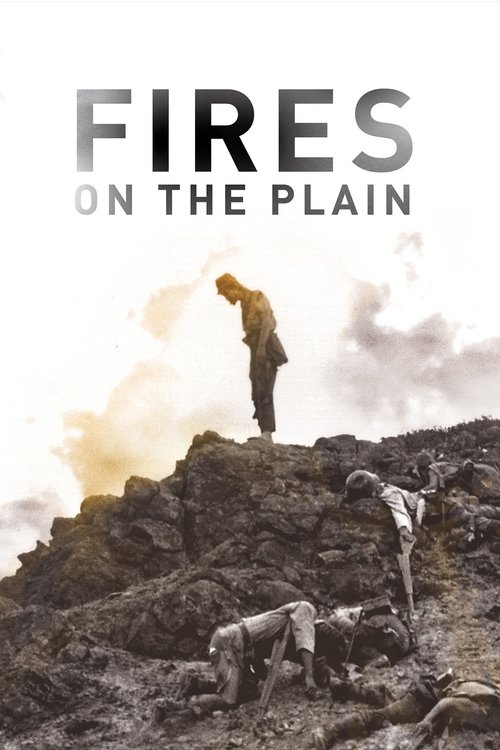
Fires on the Plain
1959 · Kon Ichikawa
When you want the war film with the gloves fully off — no heroism, no mission, no uplift, just survival and its costs. Strictly a challenge; reach for it when you're ready to be shaken and want to see how far cinema can go.
What it's about
Leyte, the Philippines, early 1945: the Japanese army is disintegrating, and Private Tamura — sick with tuberculosis, useless to his unit — is turned away by both his company and the field hospital. He wanders the ravaged island among other stranded, starving soldiers, each ordered vaguely toward an evacuation point that may not exist, while mysterious fires burn on the horizon. What's left when an army stops being an army is the film's whole subject: hunger, and how far men will go to answer it.
The experience
Stark, harrowing, and utterly unsentimental — a death march rendered in beautiful black and white, punctuated by moments of grotesque, almost absurdist humor that make the horror land harder. It's not gory by modern standards but it goes to darker places than almost any war film. You come out hollowed.
Performances
Eiji Funakoshi's Tamura anchors the film — a gaunt, sunken-eyed performance of a man reduced to pure endurance, his flickers of remaining conscience registering in a face that seems to be disappearing before your eyes.
The craft
Ichikawa shoots the Philippine landscape in widescreen black and white as a vast, indifferent expanse across which tiny figures stagger — the compositions are ravishing, which makes what happens in them more terrible. Adapted from Shōhei Ōoka's acclaimed novel, it strips away plot momentum itself, replacing it with a procession of encounters that escalate toward the war's ultimate taboo. Big screen if you can; the scale is part of the argument.
Why it matters
One of the most uncompromising anti-war films ever made — the bitter companion to Ichikawa's more consoling The Burmese Harp — and a touchstone for every later film that depicts war as pure degradation rather than drama.
Snapshot
Fires on the Plain (Nobi, 野火) is Kon Ichikawa's harrowing reckoning with the Pacific War's final collapse — a film that follows one tubercular private, Tamura, as he is expelled from his own disintegrating army and left to wander the ravaged interior of Leyte in the Philippines in early 1945. Adapted from Shōhei Ōoka's acclaimed 1951 novel, the picture strips the war film of heroism, ideology, and even coherent narrative momentum, replacing them with a procession of starvation, decay, and moral extinction that culminates in the film's central taboo: cannibalism among stranded Japanese soldiers. Released by Daiei three years after Ichikawa's more elegiac The Burmese Harp (1956), Fires on the Plain is its bitter, unconsoled companion — where the earlier film sought spiritual redemption in the war's wreckage, this one finds only the body reduced to meat. It is now widely regarded as one of the most uncompromising anti-war films ever made and a cornerstone of postwar Japanese cinema.
Industry & production
The film was produced by Daiei, one of the major studios of Japan's postwar production system, for whom Ichikawa worked as a contract director through much of the 1950s. This was the mature studio era: Daiei, under Masaichi Nagata, had cultivated an internationally prestigious profile earlier in the decade (Kurosawa's Rashomon, 1950, and Mizoguchi's late masterworks were Daiei productions), and it was accustomed to backing serious literary adaptations aimed at both domestic audiences and the growing festival circuit abroad.
Fires on the Plain fits that pattern: a prestige adaptation of a celebrated, difficult novel, shot in black-and-white at a moment when color and widescreen were increasingly the commercial norm. The choice of monochrome was almost certainly aesthetic rather than merely economic, suiting the film's ashen, documentary starkness. The production is generally understood to have been shot in Japan rather than on location in the Philippines, with landscapes standing in for Leyte — a point worth flagging as the kind of production detail where popular accounts sometimes outrun the documented record, so I state it with appropriate caution. What is firmly established is that the film emerged from a tightly knit creative unit that Ichikawa had assembled by the late 1950s and would carry into his subsequent work.
Technology
Technologically the film is deliberately austere. It was made in standard black-and-white on 35mm within the conventions of late-1950s studio filmmaking, eschewing the anamorphic widescreen and Eastmancolor that Daiei and its rivals were pushing commercially. (Ichikawa himself was an enthusiastic adopter of widescreen in other projects, which makes the plainer format here read as a considered choice.) The absence of technological spectacle is itself the point: there are no elaborate optical effects, no lush processing, nothing to soften the image. The camera and lighting are used to render exhaustion, dysentery, mud, and rain with an almost tactile immediacy, and the film's power derives from restraint rather than from any novel apparatus. Where many war pictures of the era leaned on pyrotechnic battle staging, Fires on the Plain largely withholds combat as spectacle, keeping its technical resources trained on the human body in extremis.
Technique
Cinematography
The cinematography is credited to Setsuo Kobayashi, one of Ichikawa's key collaborators of the period, and it is central to the film's reputation. The images are high-contrast and unsparing: bleached skies over open plains, skeletal figures reduced to silhouettes, the recurring motif of distant fires smoking on the horizon that gives the film its title and its uneasy sense of watching, unreachable civilization. Kobayashi's framing repeatedly isolates Tamura against emptiness — a lone soldier in a vast, indifferent landscape — while close work registers the physical ruin of the men in grain, sweat, and shadow. The camera's coolness is essential to the film's ethics: it neither aestheticizes the horror into beauty nor flinches from it, holding a documentary detachment that makes the atrocities land harder than any sentimental treatment could.
Editing
Ichikawa began his career with a strong grounding in the craftsmanlike side of filmmaking and was known throughout his career for a keen sense of rhythm and cutting; his films characteristically move in clean, decisive strokes. In Fires on the Plain the editing enforces the narrative's fragmentation — the picaresque structure of a man wandering from encounter to encounter is rendered as a series of discrete, often abrupt episodes, mirroring Tamura's failing grip on continuity and reason. Shock cuts and elisions are used to withhold and then suddenly disclose horror (a body, a wound, an act of consumption), so that the viewer, like Tamura, is repeatedly ambushed by what the war has produced. I note that specific below-the-line editing credits for the film are not something I can attribute with confidence, so I describe the cutting's effect rather than assign authorship beyond Ichikawa's controlling sensibility.
Mise-en-scène / staging
The staging is organized around dissolution. Uniforms rot, boots are traded and stolen, rank collapses into a brute economy of survival in which a handful of grains or a pair of shoes becomes a matter of life and death. Ichikawa composes tableaux of soldiers strewn across roads and fields like refuse, and stages the film's group scenes to emphasize the erosion of the military order into a scavenging horde. The recurring image of the plains — open, exposed, offering neither cover nor refuge — turns landscape into a moral condition. Religious iconography punctuates the mise-en-scène (a ruined church, a cross, the freighted encounter with Filipino villagers), gesturing toward the Christian and existential questions that run through Ōoka's source without ever resolving them into consolation.
Sound
The score is by Yasushi Akutagawa, a composer Ichikawa worked with more than once, and it is used sparingly. Rather than swelling to underline pathos, the film often lets ambient emptiness — wind, rain, silence — carry the sense of desolation, so that music, when it enters, registers as intrusion or irony rather than reassurance. The restraint of the sound design is of a piece with the film's refusal of catharsis; there is little of the martial or the mournful uplift that conventionally frames screen death. The sonic world is one of depletion, matching the visual one.
Performance
Eiji Funakoshi's performance as Private Tamura anchors the film. He plays the soldier as a man being hollowed out in real time — physically wasting, his moral resistance fraying encounter by encounter until only a flickering, half-mad refusal remains. It is widely recounted that Funakoshi committed to a punishing physical transformation for the role, and whatever the precise details, the emaciated, spectral quality he brings to Tamura is inseparable from the film's impact. The supporting performances — the scavengers, the deserters, the men who introduce Tamura to "monkey meat" — are pitched toward a grim naturalism, presenting degradation without melodrama. The ensemble collectively conveys the film's thesis: that under sufficient conditions, the human is legible as an animal, and finally as food.
Narrative & dramatic mode
Dramatically the film is picaresque and episodic rather than plotted toward a goal. Tamura is turned away first by his company (his tuberculosis makes him a useless mouth) and then by the field hospital, and thereafter drifts through a series of encounters that function less as a rising action than as descending circles. The mode is closer to ordeal and allegory than to conventional war drama: there is no mission, no strategic stakes, no arc of triumph or even meaningful defeat, only the question of whether Tamura will eat, be eaten, or hold onto some last shred of the human. The novel's interiority — Ōoka wrote in a searching, philosophical first person — is largely externalized into behavior and image by the adaptation, so that the film dramatizes moral collapse through action rather than confession. The result is a narrative of attrition, in which meaning is generated by accumulation and by the escalating pressure of the central taboo.
Genre & cycle
Fires on the Plain belongs to the postwar Japanese anti-war film, a body of work through which the nation's cinema reckoned with defeat, complicity, and suffering. Within Ichikawa's own output it forms a diptych with The Burmese Harp, and the pairing defines the cycle's range: the earlier film's Buddhist-inflected humanism and possibility of redemption set against this film's near-total negation. More broadly it sits alongside the era's other great cinematic confrontations with the war and its aftermath — Kobayashi's The Human Condition trilogy (1959–61) is a frequent point of comparison as a contemporaneous, epic-scale indictment of militarism. Where much of the international war-film genre of the period still traded in heroism or tragic nobility, Fires on the Plain is an anti-war film in the strongest sense: it strips war of any redeeming frame and presents it as an engine of dehumanization, aligning it with the bleakest tradition of the genre.
Authorship & method
The film is a signal instance of Ichikawa's method as a studio auteur working through a stable creative partnership. Central to that method was his collaboration with the screenwriter Natto Wada — Ichikawa's wife — who adapted Ōoka's novel and who shaped many of his finest films of the 1950s and early '60s. Wada's screenplay is generally understood to have pared back the source's dense religious and philosophical interiority, translating Ōoka's introspection into a leaner, more concrete and behavioral structure suited to the screen; the film's externalized starkness owes much to that adaptive strategy. Ichikawa, trained partly in the graphic and craft side of filmmaking and celebrated for his visual precision and range, brought the material a controlling formal rigor — the high-contrast compositions, the clean and often shocking cutting, the refusal of sentiment. The key collaborators complete the picture: cinematographer Setsuo Kobayashi, composer Yasushi Akutagawa, and the source author Shōhei Ōoka, himself a former soldier and prisoner of war in the Philippines, whose lived experience grounds the film's authority. Ichikawa's authorship here is often characterized as chameleonic — he moved fluently between comedy, literary adaptation, and social critique — but Fires on the Plain is frequently cited as evidence of his capacity for the severe and the unflinching.
Movement / national cinema
The film stands within Japanese national cinema at a pivotal juncture. It was made inside the established studio system that had produced the international breakthroughs of Kurosawa, Mizoguchi, and Ozu, yet its bleakness and formal severity anticipate the darker, more confrontational sensibility that would flower in the Japanese New Wave of the 1960s. Ichikawa is not usually classed as a New Wave director — he was a studio professional of an older cohort — but Fires on the Plain's willingness to stare at atrocity and its refusal of consolation put it in conversation with the decade's coming rupture. As a work of national self-examination, it belongs to the broader postwar current in which Japanese artists across media confronted the war's meaning and the culpability of the militarist state, using the individual soldier's suffering as a lens on collective catastrophe.
Era / period
Made in 1959, the film arrives near the close of what is often called the second golden age of Japanese cinema and roughly fourteen years after the war it depicts — close enough that the events were living memory for its makers and audience, far enough that they could be examined with a measure of cold clarity. Its diegetic period is precisely fixed: the final weeks of the Pacific War in early 1945, as the Japanese position in the Philippines collapsed into rout. That collapse — armies without supply lines, chains of command dissolving, soldiers left to fend for themselves — is the historical substrate the film dramatizes, and Ōoka's own service and captivity anchor it in documented experience. The film thus speaks from and about two moments at once: the wartime nadir of 1945 and the reckoning conscience of the late 1950s.
Themes
The film's governing theme is dehumanization — the systematic reduction of men, by war and hunger, from moral agents to scavenging bodies and finally to potential food. Cannibalism is its central, unbearable figure: the euphemism of "monkey meat" marks the exact point at which the human refuses to name what it has become. Against this runs a strain of faith and its failure — the recurrent Christian imagery, the ruined church, the possibility and impossibility of grace — inherited from Ōoka's existential Catholicism and left deliberately unresolved. Related themes braid through: the collapse of the social and military order into a brute survival economy; the body as the war's true battleground, wasted by disease and starvation; and the persistence, in Tamura, of some last ethical refusal that may be madness, sanctity, or merely the final reflex of the human. Underlying all of it is a total anti-war conviction: the film locates the war's horror not in battle but in what battle's aftermath does to the soul.
Reception, canon & influence
Fires on the Plain was recognized early as a major and disturbing work; it is generally cited as having been honored on the international festival circuit, including a prize at the Locarno Film Festival (commonly reported as the Golden Sail, awarded in 1961), and I flag the specific award as the kind of detail worth verifying against a primary source rather than stating as settled. Critically, the film's uncompromising bleakness has been both its challenge and its claim to greatness: some contemporaries found its horrors nearly unwatchable, while its reputation has steadily risen to the status of a canonical anti-war film and one of Ichikawa's defining achievements, frequently paired with The Burmese Harp in assessments of his career.
Its influences run backward to Ōoka's 1951 novel and, through it, to the author's own wartime captivity and to a European existentialist and Christian literary sensibility, as well as to the broader postwar Japanese impulse to confront defeat honestly. Wada's adaptation is the crucial mediating force, converting that literary material into cinema. Looking forward, the film helped establish the template for the truly pitiless anti-war film — war shown as degradation rather than tragedy or adventure — and it stands as an ancestor to later cinema that treats the WWII Pacific theater and its atrocities without redemption. Its most direct legacy is Shinya Tsukamoto's 2014 remake, also titled Fires on the Plain, which returned to Ōoka's novel and Ichikawa's precedent with an even more visceral, low-budget intensity — an explicit act of homage that testifies to the enduring force of the 1959 original. More diffusely, the film remains a touchstone whenever critics reach for the cinema of ultimate human extremity, its images of soldiers wandering an indifferent plain toward the taboo standing among the most severe indictments of war the medium has produced.
Reception
Japanese critics in 1959 recoiled at its unrelenting grimness — this was war stripped of every consoling note — but it found festival acclaim abroad and has since been canonized as one of the greatest anti-war films ever made, cemented by a Criterion release.
How Fires on the Plain was received, from release to now →
Influences: the films it descends from and the films it influenced
- The Burmese Harp (1956) — The first panel of the Ichikawa/Wada Pacific diptych, it established the wandering-defeated-soldier picaresque and Wada's strategy of externalizing dense literary interiority into concrete behavioral incident — a redemptive template Fires deliberately inverts into damnation.
- Diary of a Country Priest (1951) — Model for Wada's adaptive method of stripping a religious-literary source to an austere behavioral surface, letting faith's collapse register through the suffering body and near-silent sound design rather than voiced interior monologue.
- Paisà (1946) — Neorealist episodic construction and documentary-detached, location-shot observation of war-degraded bodies — the unheroic reportage register Ichikawa adopts for soldiers wandering an indifferent plain.
- Bicycle Thieves (1948) — Picaresque of a man reduced to a single survival need, shot with detached observational realism — the template for episodic descent through an unsentimental landscape without dramatic scoring to guide response.
- Battleship Potemkin (1925) — Source of the shock-cut disclosure Ichikawa wields — montage collision that ambushes the viewer with abrupt violence rather than building suspense toward it.
- Night and Fog (1956) — Precedent for confronting atrocity through cool documentary detachment and sparse ambient scoring, presenting the unwatchable while withholding catharsis.
- Fires on the Plain (2014) — Explicit low-budget remake returning to Ōoka and Ichikawa's precedent, intensifying the shock-cut cannibalism disclosure into visceral, first-person body-horror.
- Come and See (1985) — Extends the episodic-ordeal allegory and physical-transformation performance — a boy's face aged by atrocity — into subjective sensory dehumanization of the wandering soldier.
- Grave of the Fireflies (1988) — Carries forward the unredemptive Japanese war film of slow starvation and bodily wasting, refusing tragic or heroic consolation for defeat.
- Son of Saul (2015) — Immersive close-follow on a man navigating atrocity and the taboo of the dead — heir to the documentary-detached structure of ordeal-through-hell.
- Apocalypse Now (1979) — Episodic journey deepening into war's moral dissolution and culminating in cannibalistic/sacrificial taboo — the ordeal-allegory recast as descent.
- Black Rain (1989) — Returns to austere high-contrast monochrome to render the atomic aftermath with documentary detachment and unflinching attention to bodily deterioration.
- Letters from Iwo Jima (2006) — Renders a doomed, starving Japanese garrison stripped to bare physical survival, the degradation-of-the-trapped-soldier register Letters adopts in its cave and retreat sequences.
- Shame (1968) — Strips war of ideology and spectacle to depict soldiers reduced to appetite and shame in stark monochrome, prefiguring Shame's insistence on degradation over combat.
- The Human Condition III: A Soldier's Prayer (1961) — Establishes the antiwar grammar Kobayashi extends — high-contrast monochrome reducing the lone soldier to a black figure crawling across a scorched Philippine landscape, conveying war's horror through the starving body's degradation rather than through battle spectacle.
- Barefoot Gen (1983) — Its unflinching rendering of wartime bodily degradation — starvation, decay, the human reduced to flesh — licenses Gen's directness in depicting melting and burned bodies without euphemism.
- Merry Christmas, Mr. Lawrence (1983) — Models the Japanese-made indictment of the Imperial Army from inside the ranks, filming the disciplined body's degradation in unlovely medium shots that refuse both heroism and pity — the refusal of psychological consolation Ōshima extends to Yonoi's men.
- The Human Condition (1959) — Contemporary Second-Golden-Age epic using high-contrast monochrome and the progressive dissolution of military order to chart a decent man's forced moral degradation.
- The Naked Island (1960) — Near-wordless austerity built on sparse ambient sound and documentary observation of elemental bodily labor — the same reduction of human life to survival ordeal.
- Onibaba (1964) — High-contrast black-and-white of figures dwarfed by a barren plain (susuki grass echoing Ichikawa's field), survival stripped to animal need and taboo.
- The Human Condition I: No Greater Love (1959) — Same-moment anti-war epic rendering a soldier's moral and physical degradation in stark high-contrast monochrome, sharing Kobayashi's refusal to console the viewer.
- The Human Condition II: Road to Eternity (1959) — Released the same year, it locates its anti-war argument in the starving soldier's bodily and moral degradation, rendered in stark high-contrast monochrome — the exact cost-of-survival thesis and tonal palette Kobayashi's second film shares.
Similar films
- The Burmese Harp (1956) — influence & lineage · same viewing thread
- Grave of the Fireflies (1988) — influence & lineage
- Onibaba (1964) — influence & lineage
- Letters from Iwo Jima (2006) — same viewing thread
- The Human Condition III: A Soldier's Prayer (1961) — same viewing thread
- The Human Condition II: Road to Eternity (1959) — same viewing thread
- The Emperor's Naked Army Marches On (1987) — same viewing thread
- The Human Condition I: No Greater Love (1959) — same viewing thread
All the films related to Fires on the Plain →
Watch it with: curated runs of related films
- Japan's Long Reckoning With War — Watch these when you want Japanese cinema turning its unflinching gaze on its own war — the conscript's conscience, the retreat, the survivor who won't let the officers forget — each film picking up the moral wreckage the last one left.