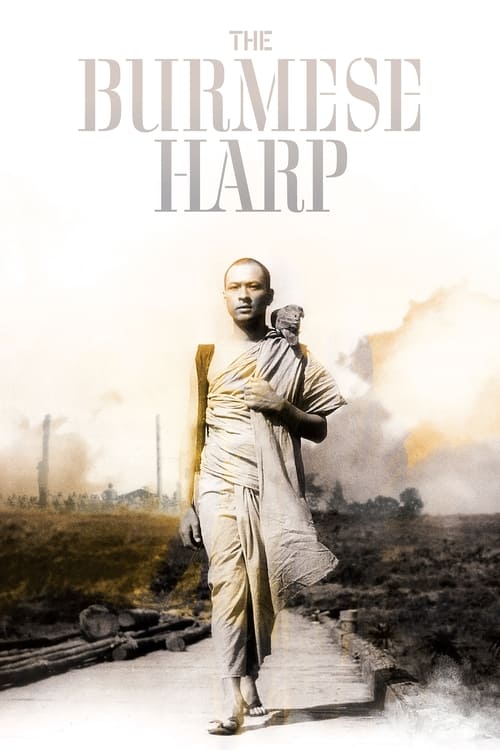
The Burmese Harp
1956 · Kon Ichikawa
For a quiet, reflective night when you want a film about conscience — something humane and sad that leaves you still rather than shaken. One of the gentlest great war films ever made; a good cry is likely.
What it's about
Burma, the final days of the Second World War. A Japanese company survives its retreat partly by singing together, accompanied by Private Mizushima on a Burmese harp. When the surrender comes, Mizushima is sent on a mission to a holdout garrison and becomes separated from his unit — and to survive, disguises himself as a Buddhist monk. What he sees on the road back changes the question of the film from how to get home to what a man owes the dead.
The experience
Serene on its surface and shattering underneath — music, landscape, and long silences carrying a grief the characters can barely speak. It's contemplative rather than grim, and it builds to an emotional force that sneaks up on you completely.
The craft
Ichikawa composes the Burmese plains and ruined temples in luminous black and white, and makes song itself the film's structure — choruses passing between enemies, a harp answering where words fail. The sound of massed voices in the middle of a war is the film's signature effect, and it lands hardest with the volume up.
Why it matters
One of the founding anti-war statements of postwar Japanese cinema and Ichikawa's international breakthrough, nominated for the first-ever foreign-language Oscar — its vision of atonement after national catastrophe has echoed through war films ever since.
Snapshot
The Burmese Harp (Biruma no tategoto) is Kon Ichikawa's first internationally celebrated film and one of the enduring anti-war statements of postwar Japanese cinema. Adapted from Michio Takeyama's popular novel, it follows Private Mizushima, a soldier in a Japanese company stationed in Burma in the closing days of the Second World War. The company, led by a music-loving captain, survives partly by singing together; Mizushima accompanies them on a Burmese harp. After the surrender, Mizushima is sent to persuade a holdout garrison to lay down arms; they refuse and are annihilated. Presumed dead, he survives, disguises himself as a Buddhist monk to make his way back, and along the road is so shattered by the sight of unburied Japanese corpses that he resolves to remain in Burma as a monk to bury the dead rather than return home. The film fuses a realist war-survival narrative with a parable of spiritual conversion, and its central image — a soldier who trades his uniform for saffron robes — became one of the touchstones of humanist filmmaking in the 1950s. It marked Ichikawa's arrival on the world stage and remains, alongside his later Fires on the Plain, one of the two poles of his reckoning with Japan's war.
Industry & production
The film was produced by Nikkatsu, the venerable studio that had relaunched its own production arm earlier in the decade, and it belongs to the fertile mid-1950s moment when Japanese cinema was consolidating both a robust domestic studio system and a new international profile in the wake of Rashomon's success at Venice in 1951. Ichikawa was by this point an experienced studio craftsman who had moved among companies, and The Burmese Harp was mounted as a serious literary adaptation of a well-known and morally weighty source. In its original Japanese release the film appeared in two parts in early 1956, a distribution pattern reflecting its length and the prestige attached to the material; it was subsequently shortened for international circulation, and the version most widely seen abroad runs somewhat tighter than the domestic release. Reliable, itemized production figures — budget and box-office returns — are not well documented in the English-language record, and I will not invent them.
The most frequently discussed production constraint concerns location. Although the film is set entirely in Burma, the record indicates that the bulk of shooting was carried out in Japan, with the landscape made to stand in for Southeast Asia; the degree of any actual on-location Burmese footage is not something I can state with confidence, so I flag it rather than assert a clean answer. What is clear is that Ichikawa and his collaborators built a convincing sense of place largely through selection of terrain, art direction, and the framing of figures against sky and earth rather than through documentary location authenticity.
Technology
The film was shot in black-and-white on standard 35mm in the Academy ratio, consistent with mainstream Japanese studio practice of the mid-1950s, before the widespread adoption of anamorphic widescreen formats in the country. There is nothing technologically experimental about the apparatus; the film's power comes from disciplined use of conventional tools. Monochrome is essential to its effect — the tonal register of white sky, dark earth, and the pale robes and shaven head of the monk carries much of the film's meaning, and the absence of color abstracts the Burmese setting into something closer to parable. Ichikawa, who would become one of the most adventurous Japanese directors in his handling of the widescreen frame and of color later in the decade, here works within the classical constraints of the format with great precision.
Technique
Cinematography
The cinematography, credited to Minoru Yokoyama, favors clean, legible compositions that isolate the human figure within landscape. The film's recurring visual idea is the small figure — a soldier, a monk — set against expanses of sky, hillside, and open ground, an arrangement that renders the individual both dignified and terribly exposed. Yokoyama's monochrome photography is high in contrast where the drama demands it (the massacre of the holdout garrison, the fields of the dead) and softer, more lyrical in the passages built around music and camaraderie. The imaging of Mizushima's transformation — the shaven head, the robes, the harp — depends on the camera's patient attention to a single body moving through a devastated world, and the film repeatedly stages the recognition of that figure by his former comrades as a matter of looking and mis-seeing.
Editing
Ichikawa was known throughout his career for the rhythmic precision of his cutting, and The Burmese Harp is edited to modulate between two tempos: the collective, almost musical rhythm of the singing company, and the slower, more contemplative pace of Mizushima's solitary pilgrimage. The film's structure hinges on withheld and delayed recognition — the company's growing suspicion that the monk they keep glimpsing is their lost comrade — and the editing sustains this suspense across the second half. The specific editor of record is not something I can name with certainty from the reliable sources at hand, so I note that rather than guess.
Mise-en-scène / staging
Staging is central to the film's meaning. The company is repeatedly composed as a group — singing, marching, working — while Mizushima is progressively separated out and reframed as a solitary. The costuming carries enormous weight: the shift from the uniform of the imperial army to the robes of a Theravada monk is the film's governing visual transformation, and the props — above all the harp itself, and later the parrot — function as bearers of identity and message across the gulf that opens between Mizushima and his unit. The fields strewn with the Japanese dead, and the acts of burial that follow, are staged with a gravity that turns landscape into a moral space.
Sound
Music is not decoration here but the film's organizing principle. The company sings to keep its spirit and even, in one celebrated conceit, to communicate and to defuse danger; the Japanese song known in English as "Home Sweet Home" ("Hanyū no Yado") recurs as a motif of longing for the homeland. The Burmese harp — an arched harp — is both Mizushima's instrument and the emblem of his passage from soldier to something else, and the diegetic music of voices and strings is woven against the orchestral score. The score is credited to Akira Ifukube, the composer best known internationally for the Godzilla films, whose work here serves the film's elegiac and spiritual register rather than spectacle.
Performance
The performances are pitched toward restraint and sincerity. Shōji Yasui plays Mizushima, and the role demands a largely internal transformation registered through face, posture, and the eventual refusal to speak or reveal himself to his comrades; the character's arc from soldier to monk is conveyed less through dialogue than through bearing. Rentarō Mikuni plays the captain who leads the company through song, giving the group scenes their warmth and cohesion. The ensemble of the company functions almost as a single character — the choral body against which Mizushima's individuation is measured.
Narrative & dramatic mode
The film operates in a double mode: it is at once a realist account of a defeated army's last days and a spiritual parable of conscience and renunciation. Its dramatic engine is a moral question rather than a plot mechanism — what does one owe the dead, and can an individual redeem, through a private vocation, a collective catastrophe? The narrative is structured around separation and the failure (or refusal) of reunion: the company wants Mizushima back; he chooses instead to stay among the dead. The famous devices of the late film — the parrot trained to speak, and the letter in which Mizushima at last explains himself — are the means by which his decision is finally communicated across the distance he has deliberately created. The mode is fundamentally humanist and elegiac, and the film risks, and largely earns, an overtly sentimental and religious register that Ichikawa would later invert entirely.
Genre & cycle
The Burmese Harp is a war film and an anti-war film, but it belongs less to the combat genre than to a postwar cycle of Japanese films reckoning with defeat, guilt, and the fate of the ordinary soldier. It stands as the humanist, redemptive pole of that reckoning. Ichikawa himself supplied the opposite pole three years later with Fires on the Plain (1959), a harrowing, nihilistic depiction of starvation and dehumanization among Japanese soldiers in the Philippines; the two films are almost always discussed together as complementary and contradictory war statements from the same director. Within the broader international context, the film sits alongside the wave of 1950s world cinema that used the recent war as a subject for moral inquiry.
Authorship & method
The film is a signal work of the collaboration between Ichikawa and the screenwriter Natto Wada, his wife, who wrote or co-wrote the scripts for most of his major films of this period; the adaptation of Takeyama's novel into a taut moral drama is central to the film's achievement and to understanding Ichikawa's authorship, which was always deeply bound up with Wada's writing. Ichikawa had come to feature direction after early work that included animation, and he was celebrated for his versatility across genres and tones and for his graphic sense of composition and cutting. Here the key collaborators form a recognizable constellation: Wada on the screenplay, Minoru Yokoyama on the black-and-white photography, and Akira Ifukube on the score. The film demonstrates Ichikawa's capacity for controlled sentiment and spiritual seriousness — a register he would deliberately abandon in the corrosive irony of much of his later work, which makes The Burmese Harp a revealing early statement of range rather than a template he repeated.
Movement / national cinema
The film belongs to the golden age of Japanese cinema in the 1950s, the decade that carried Kurosawa, Mizoguchi, Ozu, Naruse, and Ichikawa to international prominence. It is not a manifesto film of any single movement but a product of the mature studio system at its creative height, and it participated in the second wave of Japanese films to reach Western festivals and art houses after Rashomon opened that door. As national cinema, it is inseparable from Japan's postwar processing of the war: the choice to tell the story from the vantage of a defeated, occupied army, and to frame redemption in explicitly Buddhist terms, situates it firmly within a Japanese idiom of mourning and atonement even as its humanism spoke to audiences abroad.
Era / period
Made barely a decade after the surrender, the film is a work of the immediate postwar era addressing the very recent past; its source novel had been published soon after the war, and the wounds it treats were fresh for its first audiences. The mid-1950s setting of its production — a Japan rebuilding, newly re-entering international cultural life, and still negotiating the memory of empire and defeat — is legible throughout. The film's spiritual consolation should be read partly as a response to that specific moment's need to make sense of enormous loss, which is also why its later, harsher counterpart, Fires on the Plain, reads as a deliberate refusal of the earlier film's comfort.
Themes
The film's central themes are the obligation of the living to the dead, the possibility of individual atonement for collective violence, and the tension between the pull of home and the claims of conscience. Music functions as a theme in its own right — as the medium of human fellowship, of communication across enmity, and of the soul's expression. Renunciation is the film's culminating idea: Mizushima's decision to remain and bury the dead is a withdrawal from the national community of the returning soldiers in favor of a vocation of mourning, and the film treats this choice as both a personal salvation and an unhealable separation. Buddhism supplies the vocabulary of that transformation, though the film's religiosity is broadly humanist in reach rather than doctrinal.
Reception, canon & influence
The Burmese Harp was well received internationally and became one of the early Japanese films to gain significant Western recognition. It was awarded a prize at the Venice Film Festival in 1956 (the San Giorgio Prize) and was among the Japanese films recognized in the Academy Award for Best Foreign Language Film in this period, achievements that confirmed Ichikawa's international standing and helped extend the postwar international interest in Japanese cinema.
Looking backward, the decisive influence on the film is literary: Takeyama's novel, with its Buddhist framework and its central figure of the soldier-monk, supplied the story, the moral architecture, and the themes, which Wada and Ichikawa distilled for the screen. The film also draws on the broader postwar Japanese impulse to narrate the war from the perspective of the ordinary, defeated soldier.
Looking forward, the film's legacy is substantial. It secured Ichikawa's reputation and set up the extraordinary contrast with Fires on the Plain, so that the two together came to define one axis of postwar war cinema — redemption against annihilation. Its central image of the soldier turned monk, and its use of communal song as a humanizing force, have been widely cited in discussions of anti-war and humanist filmmaking. Ichikawa returned to the material himself, remaking The Burmese Harp in color in 1985 — an unusual case of a director revisiting his own early success, and a testament to the enduring hold the story had on him and on Japanese audiences. The film remains a fixture in surveys of Japanese cinema and in the anti-war canon, valued both as a moving parable and as a key to understanding one of Japan's most versatile directors.
A Deleuzian reading
The company is singing.
The full Deleuzian reading of The Burmese Harp →
Reception
It was Kon Ichikawa's international breakthrough — a prize at Venice and an Oscar nomination made it the face of Japanese humanist cinema abroad. Today it's secure in the canon (Criterion and all), though it's now often read side-by-side with the far harsher Fires on the Plain, which complicates its gentle reputation.
How The Burmese Harp was received, from release to now →
How to watch The Burmese Harp: what to notice on a first viewing
- Watch how small the soldiers look against open land. Ichikawa and cinematographer Minoru Yokoyama repeatedly set a single soldier or monk against wide stretches of sky, hillside, and open ground, dwarfing the human figure. The scale makes each person look both dignified and completely exposed.
- Listen for the company singing together, often. The soldiers sing as a group throughout the film, sometimes for morale, once even to signal danger, and the song 'Home Sweet Home' keeps returning. The singing holds this unit together before anything else does.
- Watch the image harden into stark black and white. Yokoyama's photography turns high contrast during scenes of combat and death, then relaxes into softer, more lyrical light whenever the men are singing or at ease. The lighting itself tells you which register of the film you are in.
- Track the harp Mizushima carries and plays. The arched Burmese harp travels with him everywhere. Kon makes it the thing his comrades know him by, and the sound that answers for him. The instrument marks him as himself, wherever the story takes him.
The whole guide to watching The Burmese Harp, with the keys for a rewatch →
Influences: the films it descends from and the films it influenced
- Battleship Potemkin (1925) — The graphic, rhythmic montage Ichikawa was celebrated for — cutting on composition and tempo rather than continuity — descends from Eisenstein's dialectical editing, visible in the film's percussive troop-movement and marching passages.
- All Quiet on the Western Front (1930) — Established the template Ichikawa inherits: narrating the war entirely from the defeated ordinary soldier's eye-level, with figures dwarfed in a churned landscape and a downbeat, anti-heroic close.
- La Grande Illusion (1937) — Renoir's use of communal singing among POWs as a trans-national humanizing force — soldiers joining across the wire — is the direct precedent for Mizushima's harp and the company's choral singing binding captors, captives, and enemy.
- Rashomon (1950) — Opened the Venice/festival pathway and Western appetite for Japanese cinema that Burmese Harp rode to its 1956 San Giorgio Prize, and modeled the high-contrast monochrome and figure-against-wilderness photography Yokoyama extends here.
- Ikiru (1952) — Kurosawa's protagonist reaching spiritual atonement conveyed through withheld interiority and a single humbling song prefigures Mizushima's renunciation staged as internal restraint rather than declared conversion.
- Ugetsu (1953) — Golden-Age Japanese moral parable built on the long-held figure-in-landscape shot, where a lone traveler moving through mist and terrain carries the film's spiritual weight — the visual grammar Ichikawa adopts for the monk crossing Burma.
- Twenty-Four Eyes (1954) — Kinoshita's postwar humanism uses shared, remembered songs as the emotional and anti-war engine of the film — communal diegetic music as a moral throughline, the exact device Wada and Ichikawa build the recognition scenes around.
- Fires on the Plain (1959) — Ichikawa and screenwriter Natto Wada's photographic negative of this film — the same soldier-in-defeat-crossing-a-landscape structure inverted from redemption toward annihilation and cannibalism, defining the two-film axis of postwar Japanese war cinema.
- Merry Christmas Mr. Lawrence (1983) — Reworks the same Burma-theater POW-camp encounter between Japanese and Allied soldiers, using a recurring musical motif and cross-cultural recognition as the vehicle for the film's humanist reckoning.
- Come and See (1985) — Radicalizes the ordinary-soldier's-perspective anti-war parable Burmese Harp helped canonize, tracking one youth's spiritual devastation through landscape rather than heroics.
- Harp of Burma (1985) — Ichikawa's own color remake of his 1956 film — a rare self-revisitation preserving the costume-transformation of soldier into monk and the communal-song structure while restaging them in color.
- Grave of the Fireflies (1988) — Continues the humanist anti-war parable told from the defenseless ordinary victim's vantage, resolving trauma through elegy and withheld recognition rather than combat spectacle.
- The Thin Red Line (1998) — Turns the soldier into a contemplative figure dissolved into landscape, and threads diegetic communal singing (the Melanesian villagers' hymns) through the war as a spiritual counter-voice — the Mizushima device at epic scale.
- Letters from Iwo Jima (2006) — Narrates the Pacific war from the defeated Japanese soldier's interior perspective in near-monochrome, privileging internal restraint and small gestures of humanity over combat heroics.
- The Human Condition I: No Greater Love (1959) — Postwar Japanese anti-war film built on a soldier's awakening conscience toward the war dead, using on-location environmental realism over heroics.
- Spring, Summer, Fall, Winter... and Spring (2003) — A man's renunciation into monkhood as expiation for violence, the body's stillness and the robe doing the moral work, anticipating the killer-turned-penitent monk.
- The Wind Rises (2013) — Anchors the Japanese anti-war humanist tradition that mourns rather than valorizes, letting a beautiful surface carry grief for the war — the tonal lineage behind Miyazaki's paired anti-war statements and the film's elegiac close.
- The Human Condition III: A Soldier's Prayer (1961) — Model for the postwar bungei-eiga soldier-as-conscience: a literary-adaptation humanism in which a wandering ex-soldier becomes a moral witness, filmed as a solitary silhouette against terrain, indicting war without glorifying combat.
- Godzilla (1954) — Shares composer Akira Ifukube from the same season, whose weighty brass-and-choral orchestral idiom scores the film's grief and processional passages in the same monumental postwar register.
- The Human Condition (1959) — Extends the same ordinary-conscript's-eye anti-war humanism into an epic, with high-contrast monochrome and vast figure-in-landscape compositions tracking one man's moral endurance across a hostile continent.
- The Human Condition II: Road to Eternity (1959) — Sites its critique of war entirely in a single soldier's awakening conscience and refusal to rejoin the machine, the same lone-man-of-conscience-inside-the-army architecture Kaji embodies.
Similar films
- Fires on the Plain (1959) — influence & lineage · same viewing thread
- Letters from Iwo Jima (2006) — influence & lineage · same viewing thread
- Merry Christmas, Mr. Lawrence (1983) — influence & lineage · same viewing thread
- Rashomon (1950) — influence & lineage
- Grave of the Fireflies (1988) — influence & lineage
- Twenty-Four Eyes (1954) — influence & lineage
- Ikiru (1952) — influence & lineage
- Ugetsu (1953) — influence & lineage
All the films related to The Burmese Harp →
Watch it with: curated runs of related films
- Japan's Long Reckoning With War — Watch these when you want Japanese cinema turning its unflinching gaze on its own war — the conscript's conscience, the retreat, the survivor who won't let the officers forget — each film picking up the moral wreckage the last one left.