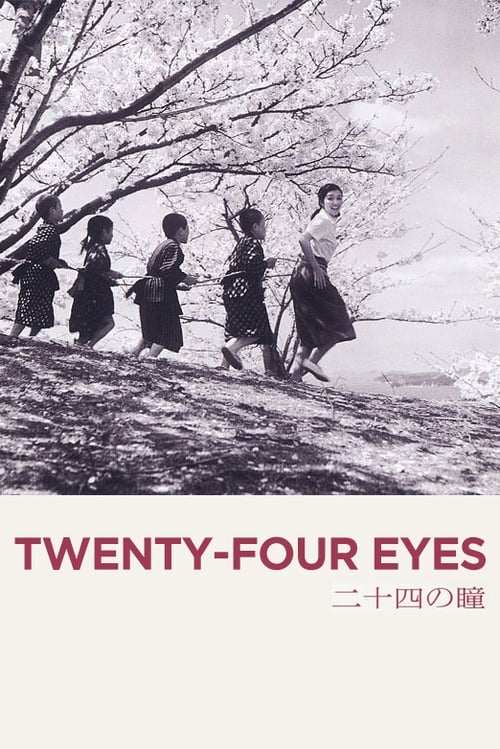
Twenty-Four Eyes
1954 · Keisuke Kinoshita
When you need a good cry — the deep, cleansing kind — and want a film about kindness holding out against history. It's a comfort and a heartbreak in the same breath; keep tissues within reach.
What it's about
In 1928, a young teacher arrives on a small island in Japan's Inland Sea to take charge of twelve first-graders — the twenty-four eyes of the title. The film follows Miss Ōishi and her pupils across eighteen years, through poverty, the drumbeat of militarism, and the Pacific War, watching childhood friendships collide with a history none of them chose. No battles are shown; the war arrives instead through the classroom, one absence at a time.
The experience
Tender, unhurried, and quietly heartbreaking — it earns its tears honestly, through folk songs, small faces, and the slow passage of years. Few films are this gentle and this devastating at once.
Performances
Hideko Takamine is luminous as Miss Ōishi, aging from bright-eyed newcomer to grieving witness with complete conviction — one of the defining performances of Japanese cinema's golden age. The child actors, cast in pairs across the years, are remarkably natural.
The craft
Kinoshita shoots the island's shorelines and school paths with a lyricism that makes the encroaching war feel like weather moving in, and he weaves familiar school songs through the film until the melodies themselves become unbearable. The structure — history registered as attrition rather than spectacle — is the quiet masterstroke.
Why it matters
An enormous popular and critical success in postwar Japan, topping the year-end critics' poll and becoming one of the country's most beloved anti-war films — proof that a war film could break hearts without showing a single battle.
Snapshot
Twenty-Four Eyes (二十四の瞳, Nijūshi no Hitomi) is Keisuke Kinoshita's lyrical anti-war chronicle of a young schoolteacher and the twelve first-graders — the twenty-four eyes of the title — she meets on a remote island in the Inland Sea. Adapted from Sakae Tsuboi's 1952 novel and set on Shōdoshima, it follows Miss Ōishi (Hisako Ōishi, played by Hideko Takamine) and her pupils across eighteen years, from 1928 through the militarization of Japanese life, the Pacific War, and the impoverished aftermath of 1946. Rather than dramatize battle, Kinoshita registers history as attrition: children who once sang folk songs on the shore are ground down by poverty, conscription, and death, while their teacher — powerless and grieving — watches a generation be consumed. Released by Shochiku, the film topped Kinema Junpō's year-end critics' poll for 1954, placing above Kurosawa's Seven Samurai, and became one of the defining humanist statements of Japan's postwar cinema. It remains Kinoshita's most beloved work and a touchstone of the sentimental, pacifist strain in Japanese filmmaking.
Industry & production
The film was produced and distributed by Shochiku, the studio where Kinoshita spent nearly his entire career and where he had become, alongside Yasujirō Ozu, one of the house's most prestigious directors. By 1954 Kinoshita was extraordinarily prolific and commercially reliable — he had directed the first Japanese color feature, Carmen Comes Home (1951), for the studio — and Twenty-Four Eyes arrived at the crest of that standing.
The source was Sakae Tsuboi's novel, itself rooted in the author's own Shōdoshima background; its story of a female teacher and her doomed pupils carried an unmistakable pacifist and anti-authoritarian charge in a Japan then reckoning openly with the war. The production is notable for extensive location shooting on Shōdoshima, the island in the Seto Inland Sea where the story is set — a choice that grounds the film's imagery in real coves, seawalls, ferry routes, and mountain schoolrooms. Kinoshita's most discussed casting decision was practical and poignant: to portray the twelve children convincingly across the years, he is widely reported to have cast real siblings, using younger and older brothers and sisters of the same families so that faces would plausibly "age" between the film's early and late sections. This lends the passage of time an unusual physical credibility.
The film was a substantial success and a prestige property for Shochiku; precise box-office figures are not something I can cite reliably, so I will not invent them, but its commercial and critical reception was strong enough to make it a national event and a perennial re-release title.
Technology
Twenty-Four Eyes was shot in black-and-white on 35mm in the standard Academy ratio (roughly 1.37:1), the norm for Japanese features before the mid-1950s shift toward widescreen. The choice of monochrome is worth noting precisely because Kinoshita, of all Japanese directors, had pioneered color at Shochiku three years earlier; here he reverted to black-and-white, whose tonal restraint suits the film's austerity, its poverty, and its documentary-like island light. The film is long — well over two hours — reflecting its multi-decade span. Beyond these baseline formats, the film does not foreground technological novelty; its innovations are those of technique and structure rather than apparatus.
Technique
Cinematography
The photography is by Hiroshi Kusuda, Kinoshita's frequent cinematographer. Its signature is the expansive landscape: wide compositions of the Inland Sea, the shoreline, mountain paths, and the schoolhouse set against sky and water. Kinoshita repeatedly stages human figures small within these vistas — the teacher cycling along a coastal road, the line of children walking a path — so that individual lives are visibly dwarfed by geography and, by extension, by history. The island light and long horizons give the film a pastoral serenity that the narrative steadily betrays. Kusuda's monochrome favors soft, legible gradations over hard contrast, matching the film's tenderness rather than dramatizing it with expressionist shadow.
Editing
Structurally the film is built as a series of temporal leaps, and its most important formal problem is the management of ellipsis: years pass between sequences, and the cutting must carry the viewer across gaps of poverty, war, and death without literalizing them. Kinoshita and his editor handle these transitions largely through song, recurring locations, and the returning image of the class, so that the audience measures elapsed time by changed faces in the same familiar places. I am not able to confirm the editor's name with certainty and will not guess it; Kinoshita frequently shaped the cutting of his own films closely, and the film's rhythm — patient, accumulative, unhurried — is consistent with his authorial temperament.
Mise-en-scène / staging
Kinoshita's staging is organized around repetition and return. The same schoolroom, the same shoreline, the same walk to school recur across the decades, and the emotional force comes from what has changed within an unchanged frame. Group compositions dominate — the teacher amid her ring of children — and the recurrent motif of the class photograph (and the act of counting or naming the twelve) becomes a structuring device, a fixed image against which loss is later measured. The film's most famous set pieces are collective and processional rather than dramatic confrontations: children singing together, a class outing, farewells at the dock. Kinoshita stages sentiment openly, without the ironic distance of an Ozu or the tension of a Kurosawa.
Sound
Music is arguably the film's central expressive instrument, and its use of song is inseparable from meaning. The score, by the director's younger brother Chūji Kinoshita, weaves together the Japanese school songs (shōka) and folk melodies that the children would actually have sung across these years — including well-known pieces of the period's schoolroom repertoire — so that the soundtrack functions as a historical and emotional index. Songs the pupils sing as innocents return, transformed in feeling, once the same figures have been marked by war and death; the recurrence of a melody becomes a measure of everything that has been lost between hearings. This diegetic-to-emotive use of familiar music is the film's most distinctive technical achievement and a large part of why it moved contemporary audiences so powerfully.
Performance
Hideko Takamine anchors the film as Miss Ōishi, aging from an idealistic young woman bicycling to her first posting into a worn, grieving teacher and mother by the war's end. Takamine — one of the great screen actors of the era, celebrated equally for her work with Mikio Naruse — plays Ōishi with restraint rather than histrionics, letting the character's helplessness register as quiet endurance; her tears carry the film's pacifism more than any speech does. The children, cast in part through real siblings, are directed for naturalism, and much of the film's emotional credibility rests on the ensemble's un-actorly simplicity against Takamine's more shaded central performance.
Narrative & dramatic mode
The film's mode is the chronicle: an episodic, decades-spanning narrative in which the organizing unit is the passage of time rather than a single dramatic arc. It is structured in two broad movements — a prewar idyll of the teacher and her first-graders, and a darker second half in which the grown children and their teacher are overtaken by militarism, poverty, and war. The dramatic engine is not conflict between characters but the pressure of history on a small, sympathetic group; antagonism is diffuse and systemic (nationalism, economic hardship, the war machine) rather than embodied in a villain. This makes the film elegiac rather than suspenseful. Emotionally it operates in a frankly melodramatic register — Kinoshita neither hides nor undercuts sentiment — but its melodrama is put to argumentative ends: the accumulation of individual losses becomes an indictment of the forces that caused them.
Genre & cycle
Twenty-Four Eyes sits at the intersection of two genres. It is a shomin-geki — the Shochiku tradition of dramas about ordinary lower- and middle-class life — extended across historical time; and it is a signal work in the postwar Japanese anti-war film, the cycle of pacifist and war-remembrance pictures produced in the decade after 1945 as the industry processed defeat. Within that cycle it belongs to the "home front" and "victim" strain, viewing the war from the vantage of civilians, women, and children rather than soldiers or commanders, and emphasizing suffering and waste over heroism. It also participates in the perennial Japanese genre of the teacher-and-pupils story, which it arguably helped canonize in cinematic form.
Authorship & method
Keisuke Kinoshita both wrote and directed the film, adapting Tsuboi's novel himself, and it is central to his authorial identity. Against the towering international reputations of Kurosawa and Mizoguchi, Kinoshita has long been characterized as the great sentimentalist and lyricist of Shochiku humanism — a director of tenderness, domestic feeling, and open emotion, with a formal restlessness that ranged from this film's plainspoken realism to the experimental framing devices of later works. Twenty-Four Eyes is often taken as the fullest expression of his humanist, anti-militarist convictions.
His key collaborators are notably a family and studio circle. The score is by his brother Chūji Kinoshita, a career-long partnership whose musical intelligence is essential to this film in particular. The cinematography is by Hiroshi Kusuda, a regular Kinoshita cameraman responsible for the film's landscape lyricism. The star, Hideko Takamine, though most associated with Naruse, gives here one of her definitive performances. The screenplay is Kinoshita's own, keeping authorship of image, structure, and text tightly held. (I cannot reliably attribute the editing credit and have not invented a name for it.)
Movement / national cinema
The film is a landmark of Japanese cinema's postwar "golden age" of the 1950s — the same window that produced Rashomon, Tokyo Story, Ugetsu, and Seven Samurai — and specifically of Shochiku's humanist tradition, the studio "flavor" (the so-called Ōfuna style) of gentle, emotionally direct dramas about everyday people. Where Ozu distilled that sensibility into formal rigor, Kinoshita pushed it toward lyrical, tearful humanism, and Twenty-Four Eyes is that tendency's most famous achievement. Nationally, the film also belongs to the specific postwar project of reckoning with the war through the eyes of its ordinary victims — a stance that carried real political weight in 1954, as the film's sympathies with a teacher suspected of "dangerous" liberal or leftist thought quietly rebuke the wartime state.
Era / period
The film's diegetic span — 1928 to 1946 — is precisely the arc it seeks to indict: from the relative openness of the late 1920s, through the rise of militarism and thought-control in the 1930s, into total war and then ruinous defeat. Its own moment of production, 1954, is equally significant. It appeared less than a decade after surrender, during the American-shaped postwar order, at a time when Japanese cinema and society were actively and openly relitigating the war's meaning and cost. The film's pacifism landed in a receptive climate, and its focus on a schoolteacher spoke to live anxieties about education, indoctrination, and the responsibilities of the wartime generation.
Themes
The film's governing theme is the destruction of innocence by war and nationalism — dramatized through the literal fate of children who sing on a beach and are later maimed, killed, orphaned, or impoverished. Closely bound to it is the ethical position of the teacher: education as care versus education as conscription, and the anguish of a woman who instills love of life in pupils she cannot save from a state that demands their deaths. Poverty is a constant, unromanticized pressure, foreclosing the children's futures long before the war does. The film mounts a sustained pacifist argument by accumulation rather than assertion, insisting that history be counted as individual losses. Memory and return are formal themes as much as emotional ones — the recurring songs, photographs, and places make remembrance the film's very method. And underlying all of it is a maternal, humanist vision of solidarity among the powerless, offered as the only available answer to forces no single person can resist.
Reception, canon & influence
Critically, Twenty-Four Eyes was received as a major work on release: it was voted the best Japanese film of 1954 in the influential Kinema Junpō year-end poll, famously ranking above Seven Samurai — a result often cited to illustrate how differently domestic critics of the moment weighed Kinoshita's humanism against Kurosawa's spectacle. It also drew international recognition, winning the Golden Globe for Best Foreign Film (the Samuel Goldwyn International Award) in 1955, a mark of its early crossover standing. Its enduring reputation is inseparable from its emotional power; even admirers describe it as unabashedly a "three-handkerchief" film, and its detractors' charge — sentimentality — is essentially a description of its method rather than a refutation of its craft.
Looking backward, the film draws on Tsuboi's autobiographical novel and on the deep Shochiku shomin-geki tradition, and it channels the immediate postwar culture of war-remembrance and pacifist reckoning. Looking forward, it became a canonical and continually re-watched national classic, a fixture in accounts of the 1950s golden age and one of the two or three films by which Kinoshita is remembered internationally. Its convergence of school-song score, child ensemble, and anti-war elegy helped codify a durable template for Japanese teacher-and-pupils and home-front war narratives, and the story's cultural staying power is confirmed by later remakes and adaptations — including a 1987 feature version — that return to the same material. Within film scholarship the film also functions as the standard counterweight to Kurosawa in discussions of Japanese humanism: the case for lyricism, feeling, and the domestic scale of history against the epic and the heroic.
Reception
A colossal hit in 1954 Japan and the critics' pick of its year, it stayed a national touchstone while the West canonized Kurosawa instead — only in recent decades, via Criterion and Kinoshita retrospectives, have international cinephiles caught up.
How Twenty-Four Eyes was received, from release to now →
Influences: the films it descends from and the films it influenced
- I Was Born, But... (1932) — Establishes the Shochiku Kamata/Ofuna shomin-geki house style — patient, low-key domestic realism that observes the social world from children's eye level — the exact register Kinoshita inherits for his classroom ensemble.
- The Neighbor's Wife and Mine (1931) — Japan's first true talkie and the seed of 'Goshoism' — the lyrical braiding of laughter and tears in ordinary life plus naturalistic diegetic sound and song, the tonal recipe underpinning Kinoshita's tears-as-method.
- Army (1944) — Its famous prolonged tracking shot of a mother chasing her marching-off son channels anti-militarist grief through a maternal body in motion; Kinoshita reuses this elegiac follow-the-bereaved camera and its smuggled pacifism.
- Morning for the Osone Family (1946) — His first overt anti-militarist family melodrama, fixing the structural template of a home-front household progressively dismantled by conscription and war deaths that Twenty-Four Eyes scales up to a whole class.
- Goodbye, Mr. Chips (1939) — Codifies the teacher-life-chronicle form in which one schoolteacher's decades are measured by successive classes and by pupils swallowed by war — the same longitudinal teacher-and-pupils armature.
- The Burmese Harp (1956) — Uses communal singing (soldiers' choral songs) as the anti-war film's emotional and structural motor, directly paralleling Kinoshita's recurring shoka as the device that binds memory and grief.
- The Human Condition (1959) — Kobayashi, Kinoshita's former assistant director, extends Shochiku humanist anti-militarism to epic length; a direct mentorship lineage carrying the studio's ethical melodrama into wartime tragedy.
- The Yellow Handkerchief (1977) — Yamada is the standard-bearer of Shochiku Ofuna lyrical humanism — ordinary people, restrained feeling, and expansive landscape as emotional register — carrying Kinoshita's shomin-geki tenderness forward intact.
- Twenty-Four Eyes (1987) — A direct remake returning to Tsuboi's novel and reproducing the shoka-scored teacher-and-twelve-pupils structure, confirming the original as a reusable national template.
- Grave of the Fireflies (1988) — Devastates through the destruction of children on the home front, extending Kinoshita's 'destruction of innocence' anti-war melodrama and its unashamed willingness to wring grief without ironic distance.
- Cinema Paradiso (1988) — Builds a decades-spanning nostalgic chronicle organized by departure-and-return and by a single recurring musical leitmotif, embracing the same sentiment-as-method that Kinoshita's detractors called three-handkerchief.
- Village of Dreams (1996) — An autobiographical rural-childhood memory film built on landscape lyricism and real-brother casting (twin boys), echoing Kinoshita's soft-monochrome pastoral and use of actual siblings to authenticate a remembered childhood.
- Godzilla Minus One (2023) — Kinoshita's postwar melodrama formalizes the implosive grief performance register — grief expressed through physical containment, averted gaze, and delayed eruption rather than outward display — that Yamazaki applies to Kōichi's survivor-guilt sequences, where PTSD manifests as bodily rigidity and silence rather than audible mourning.
- The Human Condition I: No Greater Love (1959) — Kobayashi's mentor model: restrained humanist pacifism carried by performance and a sparse Chūji Kinoshita score rather than rhetoric, the exact emotional register Kobayashi inherited through his Kinoshita apprenticeship.
- The Hidden Blade (2004) — Shochiku humanist melodrama of decent ordinary people crushed by historical forces, the studio's classical-melodrama emotional register in which Yamada was formed.
- From Up on Poppy Hill (2011) — Model for sentimental Shōwa period drama scored with era-specific popular songs, using diegetic period music to fix a nostalgic historical moment emotionally.
- The Human Condition II: Road to Eternity (1959) — Kobayashi's mentor's method of anti-militarist indictment built through patient, longitudinal accumulation of ordinary lives quietly destroyed rather than battlefield spectacle — the humanist-chronicle template Kobayashi inherited directly as Kinoshita's assistant.
- Shoeshine (1946) — Contemporaneous neorealist practice of location shooting and casting real, non-professional children for unforced pathos, paralleling Kinoshita's on-location Shodoshima work and child ensemble (including real siblings).
- Children of Hiroshima (1952) — A teacher returning to find and survey what the war did to her former pupils — the identical teacher-and-scattered-pupils elegiac anti-war survey, staged two years earlier.
- Floating Clouds (1955) — Showcases Hideko Takamine's signature register of restrained, interiorized endurance — the same withheld, aging-into-sorrow performance she gives as Oishi-sensei.
- Times of Joy and Sorrow (1957) — Companion decades-spanning episodic chronicle (a lighthouse-keeper couple) driven by a recurring Chuji Kinoshita theme song and marked by temporal ellipses across eras — the same song-anchored chronicle machinery.
Similar films
- Floating Clouds (1955) — influence & lineage
- Grave of the Fireflies (1988) — influence & lineage
- The Burmese Harp (1956) — influence & lineage
- Tokyo Story (1953) — shared sensibility
- Nobody Knows (2004) — shared sensibility
- Letters from Iwo Jima (2006) — shared sensibility
- The Ballad of Narayama (1958) — shared sensibility
- In This Corner of the World (2016) — shared sensibility