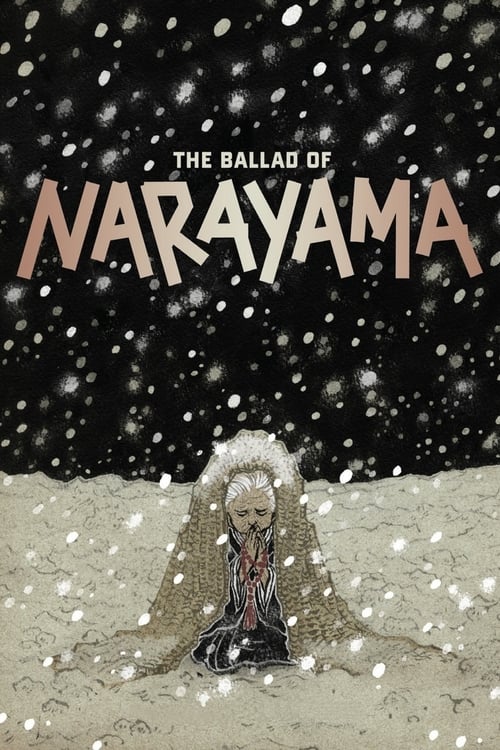
The Ballad of Narayama
1958 · Keisuke Kinoshita
For when you want to be genuinely moved and don't mind being challenged — a slow, formal, deeply humane film to sit with alone and think about for days. Not a comfort watch; a lasting one.
What it's about
In a remote mountain village where food is chronically scarce, custom demands that anyone who reaches seventy be carried up the sacred mountain of Narayama and left there to die. Orin, a vigorous grandmother of sixty-nine, has fully accepted her turn — the film follows her final year as she sets her house in order and tries to prepare her grieving son for the day he must carry her up. It's a folk tale about duty, scarcity, and love, told with unnerving calm.
The experience
Stately, strange, and devastating. The whole thing unfolds on frankly artificial theatrical sets, with sung narration, so it feels less like watching events than watching a ritual performed — which makes the emotion land harder, not softer. It builds to a final stretch of almost unbearable tenderness.
Performances
Kinuyo Tanaka is extraordinary as Orin — serene, stubborn, and radiant, playing a woman preparing for her own death with a matter-of-factness that breaks your heart precisely because it never asks you to cry.
The craft
Keisuke Kinoshita stages the entire film on visibly artificial studio sets, borrowing the conventions of kabuki theater: painted backdrops, stylized lighting shifts, sets that slide away mid-scene, a sung ballad carrying the story. The color design is bold and unreal, and the deliberate theatricality turns a grim folk custom into something ceremonial — it's one of the most formally daring films of its era and looks like nothing else.
Why it matters
A landmark of Japanese studio filmmaking that proved radical theatrical stylization could carry raw human tragedy, and the definitive first screen telling of a story influential enough to be famously retold a generation later.
Snapshot
The Ballad of Narayama (Narayama-bushi kō, 楢山節考) is Keisuke Kinoshita's austere, formally radical adaptation of Shichirō Fukazawa's prize-winning 1956 novella, produced at Shochiku. It dramatizes ubasute — the folkloric practice by which a remote, famine-haunted mountain village sends its elders, upon reaching seventy, to die of exposure on the peak of Narayama. Its subject is Orin, a still-vigorous woman of sixty-nine (Kinuyo Tanaka) who has made peace with her coming journey and spends the film readying her family — above all her reluctant, grieving son Tatsuhei (Teiji Takahashi) — for the day he must carry her up the mountain. What distinguishes the film is not the harrowing premise but the presentation: Kinoshita stages the entire work on frankly artificial studio sets, framed as a performance in the manner of kabuki and bunraku puppet theater, complete with a chanted jōruri-style narration, shamisen accompaniment, a revolving stage, and lighting that shifts color before the viewer's eyes. It topped the Kinema Junpō critics' poll for 1958 and stands as one of the boldest stylistic experiments of the Japanese cinema's golden age.
Industry & production
The film was made within Shochiku, the studio most associated with domestic drama (shomin-geki) and with the polished house style of Ofuna, and Kinoshita was by 1958 one of its most bankable and prolific auteurs — a figure of comparable standing to Yasujirō Ozu on the Shochiku roster. That institutional context matters: Kinoshita had the prestige to mount a deliberately uncommercial, anti-illusionist experiment inside a mainstream studio, using its full technical apparatus — soundstages, color processing, anamorphic widescreen, and skilled craft departments — to build an ostentatiously theatrical world rather than a naturalistic one. The production was studio-bound almost in its entirety, an aesthetic choice as much as a logistical one, since the artifice of the enclosed set is fundamental to the film's meaning. Precise budget and box-office figures are not something I can state reliably here, and I will not invent them; the film's enduring reputation rests on critical rather than commercial grounds.
Technology
The Ballad of Narayama was shot in color and in Shochiku's anamorphic widescreen process, marketed as Shochiku GrandScope. Kinoshita was already central to the studio's color history — he had directed Carmen Comes Home (1951), generally identified as Japan's first color feature — and here he turns color into an overtly expressive, non-naturalistic instrument. Rather than using the emulsion to record the world faithfully, the production manipulated colored light and painted backings so that skies flush red or drop to black and sets are washed in unrealistic hues to mark emotional turns. The exact color stock is not something I can confirm with certainty and I won't guess it, but the salient point is technological intent: the widescreen frame and color palette are deployed as elements of a designed picture-plane, closer to woodblock print and stage tableau than to location realism. The one deliberate rupture of that constructed world — the film's final image — exploits the same technology in the opposite direction, cutting to a real, contemporary location shot.
Technique
Cinematography
The camerawork, by Hiroshi Kusuda (a frequent Kinoshita collaborator), is disciplined and presentational. Compositions are arranged frontally, as if for a proscenium, and the camera favors measured lateral moves, framings that respect the flatness of the painted set, and staging in depth that is nonetheless legibly "staged." Kusuda and Kinoshita use the artificial lighting as an active narrative device: darkness closes in around a figure, a background bleeds into color, or a spotlight isolates an actor as on a stage. The widescreen frame is composed for balance and stillness rather than for the immersive expanse one might expect from the format, reinforcing the sense that we are watching a performance framed within a frame.
Editing
Cutting is subordinated to the theatrical conception. Scene changes are frequently effected not by conventional continuity editing but by stage mechanics visible within the shot — the revolving stage turning to reveal a new locale, curtains or lighting transitions marking act divisions — so that the "edit" is often diegetically theatrical rather than filmic. Against this deliberately measured, presentational rhythm, the film's most famous cut lands with maximum force: the abrupt jump from the stylized world of the story to a modern documentary shot at the end, an edit whose shock depends entirely on the uniform artifice that preceded it.
Mise-en-scène / staging
This is the film's defining register. Kinoshita borrows the grammar of kabuki and bunraku wholesale: the mawari-butai (revolving stage) rotates sets into view; backdrops are unmistakably painted; scenes are bounded by stage conventions; and the transitions are choreographed as theatrical set-changes. Objects and figures are arranged in composed tableaux. The strategy is anti-illusionist — the viewer is never allowed to forget they are watching a constructed performance of a legend — and this distancing is precisely what lends the cruel material its ritual, mythic weight. The design turns a story that could be merely grim into a formalized elegy.
Sound
The soundtrack is inseparable from the staging. A chanted narration in the jōruri/gidayū idiom of the puppet theater, delivered to shamisen accompaniment, carries and comments on the action much as a tayū narrator does in bunraku; the very title, "The Ballad of Narayama," foregrounds this sung-recited mode. The score is credited to the director's brother, Chūji Kinoshita, a regular collaborator, who wove together this theatrical chant tradition with the film's dramatic underscoring. Sound thus operates as another layer of framing device, continually reminding us that we are being told a tale in a traditional performance form.
Performance
Acting styles are pitched to the stylization. Kinuyo Tanaka — one of the towering actresses of Japanese cinema and herself a director — gives a performance of dignified restraint as Orin, playing serenity and resolve against the surrounding cruelty. The most frequently cited detail concerns Orin's teeth: in the story a full set of teeth is a shameful sign of a still-hearty appetite in a starving village, and Orin smashes them against a stone to diminish herself before the journey. Tanaka is widely reported to have had healthy teeth altered or removed to achieve the effect on screen; this anecdote is well established in accounts of the film, and it exemplifies the physical commitment the role demanded. Around her, Teiji Takahashi's Tatsuhei supplies the film's emotional undertow of filial anguish, while the grandson's callousness and the neighboring old man Mata's terror of the mountain sharpen the moral field.
Narrative & dramatic mode
The narrative is a linear ritual march toward a foreordained end: the film is organized less by suspense than by the approach of a known, inescapable event. Its dramatic mode is that of folk legend or ballad — hence the framing narration — rather than psychological realism. Kinoshita structures the story around Orin's preparations: securing her son's remarriage, arranging the household, and steeling Tatsuhei for his duty, so that the drama lies in acceptance and its cost rather than in whether the custom will be carried out. The counterpoint of Mata, who resists his fate, throws Orin's composure into relief and darkens the tale. The mode is elegiac and mythic; the theatrical apparatus keeps the audience at a contemplative remove even as the events grow unbearable.
Genre & cycle
Nominally a period drama (jidaigeki) set in an unspecified feudal past, the film sits apart from the sword-driven mainstream of that genre. It belongs more truly to a strain of literary adaptation and folkloric tragedy, and it is best understood as a formal experiment — an attempt to fuse cinema with the conventions of classical Japanese theater. There is no large "cycle" of comparable films; its closest kin are other prestige literary adaptations of the era and, retrospectively, Shohei Imamura's 1983 remake, which addresses the same source in a diametrically opposed naturalistic key. Within Kinoshita's own varied output — which ranged from sentimental melodrama to comedy to social critique — it is the most stylistically extreme entry.
Authorship & method
Kinoshita's authorship here is defined by a willingness to subordinate his customary lyric humanism to a rigorous formal conceit. Known popularly for the tearful humanism of Twenty-Four Eyes (1954) and for the pioneering color of Carmen Comes Home (1951), he reveals in Narayama a colder, more architectural sensibility, one prepared to alienate the viewer in the service of a mythic reading. He also wrote the screenplay adaptation of Fukazawa's novella himself, controlling the compression of the source into theatrical acts. His key collaborators reinforce a family-and-studio method: cinematographer Hiroshi Kusuda executing the demanding lighting-as-narration scheme; his brother Chūji Kinoshita composing the score and integrating the chant tradition; and star Kinuyo Tanaka anchoring the performance style. The result reads as a total design in which direction, writing, image, and music are unusually unified around a single idea.
Movement / national cinema
The film is a product of the Japanese cinema's postwar golden age, the same fertile late-1950s moment that produced major work by Kurosawa, Mizoguchi, Ozu, and Naruse. Kinoshita is conventionally grouped with these masters as a leading Shochiku director. What makes Narayama nationally significant is its explicit dialogue with indigenous performance traditions — kabuki, bunraku, jōruri chant — at a time when much prestige Japanese cinema was engaging (and being received abroad) through more Western-legible realist or humanist frames. The film asserts a distinctly Japanese theatrical heritage as the proper vehicle for a Japanese folk legend, making it a landmark of national-cinematic self-reference.
Era / period
Made in 1958, the film reflects a moment of postwar confidence and technical expansion in the Japanese studios — widescreen, color, and international festival ambition were all ascendant. Yet its content looks backward, to a pre-modern subsistence world governed by scarcity and custom. This tension between a modern industrial cinema and an archaic rural fable is not incidental; it is thematized directly in the ending's leap to the present day, which measures the distance between the legend's world and the audience's own.
Themes
The central themes are mortality, filial duty, and the moral economy of scarcity. Ubasute is presented not as barbarism to be condemned but as a communal logic in which the old sacrifice themselves so the young may survive, and the film's power lies in holding sympathy and horror in suspension. Orin embodies acceptance, dignity, and self-effacement — even self-mutilation — as forms of love; Tatsuhei embodies the agony of a duty that is also a betrayal; Mata embodies the natural human refusal of death that the custom must override. Around these run motifs of shame, appetite, and the body as a resource in a starving society. The stylization universalizes these concerns, lifting them from ethnographic curiosity toward myth: this is a ballad about how communities metabolize death.
Reception, canon & influence
Critically, the film was honored at home, taking the top position in the influential Kinema Junpō year-end critics' poll for 1958 and confirming Kinoshita's standing among the era's leading directors. Its reception abroad was more gradual and, at times, divided: the aggressive theatrical stylization struck some Western viewers as static or "stagey," and for a period the film was less internationally visible than the naturalistic 1983 remake. Over time, however, it has been reappraised as a masterpiece of formal daring, and its restoration and home-video circulation (including editions aimed at cinephile audiences) have restored it to the canon of major Japanese films.
Looking backward, the film's influences are chiefly theatrical and literary rather than cinematic: Fukazawa's 1956 novella (which itself drew on the ubasute legend and the folk song that gives the work its title) supplied the story, and the classical stagecraft of kabuki and bunraku supplied the form. Kinoshita's synthesis of these into a color widescreen film was, on the evidence, largely without direct precedent.
Looking forward, its most conspicuous descendant is Shohei Imamura's The Ballad of Narayama (1983), which returns to the same Fukazawa source but rejects Kinoshita's artifice for a visceral, earthbound naturalism and went on to win the Palme d'Or at Cannes — a pairing now frequently taught as a case study in how radically style can transform identical material. More broadly, Kinoshita's film stands as an enduring reference point for filmmakers and scholars interested in the fusion of cinema with theatrical convention and in the expressive, anti-realist use of color and staging. Its final gesture — the sudden cut from the constructed legend to a real modern railway location — remains one of the most discussed endings in Japanese cinema, a formal stroke whose influence lies less in direct imitation than in its demonstration of what such a rupture can do.
Reception
Acclaimed in Japan on release, it was long overshadowed in the West by Shohei Imamura's Palme d'Or-winning 1983 remake — until the 2013 Criterion release (and a late Roger Ebert 'Great Movies' essay) turned it into a rediscovered treasure, with many now calling it the superior version.
How The Ballad of Narayama was received, from release to now →
Influences: the films it descends from and the films it influenced
- Carmen Comes Home (1951) — Kinoshita's own Fujicolor experiment — Japan's first domestic color feature — established his practice of treating color as a designed expressive value rather than reproduction, the direct technical rehearsal for Narayama's Grandscope palette.
- Gate of Hell (1953) — Its Eastmancolor jidaigeki showed color could be composed like a painted scroll and keyed to emotional states, modeling the 'color-and-lighting-as-narration' scheme Hiroshi Kusuda executes in Narayama.
- A Story from Chikamatsu (1954) — Adapting a Chikamatsu bunraku puppet-play, it carries the joruri narrative sensibility — sung/chanted fatalism driving the action — into cinema, the same puppet-theater DNA behind Narayama's joruri chant and revolving-stage transitions.
- The 47 Ronin (1941) — Mizoguchi stages the kabuki Chūshingura in frontal, proscenium-like long shots that hold theatrical distance rather than cutting into naturalism, prefiguring Narayama's anti-illusionist frontal framing.
- Sanshō the Bailiff (1954) — Its setsuwa folk-legend telling and Kinuyo Tanaka's incantatory maternal lament ('Zushio... Anju...') supply both the folk-ballad narrative mode and the specific Tanaka performance register Kinoshita anchors Narayama on.
- Ugetsu (1953) — The Lady Wakasa sequences deploy Noh music, gesture and dreamlike anti-realist lighting to signal the supernatural, an early cinematic grafting of theatrical convention that Narayama systematizes into a whole film's form.
- The Ballad of Narayama (1983) — Returns to the identical Fukazawa source but systematically inverts Kinoshita's every device — location shooting and animal-instinct naturalism replacing the soundstage, revolving stage and joruri — the canonical style-vs-style case study.
- Double Suicide (1969) — Shinoda makes the bunraku metaphor literal: black-hooded kurogo puppeteers move through live-action scenes and joruri chanters narrate, pushing Narayama's puppet-theater staging and anti-illusionist exposure of the apparatus to its endpoint.
- Kwaidan (1964) — Entirely soundstage-bound with hand-painted skies and eye-motif backdrops, it extends Narayama's total-design, deliberately artificial scenography and expressive non-naturalistic color into anthology form.
- Dodes'ka-den (1970) — Kurosawa's first color film uses painted-set, saturated expressionist color keyed to inner states over a theatrical shantytown 'stage,' inheriting Narayama's use of built, palette-controlled artifice as meaning.
- Ran (1985) — Color-coded armies and Noh-derived performance (Lady Kaede, the mask-like faces) fuse theatrical convention with widescreen color-as-narration, the mature descendant of Narayama's kabuki-plus-Grandscope synthesis.
- Pastoral: To Die in the Country (1974) — Terayama's avant-garde folk-memory piece breaks the frame, exposes its own theatricality and mixes carnival/folk-song staging, radicalizing Narayama's anti-illusionist rupture and folk-ballad mode.
- The Twilight Samurai (2002) — An earlier Shochiku treatment of ordinary rural people facing survival and duty with restraint, part of the studio's humanist realist tradition from which Yamada draws his empathy for the un-storied poor.
- Throne of Blood (1957) — Kurosawa imports Noh mask-acting, stylized gliding movement and gesture into a near-contemporary jidaigeki, the parallel gambit to Narayama's kabuki-bunraku performance stylization within a golden-age film.
- Dogville (2003) — A bare soundstage with chalk-outlined 'walls' and an omniscient narrator enforces Brechtian anti-illusionist staging identical in principle to Narayama's exposed sets and revolving-stage artifice, arriving from the European theatrical tradition.
- Hero (2002) — Structures its narrative into monochrome color chapters where palette encodes truth-value and emotion, a wuxia parallel to Narayama's lighting-and-color-as-narration built on Asian theatrical stylization.
- Yearning (1964) — Kinoshita's Takamine collaboration shares the actress's restrained-interiority method and the studio woman's-film's focus on a woman bearing familial economic burden.
Similar films
- Pastoral: To Die in the Country (1974) — influence & lineage
- Ran (1985) — influence & lineage
- Throne of Blood (1957) — influence & lineage
- Ugetsu (1953) — influence & lineage
- Gate of Hell (1953) — influence & lineage
- Tokyo Story (1953) — shared sensibility
- The Life of Oharu (1952) — shared sensibility
- When a Woman Ascends the Stairs (1960) — shared sensibility