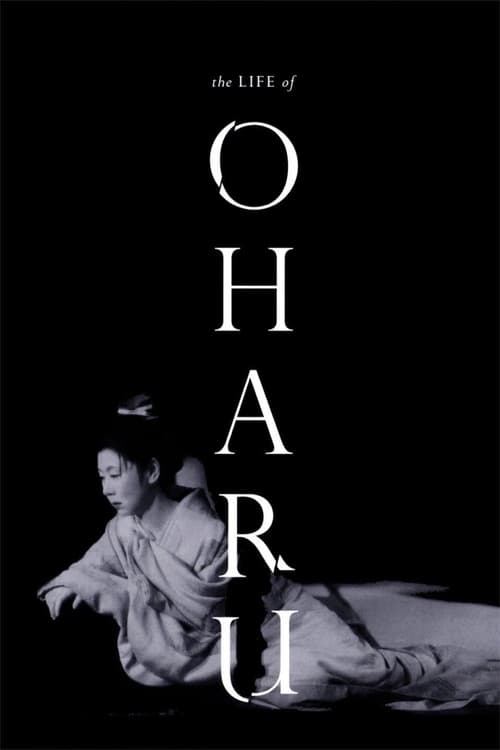
The Life of Oharu
1952 · Kenji Mizoguchi
For a night when you want to be genuinely moved and don't mind being wrecked a little — a serious, patient film that repays your full attention. This is challenge, not comfort, but the kind that leaves you grateful.
What it's about
In Edo-period Japan, a noblewoman serving at the imperial court falls in love with a page far beneath her rank, and the affair gets her whole family banished. What follows is her life told in memory: from lady-in-waiting to lord's concubine, from a pleasure-quarter courtesan to servant, wife, and finally an aging woman begging on the roadside. It follows one person through every layer of a society built to use her up, as she keeps trying — and being refused the chance — to live on her own terms.
The experience
Slow, grave, and quietly furious, it moves like a river you can't swim against. The sadness accumulates rather than strikes, and by the end it has become something close to awe — you feel the weight of a whole life pressed into two hours.
Performances
Kinuyo Tanaka plays Oharu across decades of her life, from courtly youth to destitute old age, with almost no self-pity — she lets you watch dignity survive everything done to it, in one of the most admired performances in Japanese cinema.
The craft
Mizoguchi shoots in long, flowing takes that follow Oharu rather than cutting away from her, often watching from a discreet distance so her suffering never becomes a spectacle. The compositions have a scroll-painting elegance — gates, corridors, and screens keep framing and confining her — and the restraint of the camera is exactly what makes the film devastating. It rewards a dark room and no distractions.
Why it matters
The film brought Mizoguchi international recognition late in his career and helped open Western eyes to Japanese cinema in the early 1950s, and it remains a touchstone for filmmakers drawn to stories of women ground down by social order.
Snapshot
The Life of Oharu (Saikaku ichidai onna, literally "The Life of a Woman by Saikaku") is Kenji Mizoguchi's chronicle of a woman's descent through the rigid strata of Edo-period Japan, adapted from Ihara Saikaku's 1686 novel Kōshoku ichidai onna ("The Life of an Amorous Woman"). Kinuyo Tanaka plays Oharu, once a lady-in-waiting at the imperial court in Kyoto, whose love affair with a page beneath her station triggers an inexorable fall — through banishment, a stint as a lord's concubine, sale to a Shimabara brothel, marriage, servitude, and finally beggary as an aging streetwalker and mendicant nun. Framed as the recollection of the fifty-year-old Oharu gazing at a temple's arhat statues, the film is at once a Buddhist meditation on suffering and a scalding indictment of a patriarchal order that treats women as disposable property. Made when Mizoguchi was in his mid-fifties and had already directed for two decades, Oharu won the International Award (often cited as the Silver Lion) at the 1952 Venice Film Festival, and — arriving in the wake of Rashomon's 1951 triumph — helped confirm to Western audiences that Japanese cinema had a second great master. It inaugurated the extraordinary final period that would also produce Ugetsu (1953) and Sansho the Bailiff (1954).
Industry & production
Oharu was produced under the banner of Shintoho (Shin Toho), the studio that had splintered from Toho amid the bitter labor disputes of the late 1940s, in association with Mizoguchi's own production arrangement — the project is frequently described as one the director fought to realize on his own terms. By 1951 Mizoguchi's postwar features had met with only modest commercial success, and the international breakthrough of Akira Kurosawa's Rashomon at Venice reportedly stung a director who considered himself the senior figure of Japanese art cinema. Oharu was conceived, in part, as his answer: a prestige literary adaptation of impeccable classical pedigree, mounted with period detail and the participation of Kinuyo Tanaka, one of the most respected actresses in Japan and Mizoguchi's most important on-screen collaborator.
The screenplay was written by Yoshikata Yoda, Mizoguchi's regular scenarist, with the director closely involved. Yoda's task was formidable: Saikaku's source is an episodic, comic, and frankly erotic picaresque, and the adaptation reshapes it into a sustained tragic arc while preserving the novel's structure of successive social descents. The production is remembered as arduous — Mizoguchi's exacting perfectionism, his insistence on authentic period atmosphere, and his demand for long unbroken takes placed heavy burdens on cast and crew. Precise budget and box-office figures are not something I can reliably cite; the film's domestic commercial reception was reportedly lukewarm, and its reputation was made abroad rather than at home, a pattern that would recur across Mizoguchi's late masterpieces.
Technology
Oharu was made with the standard tools of early-1950s Japanese studio production: 35mm black-and-white film, the Academy aspect ratio, and studio-built sets supplemented by location work, all predating the color and widescreen conversions that would sweep Japanese cinema later in the decade. What distinguishes the film technologically is less any novel apparatus than the disciplined deployment of the crane and the dolly. Mizoguchi's aesthetic depended on fluid, sustained camera movement across large, deep sets, which required careful engineering of dolly track, crane arms, and the scenic space itself so that the camera could glide laterally past screens, walls, and figures without cutting. The lighting is naturalistic and often low-key, modeling the textures of kimono, tatami, and weathered wood. Sound was recorded and mixed to the mono optical standard of the period. The film's "technology," in short, is best understood as the mobilization of conventional means toward an unusually demanding choreography of camera and performer.
Technique
Cinematography
The photography — credited to Yoshimi Hirano — is central to the film's meaning. Mizoguchi is celebrated for the "one scene, one shot" method (wan shīn, wan katto), and Oharu is one of its most sustained demonstrations: episodes unfold in long takes with a camera that observes from a measured, often elevated distance. The lens keeps its subjects at arm's length, frequently framing Oharu within doorways, latticework, and the receding planes of Japanese interiors, so that architecture seems to enclose and constrain her. The recurring lateral track — the camera drifting alongside a walking figure, or panning across a room to reveal the social forces arrayed around the heroine — has often been likened to the unrolling of a emakimono picture scroll. This distance is not coldness but a moral stance: it refuses the consolations of the close-up, denying the viewer easy identification and instead presenting Oharu's degradation as a spectacle of social process. Depth staging keeps foreground and background in continuous dialogue, so that a private humiliation is almost always shown to be witnessed, judged, or transacted by others.
Editing
Editing in Oharu is defined largely by its restraint. Because whole scenes play out in single takes, cutting occurs at the seams between episodes rather than within them, and the film's rhythm is governed by the internal duration of shots more than by montage. The overarching structure is a flashback: the aged Oharu, contemplating the rakan statues, becomes the frame from which the chronological recollection unspools, and the film returns to old age at its close, giving the whole a circular, elegiac shape. Transitions between the stations of her life are frequently elliptical, trusting the viewer to register how far she has fallen since the previous scene. The effect is of a life reviewed and comprehended as a totality rather than experienced moment to moment — an editing logic consonant with the film's Buddhist framing of a life seen from its end.
Mise-en-scène / staging
Staging is where Mizoguchi's genius is most concentrated. He composes in depth and blocks his actors so that power relations are legible in space — who kneels and who stands, who occupies the interior recess and who is exposed at the threshold, who moves freely and who is hemmed in. Sliding screens (fusuma and shōji) partition the frame into zones of privacy and surveillance; a scene of Oharu's inspection as a potential concubine, for instance, turns her body into an object appraised across a room. The period reconstruction — art direction by Hiroshi Mizutani — is meticulous without being ostentatious, the sets built to accommodate the roving camera. Throughout, Mizoguchi choreographs entrances, exits, and reversals of fortune as continuous physical events, so that social catastrophe registers as movement through architecture.
Sound
The score is by Ichirō Saitō, drawing on traditional Japanese idioms and instrumentation to underscore the period setting and the film's mournful register. Mizoguchi uses sound with the same economy as his images: ambient noise, off-screen voices, and the textures of chant and percussion carry considerable weight, and silence is deployed expressively. Detailed technical documentation of the sound design is thin, but the general strategy is of a piece with the visual style — restrained, atmospheric, and subordinated to the long take rather than driving emotion through continuous musical cueing.
Performance
Kinuyo Tanaka's Oharu is the film's spine and one of the landmark performances of Japanese cinema. She must traverse decades — from a poised young courtier to a broken beggar-woman — and she registers the accumulation of suffering through calibrated shifts in bearing, gait, and voice rather than through outbursts. Mizoguchi's distanced camera throws unusual demands on the actor: without close-ups to magnify feeling, Tanaka must convey interior states in full-figure, often at a remove, and she sustains dignity even as the narrative strips everything from her. The supporting cast draws on the era's talent, including a young Toshirō Mifune as Katsunosuke, the page whose love ignites Oharu's fall. The ensemble's kneeling, bowing, and hierarchical posturing is itself a performance of the social system the film anatomizes.
Narrative & dramatic mode
The film's dramatic mode is tragic and cumulative: a downward spiral in which each apparent reprieve — a marriage, a position, a patron — proves only the prelude to a further fall. Structurally it is episodic, inherited from Saikaku's picaresque, but Mizoguchi reorients the episodes into a single descending line, so that the picaresque's comic serial reinvention becomes tragic serial dispossession. The retrospective frame lends the whole an air of fatality; because we begin with Oharu already aged and destitute, the outcome is never in doubt, and the drama lies not in suspense but in the moral weight of watching how it comes to pass. This is a cinema of consequence rather than surprise — a woman's life presented as an accumulating indictment, its emotional climaxes (the loss of the page, the wrenching glimpse of the son she was forced to surrender) landing all the harder for the surrounding restraint.
Genre & cycle
Oharu belongs to the jidaigeki, the Japanese period film, but to its serious, socially critical wing rather than the swordplay-driven chanbara. Within Mizoguchi's own output it is a keystone of his cycle of films centered on the suffering of women — a preoccupation stretching back through the 1930s (Sisters of the Gion, Osaka Elegy) and forward to Ugetsu, Sansho the Bailiff, and Street of Shame. It can also be read as a literary-adaptation prestige film, part of a broader postwar tendency to mine the classics of Japanese fiction for cinema of artistic ambition. As a woman's tragedy set against the injustices of the feudal past, it stands at the confluence of period spectacle and social-problem drama.
Authorship & method
Oharu is a signal work of Mizoguchi's authorship — indeed many critics locate here the full maturation of his style. His method was famously exacting: he demanded absolute fidelity of period atmosphere, extensive rehearsal, and long takes that required actors and camera crew to sustain complex, unbroken performances, and he was notorious for withholding explicit direction while insisting that his collaborators divine the right result. The film is inseparable from a nucleus of key collaborators. Screenwriter Yoshikata Yoda shaped Saikaku's material into its tragic architecture over the course of a long partnership with the director. Cinematographer Yoshimi Hirano realized the distanced, mobile, depth-staged image. Composer Ichirō Saitō supplied the traditional-inflected score, and art director Hiroshi Mizutani built the period world through which the camera moves. Above all, actress Kinuyo Tanaka — herself soon to become one of Japan's first women directors — was the indispensable interpreter of Mizoguchi's vision of female endurance. The auteurist reading of Mizoguchi, later canonized by French critics, treats these films as the coherent expression of a single moral and aesthetic sensibility, and Oharu is one of its founding exhibits.
Movement / national cinema
The film sits at a pivotal moment in the international emergence of Japanese national cinema. Rashomon's Venice success in 1951 opened Western festivals and art houses to Japanese films, and Oharu, Ugetsu, and Sansho the Bailiff followed in quick succession to make Mizoguchi, alongside Kurosawa and later Ozu, one of the pillars by which the West came to know that cinema. Domestically, Mizoguchi belonged to an older generation than the postwar new wave, rooted in the studio traditions of the 1920s and 1930s and in the classical Japanese arts — the picture scroll, the woodblock print, the theatrical conventions of restraint. His long-take, distanced aesthetic came to be seen, especially by European critics, as expressing something essential about a Japanese pictorial and dramaturgical sensibility, though this framing risks flattening a style that was also the product of individual invention and industrial circumstance.
Era / period
The film is set in the seventeenth century, during the Edo period, in and around Kyoto and the pleasure quarters of the era. Its social world is one of codified hierarchy: an imperial court, provincial lords requiring male heirs, licensed brothel districts, merchant households, and a Buddhist religious establishment, all governing the movement — and immobility — of women. Mizoguchi treats this past not as nostalgic pageant but as a system of constraint whose injustices resonate with the present. Made in 1952, during the closing months of the Allied occupation of Japan and amid postwar debates over women's rights and social reform, the film's excoriation of feudal patriarchy carried contemporary charge, its historical setting a lens through which to examine enduring structures of gendered subordination.
Themes
At its core the film is about the commodification of women within a patriarchal order: Oharu is desired, purchased, used, and discarded, valued for her body and her capacity to bear an heir but never permitted autonomy or an enduring place. Love, in this world, is a transgression that the powerful punish — the page's execution sets the entire tragedy in motion — while institutionally sanctioned unions are transactions of property and lineage. Suffering is refracted through a Buddhist frame: the arhat statues that open the film, the vision of a life reviewed near its end, the trajectory toward renunciation and beggary all cast Oharu's fall within notions of impermanence, worldly attachment, and the karmic weight of existence. Interwoven is a sharp social criticism — the hypocrisy of the pious, the cruelty of masters, the collusion of family in a daughter's sale — that refuses to let metaphysical resignation excuse human injustice. Endurance and dignity form the final theme: Oharu is stripped of everything yet is never reduced, in the film's moral accounting, to less than fully human.
Reception, canon & influence
The film's decisive reception was international. Its award at the 1952 Venice Film Festival brought Mizoguchi the recognition he had sought and, together with the successes of Ugetsu and Sansho the Bailiff over the next two years, established him in European critical circles as a master of the first rank. He became a touchstone for the critics of Cahiers du Cinéma: figures associated with the emerging French New Wave, among them Jacques Rivette and Jean-Luc Godard, championed Mizoguchi with particular fervor, and Rivette's advocacy is often cited as emblematic of the intense esteem the French held for him. This critical enthusiasm helped install Mizoguchi securely in the international canon, where Oharu has remained a fixture of surveys of world cinema. Domestic reception, by contrast, was reportedly more muted at the time, and the film's stature grew as much through its foreign reputation as at home.
Looking backward, the film's influences are legible: Ihara Saikaku's seventeenth-century novel supplied its narrative substance and its picaresque architecture; classical Japanese visual arts — the horizontal scroll, the print — inform its compositional sense; and the long-take, deep-staging aesthetic extends Mizoguchi's own decades of prewar practice, refined to its purest form. Looking forward, its legacy operates on two levels. Within Mizoguchi's career it is the threshold to his final masterpieces, sharing their concerns and methods. Beyond it, the film — with its companions — helped make the sustained long take and the morally weighted distanced camera part of the international vocabulary of art cinema; critics and filmmakers who prize duration and mise-en-scène over montage frequently trace a lineage back to Mizoguchi. His example fed directly into the theoretical valorization of the long take (a tendency associated with André Bazin's realist criticism) and into a genealogy of directors, from the French New Wave onward, for whom the unbroken, observing shot became an ethical as well as an aesthetic choice. The Life of Oharu thus stands both as the culmination of one artist's long development and as a source-point in the wider history of how cinema learned to look, patiently and from a distance, at human suffering.
A Deleuzian reading
A room with the screens slid back.
The full Deleuzian reading of The Life of Oharu →
Reception
Japanese audiences and Shintoho largely shrugged at it in 1952, but the International Prize at Venice that same year vindicated Mizoguchi overnight — kicking off his legendary three-year Venice streak (Ugetsu and Sansho followed) and cementing Oharu as one of the peaks of his late career.
How The Life of Oharu was received, from release to now →
Influences: the films it descends from and the films it influenced
- The Story of the Last Chrysanthemum (1939) — Perfects the one-scene-one-shot method Oharu inherits — extended lateral tracking takes that glide alongside actors at full-figure distance, refusing the close-up so the environment and social hierarchy stay locked in frame with the performer.
- Osaka Elegy (1936) — Establishes the deep-staging, distanced camera that observes a woman's exploitation without cutting in for sympathy, blocking figures across foreground and background so power relations are legible in the composition itself.
- Sisters of the Gion (1936) — Prewar dry run for Oharu's theme of women as commodity, staged with the same restraint — geisha bargained over in sustained wide shots where the camera withholds judgment and lets the transaction play in real time.
- The 47 Ronin (1941) — Develops the jidaigeki period-fidelity and architectural depth-staging — camera moving through meticulously built Edo interiors, using shoji screens and corridors as screen-partitions that fragment and frame the actors.
- Street of Shame (1956) — Mizoguchi's last film returns to Oharu's commodification-of-women theme, mapping a brothel's economy through the same lateral tracking and depth-staged group blocking that keeps every woman visible within the institution.
- Love Letter (1953) — Oharu's indispensable lead carried Mizoguchi's directorial method into her own filmmaking — his insistence on rehearsed, sustained full-figure performance and restrained emotional register learned directly from interpreting his vision.
- The Travelling Players (1975) — Extends the Mizoguchi long-take-with-lateral-tracking into vast durations that sweep across historical time, using the unbroken observing shot and full-figure distance as the ethical grammar for collective suffering.
- Flowers of Shanghai (1998) — Directly inherits Oharu's courtesan-house subject and its method — static and slowly drifting long takes at a fixed remove, elliptical fades between scenes, women commodified within lamp-lit interiors observed without close-up.
- L'Amour fou (1969) — Rivette, Mizoguchi's most fervent Cahiers champion, built a cinema of duration on the principle Oharu taught him — the unbroken take as an act of patient observation where real time and performance are inseparable.
- Vagabond (1985) — Inverts the picaresque as Oharu does — a woman's episodic descent charted through cool, laterally tracking shots that observe her decline from a distance, refusing sentimental identification with the fallen protagonist.
- Barry Lyndon (1975) — Shares the inverted-picaresque of a life's rise and irreversible fall rendered as painterly, full-figure tableaux held at ironic remove, the camera composing period space like a scroll-painting rather than cutting into character.
- Forever a Woman (1955) — Tanaka's own lead role under Mizoguchi's long-take, unblinking chronicle of a woman's bodily degradation trained her in the sustained, non-melodramatic framing she reapplies to the mastectomy ward as a director.
- Yearning (1964) — Mizoguchi's use of blocking and long-shot distance to encode a woman's descending social station is the staging-as-hierarchy method Naruse compresses into intimate medium shots.
- Floating Clouds (1955) — Its episodic structure of a woman falling through successive stations of betrayal supplies the descent-narrative shape — endurance without redemption — that Floating Clouds compresses into one relationship.
- Ugetsu (1953) — Immediate successor sharing Yoda's scenario architecture and Hirano-school cinematography, extending the elliptical transition and the floating crane long-take into supernatural register while keeping the morally-weighted distance.
- Sansho the Bailiff (1954) — Completes the trilogy of distanced suffering — the camera holds long, unbroken shots on human cruelty from a fixed remove, making duration itself the vehicle of tragic descent rather than montage.
- The Earrings of Madame de... (1953) — Parallel invention of the camera as moving moral witness — an unbroken, gliding tracking shot follows a woman's circulation through a society that treats her as an object, the mobile long-take doing the ethical work Cahiers prized in both directors.
- Le Plaisir (1952) — Contemporary picaresque of pleasure and its cost, built from sweeping mobile camera choreography through period space, sharing Oharu's episodic architecture of a woman passed from milieu to milieu.
- When a Woman Ascends the Stairs (1960) — Parallel strand of Japanese national cinema on female endurance and economic survival, staging a woman's slow attrition through restrained blocking and depth-composed interiors where money and dependence structure every frame.
- Chikamatsu Monogatari (1954) — Same Yoda/Mizoguchi nucleus builds a woman's ruin by feudal order through episodic descent staged in receding depth, immediately preceding Chikamatsu's method.
Similar films
- Sansho the Bailiff (1954) — influence & lineage
- Ugetsu (1953) — influence & lineage
- Street of Shame (1956) — influence & lineage
- When a Woman Ascends the Stairs (1960) — influence & lineage
- Flowers of Shanghai (1998) — influence & lineage
- Chikamatsu Monogatari (1954) — shared sensibility
- Gate of Hell (1953) — shared sensibility
- Tokyo Story (1953) — shared sensibility