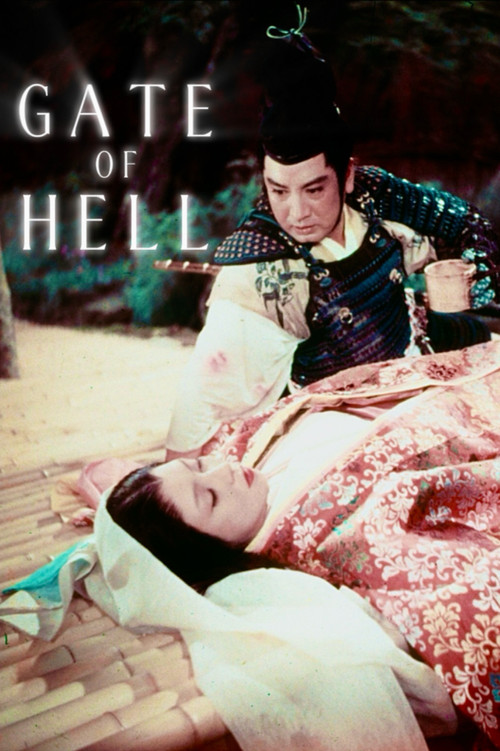
Gate of Hell
1953 · Teinosuke Kinugasa
For when you want a beautiful, ominous slow burn — a costume drama with a knot in its stomach. It suits a contemplative evening more than a comfort-food one.
What it's about
During a violent palace uprising in twelfth-century Japan, the samurai Moritō distinguishes himself by escorting a noblewoman decoy, Kesa, to safety — and falls consumingly in love with her. When his reward is his for the asking, he asks for her hand, only to learn she is already married to a fellow palace guard. His obsession refuses the answer, and heroism curdles into a pursuit that puts everyone's honor, and lives, in the balance.
The experience
It starts as sweeping historical spectacle and tightens into an intimate, airless triangle — the dread builds scene by scene as one man's wanting overrides everything. Stately in pace, but the emotional screws never stop turning.
Performances
Machiko Kyō gives Kesa a composed surface over unbearable private strain — a performance of what cannot be said aloud — while Kazuo Hasegawa makes Moritō's slide from hero to fixated pursuer disturbingly plausible.
The craft
This is one of the most ravishing color films ever made: silks, banners, and candlelit interiors composed like scroll paintings, with color itself carrying the emotion. It announced Japanese color cinema to the world, and it demands the biggest, best screen you can give it.
Why it matters
An international sensation that won the top prize at Cannes and Hollywood honors, it opened Western eyes to Japanese period cinema and set a benchmark for color design that filmmakers still study.
Snapshot
Gate of Hell (Jigokumon, 地獄門) is the film through which postwar Japanese color cinema announced itself to the world. A jidaigeki produced by the Daiei studio at the height of its international prestige, it tells a compact and pitiless story drawn from twelfth-century history: during the Heiji disturbance of 1159, the samurai Moritō (Kazuo Hasegawa) performs a feat of loyal valor by spiriting a decoy noblewoman to safety, conceives a consuming passion for her, and — on learning she is the lovely Kesa (Machiko Kyō), already married to the palace guard Wataru (Isao Yamagata) — pursues her with an obsession that will not be denied. What begins as a tale of feudal heroism narrows into a chamber tragedy of desire, coercion, and sacrifice, resolved by an act of self-immolating renunciation that turns a warrior into a penitent. The film's enduring fame, however, rests less on its narrative than on its surface: shot in Eastmancolor and conceived by a former avant-gardist with a painter's eye, it stunned audiences in Europe and America with the restraint and refinement of its color. It took the Grand Prix at the 1954 Cannes Film Festival and an Academy Honorary Award as the outstanding foreign language film released in the United States that year, with its costume designer Sanzō Wada also winning a competitive Oscar. For Western viewers of the early 1950s, Gate of Hell was a revelation of what color photography could be made to do, and it remains a landmark in the history of the medium's chromatic art.
Industry & production
Gate of Hell was produced by Daiei, the studio headed by Masaichi Nagata, whose ambitions for the international market had been spectacularly vindicated by the success of Kurosawa's Rashomon — a Daiei picture that took the Golden Lion at Venice in 1951 and, the following year, an Academy Honorary Award. That triumph reoriented the Japanese industry's sense of its own export possibilities, and Nagata pursued a deliberate strategy of prestige productions aimed at foreign festivals and audiences. Gate of Hell belongs squarely to this campaign: it pairs the studio's most internationally visible star, Machiko Kyō — who had played the woman at the center of Rashomon and would soon appear in Mizoguchi's Ugetsu and, later, in Hollywood's The Teahouse of the August Moon — with the veteran leading man Kazuo Hasegawa, one of the most popular and bankable actors in Japanese cinema, in a property mounted with conspicuous expense.
The film's most consequential production decision was its commitment to color. Japan's first color feature, Keisuke Kinoshita's Carmen Comes Home, had appeared in 1951 using the domestic Fujicolor process; Gate of Hell was made in Eastmancolor and represented Daiei's entry into color filmmaking, undertaken with the studio's full resources and a clear eye toward the impression it would make abroad. Color in early-1950s Japan was still costly and technically uncertain, and the choice to commit a major historical production to it — rather than to the safer, monochrome register of the prestige jidaigeki — was a calculated gamble on novelty and beauty as instruments of international appeal.
The screenplay, written by Kinugasa, adapts a play by Kan Kikuchi, the influential writer and literary entrepreneur, treating the legend of Endō Moritō and the lady Kesa. The source material gave the film a literary pedigree and a tightly bounded dramatic core. The detailed financial record of the production is not something the popular sources reliably document, and it would be invention to assign budget or box-office figures; what is securely established is the film's character as a flagship prestige release engineered, like Rashomon before it, to carry Daiei's name onto the world's screens.
Technology
The technological significance of Gate of Hell is inseparable from its use of Eastmancolor, the single-strip color negative process that, from the early 1950s, was rapidly displacing the cumbersome three-strip Technicolor system worldwide. The film stands as one of the most celebrated early Japanese uses of the process and, internationally, as one of the most artistically assured demonstrations of what the new color stocks could achieve in the hands of filmmakers who treated color as a compositional element rather than a spectacle. Where much early color cinema reached for saturated brilliance, Gate of Hell is distinguished by chromatic restraint and control — muted, harmonized tones, deliberate accents of intense color against subdued grounds — an aesthetic widely understood to draw on the traditions of Japanese scroll painting and woodblock printing. The achievement is as much one of taste and design as of engineering, but it depended on the technical latitude of the new stock and on careful management of the color process from costume and set through to the final print. Beyond its color, the film employs no unusual apparatus; its innovation lies entirely in the disciplined application of a still-young color technology to a refined pictorial end.
Technique
Cinematography
The cinematography is by Kōhei Sugiyama, and it is the film's most lauded element. Sugiyama's images are organized as a succession of carefully balanced color compositions: silks and banners deployed as deliberate chromatic events, interiors built from harmonized neutrals against which a single robe or curtain registers with calculated force, landscapes and processions arranged with the frontality and flatness of a painted scroll. The camera is generally composed and stately, favoring stable framings that let the eye read the surface of the image, though the film's celebrated opening — the chaos of the Heiji uprising, with its unfurling battle imagery — shows that the picture can mobilize movement and turbulence when the drama demands. The overarching strategy is pictorial: Sugiyama and Kinugasa treat the color frame as a designed object, and the film's international reputation as a watershed in color cinematography rests on the consistency and refinement of that design.
Editing
The film's editing serves its measured, almost ceremonial sense of pace. After the kinetic turbulence of the opening rebellion, the cutting settles into a deliberate rhythm that allows compositions to be held and read, and that concentrates the drama into a series of charged confrontations as the story contracts from public history to private obsession. The transitions tend toward clarity rather than display, organizing the narrative as a clean progression of cause and consequence. I am not able to attest reliably to the individual credited as editor, and I will not invent an attribution; what can be said with confidence is that the film's tempo — patient, accumulating, tightening toward its tragic resolution — is integral to its effect, refusing haste so that each step of Moritō's descent registers fully.
Mise-en-scène / staging
Gate of Hell is, above all, a triumph of staging and design. Its mise-en-scène reconstructs the aristocratic world of the late Heian period as a realm of formalized surfaces — courtly costume, screens, banners, horses, and architecture — composed for the color camera with the evident influence of classical Japanese pictorial art. The costumes, designed by the painter and color theorist Sanzō Wada, are not merely accurate but compositional: their hues and patterns are integral to the color scheme of each shot, and Wada's standing as a color authority was recognized by the Academy Award his work received. The staging draws a sustained contrast between the public and the intimate — the martial pageantry and crowded movement of the rebellion against the hushed, enclosed interiors in which the human tragedy plays out — and it uses the decorum of feudal manners to heighten the violence of Moritō's transgressive desire. Every element of the frame, from the placement of figures to the fall of fabric, is marshaled toward an ideal of pictorial harmony that the story's emotional violence then disrupts.
Sound
The score is by Yasushi Akutagawa — son of the writer Ryūnosuke Akutagawa, whose stories had furnished the basis of Rashomon — a composer of standing in postwar Japanese music. His music supports the film's blend of historical grandeur and intimate tragedy, lending ceremony to the public scenes and tension to the private ones. As with much jidaigeki of the period, the sound world also draws on the conventions and instrumental colors associated with classical Japanese performance traditions. The detailed sound-design record is thin in the popular literature, and beyond the prominence and quality of Akutagawa's score it would be speculative to claim specific innovations; the film's sonic register is best described as one of restrained, supportive scoring in service of mood and period.
Performance
The performances are pitched to the film's formal, tragic key. Kazuo Hasegawa's Moritō is the film's engine: a man whose battlefield valor curdles into a fixed and finally monstrous obsession, played with an intensity that the surrounding decorum makes all the more disturbing. Hasegawa traces the warrior's transformation from loyal hero to coercive pursuer to shattered penitent without softening the ugliness of his fixation, and the role's final turn toward renunciation gives the performance its tragic arc. Machiko Kyō's Kesa is its necessary counterpoint — composed, dignified, and trapped, her outward serenity concealing the resolve that will drive the story's terrible climax; Kyō, already an international presence through Rashomon, brings a controlled gravity that anchors the film's moral center. Isao Yamagata's Wataru, the husband, supplies the third point of the triangle as a figure of honorable constancy. The ensemble plays within the stylized register of the period film, and the restraint of the performances is consonant with the film's overall aesthetic of disciplined surface containing violent feeling.
Narrative & dramatic mode
The film's dramatic mode is tragedy, and its structure is one of progressive contraction. It opens onto the canvas of history — the Heiji disturbance, an actual twelfth-century power struggle — and stages Moritō's heroism within that public turmoil, only to abandon the historical panorama almost entirely once the private drama takes hold. From the moment Moritō fixes upon Kesa, the film narrows relentlessly: from war to court, from court to household, from household to a single bedchamber in which the tragedy is consummated. The engine is not plot complication but moral inevitability. Moritō's desire, having no legitimate object, can be satisfied only through coercion, and his demand for Kesa — a married woman — sets in motion a trap from which there is no honorable exit. The dénouement turns on an act of substitution and self-sacrifice whose specifics give the film its devastating force, and which converts the warrior's obsession into the occasion for his renunciation of the world. This is melodrama in the elevated sense: a drama of irreconcilable obligations — desire against marriage, loyalty against honor, life against death — in which the only resolution available is sacrificial.
Genre & cycle
Gate of Hell is a jidaigeki, the Japanese period film, and specifically a prestige historical drama set in the aristocratic past rather than the swordfighting chanbara of the popular tradition. Within the postwar cycle of internationally directed Japanese period films, it sits alongside Kurosawa's Rashomon and Mizoguchi's Ugetsu and Sansho the Bailiff as part of the wave of jidaigeki that carried Japanese cinema to Western festivals and art houses in the early 1950s. It is distinguished within that group by its color and by its concentration on courtly rather than martial or peasant material. As a story of fatal passion culminating in a woman's self-sacrifice and a man's spiritual conversion, it also draws on enduring patterns of Japanese tragic and Buddhist narrative, in which worldly attachment leads to ruin and renunciation. Its membership in the export-oriented prestige cycle is the most consequential generic fact about it: like its companions, it was made to be seen abroad, and it shaped foreign perceptions of what Japanese cinema was.
Authorship & method
Teinosuke Kinugasa, by the time of Gate of Hell, was a veteran of nearly three decades in Japanese film with one of the more remarkable trajectories in the national cinema. He had begun as an onnagata, a male performer of female roles, before moving behind the camera, and in the silent era he had made two of the most radical avant-garde films in Japanese history — A Page of Madness (Kurutta ichipeiji, 1926), an expressionist tour de force set in an asylum, and Crossroads (Jūjiro, 1928), which he carried to Europe. That experimental formation is the key to understanding Gate of Hell: the film's mastery of pictorial composition and its treatment of color as an expressive, designed system reflect the sensibility of an artist long attuned to the image as a constructed thing, even as the mature work trades the silent avant-garde's frenzy for classical restraint.
Kinugasa's authorship here is realized through an exceptional team of collaborators, and the film is fairly understood as a convergence of design talents. Cinematographer Kōhei Sugiyama executed the color compositions; costume designer Sanzō Wada, a painter and recognized color theorist, supplied the chromatic vocabulary that the Academy singled out for its own award; composer Yasushi Akutagawa provided the score. Kinugasa also wrote the screenplay himself, adapting Kan Kikuchi's play, so that the film's narrative shape as well as its visual conception bear his hand. The method on display is one of total pictorial control — a film conceived as a sequence of designed color images in which costume, set, and photography are coordinated toward a unified aesthetic. Where the documentary record is thin on the granular division of creative labor among these collaborators, the safest characterization is that Gate of Hell is a designer's film as much as a director's, its beauty the product of a coordinated visual culture rather than any single department.
Movement / national cinema
The film is a central document of the postwar internationalization of Japanese cinema. The years from 1951 to the mid-1950s saw a remarkable run of Japanese pictures triumph at European festivals — Rashomon at Venice, Ugetsu there as well, and Gate of Hell at Cannes — establishing Japanese film as one of the major national cinemas in the eyes of Western critics and cinephiles for the first time. Gate of Hell was an instrument of that breakthrough, and its specific contribution was to demonstrate that Japanese cinema commanded not only narrative and dramatic sophistication but a distinctive and superlative visual culture, rooted in indigenous pictorial traditions yet realized through the newest film technology. It belongs to the Daiei strand of this movement — the studio of Nagata, oriented above all to the international prestige market — and it should be read as part of a deliberate national-industrial project to win foreign recognition and revenue, as much as an expression of any aesthetic school. Its color, drawing visibly on the ukiyo-e and scroll-painting heritage, made the encounter between a Japanese visual tradition and Western audiences peculiarly direct.
Era / period
The film is doubly periodized. As an artifact, it is a product of early-1950s Japan, made in the years just after the Allied occupation ended, when the industry was both recovering its confidence and discovering an international audience; its very existence as a costly color prestige export speaks to that moment of postwar industrial ambition and outward-looking optimism. As a depicted world, it reaches back to the late Heian period and the Heiji disturbance of 1159, a historical episode of court factional warfare. The film treats that distant aristocratic past with reverence and pictorial care, reconstructing its costumes, manners, and architecture as objects of beauty, but it uses the historical setting less for political analysis than as the stage for a timeless tragedy of passion and honor. The gap between the two eras is itself meaningful: a modern, technologically advanced 1950s industry turning the new medium of color toward the recreation of a remote national past, presenting that past to the world as both heritage and spectacle.
Themes
At the film's core is the theme of destructive desire — passion that, finding no legitimate channel, becomes coercion and ruin. Moritō's obsession with Kesa is presented without exculpation as a force that corrodes the warrior's honor and threatens an innocent household, and the film's moral seriousness lies in its refusal to romanticize it. Against this stands the theme of fidelity and sacrifice, embodied in Kesa, whose resolution of the impossible situation forced upon her is an act of self-immolation in defense of her marriage and her husband's life. The tension between obligation and desire — between the claims of marriage, loyalty, and honor and the disordering power of want — organizes the whole. Threaded through it is a Buddhist-inflected vision of worldly attachment as the source of suffering, culminating in renunciation: the transformation of the obsessed warrior into a penitent who turns from the world is the film's final moral statement, the recognition that the only release from such passion is its abandonment. Underlying these is a meditation on the relationship between surface and depth — between the exquisite, ordered beauty of the depicted world and the violence of feeling it contains — a tension the film's own ravishing form enacts.
Reception, canon & influence
Gate of Hell was received in the West as a sensation of color, and its early reputation rested overwhelmingly on the beauty of its images. It won the Grand Prix at the Cannes Film Festival in 1954 and received an Academy Honorary Award as the outstanding foreign language film released in the United States that year, while Sanzō Wada won the competitive Academy Award for Best Costume Design (Color) — recognition that confirmed the film's status as a benchmark for the artistic use of color. Western critics and filmmakers responded with particular intensity to its chromatic refinement, and it became, for a time, a standard reference in discussions of color cinematography. The critical record over the longer term has been more measured about the film's dramatic content than about its visual achievement, and its reputation today is most secure precisely as a landmark of color design; this division between rapturous praise for its surface and cooler assessment of its drama is itself a recurring feature of its reception.
The influences on the film run backward to the deep traditions of Japanese visual art — the scroll painting and woodblock print whose compositional sense and color harmonies inform Sugiyama's photography and Wada's costumes — and to Kinugasa's own formation in the silent avant-garde, with its conception of the image as an expressive construction. The narrative draws on Kan Kikuchi's dramatization of an established legend and, behind it, on the historical and Buddhist literary traditions surrounding the Heiji era and the figure of the warrior-turned-monk.
Its influence forward is felt chiefly in two registers. Within the international breakthrough of Japanese cinema, it consolidated, alongside Rashomon and Ugetsu, the postwar arrival of Japanese film on the world stage and helped fix the Western image of Japanese cinema as a tradition of exceptional visual beauty. Within the history of color, it became an enduring touchstone for filmmakers and critics concerned with the disciplined, painterly use of the color frame — an example, repeatedly cited, of color treated as composition rather than mere reproduction, and a counterargument to the assumption that early color meant garish saturation. If its dramatic standing has proven less commanding than that of its great contemporaries, its place in the canon as a pioneering achievement of color art is secure.
A Deleuzian reading
Watch the moment Moritō first looks at her.
The full Deleuzian reading of Gate of Hell →
Reception
In 1954 it swept the West — the Grand Prix at Cannes plus two Academy Awards — as part of the wave (after Rashomon and Ugetsu) that opened Western eyes to Japanese cinema, while critics at home in Japan shrugged, seeing it as pretty exotica for export. Then its Eastmancolor prints literally faded for decades, until the 2011 restoration (and subsequent Criterion release) brought its colors roaring back and re-established it as a landmark.
How Gate of Hell was received, from release to now →
Influences: the films it descends from and the films it influenced
- A Page of Madness (1926) — Kinugasa's own silent expressionist experiment trained him to treat the frame as a constructed, designed image rather than a record of action — the compositional control later disciplined into Gate of Hell's color staging.
- Crossroads (1928) — Kinugasa's avant-garde period piece established his method of building mood through deliberate chiaroscuro and pictorial abstraction, the same image-first sensibility carried into the color frame three decades later.
- Becky Sharp (1935) — The first three-strip Technicolor feature pioneered color as dramaturgy — coding emotion and scene through palette shifts — the foundational idea Gate of Hell refines into painterly restraint.
- Black Narcissus (1947) — Jack Cardiff's controlled, painting-derived Technicolor design treated color as emotional architecture, the precedent for Sugiyama and Wada conceiving color as composition rather than reproduction.
- The Red Shoes (1948) — Its fusion of costume, set, and lighting into a single chromatic design system models the total pictorial control Gate of Hell exercises over its Heian palette.
- The River (1951) — An early non-Hollywood demonstration that color could be quiet and painterly rather than garish, anticipating Gate of Hell's argument against saturated spectacle.
- Rashomon (1950) — The film that opened the West to Japanese cinema and gave Machiko Kyō her breakthrough as the ambiguous object of desire — both the festival pathway and the lead performer Gate of Hell inherits.
- Ugetsu (1953) — Mizoguchi's period tragedy, also starring Machiko Kyō, set the model of ceremonial pacing and a painterly classical frame applied to a tale of desire and ruin.
- An Actor's Revenge (1963) — Ichikawa extends Gate of Hell's stylized color jidaigeki into widescreen kabuki theatricality, foregrounding the onnagata performance tradition that was Kinugasa's own origin.
- Kwaidan (1964) — Kobayashi builds an entirely studio-painted, designed color world for its period ghost tales, the fullest extension of Gate of Hell's principle of color as constructed composition.
- Cries and Whispers (1972) — Bergman and Sven Nykvist organize the whole film around a single dominant hue as an expressive, designed system, the logical heir to color-as-composition over color-as-record.
- Ran (1985) — Kurosawa color-blocks armies and costumes into compositional fields within a Heian-descended jidaigeki, treating Wada-style costume color as the primary design instrument Gate of Hell pioneered.
- Hero (2002) — Zhang structures the period narrative through monochrome color chapters, pushing Gate of Hell's idea of color as composition and meaning to a programmatic extreme.
- House of Flying Daggers (2004) — Its painterly, saturated-yet-controlled period palette and costume-driven color staging carry forward the disciplined chromatic design lineage of the painterly martial frame.
- In the Mood for Love (2000) — Wong and Christopher Doyle make costume and color the medium of suppressed desire, extending Gate of Hell's pairing of stylized restraint with chromatic composition to render coercion and longing.
- Samurai I: Musashi Miyamoto (1954) — Kinugasa's Fujicolor work treated color as tonal grammar rather than spectacle — deliberately desaturated registers for interiority, saturated reds as moral alarm — establishing the chromatic restraint Inagaki extends in Eastmancolor the following year.
- Samurai II: Duel at Ichijoji Temple (1955) — As the first Japanese feature in Eastmancolor, Kinugasa's film established the color-processing conventions and saturated palette that Toho adopted for the Samurai trilogy, making it the direct technical model for Inagaki's prestige color cinematography.
- Tokyo Drifter (1966) — As Japan's first major color film, it established Kabuki-derived theatrical blocking and frontal staging within expressive Eastmancolor cinematography — using bold flat color planes in interior sets as emotional rather than environmental description, the chromatic design logic Suzuki radicalizes into primary-color set abstraction.
- In the Realm of the Senses (1976) — Pioneers the lacquered, hyper-saturated period-color palette and meticulous historical interior reconstruction that Hideo Itō's shunga-inflected cinematography descends from.
- Dolls (2002) — Pioneers the deliberately super-saturated Eastmancolor jidaigeki palette, treating dyed-textile color as the film's primary expressive medium — the ancestor of Dolls' color-as-structure logic carried by costume.
- Sansho the Bailiff (1954) — A contemporaneous postwar jidaigeki built on scroll-like long-take composition and Buddhist tragedy of self-sacrifice, sharing Gate of Hell's ceremonial tempo and moral register.
- Senso (1954) — Visconti's near-simultaneous turn to lush period color treats costume and painting as the source of the palette, the same costume-theorist's approach Sanzō Wada brought to Gate of Hell.
Similar films
- Ugetsu (1953) — influence & lineage
- Ran (1985) — influence & lineage
- Rashomon (1950) — influence & lineage
- Sansho the Bailiff (1954) — influence & lineage
- In the Mood for Love (2000) — influence & lineage
- Chikamatsu Monogatari (1954) — shared sensibility
- The Life of Oharu (1952) — shared sensibility
- Kagemusha (1980) — shared sensibility
All the films related to Gate of Hell →