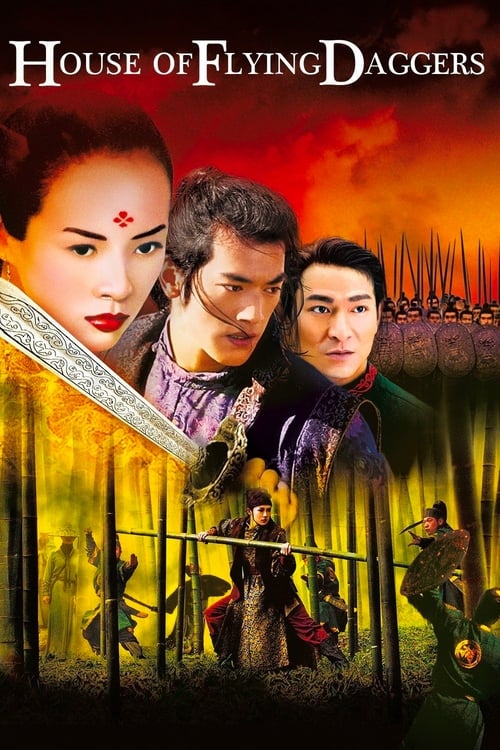
House of Flying Daggers
2004 · Zhang Yimou
For a big, swoony spectacle night — when you want to be dazzled and don't mind your action movie turning into a full-blooded tragic romance. Pure sensory pleasure, zero homework.
What it's about
In 859 AD, as the Tang Dynasty rots, a corrupt government hunts a rebel society called the Flying Daggers. A charming captain named Jin breaks Mei, a beautiful blind dancer suspected of rebel ties, out of prison — a ruse meant to lead the authorities to her comrades. On the road, pursuit turns to romance and a love triangle forms, but in this world of spies and double agents, almost no one is who they claim to be.
The experience
Ravishing and headlong — an action romance that plays like a fever dream, with combat staged as choreography and colors so saturated they feel like emotions. It sweeps you up first and breaks your heart second.
Performances
Zhang Ziyi is the film's center of gravity, dancing, fighting, and playing layers of pretense as the blind Mei, with Takeshi Kaneshiro's roguish charm and Andy Lau's watchful stillness completing the triangle.
The craft
Zhang Yimou builds set pieces you don't forget — an echo-game dance in a pleasure house, a bamboo-forest ambush from above, a battle as the season itself turns — each color-coded and scored like an aria. This is exactly the film big screens and good speakers exist for; every frame is composed like a painting.
Why it matters
Alongside its immediate predecessor it powered the global wuxia wave of the early 2000s, proving Chinese martial-arts spectacle could be international event cinema, and completed Zhang Yimou's reinvention as a director of grand visual epics.
Snapshot
House of Flying Daggers (Chinese: 十面埋伏, Shí miàn mái fú, "Ambush from Ten Sides") is Zhang Yimou's second consecutive martial-arts epic, following Hero (2002), and the film that consolidated his early-2000s reinvention from poet of provincial melodrama into a maker of internationally marketed wuxia spectacle. Set in 859 AD, in the twilight of the Tang Dynasty, it stages a love triangle inside a labyrinth of espionage: a captain named Jin (Takeshi Kaneshiro) springs a blind dancer, Mei (Zhang Ziyi), from custody, ostensibly to follow her back to the outlawed Flying Daggers society, while his fellow officer Leo (Andy Lau) watches from the shadows. Almost nothing in that premise survives intact; the picture is built on a cascade of reversals in which identities, allegiances, and even Mei's blindness prove to be performances. Where Hero was a chilly meditation on power and unity, Daggers is a melodrama of doomed romance dressed in the grammar of action cinema, and it is among the most ravishingly photographed films of its decade — a quality recognized by an Academy Award nomination for cinematography.
Industry & production
The film belongs to the wave of pan-Asian, globally financed wuxia blockbusters that Ang Lee's Crouching Tiger, Hidden Dragon (2000) made commercially viable. It was a Chinese–Hong Kong co-production assembled through Edko Films and producer Bill Kong, the Hong Kong financier whose backing connects Crouching Tiger, Hero, and Daggers into a loose commercial lineage, together with Zhang's mainland production apparatus. The casting was deliberately cross-territorial — Zhang Ziyi from the mainland, the Japanese-Taiwanese star Takeshi Kaneshiro, and the Hong Kong Cantopop and screen icon Andy Lau — a configuration designed to sell across Greater China and into Western art-house and crossover markets, where Sony Pictures Classics handled the U.S. release.
Production was shadowed by tragedy. The veteran Hong Kong star Anita Mui had been cast as the leader of the Flying Daggers; she died of cervical cancer in late December 2003, during or shortly before her scenes. Rather than recast, Zhang rewrote the role out of the finished film and dedicated the picture to her memory — a decision that subtly alters the narrative architecture, leaving the society's leadership more diffuse than originally planned. The film premiered out of competition at the 2004 Cannes Film Festival, positioning it from the outset as a prestige international release rather than a purely domestic genre product.
Technology
Daggers was made at the moment the digital intermediate (DI) was becoming standard for high-end features, and like Hero before it the film clearly depends on extensive digital color control to achieve its saturated, chromatically themed environments — the emerald bamboo, the autumnal meadow, the final blanketing white. The precise grading pipeline is not something I can document in detail without risking invention, but the look is consistent with a film color-managed in post rather than achieved entirely in-camera. Visual effects are used with notable restraint for a film of this scale: digital work augments the wirework and the famous flight of blades and bamboo, but the aesthetic priority is plainly photographic and physical rather than effects-driven. The signature technological "instrument" of the film is arguably analog and choreographic — the rigging of wires, the drums of the Echo Game, the engineered fall of bamboo — more than any computer-generated set piece.
Technique
Cinematography
The cinematography, by Zhao Xiaoding, is the film's defining achievement and earned the production its sole Academy Award nomination. Zhang organizes the picture as a sequence of color-coded movements: the jewel-toned interior of the Peony Pavilion brothel; the overwhelming green of the bamboo forest; a golden, wind-rippled meadow; and a final duel that begins in autumn and ends, impossibly and beautifully, in snow. The camera is mobile and often vertiginous, plunging through bamboo canopies and tracking thrown daggers in flight, yet Zhao consistently composes for graphic clarity — silhouettes against fields of single dominant color, costume and landscape tuned to the same palette. The result reads less as naturalism than as a series of designed images, each scene keyed to an emotional register through hue.
Editing
The editing, credited to Cheng Long, has to manage two competing demands: the propulsive rhythm of the action sequences and the film's reliance on withheld information. Set pieces such as the bamboo-forest ambush are cut for kinetic legibility, sustaining spatial coherence across rapid wire-assisted movement. Elsewhere the cutting serves the plot's machinery of revelation, timing the disclosure of each reversal — Mei's sight, Leo and Mei's prior bond, the officers' true mission — for maximum reversal of audience sympathy. Some critics have argued the film accumulates these turns faster than its emotional logic can absorb; the editing is where that strain is most visible.
Mise-en-scène / staging
Zhang stages two bravura sequences that have become the film's calling cards. The first is the "Echo Game" in the brothel, in which Leo flings beans at a ring of standing drums and the supposedly blind Mei must strike the same drums with the long silk sleeves of her dance costume — a set piece that fuses dance, percussion, and martial display into a single rhythmic event. The second is the bamboo-forest battle, in which soldiers drop through the canopy and fell sharpened bamboo as weapons. Throughout, Zhang treats landscape as a participant: the meadow, the forest, and the snow are not backdrops but pressures shaping the action and the romance.
Sound
Sound design is unusually foregrounded for a wuxia film, largely because of the Echo Game, which makes the audibility of beans striking drumheads a dramatic event in itself — the soundtrack becomes the mechanism of the scene. More broadly the film exploits the acoustic texture of its environments: the hush and rustle of bamboo, wind across the meadow, the muffling of the closing snowfall. These ambient registers work in close partnership with the score rather than being subordinated to it.
Performance
Zhang Ziyi anchors the film, and the role is constructed as a layered performance-within-a-performance: Mei must convincingly play a blind woman to the other characters while signaling, in retrospect, the calculation beneath. Her dancer's physical training is exploited directly in the Echo Game. Takeshi Kaneshiro plays Jin as a charming, increasingly unmoored rake whose feigned seduction curdles into genuine feeling, while Andy Lau gives Leo a banked, jealous gravity that pays off in the final confrontation. The film's emotional credibility rests on whether these three can sustain sincerity through so many reversals of pretext; performances are central to whatever conviction the melodrama achieves.
Narrative & dramatic mode
The dramatic mode is melodrama in the strict sense — a cinema of heightened emotion, coincidence, and fated love — wearing the costume of the spy thriller and the action film. The narrative is governed by deception and disclosure: virtually every relationship is initially presented as a cover story and then peeled back. This structure generates real suspense but also courts implausibility, since each revelation requires the audience to retroactively reinterpret what it has seen. The film ultimately subordinates its political frame — the corrupt government, the rebel society — to the private agony of the triangle, so that the war recedes and the three lovers' mutual betrayals become the only stakes that matter. The closing duel, fought across a season's change into snow, abandons strict realism for operatic, almost abstract emotional expression.
Genre & cycle
Daggers is a wuxia film, the Chinese martial-chivalry genre with deep roots in literature, Peking opera, and the Hong Kong cinema of King Hu and Chang Cheh. More specifically it belongs to a short, intense cycle of prestige wuxia epics that followed Crouching Tiger, Hidden Dragon: Zhang's own Hero (2002) and Daggers (2004), Chen Kaige's The Promise (2005), and Zhang's Curse of the Golden Flower (2006). These films share lavish budgets, painterly color schemes, star ensembles, wire-fu choreography, and an address to global as well as domestic audiences. Within that cycle Daggers is the most romance-driven and the least overtly allegorical, trading Hero's philosophical-political argument for a tragedy of love.
Authorship & method
The film is the product of Zhang Yimou working with a roster of major collaborators. The screenplay is credited to Zhang with Li Feng and Wang Bin. Action choreography was directed by Ching Siu-tung, the Hong Kong action master whose stylized, gravity-defying wirework (familiar from the A Chinese Ghost Story and Swordsman films) shapes the film's combat aesthetic. Cinematographer Zhao Xiaoding gives the film its color-keyed visual identity. The score is by the Japanese composer Shigeru Umebayashi — best known internationally for Wong Kar-wai's In the Mood for Love — whose lush, melancholy themes underline the romance; the end-credits song "Lovers," sung by the soprano Kathleen Battle, extends that register into the concert-hall sublime. Editing is credited to Cheng Long.
Methodologically, Daggers exemplifies Zhang's lifelong preoccupation with color as primary expressive material — the same sensibility that organized Red Sorghum, Ju Dou, and Raise the Red Lantern now scaled up to blockbuster landscape and action. His method here is to subordinate every department — costume, location, choreography, sound — to a unifying chromatic and emotional design per sequence, a strongly authorial, almost compositional approach to spectacle. The well-documented anecdote that an unseasonal snowfall during the Ukrainian shoot of the finale forced Zhang to adapt and incorporate the real snow into the climactic duel is characteristic of his willingness to fold accident into design.
Movement / national cinema
Zhang Yimou is a foundational figure of China's Fifth Generation, the cohort of directors who graduated from the Beijing Film Academy in the early 1980s and remade Chinese cinema with visually bold, often allegorical work — Chen Kaige and Tian Zhuangzhuang among his peers. Zhang first emerged as a cinematographer (notably on Chen's Yellow Earth) before directing the internationally celebrated melodramas of the late 1980s and 1990s, many starring Gong Li. Hero and Daggers mark his pivot from that mode toward state-of-the-art commercial spectacle. That pivot was contentious: Hero in particular drew criticism for what some read as an endorsement of authoritarian unification, and Zhang's move into big-budget nationalist-scaled cinema was debated as accommodation with the official film industry. Daggers, with its apolitical romantic core, is harder to read in those terms, but it remains part of the same project of building a Chinese cinema able to compete with Hollywood on production scale and global reach.
Era / period
The film is set in 859 AD, the late Tang Dynasty, a period of dynastic decline, factionalism, and rural unrest — a historical frame that makes the existence of an outlaw society opposing a corrupt government plausible. The period detail is treated decoratively rather than documentarily: costume, music, and architecture evoke a stylized Tang grandeur tuned to the film's color schemes rather than to strict historical reconstruction. As with much wuxia, the past functions less as history than as a mythic stage on which questions of loyalty, love, and honor can be played at heightened pitch.
Themes
The film's governing theme is the instability of appearances — sight and blindness, sincerity and performance, cover story and truth. Mei's feigned blindness literalizes a world in which seeing cannot be trusted, and the recurrent motif of disguise extends to every major character. Against this runs the theme of love as both weapon and undoing: affection initially deployed as espionage tradecraft becomes genuine, and that genuineness is precisely what destroys the characters. The film also sets the personal against the political, ultimately privileging private passion over collective cause to the point that the rebellion all but vanishes from the climax. Finally, there is the recurrent Zhang preoccupation with the relationship between human emotion and the natural world, the seasons and landscapes that mirror and amplify feeling — never more literally than in the snow that falls on the final duel.
Reception, canon & influence
Critically, Daggers was widely praised for its visual splendor, its action choreography, and Zhang Ziyi's performance; the cinematography in particular drew near-universal admiration and the Academy Award nomination. Among English-language critics it was a strong favorite — Roger Ebert was a notable enthusiast — though a recurring reservation held that the film's piling-up of plot reversals strained credibility and that the prolonged, season-defying final duel tipped from the operatic into the excessive. The consensus that emerged places it as the more emotionally generous and visually rapturous companion to the colder, more intellectually ambitious Hero.
Looking backward, the film draws on a deep wuxia lineage. The bamboo-forest battle is in direct dialogue with King Hu's A Touch of Zen (1971), whose bamboo-grove swordplay is the genre's canonical reference, and with the same motif in Crouching Tiger, Hidden Dragon, the film that made this whole cycle commercially imaginable. The Chinese title, Ambush from Ten Sides, invokes a famous classical pipa composition, anchoring the film in a traditional musical and martial imaginary. More broadly it inherits the Hong Kong wire-fu tradition through Ching Siu-tung's choreography and Zhang's own long-standing chromatic expressionism.
Looking forward, Daggers helped sustain — and, with the cycle's eventual exhaustion, helped define the high-water mark of — the international wuxia blockbuster boom of the mid-2000s, feeding directly into Zhang's Curse of the Golden Flower (2006) and the broader run of Chinese epics that followed. Its color-saturated, landscape-scaled action cinematography became a widely admired reference point, and the film remains a touchstone for discussions of how genre spectacle can be made to carry both painterly beauty and melodramatic feeling. If its influence is less often discussed in narrative terms than in visual ones, that is fitting for a film whose deepest authorship lies in the image.
A Deleuzian reading
Watch the bean leave Leo's fingers.
The full Deleuzian reading of House of Flying Daggers →
Reception
Landed in 2004 as the flashier half of Zhang Yimou's one-two wuxia punch with Hero — critics swooned over the visuals but many sniffed at the melodrama; today it's settled in as a beloved eye-candy classic, endlessly gif'd even by people lukewarm on the story.
How House of Flying Daggers was received, from release to now →
Influences: the films it descends from and the films it influenced
- A Touch of Zen (1971) — Its bamboo-grove swordfight — bodies glimpsed and fragmented through swaying foliage, cut for spatial disorientation — is the canonical set piece Daggers directly reworks in its bamboo-forest ambush.
- Dragon Inn (1967) — Establishes the landscape-as-battlefield ambush staging — converging attackers exploiting terrain — that Daggers' 'Ambush from Ten Sides' choreography extends to color-scaled scope.
- Come Drink With Me (1966) — Pioneers the balletic female warrior whose deceptively poised stillness erupts into precise, dance-blocked combat — the template for Mei's restaurant Echo Game performance.
- Crouching Tiger, Hidden Dragon (2000) — Made the prestige international wuxia commercially imaginable and set the airborne bamboo-treetop duel as a marquee motif that Daggers answers with its own forest battle.
- Hero (2002) — Zhang's immediately prior film, organizing the narrative into color-coded sequences where each saturated palette carries a distinct emotional and narrative register — the structural method Daggers inherits.
- Raise the Red Lantern (1991) — Establishes Zhang's signature of subordinating every department to a unifying chromatic design per space, color as primary expressive material later scaled up to landscape action.
- Ju Dou (1990) — Its dye-vat cascades of saturated fabric color demonstrate Zhang's use of textile and pigment as emotional symbolism, a sensibility carried into Daggers' costume-keyed palettes.
- Red Sorghum (1987) — The blood-red sorghum fields launch Zhang's chromatic expressionism — landscape flooded with a single charged hue — the authorial signature Daggers monumentalizes.
- A Chinese Ghost Story (1987) — Showcases choreographer Ching Siu-tung's gravity-defying wirework and aerial flight aesthetic that directly shapes Daggers' combat design.
- Swordsman II (1992) — Refines Ching's stylized wire-fu — impossible trajectories, weapons as extensions of flung sleeves and fabric — the Hong Kong tradition Zhang imports through the same choreographer.
- Gate of Hell (1953) — Its painterly, saturated-yet-controlled period palette and costume-driven color staging carry forward the disciplined chromatic design lineage of the painterly martial frame.
- Dolls (2002) — Extends the color-coded-costume melodrama into an explicitly seasonal, snowbound tragedy of doomed lovers, sharing Dolls' method of letting fabric, landscape, and seasonal shift carry a fated-love parable.
- Curse of the Golden Flower (2006) — Zhang's direct successor, pushing the color-saturated, landscape-and-costume-keyed spectacle of Daggers into maximalist palace-scaled chromatic excess.
- The Promise (2005) — A Fifth Generation peer chasing the international wuxia-blockbuster mode Daggers helped define, foregrounding CGI-assisted, color-designed fantasy combat.
- The Banquet (2006) — Rides the mid-2000s boom with color-keyed wuxia melodrama, subordinating choreography to a unifying chromatic and emotional design per sequence in Zhang's manner.
- Reign of Assassins (2010) — Builds its plot on the female assassin operating under layered disguise and shifting allegiance — the performance-of-deception structure central to Mei's character.
- Shadow (2018) — Inverts Daggers' hyper-saturation into an ink-wash monochrome palette — a self-reflexive return that proves color-design-as-authorship by subtracting the color.
- In the Mood for Love (2000) — Composer Shigeru Umebayashi's lush, melancholic recurring string theme from this film is the emotional idiom he brings to Daggers' romance score.
- The Grandmaster (2013) — Pairs Umebayashi-style melancholic scoring with painterly, slow-motion martial choreography treated as emotional lyric rather than mere action, the same fusion of beauty and feeling.
- Memoirs of a Geisha (2005) — The Echo Game drum-dance builds an entire setpiece from Zhang Ziyi's ritualized movement as dancer-performer — the same conception of choreographed female performance Memoirs stages in Sayuri's debut dance.
Similar films
- Hero (2002) — influence & lineage · same viewing thread · often watched together
- Crouching Tiger, Hidden Dragon (2000) — influence & lineage · same viewing thread
- Dragon Inn (1967) — influence & lineage · same viewing thread
- Shadow (2018) — influence & lineage · often watched together
- Raise the Red Lantern (1991) — influence & lineage
- Come Drink with Me (1966) — influence & lineage
- The Grandmaster (2013) — influence & lineage
- In the Mood for Love (2000) — influence & lineage
All the films related to House of Flying Daggers →
Watch it with: curated runs of related films
- Wuxia and Its Heirs — Watch these as a bloodline — King Hu's weightless swordplay flowering into Zhang Yimou's painted epics and finally Tarantino's homage, all built on choreography as dance.