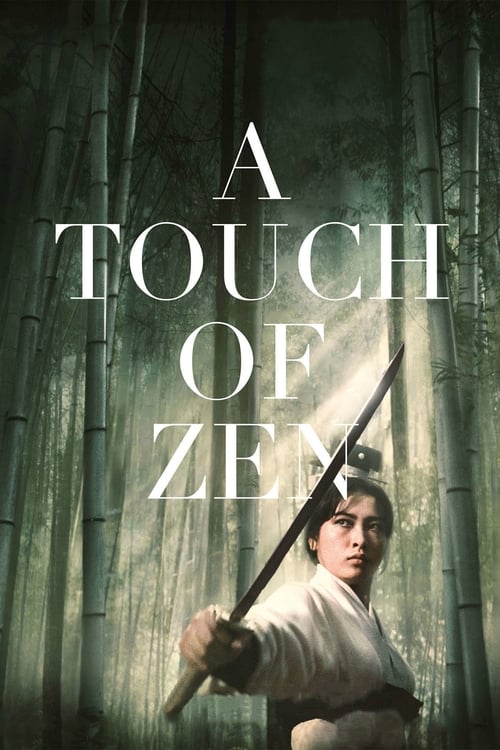
A Touch of Zen
1970 · King Hu
For when you want to give a whole evening to a masterpiece — a challenge-and-reward watch for a focused night, not background viewing. Reach for it when you're craving action with genuine mystery and spiritual weight.
What it's about
An unambitious small-town scholar-painter becomes curious about the mysterious woman lodging in the supposedly haunted fort next door — and discovers she is a fugitive noblewoman hunted by a corrupt regime's secret police. What begins as a quiet ghost story opens out into a vast tale of intrigue, martial-arts resistance, and Buddhist monks whose skills verge on the miraculous.
The experience
A three-hour epic that keeps transforming under you — eerie and hushed, then thrillingly kinetic, then serenely mystical. It demands patience and repays it with some of the most breathtaking action ever staged, and an ending that feels closer to revelation than victory.
The craft
King Hu choreographs combat as bursts of movement cut on rhythm rather than continuous spectacle — the legendary bamboo-forest fight alone rewrote what a sword duel could look like. Mist, sunlight, and mountain landscapes are used almost as characters, and the shift from ghost-story atmosphere to Buddhist transcendence is engineered entirely through image and sound. See it as big and loud as you can.
Why it matters
Its 1975 Cannes recognition made it the most internationally celebrated Chinese-language film of its era, and its editing style and bamboo-grove imagery echo through decades of martial-arts cinema since.
Snapshot
A Touch of Zen (俠女, Xia Nü, literally "The Chivalrous Woman") is King Hu's three-hour wuxia epic, adapted from a brief supernatural tale by the Qing-dynasty writer Pu Songling. It begins as a hushed provincial ghost story — an idle village scholar drawn to a mysterious woman lodging in a supposedly haunted fort — and, across its enormous running time, metamorphoses into a martial-arts intrigue about eunuch secret police, then again into a work of Buddhist metaphysics in which enlightenment, not victory, is the destination. Made in Taiwan over an unusually protracted production and released domestically in two parts before circulating internationally as a single feature, the film was a commercial disappointment on first release but became, after its 1975 Cannes recognition, the most internationally celebrated Chinese-language film of its era and a foundational reference for the modern martial-arts art film. Its bamboo-grove duel is among the most imitated sequences in world cinema.
Industry & production
The film was produced by the Union Film Company (聯邦影業, Lianbang), the Taiwanese studio that had backed Hu after his departure from Hong Kong's Shaw Brothers. Hu had left the vertically integrated Shaw system — where he made the genre-defining Come Drink with Me (1966) — for the greater creative autonomy Taiwan offered, and there directed the smash hit Dragon Inn (Dragon Gate Inn, 1967) before embarking on A Touch of Zen. That autonomy came at a cost: the production is famous for its length and difficulty. Rather than shoot on standing studio sets, Hu had a substantial fort/compound built as a location and, by widely repeated account, allowed it to weather and become overgrown so that it would read as genuinely abandoned on camera — a decision that stretched the schedule across an extended period (commonly dated roughly 1968–1970). Exact budget figures and precise shooting-day counts are not something I can state reliably, and I won't invent them; what the historical record consistently emphasizes is that the shoot was long, perfectionist, and financially strained.
The distribution history reflects that strain. In Taiwan the film was released in two separate parts, and it did not perform well commercially on first release — a failure often attributed to its length, its slow-burn structure, and its refusal of straightforward genre gratification. Its fortunes reversed only when a re-edited, complete version reached the 1975 Cannes Film Festival.
Technology
A Touch of Zen was shot on 35mm color film in a widescreen format, the standard prestige configuration for the Hong Kong/Taiwan wuxia films of the period. Its most consequential "technology," however, is mechanical and editorial rather than optical. Hu's action does not rely on visible effects; it relies on trampolines, wires, undercranking, and above all cutting to manufacture superhuman lightness. Fighters leap into and out of frame, alight in treetops, and cross impossible distances because the camera and the cutting bench conspire to elide the physics — a performer springs from a hidden trampoline, the cut lands them on a branch, and the eye completes a flight that was never continuously photographed. This assembly-based approach to weightlessness (qing gong, the "lightness skill" of martial legend) is the film's signature technical achievement and its most influential legacy.
Technique
Cinematography
The cinematography, by Hua Hui-ying, is central to the film's reputation. Hu composes for landscape and for light: reeds, mist, misty ridgelines, and the celebrated bamboo forest, where shafts of sun rake through vertical stalks and dust hangs in the air. The most quoted passage is the bamboo-grove ambush, in which combatants dart among the trunks in glancing fragments — a flash of a body, a sword, a treetop — assembled into a rhythm of appearance and disappearance rather than sustained combat coverage. The film's finale pushes the camera toward the sun itself, using solar flare and silhouette to render spiritual transcendence in optical terms. Throughout, Hu favors the expressive over the merely legible: he will withhold a clear geography of a fight in order to preserve mystery, surprise, and graphic beauty.
Editing
Editing is arguably the film's true authorship. Hu, who cut his own films, built action out of very brief shots — sometimes only a few frames — so that a leap or a strike registers as a sensation of speed rather than a readable movement. The debt is to Peking (Beijing) opera, where combat is stylized, rhythmic, and percussive rather than realistic; Hu translates that stage grammar into montage, letting the cut, not the choreography alone, carry the tempo. The result is a form of action editing that prizes ellipsis and musical phrasing, and it is this editorial signature — the "flash cut" flight — that later filmmakers would study most closely.
Mise-en-scène / staging
Hu was trained as a painter and had worked as an art director, and A Touch of Zen is meticulously designed as a series of compositions. The Ming-dynasty world is rendered with attention to architecture, costume, and the textures of a decaying frontier outpost; the overgrown fort functions almost as a character, a haunted stage on which the early "ghost story" acts play out. Hu stages set-pieces with theatrical spatial logic — thresholds, courtyards, cobwebbed rooms, the forest as an arena — and choreographs not just fighters but atmosphere: fog, dusk, the interplay of the built and the natural.
Sound
The score is by Wu Ta-chiang, and it is built substantially on the percussion idiom of Peking opera — the drums, clappers, and gongs that in the opera tradition punctuate and drive combat. Rather than a Western symphonic underscore, the film uses these rhythmic accents to mark blows, leaps, and tension, reinforcing the editorial pulse. This marriage of operatic percussion to montage is essential to how the action "reads" as dance.
Performance
Hsu Feng, as the fugitive Yang Hui-zhen, gives the film its cool, watchful center — a warrior-woman whose reserve carries both menace and grief; the role made her Hu's defining star and a lasting icon of the swordswoman (xia nü) archetype. Shih Chun plays Gu Sheng-tsai, the ineffectual scholar-painter through whose ordinary, even comic perspective the extraordinary events are first filtered — a deliberately unheroic point-of-view figure. Roy Chiao brings gravity to the Buddhist abbot Hui Yuan, whose serenity and ultimate self-sacrifice carry the film's religious argument, while Bai Ying embodies the martial authority of the pursuing forces. Performance here is stylized in keeping with the opera roots: gesture, poise, and stillness matter as much as naturalistic emotion.
Narrative & dramatic mode
The film's boldest gambit is structural. It withholds its heroine and its genre, opening instead on the mundane world of Gu, a middle-aged scholar content to paint and drift, whose curiosity about a new neighbor and a "haunted" fort initiates a slow mystery. Only gradually does the wuxia machinery reveal itself — Yang is a hunted noblewoman, daughter of a purged official, protected by loyalists and pursued by the Eastern Depot's secret police. Midway, an elaborately staged nocturnal ambush pays off the accumulated suspense. Then, having delivered its martial spectacle, the film pivots a third time into a Buddhist register, subordinating vengeance and survival to questions of attachment, mercy, and enlightenment. The dramatic mode thus shifts from domestic-comic to gothic-suspenseful to martial to transcendental — a deliberately unbalanced architecture that frustrated first-run audiences but is now read as the film's philosophical design: the genre is a vehicle to be transcended.
Genre & cycle
A Touch of Zen belongs to the wuxia pian (martial-chivalry film) and specifically to the "new wuxia" cycle that Hu, alongside Chang Cheh at Shaw Brothers, inaugurated in the mid-1960s — a modernization of the swordplay film with faster, more graphically sophisticated action. But the film is also a genre-transcending work: it takes the swordswoman-on-the-run premise established by Come Drink with Me and Dragon Inn and complicates it with ghost-story atmospherics and overt religious philosophy. Within Hu's own run of films it is the culmination and the most ambitious statement — where his earlier features were tightly efficient, this one is expansive, essayistic, and willing to sacrifice pace for meaning.
Authorship & method
A Touch of Zen is a near-total auteur work. King Hu (Hu Jinquan) wrote or adapted the screenplay from Pu Songling, directed, controlled the art direction and design out of his painter's training, and edited — meaning the film's defining rhythm is his own hand at the cutting bench. His method fused three sources: the Ming-dynasty historical imagination and its world of eunuch intrigue; Peking opera's stylized, percussive combat and gestural performance; and Chan (Zen) Buddhist thought as both theme and formal principle. His key collaborators extended that vision: cinematographer Hua Hui-ying realized the landscape lyricism and the light-through-bamboo imagery; composer Wu Ta-chiang supplied the opera-percussion score that binds sound to cut; and the film's martial choreography follows the tradition of the action directors Hu worked with across his Hong Kong and Taiwan films (Han Ying-chieh is the choreographer most associated with Hu's action of this era; I'd flag that detailed, role-by-role choreography credits for this specific production are less firmly documented in general sources than the above principals). What unifies them is Hu's insistence that action be composed — designed, scored, and cut — rather than merely staged.
Movement / national cinema
The film sits at the intersection of Hong Kong and Taiwanese cinema. Hu was a mainland-born émigré who came up in the Hong Kong studio system and then relocated his practice to Taiwan, and A Touch of Zen is a Taiwanese production (Union Film) made by a Hong Kong-formed master. It thus belongs to the broader Sinophone martial-arts cinema of the 1960s–70s rather than to any single national school, and it predates the Taiwan New Cinema of the 1980s. Its longer significance is as a bridge: it demonstrated that the popular wuxia form could carry the ambitions of art cinema, a lesson later Chinese-language filmmakers on both sides of the strait would absorb.
Era / period
Diegetically the film is set in the Ming dynasty, a period Hu returned to repeatedly for its combination of Confucian bureaucracy, factional court politics, and the sinister apparatus of the eunuch-run secret police (the Eastern Depot, or Dongchang). This setting lets Hu stage a recurring theme — the individual and the loyal remnant against a corrupt, all-seeing state. Historically the film was made at the turn of the 1960s into the 1970s, at the height of the new-wuxia boom but pointing beyond it toward a more contemplative, internationally legible art cinema.
Themes
The governing theme is Buddhist: the renunciation of attachment — to revenge, to worldly striving, even to life — as the path to liberation. The scholar Gu embodies worldly ambition's inversion (he is content, undriven, a comic figure who is nonetheless the moral witness), while the abbot Hui Yuan embodies enlightened detachment, most powerfully in a climactic act of self-sacrifice rendered in radiant, near-abstract imagery. Adjacent themes include the corruption of state power and the dignity of resistance; the swordswoman as an autonomous, self-possessed agent rather than a romantic object; and the tension between violence and mercy — the film stages spectacular combat only to question whether killing can ever be righteous. Formally, the movement from genre thriller to spiritual meditation enacts the theme of transcendence.
Reception, canon & influence
On first release the film underperformed commercially, hindered by its length and its split, two-part Taiwan distribution. Its critical rehabilitation came at the 1975 Cannes Film Festival, where it won the Technical Grand Prize (Grand Prix de la Commission Supérieure Technique) — a landmark moment widely cited as the first major recognition of a Chinese-language film at a top European festival, and the event that established Hu's international reputation and secured the film's place in the canon. In later decades the film was digitally restored (a 4K restoration returned it to Cannes Classics in 2015) and now appears routinely on critics' lists of the greatest martial-arts films and, more broadly, the greatest films.
Influences on the film (backward): the literary source is Pu Songling's Strange Tales from a Chinese Studio (Liaozhai Zhiyi); the performance and combat grammar derive from Peking opera; the philosophical frame comes from Chan/Zen Buddhism; and the immediate cinematic lineage runs through Hu's own Come Drink with Me and Dragon Inn, which established his swordswoman heroines and his kinetic editing.
Legacy (forward): the film's influence on subsequent action cinema is direct and acknowledged. Ang Lee has repeatedly cited Hu as an inspiration, and Crouching Tiger, Hidden Dragon (2000) — with its treetop and bamboo combat — is in explicit dialogue with A Touch of Zen; Zhang Yimou's House of Flying Daggers (2004) likewise extends Hu's bamboo-forest choreography. More broadly, the film's model of the martial-arts film as a vehicle for beauty and metaphysical seriousness, and its edit-driven approach to weightless combat, shaped the international "wuxia art film" that flourished around the turn of the millennium and the way Western critics and filmmakers came to take the genre seriously.
A Deleuzian reading
You never see the jump.
The full Deleuzian reading of A Touch of Zen →
Reception
A commercial flop on first release in Taiwan — the distributor even chopped it into two parts — it was vindicated at Cannes in 1975 with a technical prize, becoming the first Chinese-language film honored there. Now it's routinely called the greatest wuxia film ever made.
How A Touch of Zen was received, from release to now →
How to watch A Touch of Zen: what to notice on a first viewing
- Watch for very brief, almost subliminal shots during fights. Hu builds action out of shots sometimes only a few frames long, so a leap reads as pure speed rather than a movement you can actually trace. You feel the motion completely without ever quite seeing it happen.
- Listen for drums and gongs landing on each strike. Wu Ta-chiang's score uses opera percussion instead of a symphonic underscore, so the cuts land on a beat the way a fight in opera would. The action reads as choreographed dance because the sound is timing it like one.
- Notice how overgrown and abandoned the fort looks. Hu had the set built and left to weather on location so it would read as genuinely decayed rather than dressed to look old. The setting itself feels haunted before anything supernatural is ever confirmed.
- Watch the bamboo forest fight in glancing fragments. A body, a sword, a treetop appear and vanish rather than being tracked in a continuous, readable choreography, dust hanging visible in the shafts of light. Hu withholds a clear map of the fight to keep it mysterious and beautiful rather than simply legible.
- Watch events filtered through the ordinary painter's curiosity. Much of the extraordinary story reaches us through Gu, a mild, faintly comic scholar who mostly watches rather than acts. We experience the mystery at exactly the pace an ordinary bystander would notice it.
The whole guide to watching A Touch of Zen, with the keys for a rewatch →
Influences: the films it descends from and the films it influenced
- Come Drink with Me (1966) — Hu's own prototype — it established the female swordfighter lead and the percussion-timed cut that snaps a blade strike to a Peking-opera cymbal crash, the grammar Zen perfects.
- Dragon Inn (1967) — Perfected the single-location siege — the inn as a pressure-cooker arena of shifting alliances — that Zen expands into its decaying-fort set-piece where architecture becomes a combatant.
- Seven Samurai (1954) — Source of Hu's multi-camera coverage and fragmentary rhythmic cutting of combat, which shatters swordplay into brief edited bursts rather than filming continuous choreography.
- Rashomon (1950) — Miyagawa's practice of pointing the lens up into sun through forest canopy prefigures Hua Hui-ying's solar-flare-through-bamboo silhouettes in Zen.
- Harakiri (1962) — Model for the stillness-then-eruption rhythm: painterly, near-static wide compositions that detonate into a few seconds of violent motion, a tempo Hu adopts for his ambushes.
- Kuroneko (1968) — Extends the same craft cross-culturally: a wronged woman's spirit avenging her slaughtered family from within a haunted grove, staged with trampoline/wire-assisted leaps and bamboo-forest chiaroscuro that echo Kuroneko's slow-motion aerial combat.
- Legend of the Mountain (1979) — Hu reapplies Zen's mist-and-bamboo landscape lyricism and Chan-Buddhist frame to a ghost story, treating the natural world as a metaphysical stage.
- A Chinese Ghost Story (1987) — Draws on the same Pu Songling supernatural source and escalates Hu's trampoline-assisted wire flight into full weightless levitation and flying through the frame.
- Ashes of Time (1994) — Abstracts Hu's flash-cut combat into pure step-printed motion-blur montage, where the edit and smeared movement — not readable choreography — carry the fight.
- Crouching Tiger, Hidden Dragon (2000) — Ang Lee's treetop bamboo-grove duel is an explicit homage to Zen's bamboo fight, extending wire-assisted weightless swordplay into lyrical vertical spectacle.
- Hero (2002) — Inherits Hu's conception of the duel as a composed, color-coded painterly tableau in which the fight is staged to serve an idea rather than mere spectacle.
- House of Flying Daggers (2004) — Restages Hu's bamboo-forest choreography almost directly, using the same up-and-down vertical grove blocking with combatants darting between stalks.
- The Assassin (2015) — An avowed King Hu homage — court intrigue, elliptical genre-transcending structure, and curt bursts of swordplay set against long stretches of landscape stillness.
- Kill Bill Vol. 1 (2003) — Cites Hu directly, borrowing the percussion-punctuated edit, the freeze-and-strike combat beat, and the avenging swordswoman archetype Hu codified.
- The Matrix (1999) — Imported Hong Kong wire-fu via Yuen Woo-ping — a lineage descended from Hu's trampoline-wire flight — bringing weightless, edit-built martial combat to Hollywood.
- The Blade (1995) — Pushes Hu's kinetic fragmentary cutting to a frenzied extreme, dissolving fights into near-abstract slashes of motion that trace their editorial logic back to Zen.
- Shadow (2018) — Founds the choreographic wuxia vocabulary — combat as edited, gravity-defying dance staged against landscape — and the scroll-like horizontal composition that Shadow inherits through the genre line.
- The Grandmaster (2013) — King Hu stages combat amid architecture, weather, and natural elements with trampoline-and-cut lift, the staging tradition Grandmaster's rain-soaked, lantern-lit opening brawl extends.
- Raining in the Mountain (1979) — Transposes Zen's fortress intrigue into a monastery, choreographing pursuit as balletic movement threading through temple architecture and staircases.
Similar films
- The Assassin (2015) — influence & lineage · same viewing thread
- Ashes of Time (1994) — influence & lineage · same viewing thread
- Seven Samurai (1954) — influence & lineage · often watched together
- Rashomon (1950) — influence & lineage · often watched together
- Legend of the Mountain (1979) — influence & lineage
- Dragon Inn (1967) — influence & lineage
- Crouching Tiger, Hidden Dragon (2000) — influence & lineage
- House of Flying Daggers (2004) — influence & lineage
All the films related to A Touch of Zen →
Watch it with: curated runs of related films
- Stillness, Then the Blade — Watch these back to back for the way each one holds its breath — painterly stillness, coiled calm, and violence that lands like a single brushstroke.