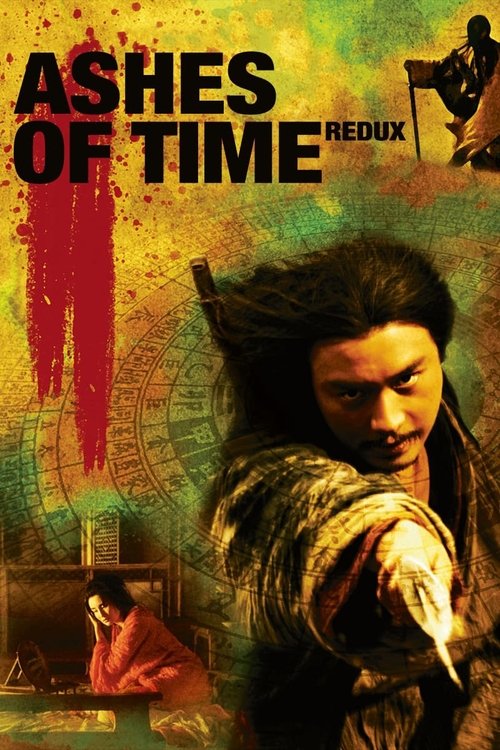
Ashes of Time
1994 · Wong Kar-Wai
Generates discourse without new films: the Blossoms Shanghai TV pivot, In the Mood for Love's ascension up the Sight & Sound poll, and his permanent status as Letterboxd's most romanticized stylist.
For a late night when you're feeling wistful and want mood over plot — something gorgeous and sad to get lost in. Not for when you want a straightforward action fix; this one rewards patience and a certain broken-hearted frame of mind.
What it's about
In a scorched desert, a heartbroken swordsman named Ouyang Feng brokers revenge: killers for hire, matched to clients who can pay. Across five seasons of exile, drifters arrive with their stories — unrequited loves, debts of honor, memories they'd pay to lose — and each one reflects the feeling Ouyang refuses to admit he carries. It wears the costume of a martial-arts epic, but it's really a chamber piece about rejection, memory, and time.
The experience
Dreamlike and melancholy — swordfights dissolve into smears of light while voiceovers circle old wounds. It's a film you drift through rather than follow, hypnotic if you surrender to it, opaque if you fight it, and it lingers like a half-remembered heartbreak.
Performances
Leslie Cheung gives the desert broker a wounded stillness that holds the whole film together, and the ensemble — drawn from the peak of Hong Kong stardom — plays longing in every register.
The craft
Wong Kar-Wai takes the swordplay genre and turns it inside out: combat rendered as abstraction, the desert shot in burning golds and blues, time structured by seasons instead of plot. It's one of the most ravishing-looking films of its era and begs for a big, bright screen.
Why it matters
A commercial gamble that became a cult landmark, it showed a beloved genre could be dismantled into pure mood and memory, and it deepened Wong Kar-Wai's standing as world cinema's poet of longing.
Snapshot
Ashes of Time (東邪西毒, Dung Che Sai Duk — literally "Malicious East, Vicious West") is Wong Kar-Wai's dissolution of the wuxia film from within. Nominally a martial-arts epic assembled from a star cast at the peak of Hong Kong commercial cinema, it is in practice a chamber piece about rejection, memory, and the passage of time, staged across a scorched northwestern desert. Wong takes two antagonists from Louis Cha's (Jin Yong's) beloved Legend of the Condor Heroes — Ouyang Feng, the "Western Venom," and Huang Yaoshi, the "Eastern Heretic" — and imagines their youth as a network of thwarted loves. Ouyang Feng (Leslie Cheung) has retreated to the desert, where he brokers killings for others while nursing his own refusal to feel; the film moves through named seasons as a sequence of clients and confessions, most of them displacements of a single loss he cannot name. The result is one of the most beautiful and forbidding films of the 1990s: a genre spectacle in which the fights are smeared into abstraction and the true action is interior.
Industry & production
The film emerged from the early-1990s wuxia revival that Tsui Hark's Once Upon a Time in China (1991) and the Swordsman films had made bankable, and it was conceived as a prestige production trading on that market. Wong assembled an extraordinary ensemble — Leslie Cheung, Tony Leung Chiu-wai, Tony Leung Ka-fai, Brigitte Lin, Maggie Cheung, Jacky Cheung, Carina Lau, and Charlie Yeung — the kind of wall-to-wall star lineup that promised a commercial event.
What followed became one of the most storied troubled shoots in Hong Kong cinema. Production stretched across roughly two years, much of it on location in the arid country around Yulin in Shaanxi, and it ran badly over schedule and over budget as Wong worked without a fixed script, discovering the film in the cutting and the shooting rather than in a locked screenplay. The most celebrated consequence is that, during a hiatus in the grinding Ashes edit, Wong reconvened many of the same collaborators and shot Chungking Express (1994) quickly — a film that was completed and released first, and that reached audiences as the lithe, buoyant counterweight to the epic still stalled behind it. Precise budget and box-office figures vary across accounts and I won't assign specific numbers, but the consensus of the record is clear: Ashes of Time was an expensive, arduous undertaking that did not perform to its commercial ambitions on first release, even as it consolidated Wong's international art-cinema reputation.
The film premiered at the 1994 Venice Film Festival, where Christopher Doyle's cinematography was recognized with the festival's award for best cinematography — an early marker of the international critical standing the film would hold in defiance of its domestic commercial fate.
Technology
Ashes of Time is a film of conventional early-1990s materials pushed to unconventional ends. It was shot photochemically on 35mm, and its most distinctive images derive not from novel capture technology but from manipulation of the standard toolkit: variable shutter and frame rates, step-printing (in which frames are optically repeated to yield a stuttering, smeared motion), long lenses, and heavy filtration and lab processing that push color toward bruised ambers, jaundiced yellows, and cold blues. The action sequences in particular exploit these techniques to convert legible choreography into streaks of movement and pulses of light, an aesthetic Doyle and Wong had begun developing on Days of Being Wild and Chungking Express and here carried to an extreme. The desert light, real and punishing, becomes a technological collaborator: the film leans on natural conditions — glare, dust, the low sun — that no set could manufacture.
The other technology worth naming is restorative. In 2008 Wong returned to the material to produce Ashes of Time Redux, prompted in part by the deterioration of original elements; the Redux is both a re-edit and a color-graded, re-scored restoration, and for many contemporary viewers it is the version they encounter. That reconstruction, undertaken well into the digital-grading era, gives the film a second technological life distinct from its 1994 photochemical origins.
Technique
Cinematography
Christopher Doyle's camerawork is the film's signature and its argument. He shoots the desert as an abstract expanse of ochre and shadow, framing figures against birdcages, gauze, rippling water, and grasses that fracture the image. Motion is rarely rendered "cleanly": the step-printed blur turns swordplay into calligraphic smears and reduces bodies to gestural traces, so that a duel reads less as event than as sensation and afterimage. Doyle favors close, unstable framings and reflective, filtered surfaces; color is dramatically stylized, veering between hot golds and sickly greens. The Venice cinematography prize was well earned — the film is among the most influential examples of Doyle's collaboration with Wong, and its palette and texture became widely imitated.
Editing
The editing, overseen by William Chang Suk-Ping — who is simultaneously the film's production and costume designer, making him Wong's most total collaborator — is elliptical and associative rather than continuous. Scenes fold back on themselves; the seasonal structure imposes chapter divisions on material that otherwise refuses linear cause and effect. The film's difficulty, its reputation for opacity, stems substantially from the cutting: exposition is withheld, timelines overlap, and the voice-over narration binds fragments that the images do not connect for us. The famously protracted post-production — the film was, in effect, edited into existence — is legible in the finished work's density. The 2008 Redux is itself an editorial act, resequencing and tightening the material and foregrounding the seasonal frame more explicitly.
Mise-en-scène / staging
Chang's design gives the film its tactile world: worn robes and armor, the recurring birdcage, jars of wine, the single desert inn that serves as Ouyang Feng's outpost. Space is rendered as isolation — vast exteriors that dwarf the characters, cramped interiors slatted with light. Staging tends toward stillness and waiting; characters sit, drink, and speak past one another, and the choreography of bodies in a room carries as much weight as any sword. Nature is not backdrop but subject: sun, sand, and water are staged as forces the characters endure.
Sound
The score by Frankie Chan and Roel A. García is central to the film's melancholy, threading recurring themes through the seasons and giving emotional continuity to a fractured narrative. For the 2008 Redux, Wong commissioned a substantially reworked score featuring cello performed by Yo-Yo Ma, which recolors the film toward a more elegiac, chamber-classical register. Voice-over is a structural instrument throughout: the characters' interior monologues, delivered in a confessional register, do much of the storytelling that the images deliberately withhold.
Performance
Performance here is muted, inward, and often static — a deliberate counter to the athletic bravura the genre invites. Leslie Cheung plays Ouyang Feng as a man armored in cynicism, most expressive in what he suppresses. Brigitte Lin, drawing on the androgynous, gender-crossing star persona she had built in the Swordsman cycle, plays the divided figure(s) of Murong Yin and Murong Yang, one performer split into warring selves consumed by love and betrayal — the film's most overt piece of psychological doubling. Maggie Cheung, in limited screen time, anchors the film's central wound as the woman Ouyang Feng loved and lost; Tony Leung Chiu-wai's blind swordsman and Tony Leung Ka-fai's Huang Yaoshi extend the pattern of men undone by longing. The ensemble works in a lower key than their star wattage would predict, which is precisely the point.
Narrative & dramatic mode
The film's mode is lyric and confessional rather than dramatic in the conventional sense. Its ostensible engine — a broker connecting swordsmen to those seeking revenge — is a frame for a series of episodes, each organized around a client and each, on inspection, a variation on unrequited or foreclosed love. Time is thematized and structural: the seasonal chapters, the recurring motif of a wine said to erase memory, the persistent return to a loss that predates the film. Wong tells the story through overlapping first-person narration, withheld information, and emotional rhyme, so that the viewer assembles relationships obliquely. This is why the film is routinely described as difficult: it declines the genre's promise of clear stakes and resolved combat in favor of mood, repetition, and interiority.
Genre & cycle
Ashes of Time is a wuxia film that critiques and hollows out the wuxia film. It arrives inside the early-'90s martial-arts revival and carries all the genre's furniture — legendary swordsmen, desert duels, the mythology of Jin Yong — while systematically frustrating the genre's pleasures. The fights are abstracted into blur; the heroism is displaced by paralysis and regret; the source characters, familiar to Chinese-reading audiences as fixtures of the Condor Heroes saga, are reimagined as young men defined by romantic failure rather than martial destiny. It belongs, then, to two cycles at once: the commercial swordplay boom it exploited, and the emerging body of Wong Kar-Wai's own films about time and thwarted desire. Its deconstructive stance was pointed enough that Jeffrey Lau's comedic The Eagle Shooting Heroes (1993), made with an overlapping cast, functions as a parodic companion piece to the same material.
Authorship & method
The film is a definitive statement of Wong's method: begin without a finished script, shoot extensively, and locate the film in editing and voice-over. His authorship here is inseparable from a core team. Christopher Doyle (cinematography) supplied the visual language of smear, filtration, and unstable framing that would define Wong's international image. William Chang Suk-Ping served as production designer, costume designer, and editor — the collaborator through whom Wong's world is both built and shaped, and whose editorial hand is arguably as responsible as Wong's for the finished film's form. Frankie Chan and Roel A. García composed the score, and Sammo Hung Kam-Bo directed the action — a telling credit, in that one of the great action choreographers of Hong Kong cinema saw his work optically dissolved into impressionism. The source is Jin Yong's fiction, radically repurposed. That Wong could pause this production to make Chungking Express with much of the same crew underscores how much his authorship resides in a sensibility and a company of collaborators rather than in a script.
Movement / national cinema
The film sits within the Hong Kong "Second Wave" and Wong's ascent as the territory's preeminent art-cinema auteur, at a moment when Hong Kong was both a commercial powerhouse and, increasingly, a source of festival prestige. It is a Hong Kong production reaching into mainland Chinese landscape and mainland literary myth, made in the years when the industry was near its late-'80s/early-'90s commercial zenith and when the international festival circuit was beginning to canonize its most distinctive directors. Wong's cosmopolitan authorship — a Shanghai-born, Hong Kong–raised director working with an Australian-born cinematographer on Chinese wuxia material — exemplifies the border-crossing character of the era's Hong Kong cinema.
Era / period
Ashes of Time is a mid-1990s film shadowed by the approach of the 1997 handover, and critics have often read its preoccupations — exile, memory, the wish to forget, a sense of endings — against that horizon of anticipatory loss, though the film itself never names any such politics and such readings should be held as interpretation rather than authorial statement. More concretely, it belongs to the brief window when the wuxia revival's commercial heat coincided with a generation of stars — Leslie Cheung, Brigitte Lin, the two Tony Leungs, Maggie Cheung — at their absolute peak, several of whose careers and lives the passage of time has since given the film a retrospective poignancy its makers could not have foreseen.
Themes
The governing theme is rejection and its aftermath: nearly every character organizes a life around a love refused, withheld, or lost, and around the strategies — cynicism, violence-brokering, wine, self-division — by which they try to survive it. Memory and forgetting are literalized in the magic wine and in the seasonal cycle; time is figured as both healer and torturer, the thing that erodes feeling without extinguishing it. The film is preoccupied with substitution and displacement — Ouyang Feng's clients enact the desires he cannot — and with doubling, most vividly in Brigitte Lin's split self. Pride, the refusal to speak one's feeling until it is too late, recurs as a quiet tragedy across the ensemble. Underlying it all is exile, geographic and emotional: the desert as the outer form of an inner withdrawal.
Reception, canon & influence
On first release the film was a critical landmark and a commercial disappointment, a divergence typical of Wong's early features; it was admired abroad and at festivals — Venice honored its cinematography — while its opacity and its refusal of genre satisfaction limited its popular reach. Over subsequent decades its reputation has grown steadily, and it is now widely regarded as one of Wong's major achievements and one of the most singular martial-arts films ever made.
The influences on the film run in two directions. From Chinese popular literature it takes the world and characters of Jin Yong's Condor Heroes, which it inverts. From Wong's own developing style — the step-printed motion and saturated, filtered palette of Days of Being Wild and, concurrently, Chungking Express — it inherits a visual grammar it pushes to its limit. The wuxia revival of Tsui Hark and the star personae forged in the Swordsman films (especially Brigitte Lin's androgynous icon) are the immediate generic context it both exploits and subverts.
Its legacy is substantial. The Doyle–Wong–Chang aesthetic crystallized here — abstracted action, expressionist color, elliptical romantic storytelling — became one of the most imitated looks in world cinema, feeding both art-house and commercial filmmaking and shaping how a generation understood "atmospheric" style. The film demonstrated that a genre spectacle could be turned into an interior, poetic meditation, a move whose echoes are visible in later art-wuxia and mood-driven action cinema. Wong's own subsequent masterpieces of memory and longing, above all In the Mood for Love (2000), extend its central preoccupations. And the film's afterlife was formally renewed by Ashes of Time Redux (2008), which premiered at Cannes, introduced the Yo-Yo Ma–inflected score, and re-presented the film to international audiences — an unusual case of an auteur returning to canonize and clarify his own difficult early work, and a sign of the standing the film had by then attained.
A Deleuzian reading
A man draws a sword in the desert and the film refuses to show you the blow.
The full Deleuzian reading of Ashes of Time →
Reception
In 1994 it landed as Wong Kar-Wai's beautiful, baffling money-pit — a two-year shoot that flopped with wuxia audiences expecting Jin Yong action — and it took the 2008 Redux re-release at Cannes for the world to reappraise it as one of his major works.
How Ashes of Time was received, from release to now →
Influences: the films it descends from and the films it influenced
- Days of Being Wild (1990) — First deployment of the step-printed smear and Doyle's saturated, filtered palette married to a drifting, present-tense voice-over interiority — the exact grammar Ashes pushes to abstraction.
- A Touch of Zen (1971) — Reconceived wuxia as landscape-scaled contemplation, dissolving swordplay into abstracted movement, wind, and reed-grass texture rather than legible combat geography.
- Dragon Inn (1967) — Established the arid frontier-inn wuxia geography and the choreography of waiting and arrival at a desert waystation that Ashes strands its brokered killers within.
- Swordsman II (1992) — Forged Brigitte Lin's androgynous Asia-the-Invincible persona, the gender-crossing star icon Ashes literalizes by splitting her into the Murong Yin/Yang doubling.
- New Dragon Gate Inn (1992) — The Tsui Hark–produced desert-wuxia revival that supplied Ashes's parched frontier setting, ensemble of stars, and the commercial genre template it then hollows out.
- Once Upon a Time in China (1991) — Anchored the early-90s wuxia boom's kinetic, wire-driven spectacle — precisely the genre satisfaction Ashes optically dissolves and refuses.
- Vivre sa vie (1962) — Modeled the film-as-chaptered-portrait built from discrete titled fragments and direct confessional address, a New Wave essayism behind Ashes's seasonal-chapter structure.
- Legend of the Mountain (1979) — Takes Hu's contemplative register to its limit — elliptical, mood-driven wuxia where desire and deliverance drift through vast desert landscapes rendered as psychic scale rather than action arena.
- In the Mood for Love (2000) — Extends the elliptical romance of missed connection, repetition-with-variation, and memory-and-forgetting, replacing the desert's isolation with corridor framing but keeping the same withholding editing.
- The Grandmaster (2013) — Wong again optically dissolves a master choreographer's fight design into step-printed, rain-and-snow impressionism — the same treatment Sammo Hung's action received here.
- Crouching Tiger, Hidden Dragon (2000) — Turned wuxia combat into lyrical, festival-facing romance of restraint and thwarted desire, proving the genre-as-interior-poem move Ashes pioneered could reach the world market.
- Hero (2002) — Builds expressionist, color-coded chapters in which each saturated palette is a competing subjective account of the same duel — inheriting Ashes's fusion of chromatic abstraction and unreliable memory.
- The Assassin (2015) — Deconstructs wuxia into elliptical stillness — action withheld, motivation left opaque, and combat subordinated to painterly landscape abstraction — the arthouse endpoint of Ashes's genre inversion.
- Moonlight (2016) — Explicitly Wong-indebted, using saturated chromatic lighting and step-printed slow-motion emotional beats to render interior longing, directly citing the Doyle-era grammar crystallized in Ashes.
- Chungking Express (1994) — Shot mid-production with the same Doyle/William Chang crew, deploying the identical step-print smear as a time-lapse blur of feeling within stalled, longing-filled encounters.
- Fallen Angels (1995) — Extends Ashes's wide-angle spatial distortion and step-printed nocturne into neon Hong Kong, keeping the elliptical, voice-over-narrated confessional lyric.
- Ashes of Time Redux (2008) — The auteur's own re-edit that recut the elliptical structure and overlaid a Yo-Yo Ma cello score, canonizing the film's mood-driven form as a deliberate object.
- Come Drink with Me (1966) — Abstracts King Hu's fragmentary action cutting to its limit — blurred, smeared glimpses of swordplay where the percussive ellipsis becomes pure impressionist rhythm.
- The Blade (1995) — An independent arrival at the same conclusion — combat smeared into abstraction (Doyle's step-printing where Tsui uses undercranking), an ochre desert palette, and fractured voiceover carrying the story the images refuse to stage.
Similar films
- The Assassin (2015) — influence & lineage · same viewing thread
- Days of Being Wild (1990) — influence & lineage
- Fallen Angels (1995) — influence & lineage
- In the Mood for Love (2000) — influence & lineage
- Hero (2002) — influence & lineage
- Crouching Tiger, Hidden Dragon (2000) — influence & lineage
- The Grandmaster (2013) — influence & lineage
- Dragon Inn (1967) — influence & lineage
All the films related to Ashes of Time →
Watch it with: curated runs of related films
- Stillness, Then the Blade — Watch these back to back for the way each one holds its breath — painterly stillness, coiled calm, and violence that lands like a single brushstroke.