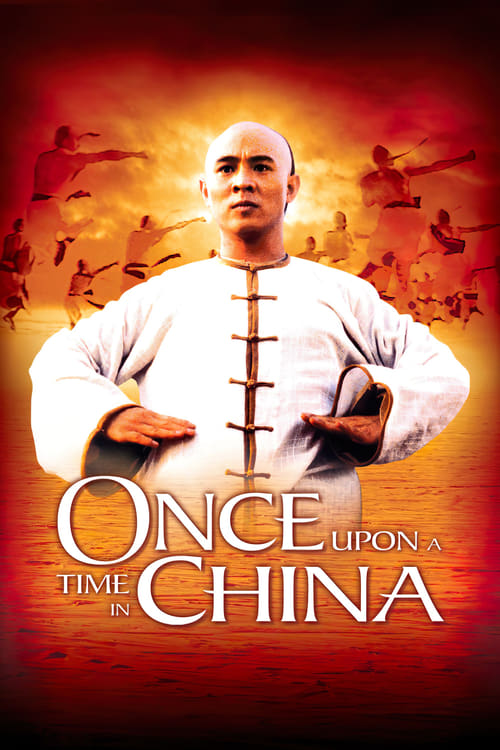
Once Upon a Time in China
1991 · Tsui Hark
For when you want spectacle with a spine — a big, stirring action epic to get swept up in. Reach for it when a plain popcorn movie feels too thin but you still want to cheer.
What it's about
In late-19th-century Canton, as Western gunboats and traders carve up a decaying Qing-dynasty China, the physician and martial-arts master Wong Fei-hung tries to hold his community together — running his clinic, training a local militia, and protecting Aunt Yee, a relative newly returned from America with Western clothes and a camera. As foreign powers, corrupt officials, and local gangs squeeze the city, staying upright gets harder, and the fights get bigger.
The experience
Sweeping and kinetic — a historical epic that keeps erupting into some of the most inventive fight choreography ever filmed, with a gravity to its politics that most kung fu films never attempt. It's rousing, occasionally mournful, and the action sequences will make you rewind.
Performances
Jet Li, then a young wushu champion, became an international star here: his Wong Fei-hung is gravely dignified and almost supernaturally fluid, a hero whose stillness is as expressive as his kicks.
The craft
Tsui Hark reinvented the kung fu film with wire-assisted choreography that turns combat into vertical ballet — the celebrated ladder fight alone justifies the biggest screen you can find. The film moves between teahouse comedy, political tragedy, and operatic action with total confidence, driven by a heroic musical theme that became iconic in its own right.
Why it matters
It relaunched Chinese cinema's most-filmed folk hero for a new generation, spawned a major franchise, made Jet Li a global star, and set the template for the 1990s Hong Kong martial-arts epic.
Snapshot
Once Upon a Time in China (黃飛鴻, Wong Fei-hung) is the film that reinvented the most enduring hero of Cantonese cinema for a new era and, in the same gesture, turned a young mainland wushu champion named Jet Li into an international martial-arts star. Tsui Hark took Wong Fei-hung — the historical physician and martial artist (1847–1925) who had already been the subject of roughly a hundred films, most famously the long-running postwar series starring Kwan Tak-hing — and recast him as a younger, gravely upright figure standing at the hinge of Chinese history. Set in late-nineteenth-century Canton (Foshan/Guangzhou) under the decaying Qing dynasty, the film stages the collision between a Chinese world of Confucian discipline and martial tradition and the encroaching power of Western empire: gunboats in the harbor, foreign concessions, missionaries, the coolie trade that ships Chinese laborers and trafficked women across the Pacific. Around this Wong builds a militia, protects his community, and conducts a chaste, half-comic courtship with the Westernized "Aunt Yee" (Rosamund Kwan), returned from America in European dress and bearing a camera. The film fuses spectacular, gravity-defying action with a genuinely melancholy meditation on a civilization unequal to the firepower arrayed against it. It became one of the defining Hong Kong films of the early 1990s, spawned a multi-film franchise, and re-established the period kung-fu epic as a vehicle for serious national reflection.
Industry & production
Once Upon a Time in China was a production of Tsui Hark's Film Workshop, the company he had founded in 1984 with his wife and producing partner Nansun Shi, in association with Golden Harvest, then the dominant force in Hong Kong commercial cinema. By 1991 Tsui was at the height of his powers as both director and producer, having already helped engineer the early-1990s revival of the period martial-arts film with productions such as A Chinese Ghost Story (which he produced) and Swordsman. The Wong Fei-hung project was conceived on an unusually ambitious scale for Hong Kong: large sets, elaborate crowd scenes, a long shoot, and action set-pieces of escalating complexity.
The film's most consequential production decision was its casting. Tsui chose Jet Li (Li Lianjie), a former multiple-time national wushu champion from the mainland whose screen career had begun with Shaolin Temple (1982) but who had not yet found a defining role in the Hong Kong industry. Li's authentic wushu training gave Wong Fei-hung a bearing and a purity of line that distinguished him sharply from the comic kung-fu persona then dominant. The supporting ensemble drew on Hong Kong's deep bench: Yuen Biao (one of the "Seven Little Fortunes" Peking-opera-trained performers, alongside Jackie Chan and Sammo Hung) as the disciple Leung Foon; Jacky Cheung, a Cantopop star, as the foreign-educated "Buck-Tooth Sol"; Kent Cheng as the portly disciple "Porky" Lam Sai-wing; and Rosamund Kwan as Aunt Yee. The veteran Yam Sai-koon (Yan Shi-kwan) played the rival master Iron Robe Yim, whose climactic duel with Wong is the film's centerpiece. The action was built in the standard Hong Kong manner by a team of credited martial-arts directors working closely with Tsui and Li; precise division of labor among them is not consistently documented, and it would be invention to assign individual set-pieces to particular hands.
Technology
Once Upon a Time in China is a 35mm photochemical production, and its innovations are choreographic and editorial rather than technological in the optical-effects sense. Its action, however, depends heavily on a battery of practical techniques that the Hong Kong industry had refined to a high art: wirework (the rigging of performers on cables to achieve the soaring leaps, mid-air reversals, and impossible recoveries that define the film's combat), trampolines and springboards, undercranking to accelerate motion, and concealed safety apparatus. The famous ladder duel in the film's climax — fought atop, between, and along toppling wooden ladders — is an exemplary fusion of wire-assisted stunt work, precise choreography, and editing. The film makes no claim to digital or mechanical novelty; its "technology" is the accumulated craft of the Hong Kong stunt tradition pushed to a new level of fluency and danger.
Technique
Cinematography
The film's visual scheme matches the grandeur of its ambitions, favoring sculptural, often low-key lighting that lends Wong Fei-hung a near-iconic, statue-like solidity, set against the smoke, dust, and torchlight of crowded period exteriors. The cinematography (credited, as was common for large Hong Kong productions of the period, to more than one camera artist) moves between two registers: stately, frontal compositions that frame Wong as an emblem of Confucian rectitude, and kinetic, mobile coverage that follows the action through cluttered, multi-plane spaces. Tsui's compositions repeatedly exploit depth — foreground obstacles, latticework, hanging cloth, ranks of bodies — to create a teeming, layered frame. The recurring image of Wong practicing or standing firm amid chaos, often backlit, gives the film its visual thesis: a single still center within a world coming apart.
Editing
The editing is fundamental to the action's legibility and impact. Hong Kong cutting of this era treated the edit as part of the choreography itself, accelerating and clarifying movement through rhythmic intercutting, brief inserts of impact, and the splicing-together of multiple takes into a single impossible-seeming flow. Once Upon a Time in China uses this grammar to build its fights as crescendos, the cutting tightening as combat intensifies, so that the ladder finale reads as a sustained acceleration toward catastrophe. Away from the action, the film's editing is more relaxed, allowing room for the comic byplay among Wong's disciples and the courtly, halting rhythm of his scenes with Aunt Yee. The contrast of tempos — patient drama, explosive combat — is a deliberate structural strategy.
Mise-en-scène / staging
Tsui's staging is maximalist. The film fills its frames with period detail — the Po Chi Lam clinic, market streets, theatrical troupes, militia drills, the encroaching iconography of Western modernity (photographs, suits, steam, firearms) — and orchestrates large ensembles in continuous motion. The production design draws a constant visual argument between Chinese and Western worlds: traditional dress against European tailoring, the brush and the herb against the camera and the gun, calligraphic interiors against the hard geometry of foreign authority. Aunt Yee's Western clothes and her camera are staged as objects of fascination and unease, embodiments of a modernity that is at once seductive and threatening. The choreography is itself a form of mise-en-scène, using the full volume of the set — vertical as well as horizontal — so that combat ascends ladders, scaffolds, and rooftops, dramatizing the film's theme of a world thrown off its axis.
Sound
The film's most celebrated sonic element is its theme music, an adaptation of the traditional Chinese martial tune "The General's Mandate" (將軍令, Jiangjunling), whose surging, march-like melody became permanently identified with Wong Fei-hung through this series. The score, with James Wong (Wong Jim) central to its musical identity, weaves this anthem through the film so that Wong's heroism is announced and underscored by a theme of folk-patriotic resonance; the melody would recur across the franchise and beyond, becoming one of the most recognizable pieces of music in Hong Kong cinema. The sound design of the action — the percussive snap of blows, the whir and crack of the ladder duel — is mixed for maximal physical impact in the punctuated Hong Kong manner.
Performance
Jet Li's performance is the film's foundation, and it is built on stillness as much as on motion. His Wong Fei-hung is grave, contained, almost ascetic — a man of few words whose moral authority is expressed through posture and restraint, and whose explosive martial capacity is held in reserve until justice demands it. The contrast between this composure and the speed and precision of Li's wushu when unleashed (including Wong's legendary "shadowless kick") gives the character his mythic weight. Around him the ensemble supplies the warmth and comedy: Yuen Biao's earnest Leung Foon and Kent Cheng's Porky provide physical humor and loyalty, while Rosamund Kwan's Aunt Yee anchors the film's emotional and thematic core, her poise and her divided loyalties — Chinese heart, Western manners — embodying the film's larger cultural dilemma. The courtship between Wong and Yee is played with a delicacy and chasteness that became a hallmark of the series.
Narrative & dramatic mode
The film's dramatic mode is the national epic in the guise of a martial-arts adventure. Its narrative interlaces several strands: Wong's defense of his community against foreign powers and their local collaborators; his rivalry with another master; the abduction and trafficking of women for the overseas labor and sex trades; and the slow-burning, comic-romantic subplot with Aunt Yee. These threads converge on a climactic confrontation that pits Wong's kung fu against both a rival martial artist and, ultimately, the gun — the film's governing irony, posed by the premise itself: whether skill, discipline, and virtue can answer firepower. The mode is heroic and at moments frankly melodramatic, but it is shadowed throughout by historical pessimism. Wong wins his fights, yet the film never lets the audience forget that individual mastery cannot reverse the larger defeat unfolding around him — the humiliation of China by the Western powers. This blend of rousing spectacle and elegiac awareness is the film's distinctive dramatic signature.
Genre & cycle
Once Upon a Time in China belongs to the kung-fu period film, and specifically to the Wong Fei-hung tradition, one of the most durable franchises in world cinema. The Wong Fei-hung films had begun in 1949 with Kwan Tak-hing, who played the hero across scores of pictures over decades, establishing him as an avuncular elder embodying Confucian virtue and Cantonese identity. Tsui Hark's intervention was to rejuvenate the figure — making Wong young, romantic, and politically charged — and to fold the kung-fu film into the larger period-epic and "national allegory" tradition. The film also rides the early-1990s wave of revived wuxia and martial-arts cinema that Tsui himself did much to launch, distinguishing itself from the contemporaneous comic kung-fu of Jackie Chan by its gravity and historical seriousness. It launched its own cycle: a run of sequels and spin-offs through the 1990s, with Jet Li returning for several entries and Vincent Zhao (Chiu Man-cheuk) taking the role in others.
Authorship & method
The film is unmistakably a Tsui Hark work, and it crystallizes his authorial preoccupations: the reinvention of traditional Chinese genres and folklore for the present; the tension between tradition and modernity; anxieties about national identity, sovereignty, and China's place in a hostile world; and a restless, maximalist visual imagination that crams the frame with movement and meaning. Tsui's method is that of the hands-on producer-director, controlling the project from conception through its action design and post-production, and shaping a large collaborative apparatus toward a unified vision. The decisive collaboration was with Jet Li, whose authentic wushu and screen gravity gave Tsui's conception its body; the partnership defined both men's careers in the period. On the musical side, the identification of the Wong Fei-hung character with the "General's Mandate" theme — central to which is James Wong's work — is one of the most successful marriages of image and music in Hong Kong cinema. The action was realized by a team of martial-arts directors in the collective Hong Kong fashion; the specific apportioning of credit among them is not reliably documented, and this account does not assign individual set-pieces to named choreographers absent firm record.
Movement / national cinema
The film is a flagship of Hong Kong commercial cinema at its early-1990s creative and industrial peak, and of the strand of that cinema associated with Tsui Hark and Film Workshop — directors who emerged from or alongside the Hong Kong New Wave and brought a heightened formal ambition to popular genre filmmaking. It is also, crucially, a work made under the shadow of 1997: produced in the years between the 1984 Sino-British Joint Declaration and the handover of Hong Kong to the People's Republic, in a period when Hong Kong cinema was intensely preoccupied with questions of Chinese identity, sovereignty, and the relationship between China and the outside world. Wong Fei-hung — a southern Chinese folk hero defending his community against foreign domination while wrestling with the lure and threat of Western modernity — was an unusually resonant figure for a Hong Kong audience contemplating its own future. The film thus reads simultaneously as historical epic and as oblique reflection on its own present.
Era / period
The film is set in the late Qing, a period of national crisis: foreign concessions, unequal treaties, gunboat diplomacy, and the predatory commerce of the coolie trade and the trafficking of women overseas. Once Upon a Time in China foregrounds these conditions, making the depredations of the English, French, and American presences — and the complicity of corrupt or impotent local authority — central to its plot. The figure of Aunt Yee, returned from America "totally Westernized," dramatizes the period's epochal encounter with modernity: the camera, Western dress, foreign learning, all presented as objects of both wonder and danger. The film's recurring confrontation of kung fu with the gun is its sharpest period statement, registering the historical truth that martial skill, however perfected, was being rendered obsolete by industrial weaponry — a metonym for China's broader nineteenth-century humiliation. The film treats this not as mere backdrop but as its true subject.
Themes
The governing theme is the confrontation between Chinese tradition and Western modernity, and the painful recognition that the former cannot, by force alone, withstand the latter. Wong Fei-hung embodies Confucian virtue — discipline, restraint, communal responsibility, filial and pedagogical duty — and the film both celebrates these values and mourns their insufficiency against guns and gunboats. Around this orbit several linked concerns: national humiliation and the longing for self-strengthening (the impulse to "better oneself," made explicit in the franchise's anthem); the seduction and threat of modernity, focalized through Aunt Yee and her camera; the exploitation of the Chinese poor by foreign and domestic predators alike, in the trafficking subplot; and the question of how a man of conscience should act in a world where righteousness is outmatched by power. The romance between Wong and Yee carries the theme in miniature — a meeting of Chinese heart and Western form, conducted with a tenderness that the surrounding violence keeps under threat. Beneath the heroics runs a sustained note of elegy for a civilization at the edge of an irreversible transformation.
Reception, canon & influence
Once Upon a Time in China was a major critical and popular success in Hong Kong and is widely regarded as one of the landmark films of the territory's cinema and of the martial-arts genre at large; it was recognized at the Hong Kong Film Awards, with its action design among the most celebrated of its year. (Specific box-office figures and award tallies are not cited here in the absence of firm documentation to hand.) Above all, the film made Jet Li a star of the first rank and re-established Wong Fei-hung — and the "General's Mandate" theme — at the center of the Cantonese cultural imagination for a new generation.
Influences on the film run backward to the decades-long Wong Fei-hung tradition inaugurated by Kwan Tak-hing in 1949, which supplied the character, his moral stature, and his iconography; to the broader Hong Kong kung-fu and wuxia traditions, including the Shaolin and Cantonese folk-hero cycles; and to the real historical record of late-Qing China's encounter with Western imperialism. Tsui Hark's own earlier work in reviving period genres set the stage for the project.
Its influence forward is substantial. The film launched a long-running franchise of sequels and spin-offs through the 1990s, and consolidated the early-1990s revival of the serious period martial-arts epic. It is a key text in the international rise of Jet Li, who would go on to a major career in both Hong Kong and Hollywood, and it helped renew global interest in wire-assisted Hong Kong action choreography in the years before that style's worldwide diffusion. As a fusion of spectacular combat with historical gravity and national allegory, it stands as a model for the martial-arts film as a vehicle of cultural reflection, and it retains a secure place in the canon of Hong Kong cinema and of the kung-fu genre.
A Deleuzian reading
The image that stays: Wong Fei-hung standing motionless, backlit, while the world smokes and lurches around him.
The full Deleuzian reading of Once Upon a Time in China →
Reception
A smash in Hong Kong in 1991, it single-handedly relaunched the Wong Fei-hung legend and set off the early-90s kung fu revival; long stuck in the West in dubbed, chopped video editions, it's since been fully canonized — Criterion boxed the whole series in 2021.
How Once Upon a Time in China was received, from release to now →
Influences: the films it descends from and the films it influenced
- The Story of Wong Fei-hung (1949) — Founded the Wong Fei-hung serial with Kwan Tak-hing, establishing the Confucian-master iconography and 'General's Mandate' folk-hero identity that Tsui inherits and reinvents wholesale.
- Come Drink With Me (1966) — Pioneered Peking-opera-derived balletic swordplay cut on percussive rhythmic accent, the foundation of OUATIC's action-as-choreography rather than brawling.
- A Touch of Zen (1971) — Codified trampoline/wire-assisted leaping and fragmented undercranked editing of combat into crescendos — the exact grammar Tsui's airborne wirework and rising set-pieces descend from.
- The One-Armed Swordsman (1967) — Shaw Brothers template of the stoic, morally burdened male hero shot in sculptural low-key light, feeding Wong's gravitas and the film's chiaroscuro.
- The 36th Chamber of Shaolin (1978) — Rendered authentic Southern Shaolin / hung-gar technique as legible screen spectacle, the real-martial-arts lineage Jet Li's wushu-grounded Wong embodies.
- Drunken Master (1978) — Reinvented Wong Fei-hung as a young athletic showcase and codified shape-based, undercranked choreography that OUATIC restores to epic seriousness.
- Zu Warriors from the Magic Mountain (1983) — Tsui's own importation of Western-crew wire rigs and optical effects into Chinese fantasy built the technical apparatus that makes OUATIC's wire-fu possible.
- Peking Opera Blues (1986) — Established Tsui's maximalist, densely packed period mise-en-scène and deep-staged crowd choreography carried directly into OUATIC's frames.
- Duel to the Death (1983) — Systematizes the undercranked, wire-assisted swordless-and-swordplay set-piece into a signature Hong Kong export style, industrializing the trampoline-and-optical toolkit Duel prototyped.
- Once Upon a Time in China II (1992) — Direct sequel extending the prop-duel vocabulary (cloth-pole/ladder combat) and tradition-versus-modernity national allegory of the original.
- Iron Monkey (1993) — Tsui-produced spin-off extending the young-Wong-Fei-hung myth with pole-fighting and undercranked aerial wirework refined from OUATIC.
- Fong Sai-yuk (1993) — Rode OUATIC's revival of the comic-serious period folk-hero epic, deploying Jet Li in the same wire-assisted Cantonese-hero mode.
- The Matrix (1999) — Imported Yuen Woo-ping's Hong Kong wire choreography wholesale into Hollywood, the global diffusion of wire-fu that OUATIC's revival catalyzed.
- Crouching Tiger, Hidden Dragon (2000) — Elevated Yuen Woo-ping wirework into art-cinema period epic, extending OUATIC's marriage of weightless combat to historical gravity.
- Hero (2002) — Fused Jet Li's screen gravity with national-allegory martial epic and crescendo set-pieces, mainland heir to OUATIC's combat-as-cultural-reflection model.
- Kill Bill (2003) — Explicit homage employing Yuen Woo-ping choreography and undercranked action-as-choreography in the Hong Kong idiom OUATIC helped export.
- Ip Man (2008) — Ip Man inherits wholesale the martial-saint-biopic structure Hark codified here: a historical kung fu master whose tournament victories against foreign opponents encode national dignity, with physical mastery standing in for civilizational pride under occupation — the same template transplanted from Wong Fei-hung to Ip Man.
- The Matrix Revolutions (2003) — Yuen Woo-ping's wire-fu vocabulary of suspended, gravity-defying combat here is the same choreographic hand that stages the trilogy's airborne superhuman brawls.
- Kung Fu Panda (2008) — Tsui and Yuen's Wong Fei-hung wire-fu — vertical ladder and pole choreography exploiting height and scaffolding — is the ancestor of KFP's staging/vertical-space combat across bridges, staircases and the Wuxi Finger Hold tower.
- Ashes of Time (1994) — Anchored the early-90s wuxia boom's kinetic, wire-driven spectacle — precisely the genre satisfaction Ashes optically dissolves and refuses.
- Kung Fu Panda 2 (2011) — Tsui/Yuen's rhythmic wushu blocking and Wong Fei-hung heroic-lineage staging model the film's ensemble martial choreography and its 'master and students' formation fighting.
- A Better Tomorrow (1986) — Tsui-produced New Wave landmark whose crescendo-built set-piece architecture and elegiac heroic register parallel OUATIC's construction and tone.
- The Legend of Drunken Master (1994) — Parallel early-90s Wong Fei-hung revival pushing ground-level undercranked hung-gar choreography against OUATIC's airborne approach.
Similar films
- Crouching Tiger, Hidden Dragon (2000) — influence & lineage · same viewing thread
- Hero (2002) — influence & lineage · same viewing thread
- A Better Tomorrow (1986) — influence & lineage
- Come Drink with Me (1966) — influence & lineage
- The 36th Chamber of Shaolin (1978) — influence & lineage
- Dragon Inn (1967) — same viewing thread
- House of Flying Daggers (2004) — same viewing thread
- Kung Fu Hustle (2004) — same viewing thread
All the films related to Once Upon a Time in China →
Watch it with: curated runs of related films
- Wuxia and Its Heirs — Watch these as a bloodline — King Hu's weightless swordplay flowering into Zhang Yimou's painted epics and finally Tarantino's homage, all built on choreography as dance.