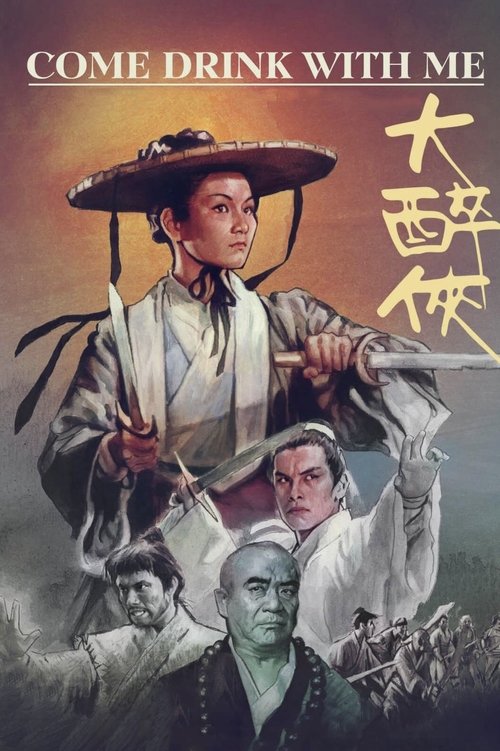
Come Drink with Me
1966 · King Hu
For when you want pure style and swordplay — an adventure night, something gorgeous and brisk that asks nothing but attention and rewards it with grace. Total comfort viewing for anyone who loves action as choreography.
What it's about
A governor's son has been kidnapped by bandits who want their leader freed from prison, and the fighter sent to get him back is Golden Sparrow — a swordswoman who first appears disguised as a man and cuts through a tavern full of thugs without breaking composure. She gets unexpected help from Drunken Cat, a shambling beggar who sings for coins and is obviously far more than he seems. The trail leads to a temple of bandit-monks and a series of duels where skill, deception, and nerve count for everything.
The experience
Elegant and quick — the fights are staged like dance numbers, all sudden bursts and held poses, with more suggestion than gore. It's playful, suspenseful, and over before you want it to be.
Performances
Cheng Pei-pei, a trained dancer, made Golden Sparrow an icon: her stillness between strikes is as thrilling as the strikes themselves, and she plays deadly composure with a hint of youthful pride that keeps the character human.
The craft
King Hu brought the rhythms and percussion of Peking opera into the martial arts film — combat built on cutting, timing, and poise rather than brute force, every duel scored like a piece of music. The Shaw Brothers production gives it rich color and grand sets; it looks wonderful on a big screen and its soundtrack of drums and clangs deserves good speakers.
Why it matters
This is a founding text of modern wuxia — it turned the martial arts picture into an art of motion and made the warrior woman a central figure of the genre, an influence that runs through decades of swordplay cinema up to the present.
Snapshot
Come Drink with Me (大醉俠, Da Zui Xia) is the film that pivoted the Hong Kong martial arts picture from rough-edged spectacle toward a self-conscious art of motion. Made for Shaw Brothers at the height of the studio's industrial expansion, it pairs a cross-dressing female swordfighter, Golden Sparrow (Cheng Pei-pei), with a beggar-sage, Drunken Cat (Yueh Hua), in a tightly wound rescue plot involving kidnapped officials and a temple of bandit-monks. Its lasting importance is less narrative than aesthetic: King Hu imported the rhythms, gestures, and percussion of Peking opera into the wuxia film and, with editor and choreographer, invented a grammar of combat built on cutting, suggestion, and poise rather than brute display. The result is widely regarded as a founding text of the "new school" wuxia cycle and the launch of both King Hu's directorial reputation and Cheng Pei-pei's career as the genre's first great female star.
Industry & production
The film was produced by Shaw Brothers Studio, the dominant Mandarin-language production house in Hong Kong, at its vertically integrated Movietown facility in Clearwater Bay. By the mid-1960s Run Run Shaw was steering the studio toward action spectacle to compete with rival Cathay/MP&GI and to recapture audiences from the Cantonese-language sector and from imported Japanese chanbara and Hollywood product. Shaw's so-called cǎisè wǔxiá shìjì — the "Colour Wuxia Century" — was a deliberate marketing and production initiative to modernize the sword film in widescreen and color, and Come Drink with Me was among its earliest and most successful realizations.
King Hu came to the project as a studio insider rather than an outside auteur: a Beijing-born émigré who had worked at Shaw as an actor, set decorator, scriptwriter, and assistant before being entrusted with direction. The picture was made within the studio's contract system, using its roster of staff cinematographers, in-house composers, standing sets, and salaried performers — an assembly-line context that makes the film's individuality all the more striking. It was a commercial success on release and is generally credited, alongside Chang Cheh's slightly later The One-Armed Swordsman (1967), with confirming the box-office viability of the new wuxia and reorienting Shaw production for the rest of the decade. The film's success also created the conditions for King Hu's departure: dissatisfied with the studio system's constraints, he left Shaw for Taiwan's Union Film shortly after, where he enjoyed greater creative control on Dragon Inn (1967) and A Touch of Zen (1971). Cheng Pei-pei and Yueh Hua, by contrast, remained Shaw contract stars.
Technology
Come Drink with Me was shot in color and in Shaw's anamorphic widescreen format, branded "Shawscope." The wide frame is integral to the film's design: King Hu uses the horizontal expanse to stage figures against architecture and landscape, to choreograph multiple combatants across the breadth of the image, and to hold the deep, frieze-like compositions that became his signature. Studio shooting at Movietown afforded controlled lighting and constructed sets — the inn, the temple courtyard, the bamboo and rock exteriors — that allowed precise blocking. The technological toolkit was otherwise conventional for a 1966 studio production: optical effects and undercranking assist some of the leaps and weapon work, but the film predates the elaborate trampoline-and-wire systems and the rapid in-camera tricks King Hu would refine in his Taiwan films. Much of the apparent superhuman speed is achieved through performance and, above all, editing rather than mechanical effect.
Technique
Cinematography
The photography favours stable, carefully composed widescreen tableaux punctuated by bursts of kinetic action. The celebrated inn sequence — Golden Sparrow seated, surrounded by bandits probing her with thrown coins and veiled threats — is built on balanced, theatrical staging in which spatial geometry telegraphs the coming violence long before a blade is drawn. King Hu's eye for classical Chinese landscape and architecture is already evident: figures are framed within doorways, against tiled roofs and temple eaves, in compositions that recall scroll painting. The film is generally attributed to the Shaw camera department, and several accounts associate it with the Japanese cinematographer Tadashi Nishimoto (working under the Chinese name He Lanshan), who shot a number of key Shaw wuxia of the period; precise crew attribution for the film should be treated with some caution, as Shaw credits of the era are inconsistently documented.
Editing
Editing is the film's most consequential technical achievement and the clearest statement of King Hu's method. Rather than presenting combat as continuous athletic display, he fragments it — a glimpse of a leap, an impact, a landing — and lets the cut imply velocities the body cannot actually perform. This "glimpse" aesthetic, in which the spectator assembles a movement too fast to be fully seen, would become the foundation of Hong Kong action cinema's editorial language. The cutting is keyed to a percussive rhythm derived from Peking opera, so that edits fall like drumbeats; King Hu, who took an unusually hands-on role in the cutting room, treated montage as choreography in its own right.
Mise-en-scène / staging
King Hu's training in art direction shows in the density and legibility of the film's spaces. The inn, the prison, and the bandits' temple are organized for performance — entrances, levels, and sightlines arranged so that bodies move through them with operatic clarity. Staging draws directly on jingju (Peking opera) convention: stylized poses, the held gesture before and after action, the patterned advance and retreat of combatants. Costume and gesture do narrative work, most pointedly in Golden Sparrow's male disguise, a convention of Chinese opera and literature that the film foregrounds and plays for both suspense and charge.
Sound
The soundtrack fuses a Chinese-instrumental and orchestral score with the gongs, drums, and clappers of opera percussion, which underscore and time the action. The music has long been attributed to the prolific Shaw composer Zhou Lanping; given the uneven state of period credits, the attribution is reported here with that caveat. Diegetic sound — the chime of thrown coins on a tabletop, the rap of a staff, the cadence of Drunken Cat's songs — is used pointedly, and the begging songs sung by Yueh Hua's character carry both comedy and coded information within the plot.
Performance
Cheng Pei-pei, a trained dancer, brings a precise, balletic physicality to Golden Sparrow that redefined what a martial heroine could be: controlled, watchful, formidable without bombast. Her dance background underwrites the poise King Hu's style demands — the ability to strike and hold a line. Yueh Hua's Drunken Cat supplies the film's tonal counterweight, a seemingly dissolute wanderer whose buffoonery masks mastery, a figure rooted in the "drunken master" archetype. Chan Hung-lit's villainy and the ensemble of bandits and monks perform in the heightened, gesture-forward register the staging calls for.
Narrative & dramatic mode
The story is a compact rescue-and-revenge structure: a band of rebels holds an official's son hostage to force the release of their imprisoned leader, and Golden Sparrow is dispatched to retrieve him. King Hu complicates this spine with a second register — the mystery of Drunken Cat's true identity and his buried history with the bandits' monastic master — so that the film moves from action set-piece toward a more inward conflict among martial peers. Information is withheld and revealed obliquely, through song and gesture as much as exposition. The dramatic mode mixes operatic stylization with bursts of comedy and a current of moral seriousness about loyalty, mastery, and the corruption of religious or martial authority. The narrative is notable for splitting its center of gravity between two protagonists and, in its later passages, shifting weight from Golden Sparrow toward Drunken Cat — a structural feature critics have long discussed, sometimes as a flaw, sometimes as evidence of King Hu's interest in the male sage-figure who recurs across his work.
Genre & cycle
Come Drink with Me sits at the threshold of the "new school" (xinpai) wuxia, distinguished from the older Cantonese sword films by color, widescreen, faster and more credible action, and higher production polish. Within the Shaw cycle it stands beside Chang Cheh's films as a co-founding work, but the two directors define divergent poles: where Chang Cheh pursued masculine, blood-soaked, yanggang ("staunch masculinity") spectacle, King Hu pursued elegance, restraint, female and scholar-monk protagonists, and an opera-derived stylization. The film also helped consolidate the martial heroine (nüxia) as a commercial draw and established recurring genre furniture — the inn as arena, the temple as labyrinth of intrigue, the disguised swordswoman — that King Hu and his imitators would return to repeatedly.
Authorship & method
The film is unmistakably an authored work emerging from an industrial system. King Hu (1932–1997) directed and co-wrote the screenplay, and his fingerprints are everywhere: in the opera aesthetics, the editorial rhythm, the painterly framing, and the thematic preoccupation with disguised heroes and corrupt sanctuaries. His method was synthetic — drawing on Peking opera (which he knew intimately), classical painting, Ming-Qing fiction, and his own background in art direction — and unusually controlling for a studio contract director, extending into choreography and the cut.
Among collaborators, the martial choreography is generally credited to Han Ying-chieh, a key action director of the period who also performed in the film; the young Sammo Hung is frequently cited as having assisted with the action, an early credit in what became a major career, though specifics of his contribution are reported variously. The score is associated with Shaw composer Zhou Lanping and the cinematography with the studio camera department (with Tadashi Nishimoto/He Lanshan named in several accounts) — both attributions offered with the caution that Shaw-era crediting is imperfect. Editing was a shared studio-and-director enterprise in which King Hu's own involvement was decisive. The performances of Cheng Pei-pei and Yueh Hua should be counted among the authorial achievements, since King Hu's style depends on performers who can deliver the held pose and the legible gesture.
Movement / national cinema
The film belongs to the Mandarin-language Hong Kong cinema of the Shaw Brothers era, a diasporic industry serving audiences across Hong Kong, Taiwan, Southeast Asia, and overseas Chinese communities. King Hu's work is often discussed as a bridge between this commercial industry and a more consciously artistic, culturally nationalist project: his films assert a continuity with classical Chinese arts — opera, ink painting, vernacular fiction — and thus carry a cultural-preservationist charge distinct from pure entertainment. Come Drink with Me is the Hong Kong/Shaw chapter of a career that would shift to Taiwan, where King Hu became central to a transnational Chinese-language art cinema that eventually won international festival recognition.
Era / period
1966 falls at an inflection point for Hong Kong cinema: the Mandarin studios were ascendant, color widescreen was becoming standard for prestige action, and the industry was absorbing the influence of Japanese samurai film and international action modes while seeking distinctively Chinese forms. The film registers this moment — modern in technique and ambition, traditional in its cultural reference points. It precedes the late-1960s and 1970s explosion of kung fu cinema and the Bruce Lee phenomenon, belonging instead to the swordplay (wuxia) wave that immediately preceded and enabled them.
Themes
The film's central thematic motifs include disguise and hidden identity — most obviously Golden Sparrow's male masquerade and Drunken Cat's concealed mastery and past. It dramatizes mastery as something veiled rather than displayed, the true adept appearing as fool or beggar. It is preoccupied with corrupted sanctuary: the Buddhist temple as a nest of violence and the perversion of religious or martial discipleship into treachery, a theme that recurs across King Hu's filmography. Loyalty, betrayal between teacher and student, and the ethics of martial obligation drive the later conflict. And, more subtly, the film stages gender as performance, granting its heroine authority through a body that is disciplined, watchful, and self-possessed rather than sexualized.
Reception, canon & influence
Come Drink with Me was a commercial success on release and has grown steadily in critical stature to become one of the most canonical of all wuxia films, routinely cited as the work that elevated the genre to art and as the foundation of King Hu's reputation. It is the film that made Cheng Pei-pei a star and the prototype of the modern martial heroine.
Looking backward, the film's influences are clearest in Peking opera — its percussion, gesture, and combat rhythm — and in classical Chinese painting and vernacular adventure fiction; critics also situate it in dialogue with the contemporaneous Japanese samurai film, which set a competitive benchmark for action craft that King Hu answered with a consciously Chinese alternative.
Looking forward, its legacy is vast. The "glimpse" editing and opera-timed action it pioneered became foundational grammar for Hong Kong action cinema, feeding the work of later choreographer-directors and, through figures associated with the production such as Sammo Hung, the kung fu comedy and action traditions of the 1970s and beyond. King Hu carried and deepened the style in Dragon Inn and A Touch of Zen, the latter winning recognition at Cannes and securing his international standing. The film's direct homages are well known: Ang Lee's Crouching Tiger, Hidden Dragon (2000) cast Cheng Pei-pei as the villain Jade Fox in explicit tribute, and named its young heroine in a lineage of "Jade"/sparrow heroines that critics trace to King Hu; Quentin Tarantino has repeatedly cited King Hu and the Shaw wuxia tradition, and the restaurant-as-arena set-piece and the female-swordfighter-in-disguise reverberate through Kill Bill and a broad swathe of subsequent martial cinema. A Shaw sequel/spin-off, Golden Swallow (1968), was directed not by King Hu but by Chang Cheh, a telling sign of how quickly the character and the cycle entered the studio's common stock.
A Deleuzian reading
Start with the inn.
The full Deleuzian reading of Come Drink with Me →
Reception
A big hit for Shaw Brothers in 1966 that made a star of Cheng Pei-pei, it was little seen in the West for decades — until Crouching Tiger, Hidden Dragon (2000) sent cinephiles back to the source and it was recanonised as the film that reinvented wuxia.
How Come Drink with Me was received, from release to now →
Influences: the films it descends from and the films it influenced
- Yojimbo (1961) — Established the disguised lone warrior entering a corrupt town and turning its tavern/way-station into a combat arena — the structural template King Hu answered as a 'Chinese alternative' with his inn set-piece.
- Seven Samurai (1954) — Pioneered the multi-camera, fragmentary cutting of combat into brief decisive bursts that King Hu adapted into his 'glimpse' editing, where a strike is registered by its effect rather than shown continuously.
- Harakiri (1962) — Modeled the rigorously composed widescreen frame and held, sculptural standoff before violence — the legible stillness King Hu builds on through performers delivering the arrested pose.
- The Burning of the Red Lotus Temple (1928) — Founded the Chinese wuxia screen tradition of flying swordsfolk and superhuman leaps that King Hu refined from spectacle into opera-timed, gravity-defying choreography.
- Sanjuro (1962) — Supplied the explosive single-cut release of long-coiled tension that informs King Hu's percussive punctuation of a duel's climactic blow.
- Samurai II: Duel at Ichijoji Temple (1955) — King Hu's foundational wuxia film transplants the chanbara's one-against-many spatial logic—outnumbered martial expert using architectural positioning to neutralize attackers—from the Japanese sword-film tradition Inagaki canonized into the Hong Kong swordsplay idiom.
- Dragon Inn (1967) — King Hu expands the corrupt-sanctuary inn into a feature-length siege, deepening the same glimpse-cutting and opera-percussion combat rhythm prototyped here.
- A Touch of Zen (1971) — Carries the trampoline-assisted bamboo-grove leaps and montage-built aerial combat to their apex, the elliptical 'glimpse' editing now fully a King Hu signature.
- Golden Swallow (1968) — A Shaw spin-off recycling Cheng Pei-pei's swordswoman, but recutting the action toward Chang's bloodier, masculine continuity — showing how fast the character entered studio stock.
- Crouching Tiger, Hidden Dragon (2000) — Explicit homage that casts Cheng Pei-pei as Jade Fox and names its heroine in King Hu's 'Jade'/swallow lineage, reviving the disguised-female-swordfighter and the inn brawl.
- Kill Bill: Vol. 1 (2003) — Reworks the restaurant-as-arena set-piece and the female-warrior-in-disguise directly from the Shaw wuxia grammar Tarantino repeatedly credits to King Hu.
- Drunken Master (1978) — Builds the kung-fu-comedy idiom out of the drunken-master archetype seeded in King Hu's wandering inebriate hero, with opera-trained timing inherited via the Shaw action lineage.
- Once Upon a Time in China (1991) — Restores King Hu's operatic aerial wirework and percussive rhythmic editing to wuxia after the 1980s, reasserting the glimpse-aesthetic as Hong Kong action grammar.
- Hero (2002) — Extends King Hu's scroll-painting framing and gesture-as-composition into saturated color-coded tableaux, treating the duel as a painterly stilled image.
- The Assassin (2015) — Most directly inherits King Hu's classical-painting framing and elliptical 'glimpse' combat, where a fight is over in a flash and the landscape composition outlasts the violence.
- The Heroic Trio (1993) — Carries the modern martial-heroine prototype Cheng Pei-pei established into contemporary action, the disguised, airborne swordswoman recast for the wire-fu era.
- Enter the Dragon (1973) — Hu's staging through thresholds and interior enclosures — doorways and corridor choke-points as choreographic constraints — is the direct formal ancestor of Lee's spatial-geometry fight design: each room in Han's fortress defines a new grammar for the confrontation held within it.
- Shadow (2018) — Codifies the inn-and-courtyard wuxia template and the female swordsmanship rhythm that the whole tradition behind Shadow descends from.
- The One-Armed Swordsman (1967) — The rival Shaw wuxia template of the same moment, trading King Hu's opera-gesture abstraction for visceral, wound-centered realism within the shared Shawscope widescreen.
- Ashes of Time (1994) — Abstracts King Hu's fragmentary action cutting to its limit — blurred, smeared glimpses of swordplay where the percussive ellipsis becomes pure impressionist rhythm.
Similar films
- Dragon Inn (1967) — influence & lineage
- Crouching Tiger, Hidden Dragon (2000) — influence & lineage
- Once Upon a Time in China (1991) — influence & lineage
- The Assassin (2015) — influence & lineage
- Kill Bill: Vol. 1 (2003) — influence & lineage
- Hero (2002) — influence & lineage
- Duel to the Death (1983) — shared sensibility
- A Touch of Zen (1970) — shared sensibility
All the films related to Come Drink with Me →