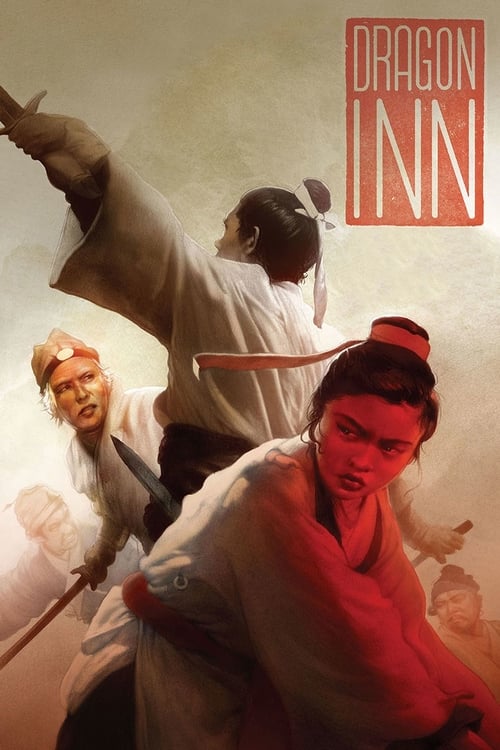
Dragon Inn
1967 · King Hu
When you want a lean, disciplined action film that trusts you to savor the buildup — the cinematic equivalent of watching a fuse burn. A treat for anyone who loves a single-location pressure cooker.
What it's about
In 15th-century China, a power-mad eunuch has the Minister of Defense executed and sends his secret police to murder the minister's exiled children before they can grow into avengers. The killers, the children, and a handful of loyalist swordsmen all converge on one remote frontier inn — and for most of the film, nobody inside can leave. Every cup of wine poured is a test; every new guest at the door changes the odds.
The experience
A slow-coiling standoff punctuated by bursts of fast, percussive swordplay — more chess match than brawl, with long stretches of watchful silence where the tension lives in who sits where and whose hand is near a blade. When violence comes, it's sudden and over in a blink.
The craft
King Hu stages the inn like a piece of music: entrances, seating arrangements, and glances choreographed with the rhythm of Peking opera, then cut into elliptical fight bursts that suggest superhuman speed rather than showing it. The widescreen frontier landscapes and the tactical use of a single interior space reward a big screen and full attention.
Why it matters
A massive hit across Taiwan, Hong Kong, and Southeast Asia, it established King Hu as the wuxia genre's first true auteur and made the remote inn the genre's defining arena — a template Chinese-language martial arts cinema has been reworking and paying homage to ever since.
Snapshot
Dragon Inn (龍門客棧, Longmen kezhan) is the film that consolidated the modern wuxia picture and made King Hu the genre's first true auteur. Made in Taiwan for the Union Film Company (Lianbang) after Hu's departure from Shaw Brothers in Hong Kong, it takes a deceptively simple premise — loyalist swordsmen converging on a remote frontier inn to protect the exiled children of an executed minister from the eunuch secret police — and turns it into a masterclass of spatial tension and percussive, elliptical action. Its enormous commercial success across Taiwan, Hong Kong, and the Southeast Asian diaspora market established the "inn" as the genre's defining crucible and set the template that Chinese-language martial arts cinema would elaborate for the next half-century. It is at once a lean action entertainment and a rigorously composed work of formal art.
Industry & production
Dragon Inn was produced by the Union Film Company, a Taiwanese studio then seeking to build a domestic industry capable of competing with the Hong Kong majors. Its making is inseparable from a pivotal career rupture: King Hu had directed Come Drink With Me (1966) for Shaw Brothers, a landmark success, but chafed under the studio's assembly-line production system and its constraints on his meticulous, time-consuming methods. He accepted an invitation to Taiwan, where Union offered him the creative autonomy — control over script, staging, and post-production — that Shaw's factory model denied.
That autonomy is legible in the finished film. Hu shot on Taiwanese locations, using the island's landscapes for the frontier exteriors while building the inn as a controlled interior stage for the film's central siege. The production is frequently cited as a foundational moment for Taiwan's commercial cinema; the picture's runaway box-office performance across the Chinese-language market is a matter of settled film-historical record, even if precise figures should be treated cautiously, as reported grosses from this period and region are inconsistent. What is not in dispute is the film's catalytic effect: it demonstrated that a Taiwan-based production could dominate the regional wuxia market and it emboldened Union to back Hu's far more ambitious follow-up, A Touch of Zen (1971), whose protracted production the Dragon Inn windfall helped underwrite.
Technology
The film was shot in color and in a widescreen anamorphic format, the standard prestige configuration for Asian action spectacle of the mid-1960s. Hu exploited the scope frame not for landscape grandeur alone but for the choreography of confined space — arranging figures laterally across the inn's rooms, doorways, staircases, and courtyards. The technology of the era imposed real limits that shaped the aesthetic: relatively heavy cameras, optical rather than digital effects, and wire-and-trampoline mechanics for the leaping, near-levitating movement that Hu favoured. Rather than disguise these means, Hu built an editing grammar around them, using the cut to complete movements the camera could not fully capture in a single take. The interplay between period-appropriate practical technique and Hu's editorial imagination is central to the film's enduring freshness.
Technique
Cinematography
The cinematography — the camerawork is generally credited to Hua Hui-ying, a longtime Hu collaborator, though readers should note that crew attributions for Taiwanese productions of this era are not always uniformly documented — serves a strict dramatic architecture. Hu composes the inn as a legible three-dimensional volume, establishing sightlines, thresholds, and vantage points so that the audience always understands who can see whom. The camera privileges the eloquent gesture: a hand settling on a sword hilt, a glance exchanged across a room, chopsticks intercepting a coin or a blade. Wide scope framings hold multiple antagonists in a single charged tableau, while sudden inserts and reframings puncture the stillness. Landscape exteriors are handled with a painter's eye for scale and emptiness, reflecting Hu's grounding in classical Chinese visual art.
Editing
Editing is the film's signature and King Hu's supreme contribution to action cinema. He constructs combat not as continuous physical display but as a rhythmic montage of fragments — a leap rendered in glimpses too brief to fully register, a strike implied by the cut between anticipation and aftermath. The scholar David Bordwell has analyzed this "constructive" or elliptical editing at length, noting how Hu withholds the complete arc of a movement and lets the spectator's eye assemble it, producing a sensation of speed and lightness no single sustained shot could achieve. Combat erupts in bursts and subsides into taut waiting; the pacing derives directly from Peking opera's alternation of stillness and explosive release. Hu exercised close control over cutting, and the film's tempo — patient, coiled, then abruptly violent — is fundamentally an editorial achievement.
Mise-en-scène / staging
The inn itself is the film's great formal invention. Hu treats it as a bounded arena in which strangers of unknown allegiance must share space, each testing the others, danger latent in every entrance and every meal. Staging exploits verticality (balconies, staircases), thresholds (doors, windows, courtyard gates), and the social ritual of the inn — ordering food, paying, sitting — as instruments of suspense. Blocking is choreographic, indebted to the stylized movement vocabulary of Chinese opera, with figures holding poses of readiness before breaking into motion. This concentration of the drama into a single charged location gave the wuxia genre one of its most durable and imitated structures.
Sound
Sound design leans heavily on the percussion idiom of Peking opera — drums, clappers, gongs (luogu) — deployed to mark tension, punctuate blows, and drive the rhythm of confrontation. The specific composing credit for the score should be stated with caution given uneven documentation of the production, but the aesthetic strategy is unambiguous and characteristic of Hu: musical rhythm and cutting rhythm are fused, so that percussion functions almost as editorial punctuation. Silence and ambient stillness are used with equal deliberation, the quiet of the inn amplifying the shock of sudden violence.
Performance
Performance style is presentational and gestural rather than psychologically naturalistic, again reflecting the opera lineage. The film made a star of Polly Shang-Kuan (Shangguan Lingfeng) as the swordswoman, extending the tradition of the martial heroine Hu had advanced with Cheng Pei-pei in Come Drink With Me. Shih Chun brings a scholarly composure to the male lead, and the antagonist — the sinister eunuch commander of the secret police — is played with cold, imperious menace. Physical performance was shaped by the martial choreography of Han Ying-chieh, the action director who had also worked with Hu on Come Drink With Me and who appears on screen as a formidable adversary. The actors' value lies less in interior expression than in precision of stance, timing, and the readable exchange of glances.
Narrative & dramatic mode
The dramatic mode is that of the siege thriller crossed with the loyalist revenge tale. The plot machinery is spare: righteous swordsmen must shepherd the exiled children of a wronged minister past the assassins of a tyrannical power, and the frontier inn becomes the bottleneck where the two forces meet. Hu extracts maximal tension from concealment and revelation — who at the inn is friend, who is agent of the enemy — before the withheld violence finally detonates. Moral alignment is clear (loyal Confucian officialdom against a corrupt eunuch autocracy), but the pleasure lies in the gamesmanship of the standoff rather than in narrative complication. The structure of gathering, testing, and climactic confrontation is classical in its economy.
Genre & cycle
Dragon Inn stands at the headwaters of the modern wuxia cycle. It arrived during the mid-1960s "new wuxia" boom — a wave that included Hu's own Come Drink With Me and Chang Cheh's more masculine, bloodier swordplay films at Shaw Brothers — and it distinguished itself through Hu's cerebral, choreographic sensibility as against Chang's visceral one. Where Chang emphasized bodily suffering and heroic bloodshed, Hu emphasized lightness, spatial intelligence, and the balletic glimpse. Dragon Inn effectively codified several genre conventions: the frontier inn as arena, the eunuch villain as the face of political corruption, and the airborne swordfighter. It thereby helped define the vocabulary later filmmakers would inherit, quote, and subvert.
Authorship & method
King Hu (Hu Jinquan, 1932–1997) is the film's undisputed author, and Dragon Inn is a pure expression of his method. Born in Beijing and relocated to Hong Kong in 1949, Hu came to directing through set design, screenwriting, acting, and assistant directing at Shaw Brothers — a breadth that made him unusually attentive to composition, décor, and total control of the frame. He was steeped in classical Chinese painting, literature, and Peking opera, and he brought a scholar's historical seriousness to a genre often treated as disposable entertainment. His working method was famously exacting: careful pre-visualisation, insistence on staging and cutting to his own design, and a refusal of factory speed — traits that drove his move from Shaw to Union.
Among key collaborators, the action director Han Ying-chieh translated Hu's opera-derived rhythmic conception into executable fight choreography and performed on screen. The cinematography is generally attributed to Hua Hui-ying, who would remain associated with Hu's work. The film's percussive musical idiom is integral to Hu's overall design, though, as noted, specific music credits from this production warrant care. Across these contributions, the governing intelligence is Hu's: he unified camera, cutting, sound, and performance into a single rhythmic system, which is why his authorship is rarely disputed.
Movement / national cinema
The film occupies a distinctive position between national cinemas. Hu was a Mainland-born, Hong Kong–trained filmmaker who made Dragon Inn in Taiwan, and the picture belongs simultaneously to the broader story of Chinese-language commercial cinema and, more specifically, to the emergence of a Taiwanese production industry. It is frequently framed as a foundational work of Taiwan's popular cinema of the late 1960s. Yet its address was pan-Chinese and diasporic, circulating powerfully through Hong Kong and the Southeast Asian markets. This transnational character — a filmmaker moving between industries, a film claimed by more than one national tradition — is itself emblematic of how postwar Chinese-language cinema actually operated.
Era / period
The film is set in the Ming dynasty and anchored to a specific historical moment: the mid-fifteenth century political turmoil surrounding the fall and execution of a loyal minister of defense — a framing widely read as evoking the real 1457 execution of Yu Qian in the aftermath of the Tianshun restoration, though the film fictionalizes freely around this anchor. The setting allows Hu to dramatize a recurrent theme of Chinese historical narrative: the corruption of the imperial order by eunuch factions and secret police, and the burden borne by upright officials and the itinerant swordsmen who serve justice outside formal power. Made in 1967, at the height of the new-wuxia boom, the film channels a period of intense regional appetite for historically costumed action, which it did much to intensify.
Themes
At its center lies the Confucian ideal of loyalty (zhong) and righteous conduct (yi) set against tyranny and institutional corruption. The eunuch secret police embody a state turned predatory, and the swordsmen who resist them enact a moral order that the official world has betrayed. The film is preoccupied with concealment and trust — the inn as a space where identity is masked and allegiance must be inferred — and with the ethics of the jianghu, the martial underworld where personal virtue substitutes for a failed public justice. Underlying it all is a sensibility that treats combat itself as a kind of ritual and moral test, an aesthetic and ethical performance rather than mere brutality.
Reception, canon & influence
Contemporary reception, as far as the record allows, was overwhelmingly positive commercially: Dragon Inn was a major box-office phenomenon across the Chinese-language market, and its success is universally acknowledged in histories of the genre, even where exact grosses are unreliable. Critically, its standing has only risen; it is now firmly canonized as one of the defining works of wuxia and King Hu is recognized internationally as one of the great stylists of action cinema. Hu's broader critical apotheosis came shortly after, when A Touch of Zen earned a technical prize at the 1975 Cannes Film Festival, retroactively illuminating Dragon Inn as the crucible of his method. The film has been restored and revived at festivals and cinematheques, sustaining its visibility for new audiences.
Backward, the film draws on Peking opera's rhythmic and gestural grammar, on classical Chinese painting and historical fiction, and on the immediate precedent of Hu's own Come Drink With Me and the mid-1960s new-wuxia wave. Forward, its influence is immense and specific. It fixed the inn set-piece and the eunuch antagonist as genre staples and inspired direct descendants: Tsui Hark produced New Dragon Gate Inn (1992) and later directed the 3D Flying Swords of Dragon Gate (2011), both explicit reworkings. Its DNA runs through the airborne, choreographic action of Ang Lee's Crouching Tiger, Hidden Dragon (2000) and the wider "wuxia revival" of that period. Its cultural resonance is perhaps most poignantly registered in Tsai Ming-liang's Goodbye, Dragon Inn (2003), an elegiac feature set in a decaying cinema during a final screening of Hu's film — a work that treats Dragon Inn itself as a monument to a passing age of moviegoing. Few action films of its era have been so thoroughly absorbed into both the working vocabulary of a genre and the memory of a film culture.
A Deleuzian reading
A hand settles on a sword hilt.
The full Deleuzian reading of Dragon Inn →
Reception
No flop-to-classic story here — it smashed box-office records across Taiwan, Hong Kong and Korea on release. What changed is the West finally catching up: long near-impossible to see properly, it was 4K-restored in the 2010s and got a Criterion edition in 2018, sealing its status as a wuxia cornerstone.
How Dragon Inn was received, from release to now →
How to watch Dragon Inn: what to notice on a first viewing
- Watch a fight in glimpses instead of one continuous motion. Hu cuts a leap or a strike into brief fragments, anticipation, then aftermath, rather than showing the full arc of the movement in one shot. Your eye assembles the motion the cuts withhold, which is what makes the action feel weightless and fast.
- Watch where each character sits or stands in the inn. Hu treats the inn as a bounded arena, using balconies, staircases, doors, and courtyard gates so that every entrance and every seating choice tests who trusts whom. The architecture itself is doing the suspicion for you before anyone draws a weapon.
- Watch a hand settle on a sword hilt before anything happens. Performance here is presentational, built from precise stance, timing, and the readable exchange of glances rather than psychological interiority. A small, deliberate gesture is the film's way of telling you a decision has already been made.
- Listen for drums and gongs marking rising tension. The score leans on Peking opera percussion, drums, clappers, gongs, to punctuate blows and drive the rhythm, fused so closely with the cutting it works almost as punctuation. Sound and cut are timed to the same beat, so the ear confirms what the eye already caught.
- Notice a wide shot holding several armed strangers at once. Hu's scope framings gather multiple potential antagonists into a single charged tableau, letting you scan the room for who might strike before anyone does. The wide frame turns you into another wary guest, checking the room the way the characters do.
The whole guide to watching Dragon Inn, with the keys for a rewatch →
Influences: the films it descends from and the films it influenced
- Come Drink With Me (1966) — Hu's own prototype: it first fixed the inn as a pressure-cooker arena and the opera-trained female knight-errant whose fights are cut to Peking-opera percussion beats — Dragon Inn systematizes exactly this configuration.
- Seven Samurai (1954) — Kurosawa's siege architecture — a fortified position defended against repeated incursions — and his deep, multi-plane staging of many bodies inside one locale supplied the spatial logic Hu adapts for the inn standoff.
- Sanjuro (1962) — Kurosawa's compression of swordplay into brief bursts — long stillness cut on the single decisive stroke rather than the whole exchange — is the direct model for Hu's constructive-elliptical action editing.
- Yojimbo (1961) — The lone wanderer arriving at a remote outpost split between warring factions, framed in dusty lateral widescreen, gives Hu the dramaturgical skeleton of the traveler entering the contested frontier inn.
- A Touch of Zen (1971) — Hu extends his own method to its apex: the wire-and-trampoline 'flying' leap assembled from discontinuous fragments and the bamboo-grove ambush cut into rhythmic shards rather than shown as continuous action.
- The Fate of Lee Khan (1973) — Hu returns to the single-inn thriller and refines it into an even more chamber-like game of covert agents, surveillance, and sudden violence detonating within one teahouse set.
- The Valiant Ones (1975) — Hu abstracts his opera-derived combat toward near-chessboard geometry, cutting each engagement on percussive rhythmic beats so movement reads as choreographed spatial notation.
- New Dragon Gate Inn (1992) — An explicit Tsui Hark–produced remake that reproduces Hu's Dragon Gate inn set-piece and eunuch antagonist at accelerated 1990s wirework speed.
- Flying Swords of Dragon Gate (2011) — Tsui's 3D reworking of the same Dragon Gate Inn, translating Hu's inn-as-arena and vertical threshold blocking into stereoscopic depth and CGI.
- Crouching Tiger, Hidden Dragon (2000) — Inherits Hu's airborne wire-assisted choreography and the martial-heroine lead, and stages a signature restaurant/inn brawl in direct homage to the Dragon Inn set-piece.
- Goodbye, Dragon Inn (2003) — Builds an entire elegiac feature around a final theatrical screening of Dragon Inn, treating Hu's editing rhythms and the moviegoing they sustained as the object of mourning.
- Hero (2002) — Preserves Hu's legible, laterally-blocked scope compositions and clean combat sightlines while re-coding them through saturated color-blocked palettes.
- House of Flying Daggers (2004) — Extends Hu's martial heroine and leap-based elliptical combat, its bamboo-forest ambush directly echoing the fragmented grove choreography Hu pioneered.
- The Assassin (2015) — Revives Hu's compositional stillness and his tactic of withholding — combat elided to a few sudden strokes framed against painterly Tang-dynasty tableaux.
- Kill Bill: Vol. 1 (2003) — The House of Blue Leaves massacre channels Hu's inn-as-arena — a single enclosed locale with tiered thresholds turned into a battleground — and cuts its melee on decisive strokes in the constructive-elliptical mode.
- Legend of the Mountain (1979) — Codified 'sinister hospitality': the isolated lodging where courtesy masks lethal intent, its confrontations detonated in abrupt percussion-cued bursts between long stretches of watchful stillness.
- Peking Opera Blues (1986) — Foregrounds the same Peking-opera performance roots and female action leads, driving its set-pieces with theatrical staging and percussive gestural timing rather than realist fighting.
- The One-Armed Swordsman (1967) — The other pillar of the mid-1960s new-wuxia wave released the same year, sharing the martial-arts-as-serious-cinema ambition while opposing Hu's balletic elision with visceral, blood-forward masculine violence.
Similar films
- Crouching Tiger, Hidden Dragon (2000) — influence & lineage · same viewing thread
- House of Flying Daggers (2004) — influence & lineage · same viewing thread
- Kill Bill: Vol. 1 (2003) — influence & lineage · same viewing thread
- Goodbye, Dragon Inn (2003) — influence & lineage
- Come Drink with Me (1966) — influence & lineage
- The Assassin (2015) — influence & lineage
- Hero (2002) — influence & lineage · same viewing thread
- Once Upon a Time in China (1991) — same viewing thread
All the films related to Dragon Inn →
Watch it with: curated runs of related films
- Wuxia and Its Heirs — Watch these as a bloodline — King Hu's weightless swordplay flowering into Zhang Yimou's painted epics and finally Tarantino's homage, all built on choreography as dance.