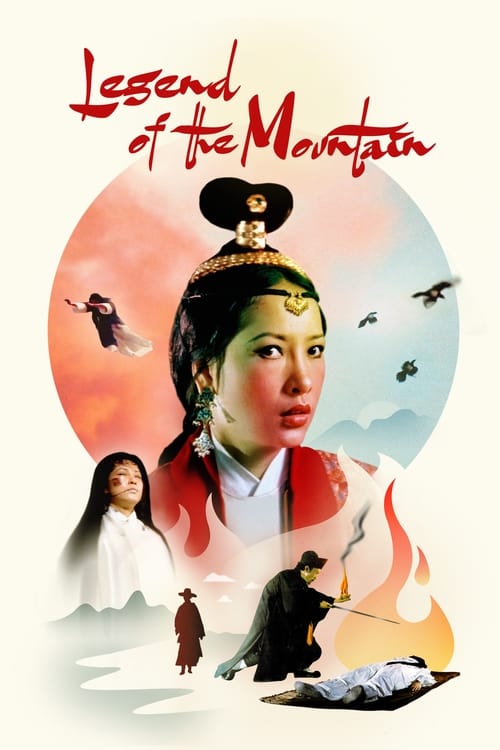
Legend of the Mountain
1979 · King Hu
For when you want to disappear into a film — a long, gorgeous, otherworldly epic for a free evening, more spellbinding than scary. Patience required; the payoff is transporting.
What it's about
A traveling scholar carries a Buddhist sutra said to hold power over the dead to a remote mountain outpost, where the hospitality of strangers grows steadily more sinister. Ghosts, sorcerers, and spirits converge on him and his sacred text, and the battle for his soul is fought not with swords but with drums, ritual, and spells.
The experience
Ravishing and unhurried — mist pouring through pines, banners against waterfalls — punctuated by eruptions of percussion and sorcery unlike anything else in cinema. It's a long, immersive trance that rewards surrender to its rhythm.
The craft
King Hu spent a year shooting in the mountains and temples of South Korea, and it shows: some of the most breathtaking landscape photography of his career frames supernatural duels staged as percussion battles of rhythm, color, and smoke. Long circulated only in a butchered cut, the restored full version is a big-screen, good-speakers experience above all.
Why it matters
A late masterpiece from the exiled director who elevated the martial-arts film to high art, its restoration cemented its standing as one of the great supernatural epics of Chinese-language cinema.
King Hu, the exiled Chinese master who elevated wuxia to high art with A Touch of Zen, spent a year in the mountains and temples of South Korea shooting this three-hour ghost story back-to-back with Raining in the Mountain. A scholar carries a Buddhist sutra with power over the dead to a remote frontier outpost, where the hospitality of strangers grows steadily more sinister; the battles here are fought not with swords but with drums, sorcery erupting in percussion duels of rhythm, color, and smoke. Hu drapes the supernatural intrigue in some of the most ravishing landscape photography of his career — mist pouring through pines, banners against waterfalls, figures dwarfed by cliff faces — turning a Song-dynasty tale into a meditation on desire and deliverance. Butchered for release and circulated for decades in a truncated cut, it was restored to full length in 2016, revealing the film Hu intended: languorous, eerie, and ecstatic. The frog on the temple path knows more than the scholar does.
A Deleuzian reading
A frog sits on a temple path in *Legend of the Mountain*.
The full Deleuzian reading of Legend of the Mountain →
Reception
Released in a drastically truncated cut in 1979 and largely a commercial afterthought, it spent decades as a hard-to-see curio — until the 4K restoration of the full three-hour version in the mid-2010s recast it as one of King Hu's supreme achievements and a lost masterpiece of supernatural cinema.
How Legend of the Mountain was received, from release to now →
Influences: the films it descends from and the films it influenced
- A Touch of Zen (1971) — Established Hu's fusion of landscape-scaled wuxia with Buddhist transcendence — the bleeding-light monk whose serene power dissolves swordplay into mysticism — the exact template Legend extends into its ghost-exorcism climax.
- Dragon Inn (1967) — Codified 'sinister hospitality': the isolated lodging where courtesy masks lethal intent, its confrontations detonated in abrupt percussion-cued bursts between long stretches of watchful stillness.
- Come Drink with Me (1966) — Imported Peking-opera percussion — gong, drum, and wooden clapper — as the rhythmic scoring of combat, with cuts landing on the beat, the sound-design grammar Legend elaborates into full percussion duels.
- Ugetsu (1953) — The model for the spectral-seduction plot in which a ghost-woman lures a wandering scholar into a phantom household, rendered through languorous long takes and mist-shrouded dissolves between the living and dead worlds.
- Kwaidan (1964) — Built supernatural dread from painterly stylized natural settings and a soundtrack of sparse, percussive effects and pointed silences rather than orchestral scoring — the aural approach behind Legend's use of sound as menace.
- Throne of Blood (1957) — Placed a malevolent forest spirit within fog and wind treated as supernatural agents, and drew on Noh stylization for otherworldly performance — antecedents for the demoness and haunted mountain of Legend.
- Onibaba (1964) — Turned windswept landscape into an active, menacing force and bound the demonic-feminine to erotic threat, the nature-as-antagonist and seductive-danger pairing Legend restages on its Korean plateaus.
- A Chinese Ghost Story (1987) — Directly extends Hu's spectral hospitality and sorcery-combat — a scholar seduced by a ghost bound to a demon, defended by flying Taoist priests hurling scriptures — into wire-fu spectacle.
- Zu Warriors from the Magic Mountain (1983) — Escalates Hu's sorcery-combat — mantra-chanting monks, projected energy, and talismanic weapons — into full fantasy spectacle, carrying forward the idea of the battle as spiritual contest.
- The Bride with White Hair (1993) — Sustains the supernatural-wuxia romance in which desire courts damnation, staged amid stylized landscape and sorcerous transformation descended from Hu's melding of ghost tale and swordplay.
- Crouching Tiger, Hidden Dragon (2000) — Ang Lee has cited King Hu directly; its treetop and bamboo-grove combat consciously echoes A Touch of Zen, and it inherits Hu's landscape-scaled compositions and the woman warrior as moral center.
- The Assassin (2015) — The purest heir to Hu's new-Taiwan wuxia: extreme languorous pacing, landscape photography over exposition, and combat as brief eruption within stillness, set in a meticulously restored dynastic milieu.
- Ashes of Time (1994) — Takes Hu's contemplative register to its limit — elliptical, mood-driven wuxia where desire and deliverance drift through vast desert landscapes rendered as psychic scale rather than action arena.
- Hero (2002) — Builds on Hu's landscape-as-narrative photography, using color-coded environments and sweeping natural vistas as the stage for wuxia grandeur, extending his sense of nature-scale into chromatic spectacle.
- Raining in the Mountain (1979) — Shot back-to-back with the same crew in the same Korean monasteries as a companion production, it shares the treatment of temple architecture and terraced landscape as a spatial chessboard on which pursuit and betrayal are choreographed.
- The Valiant Ones (1975) — Refined Hu's opera-derived combat editing into a fragmentary, beat-driven montage where a single exchange is built from many brief shots timed to drum strokes, the cutting logic reused across Legend's fight and chase set-pieces.
Similar films
- Dragon Inn (1967) — influence & lineage
- Ashes of Time (1994) — influence & lineage
- Come Drink with Me (1966) — influence & lineage
- The Assassin (2015) — influence & lineage
- Crouching Tiger, Hidden Dragon (2000) — influence & lineage
- Hero (2002) — influence & lineage
- Ugetsu (1953) — influence & lineage
- Throne of Blood (1957) — influence & lineage
All the films related to Legend of the Mountain →