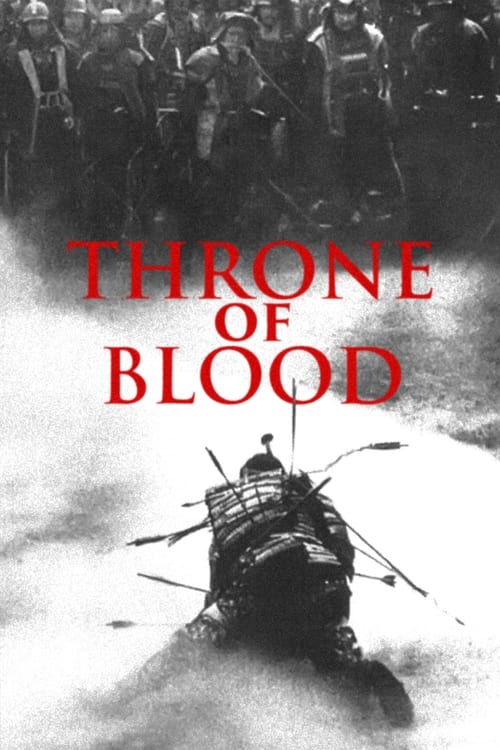
Throne of Blood
1957 · Akira Kurosawa
For when you want something ancient and elemental — a dark fable to sink into on a quiet night, not background viewing. It asks for your full attention and repays it with images you won't shake.
What it's about
Two samurai generals, riding home through a fog-bound forest after a victory, meet a spirit who prophesies that one of them, Washizu, will rule the great castle they serve. When the first part of the prophecy comes true, Washizu's coolly implacable wife begins pressing him toward the rest of it — murder, usurpation, and everything that follows ambition once it's loose. It's Shakespeare's Macbeth remade as a Japanese civil-war epic.
The experience
Eerie and hypnotic — long stretches of near-stillness and silence broken by sudden, ferocious violence. The mist, the drums, and the masklike faces build a dread that feels less like suspense and more like watching a trap close in slow motion.
Performances
Toshiro Mifune plays Washizu as a man being eaten alive by his own ambition, all coiled panic and animal ferocity, while Isuzu Yamada's near-motionless, whispering Asaji is one of the most quietly terrifying performances ever filmed.
The craft
Kurosawa shot it in real mountain fog on the slopes of Mount Fuji and borrowed the stylized stillness of classical Noh theater — faces held like masks, movement pared to almost nothing. The black-and-white images are stark and monumental, and the climax is one of cinema's great physical set pieces.
Why it matters
Widely considered one of the finest Shakespeare films ever made — precisely because it throws out the words — and a cornerstone of Kurosawa's international reputation.
Snapshot
Throne of Blood — released in Japan under the title 蜘蛛巣城 (Kumonosu-jō, "Spider Web Castle") — is Akira Kurosawa's transposition of Shakespeare's Macbeth into the Sengoku period (roughly the fifteenth and sixteenth centuries of civil war in Japan). The result is not a translation so much as a metamorphosis: every trace of Renaissance rhetoric has been stripped away and replaced by the grammar of classical Noh theater, leaving a film of almost unbearable stillness punctuated by eruptive violence. Toshiro Mifune plays the ambitious general Washizu, and Isuzu Yamada plays his wife Asaji with a mask-like immobility that many critics regard as one of cinema's most frightening performances. Shot in deep atmospheric mist on the lower slopes of Mount Fuji and framed with an austerity that keeps spectacle strictly subordinate to dread, the film is widely considered among the greatest of all Shakespeare adaptations on screen — and among the pinnacle works of the Japanese golden age.
Industry & production
By 1957 Kurosawa occupied a peculiar position within the Japanese studio system. His earlier Rashomon (1950) had won the Golden Lion at Venice and the Honorary Academy Award for Best Foreign Language Film, transforming him almost overnight from a domestic talent into an internationally certified auteur. Toho Studios, which had produced and distributed Rashomon and Seven Samurai (1954), continued to back Kurosawa's increasingly ambitious projects, giving him relative creative latitude within a system that was simultaneously the most productive film industry in the world by output and under serious commercial pressure from the rising popularity of television. Kurosawa produced Throne of Blood and the Gorky adaptation The Lower Depths in the same year — 1957 — an extraordinary feat of concurrent development that speaks to both his productivity at this period and his ability to work across radically different registers.
The production was mounted at Toho's facilities but required extensive location work. The sets were constructed on the lower slopes of Mount Fuji near Gotemba, a choice made specifically to exploit the mountain's natural fog banks. The Spider Web Castle set itself was purpose-built and then, in a gesture consistent with the film's thematic logic of cyclical destruction, was demolished after shooting concluded. The film was co-written by Kurosawa alongside three regular collaborators — Shinobu Hashimoto, Ryuzo Kikushima, and Hideo Oguni — the same team that had scripted Ikiru (1952) and Seven Samurai. The screenplay dissolves Shakespeare's language entirely; there are no soliloquies, no verbal complexity of the Elizabethan kind. The dramatic burden falls almost entirely on image and atmosphere.
Technology
Throne of Blood was shot in black and white with an Academy aspect ratio, prior to Kurosawa's turn toward widescreen that would arrive with The Hidden Fortress (1958). The choice to remain in the narrower frame serves the film's claustrophobia: figures are pressed together or isolated in compositions that feel enclosed even in open landscapes. Cinematographer Asakazu Nakai, one of Kurosawa's most trusted collaborators (their partnership stretched across much of the director's career), used the medium's tonal range to differentiate the film's spatial registers — the blazing whites of interior candlelight against oppressive black armor, the gray undifferentiated mass of fog in the Cobweb Forest. Long telephoto shots are used sparingly but to decisive effect in the finale, compressing space and making Washizu's death-by-arrows feel simultaneously inevitable and hyper-real.
The natural fog at the Gotemba location was not merely a lucky environmental condition but a central material of the film — Kurosawa scheduled shooting around the mountain's weather patterns. The production record suggests he waited for specific fog densities to photograph the forest sequences, treating the atmosphere itself as a design element on par with the constructed sets. This relationship between patience and landscape would remain characteristic of his working method.
Technique
Cinematography
Nakai's compositions consistently invoke Noh theater's spatial conventions: figures are placed front-center or pushed to strict lateral positions, with negative space deployed as weight rather than vacancy. The Cobweb Forest sequences — Washizu and his retainer Miki lost in identical, endlessly duplicating paths — are among the most disorienting in the film, using fog, repeated tree lines, and the absence of visual orientation cues to render the landscape as labyrinthine fate. The approach is anti-spectacular; Nakai and Kurosawa resist the temptation to make the supernatural visually extravagant. The forest spirit appears in a small hut, framed simply, the uncanny located in stillness and immobility rather than in effects. Light sources within the castle are often single candles or torches, casting shadows that reduce faces to geometry — particularly Asaji's, which registers less as a human face than as a carved surface.
Editing
Kurosawa edited his own films throughout much of his career, and Throne of Blood demonstrates his characteristic approach: sequences are constructed in long, durational takes that accumulate pressure, then released through sudden cuts. The editing tempo is slow by Western genre standards of the period, aligned with the rhythmic patience of Noh rather than the kinetic montage of Soviet-influenced action cinema. The film's most famous editing choice — cutting away from Washizu's murder of his lord and returning to find Asaji washing blood from her hands — compresses the moral center of the Macbeth narrative into an elision. The act disappears; its aftermath is all that remains, which is precisely the film's argument about guilt and consequence.
Mise-en-scène / staging
The Noh influence is most fully visible in the film's staging. Kurosawa had studied Noh intensively and worked directly with the theater's conventions at a structural level rather than merely decorating a film with surface references. Movement in Throne of Blood is choreographed with the deliberateness of Noh performance: figures cross the frame at controlled speeds, stop in held positions, and change direction as if following invisible stage markings. Asaji's walk — gliding across polished floors, arms fixed, head level — reproduces the characteristic locomotion of Noh actors in female roles. The banquet scene, in which Washizu is driven to public madness by hallucinations of the murdered Miki, uses the physical vocabulary of Noh possession sequences.
The set design draws on the visual language of Noh stage architecture — bare wooden surfaces, minimal furniture, the symbolic rather than realistic placement of objects — while the costumes, designed under Kurosawa's supervision, blend historical period accuracy with the exaggerated formal geometry of Noh costuming. The film's opening and closing device — a chorus chanting over the ruins of Spider Web Castle, the site now emptied of all life — is taken directly from the framing conventions of certain Noh plays, situating the entire narrative as a cautionary memory recovered from an already-completed catastrophe.
Sound
Masaru Sato composed the score, and Kurosawa used it with characteristic restraint — large sections of the film are silent or nearly so, with the sonic design dominated by wind, the creak of castle wood, and the ambient sounds of the Fuji location. The choral passages that bracket the film use a combination of traditional Japanese vocal techniques and orchestral writing, creating a mourning-song quality that removes the narrative from any specific historical moment and places it in mythological time. The silence around Asaji is itself an instrument: her scenes frequently strip away ambient sound, isolating her voice in a register of preternatural calm that amplifies the violence of what she proposes.
Performance
Toshiro Mifune's Washizu is among his most complex performances, though it operates in a register quite different from his samurai heroes in Seven Samurai or his ronin in Yojimbo (1961). Washizu is physically powerful and decisive on the battlefield; Mifune gives him the bearing of a war leader without question. But Kurosawa stages his collapse as corporeal — a progressive disintegration of the body under the pressure of guilt and prophecy, the physical confidence curdling into flinching terror. The performance in the final sequence, pinned by arrows while the army he cannot believe is human closes in, is justifiably legendary: Mifune was shot at with real arrows by archers positioned at close range, striking the predetermined marks around his body. His terror is documented as genuine, which makes the performance both ethically complex as a production decision and cinematically irreducible.
Isuzu Yamada's Asaji is the film's conceptual center. Her stillness is absolute: where Lady Macbeth in performance history has typically been played as volcanic, Yamada refuses every outward expression of desire or distress. She is modeled explicitly on the zo and fukai masks of Noh theater — the masks of middle-aged women whose inner life is entirely concentrated behind an expressionless surface. The effect is to make Asaji more frightening than any passionate villain; her suggestions arrive as statements of fact, her manipulation as geometry. The hand-washing scene — done in a single, sustained take with almost no camera movement — demonstrates Yamada's mastery of implication over statement.
Narrative & dramatic mode
The film operates as Greek tragedy as filtered through Buddhist cosmology: fate is not merely an external force but the crystallization of character, and the prophecy functions not as a cause of Washizu's actions but as a revelation of who he already is. Kurosawa removes Shakespeare's extended deliberation — the long soliloquies through which Macbeth and Lady Macbeth weigh and agonize — replacing them with a structure in which decisions are made almost instantly, their consequences then unfolding with the inevitability of natural law. This compression serves the Buddhist narrative logic: the karma is set in motion quickly; the suffering is long. The Cobweb Forest as spatial metaphor is precise — a labyrinth in which every path leads back to the same place, which is the place of one's own making.
Genre & cycle
Throne of Blood belongs to the jidaigeki (period film) tradition that forms the central pillar of Japanese prestige cinema from the silent era through the postwar decades, but it occupies an unusual position within that tradition. The typical jidaigeki is organized around action and the code of the warrior; Kurosawa's film evacuates the genre's kinetic pleasures almost entirely, using the period setting as the frame for a psychodrama that is more interested in the mechanics of self-destruction than in combat. It sits alongside his own Rashomon and Ikiru as evidence that the jidaigeki frame could sustain modernist experiments in narrative and moral ambiguity. Internationally, it belongs to a cycle of prestige Shakespeare adaptations — alongside Olivier's Hamlet (1948) and Richard III (1955) — while simultaneously rejecting the theatrical fidelity those films cultivated.
Authorship & method
Kurosawa's directing method was characterized by exhaustive preparation, collaborative script development, and iron control over the visual image. He was a trained painter and his storyboards for major sequences were detailed compositional plans rather than rough guides. The collaboration with Nakai was long-standing; the cinematographer understood how to execute Kurosawa's visual intentions with minimal direction on set. Shinobu Hashimoto's contributions to the screenplay are documented in interviews (Hashimoto later wrote a memoir of his Kurosawa collaborations, Compound Cinematics) as substantially structural — the architecture of how to compress and displace the Shakespeare narrative without losing its dramatic logic. The composers and editors who worked with Kurosawa consistently describe a working process in which his vision was clear and pre-formed while remaining open to execution discoveries on set and in the cutting room.
Movement / national cinema
The film arrives at the apex of a Japanese cinema that was simultaneously the most internationally celebrated in the world and subject to specific national conditions — the long shadow of the Second World War, the experience of the atomic bombings, the American Occupation (which ended in 1952), and the ongoing negotiation of what Japanese cultural identity meant in the postwar order. The cyclical violence of Throne of Blood, its suggestion that political ambition produces ruin that produces new ambition in an unbroken loop (underscored by the chorus), carries resonances in this context that extend beyond the Shakespeare source. Critics including Donald Richie have read the film as obliquely processing the militarist catastrophe, though Kurosawa himself was characteristically reticent about allegorical readings of his work.
Era / period
The late 1950s in Japanese cinema were a period of unusual creative density. The major postwar studios — Toho, Daiei, Shochiku, Nikkatsu — were each producing internationally significant work; Mizoguchi Kenji had died in 1956, consolidating Kurosawa's position as the most visible figure of Japanese cinema abroad. The Noh theater influence in Throne of Blood participates in a broader postwar recovery and revaluation of classical Japanese artistic forms, a project that carried cultural-political weight in a period when Japan was rebuilding its sense of its own heritage.
Themes
Fate, ambition, and the impossibility of escaping one's own character are the film's central concerns. The prophecy structure generates a tragic irony that Kurosawa makes spatial as well as dramatic: Washizu attempts to act against the prediction and fulfills it precisely through those actions, the Cobweb Forest returning him to the spirit's clearing no matter which direction he rides. Loyalty and its betrayal are examined through the Washizu-Miki friendship, which is destroyed not by hatred but by the internal logic of the paranoia that ambition generates. The motif of the forest as cognitive confusion — the inability to distinguish the real from the projected, the path from the trap — anticipates themes that will run through Kurosawa's later work. A Buddhist reading of the narrative, which several Japanese critics have foregrounded, situates the entire drama as an illustration of the Second Noble Truth: desire as the origin of suffering, the consequences as exact and inescapable as physics.
Reception, canon & influence
Initial reception in Japan was respectful but not ecstatic; the Noh stylization struck some domestic critics as austere to the point of severity, and the film did not achieve the popular success of Seven Samurai. International reception was more enthusiastic, and the film's reputation has grown steadily in the decades since. It now regularly appears on canonical lists of the greatest films ever made and is considered among the definitive Shakespeare adaptations in any medium.
The influences on the film are layered: Shakespeare's Macbeth is the narrative skeleton; the Noh tradition — particularly the plays of Zeami Motokiyo and the tradition of mugen Noh (dream Noh, in which spirits relive past actions) — supplies the aesthetic grammar; and the Western cinematic tradition, which Kurosawa had absorbed through his deep engagement with John Ford, William Wyler, and classical Hollywood, provides the structural clarity and the muscular use of landscape. The synthesis is entirely without precedent.
The film's legacy runs forward in several directions. Polanski's Macbeth (1971) is in direct conversation with it, particularly in its decision to externalize the supernatural and in its bleak, cyclical ending. Joel Coen's The Tragedy of Macbeth (2021) visibly draws on Kurosawa's compositional austerity and his decision to abstract the drama toward elemental design — bare rooms, oppressive shadow, figures isolated in expanses of white. More broadly, the film established that a Shakespeare adaptation could achieve fidelity not through language or period specificity but through structural and thematic essence transplanted entirely to another cultural tradition — a methodological precedent that has licensed dozens of subsequent cross-cultural Shakespeare films. The arrow finale — an act of mob execution that transforms a king into a pincushion, the body remaining upright as death refuses to arrive quickly — has entered the visual vocabulary of cinema as an image of retribution without catharsis.
A Deleuzian reading
Two horsemen break out of the trees at a gallop, and the fog closes behind them, and a minute later they break out again at the very same spot.
The full Deleuzian reading of Throne of Blood →
Reception
Some Shakespeare purists initially sniffed at a Macbeth with none of Shakespeare's language — Peter Brook famously argued it didn't even count as Shakespeare — but the verdict flipped hard: it's now routinely called the greatest Shakespeare film ever made, with Harold Bloom among its champions.
How Throne of Blood was received, from release to now →
Influences: the films it descends from and the films it influenced
- The Passion of Joan of Arc (1928) — Dreyer's sustained close-ups of Falconetti's face in mask-like immobility — registering psychological collapse without expression — establish the direct prototype for Isuzu Yamada's Asaji, whose zo-mask stillness Kurosawa extends from close-up into full-figure staging across an entire performance.
- Alexander Nevsky (1938) — Eisenstein and Prokofiev's synchronization of choral score to choreographed image as co-equal structural elements — sound as architecture rather than accompaniment — is the direct model for Throne of Blood's Noh chanting and silence functioning as dramatic instruments coequal with the image.
- Macbeth (1948) — Welles adapts the same source text by replacing theatrical convention with formal abstraction — paper-maché castle, fog-banked studio sets, expressionist angles rather than period realism — establishing the precedent for anti-naturalist Shakespearean transposition that Kurosawa extends through Noh grammar.
- Hamlet (1948) — Reconceives Shakespeare through atmospheric compression and a fog-bound, near-abstract castle, pursuing Olivier's strategy of replacing text with visual-spatial expression of dread.
- Onibaba (1964) — Shindo makes a Noh demon mask the literal dramatic engine of the narrative, literalizing Throne of Blood's zo-mask-stillness technique — the mask's physical effect on the face becomes the horror premise rather than a performance register, treating Asaji's immobility as a supernatural mechanism.
- Kwaidan (1964) — Kobayashi extends Throne of Blood's Noh theatrical staging into a ghost-story anthology using painted theatrical backdrops and ritualized body movement, making explicit the theatricality Kurosawa conceals — where Kurosawa absorbs Noh into ostensibly realistic space, Kobayashi displays its artifice as the horror itself.
- Kuroneko (1968) — Shindo uses a bamboo forest traversed in fog with identical repeating sightlines that prevent spatial orientation, directly inheriting the Cobweb Forest's grammar of undifferentiated landscape as the visual form of inescapable fate.
- Macbeth (1971) — Polanski inverts Throne of Blood's murder-elision method by dwelling graphically on the very acts Kurosawa cuts away from, while sharing Kurosawa's use of windswept landscape (Scottish highlands as Cobweb Forest) as psychological externalization of the protagonist's dissolution.
- Stalker (1979) — Tarkovsky builds the Zone as a labyrinthine fate landscape traversed in extreme durational takes — a space that reshapes around interior states and resists linear navigation — directly extending Throne of Blood's Cobweb Forest as the formal model for landscape-as-subjective-doom.
- Ran (1985) — Kurosawa scales Throne of Blood's Noh staging and Buddhist-fate architecture into widescreen color for a King Lear transposition, with Emi Wada's Noh-derived costume design explicitly encoding the theatrical register that Throne of Blood had sustained through performance and spatial composition alone.
- Come and See (1985) — Klimov fires live ammunition around principal actor Aleksei Kravchenko throughout production, extending Throne of Blood's real-arrows technique — performance-through-actual-physical-jeopardy — from a single climactic moment into a sustained production method for registering extremity.
- Macbeth (2015) — Kurzel uses extreme telephoto compression in the battle sequences to collapse spatial depth into a suffocating field of bodies, extending Throne of Blood's telephoto-compressed arrow finale from a single climactic technique into the film's dominant cinematographic grammar throughout.
- Dreams (1990) — Kurosawa's own template for stillness-over-expressiveness: noh-mask performance and fog-bound constructed practical sets where actors hold motionless tableau poses, reused for the fox-wedding procession and the snow-spirit.
- Shadow (2018) — Pioneers the fog-bound, diffuse sourceless light and near-monochrome studio atmosphere that Shadow's greyscale world extends, dissolving figures into a flat painterly field rather than naturalistic depth.
- Demons (1971) — Imported Noh-derived stylized performance, mask-like faces, and fog/emptiness staging into jidaigeki, legitimizing extreme theatrical abstraction of a period setting.
- Legend of the Mountain (1979) — Placed a malevolent forest spirit within fog and wind treated as supernatural agents, and drew on Noh stylization for otherworldly performance — antecedents for the demoness and haunted mountain of Legend.
- Othello (1952) — Welles fragments Shakespeare through location shooting across three countries, making wind-battered architecture and harsh natural light do the dramatic work theatrical staging once did — the same anti-theatrical impulse Kurosawa pursues through Noh grammar, pursued instead through spatial rupture and discontinuity.
- Ugetsu (1953) — Mizoguchi uses fog on Lake Biwa as a threshold material between living and dead — not atmospheric decoration but a spatial condition that dissolves ontological categories — within the same Sengoku-period register and with the same Noh-influenced durational lateral staging as Throne of Blood.
- Harakiri (1962) — Kobayashi deploys jidaigeki form with Noh-derived staging — figures placed in formal front-center positions, extreme silence preceding violence, durational confrontation sequences that accumulate pressure without kinetic montage — extending the same formal vocabulary Throne of Blood codifies.
- Star Wars: The Last Jedi (2017) — Provides the Noh-derived static theatrical tableau — characters held in stylized, near-symmetrical stillness — that Johnson uses for the Praetorian Guard standoff and confrontations.
- Titus (1999) — Models Shakespeare adapted through non-naturalistic theatrical abstraction (Noh masks, stylized gesture, ritualized violence) rather than psychological realism — the mask-and-ritual lineage from Taymor's stage practice.
- The Bad Sleep Well (1960) — The immediately prior Shakespeare transposition (Macbeth), establishing Kurosawa's method of relocating the tragedy's architecture into a native idiom rather than reciting its text — the same adaptive craft applied to Hamlet here.
- The Ballad of Narayama (1958) — Kurosawa imports Noh mask-acting, stylized gliding movement and gesture into a near-contemporary jidaigeki, the parallel gambit to Narayama's kabuki-bunraku performance stylization within a golden-age film.
Similar films
- Ran (1985) — influence & lineage · same viewing thread
- Macbeth (1971) — influence & lineage · same viewing thread
- Ugetsu (1953) — influence & lineage
- Macbeth (1948) — influence & lineage
- Kuroneko (1968) — influence & lineage
- Harakiri (1962) — influence & lineage
- Hamlet (1948) — same viewing thread
- Hamlet (1996) — same viewing thread
All the films related to Throne of Blood →
Watch it with: curated runs of related films
- Shakespeare's Kings and Killers — Watch these near each other and the same machinery keeps turning in new tongues — the murdered king, the usurped crown, the prophecy and the ambition that curdles into slaughter — as Olivier, Welles, Kurosawa, Polanski and Branagh each bend Shakespeare to the screen.