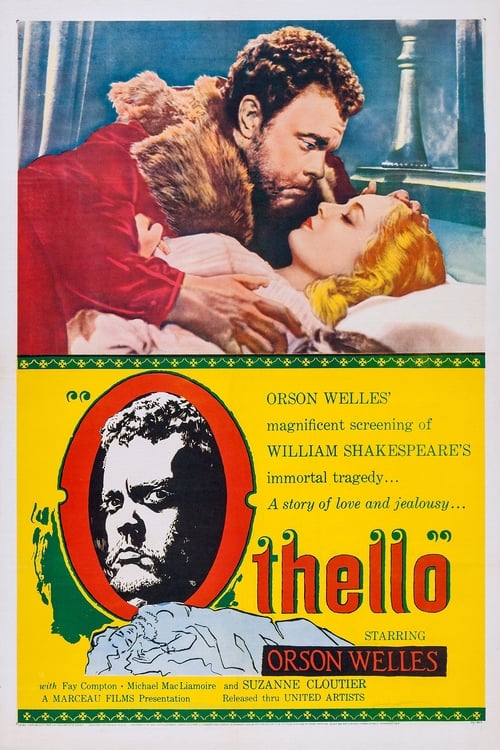
Othello
1951 · Orson Welles
For when you want Shakespeare with the dust blown off — lean, visual, and intense — or when you're in the mood to watch a great mind spiral. More gripping than homework-y, but it asks you to lean in.
What it's about
Othello, a celebrated Moorish general in the service of Venice, secretly marries Desdemona — and becomes the target of his ensign Iago, who sets out to destroy him through whispers alone. Poisoned drop by drop with suspicions of his wife's infidelity, Othello's love curdles into jealousy as Iago's web of lies tightens. Shakespeare's tragedy, compressed to its dramatic bone and told as much through shadow and architecture as through words.
The experience
Feverish and disorienting in the best way — all plunging angles, slashing shadows, and percussive cuts that make the jealousy feel like vertigo. It moves fast for Shakespeare, trading long speeches for pure visual storytelling.
Performances
Welles brings tragic gravity and a great ruined voice to Othello, while Micheál Mac Liammóir plays Iago as something coiled and reptilian — malice delivered almost entirely in insinuation.
The craft
Shot piecemeal over three years across Morocco and Italy as the money repeatedly ran out, and edited into something miraculously coherent — the sun-bleached fortresses and canals become a maze mirroring Othello's unraveling mind. The expressionist black-and-white photography and jagged editing are the show; it looks like almost nothing else from its era.
Why it matters
It won the top prize at Cannes in 1952 and stands as a landmark of independent filmmaking — proof that a masterpiece could be willed into existence outside the studio system, one borrowed camera at a time.
Snapshot
Orson Welles's Othello is one of cinema's most audacious acts of adaptation and survival: a Shakespeare film assembled across three years, four countries, and chronic financial collapse, ultimately winning the Grand Prize at Cannes in 1952 and standing as one of the most visually inventive films of the postwar decade. Welles plays the Moor himself, Mac Liammóir a reptilian Iago, and the entire enterprise is shot with the light-and-shadow vocabulary of expressionism transposed onto sun-bleached Moroccan fortresses and Venetian canals. The film strips Shakespeare's text to a dramatic skeleton and fills the silence with pure cinema: extreme angles, percussive editing, and a mise-en-scène that treats the architecture of North Africa as an extension of Othello's psychological collapse. The result is as much an essay on jealousy and vision as it is a faithful rendering of the play — a film in which watching, in every sense, is the condition of destruction.
Industry & production
Welles began assembling Othello in 1949 with Italian co-producer Scalera Film, but the arrangement collapsed almost immediately. What followed was a production model without real precedent in the postwar art-film world: Welles financed the film himself, in installments, by accepting acting roles in other productions and channeling his fees directly into the budget. His role as Harry Lime in Carol Reed's The Third Man (1949) is the most celebrated of these funding expeditions, but there were others — including Welles's appearance in Henry Hathaway's The Black Rose (1950) — that kept the project alive.
Principal photography was conducted in fragments across Morocco (primarily the walled coastal city of Essaouira, then called Mogador, and its Portuguese-built sea fortifications), Italy (Rome, Venice, the Viterbo area), and briefly elsewhere in Europe. The cast could rarely be assembled in one place; actors flew in for days or weeks, shot what was possible, and departed. Micheál Mac Liammóir, who played Iago, documented the entire ordeal in his 1952 diary Put Money in Thy Purse, one of the most vivid primary accounts of a film shoot in the literature. His portrait of Welles — simultaneously tyrannical, inspired, and operatically disorganized — is indispensable.
Desdemona's casting was itself turbulent. Lea Padovani began in the role, was replaced, and eventually Suzanne Cloutier — a French-Canadian actress — completed the part, though she reportedly spoke her lines phonetically in some scenes. Fay Compton played Emilia. Robert Coote was Roderigo. The fragmented timeline meant that not all performances were recorded with synchronized sound; a great deal of dialogue was dubbed in post-production, sometimes by different voices than those on screen.
Technology
Because location shooting was primary and the production intermittent, Welles worked with whatever cameras and lenses were locally available, and the film bears the traces of that improvisation. No single technical specification defines its look — the cinematographic approach evolved across multiple units and multiple cinematographers over three years.
The most consequential technological decision was also the most economical: Welles consistently chose location architecture over built sets, meaning the film's visual complexity was sourced from existing stone rather than fabricated studio geometry. Deep-focus photography, which Welles had pioneered on Citizen Kane (1941, with Gregg Toland), is used here with a different grammar — the Moroccan fortifications naturally produce vertiginous perspectives, and Welles exploits them without the mechanical apparatus of multi-plane studio photography.
The sound technology, by necessity, was largely post-production. The majority of the film's dialogue was looped. Whether this was an artistic choice layered onto economic constraint or purely practical is a matter of interpretation; the result, as several scholars have noted, gives the film a dissociated, sometimes dreamlike quality in which speech seems to arrive from a remove, as if from inside the characters' minds.
Technique
Cinematography
Multiple cinematographers contributed to Othello, among them Anchise Brizzi, George Fanto, Alberto Fusi, and G. R. Aldo (Aldo Graziati), with Aldo generally credited as the primary director of photography. The visual design is characterized by extreme low angles that transform characters into architectural monuments against blown-out skies; deep shadow cutting across faces and corridors in the manner of German expressionism; and a recurrent use of silhouette — figures reduced to black shapes moving across blinding Mediterranean light.
The opening funeral sequence is the film's visual manifesto: Othello and Desdemona borne in procession, the cortège seen mostly in upward-tilted fragments, faces and bodies blocked by cages, grilles, and latticed biers. The effect is of mourning filtered through iron — vision obstructed and parceled, grief geometrized. Welles establishes in the first five minutes that this will be a film about the failure of clear seeing, and the camera will enact that failure continuously.
The famous Turkish bath sequence — in which Iago engineers Cassio's disgrace — was shot when costume deliveries for a planned interior scene failed to arrive. Unable to shoot the scripted scene, Welles improvised, moving the action to a public steam bath in Morocco where the actors required no period clothing. The resulting sequence, shot through steam and shadow with figures wrapped in towels and silhouetted against tiled walls, is widely cited as one of the more remarkable instances of constraint generating invention in film history. The half-naked, spatially disorienting images transform a functional scene of conspiracy into something approaching the erotic grotesque.
Editing
The editing, credited to Welles himself with Jean Sacha and John Shepridge among the collaborators, is percussive and deliberately disorienting. Cut rhythms do not follow classical continuity; shots are held past comfort or cut before completion; spatial geography is frequently scrambled. Welles uses the cut not to clarify but to destabilize, and he frequently edits against the emotional grain of a scene — inserting cutaways that deflect rather than confirm what we expect to see.
The assassination of Roderigo is accomplished almost entirely through fragments: a hand, a shadow, the grille of a drain. This strategy — violence approached through synecdoche, trauma displaced onto partial images — recurs throughout and is consistent with the film's central preoccupation: that Othello himself never directly witnesses the infidelity he believes in. The editing form mirrors the narrative's epistemology.
Mise-en-scène / staging
Welles stages almost nothing on a flat plane. Characters are almost always separated by depth, elevated above or below one another, framed through intervening objects. Iago's relationship to Othello is staged in terms of vertical displacement — he is frequently seen from above or below, speaking upward or downward to the Moor, the power differential constantly negotiated through geometry rather than dialogue.
The Moroccan fortifications at Essaouira provide a setting that feels genuinely ancient and siege-hardened; Welles resists any impulse to prettify, instead using the crumbling battlements and choked passageways as expressions of Othello's psychological interiority. The fortress is the general's mind: massive, magnificent, and laced with gaps through which enemies may pass unseen.
Sound
The post-dubbed dialogue produces specific effects. Where classical Hollywood dubbing aims for seamless synchronization, Welles allows occasional dislocation — the voice slightly ahead of or behind the lips, the acoustic environment of the dubbed line mismatching the visual environment. These slippages, whether intentional or unavoidable, contribute to the film's uncanny register. Characters speak and are not quite embodied in their speech; presence and voice are fractionally decoupled.
The score, by Francesco Lavagnino and Alberto Barberis, draws on Mediterranean and North African tonalities — modal scales, percussion, woodwinds — and serves as a counter-current to the expressionist imagery, grounding the film in a specific geographical soundworld even as the editing abstracts the space.
Performance
Welles's Othello is a physical performance: large, deliberate, increasingly immobilized by suspicion until he moves with the terrible inevitability of a body in free fall. He does not play the Moor as a man deceived; he plays him as a man who catastrophically needs to be deceived — who requires a narrative of betrayal to externalize the self-doubt his outsider status has installed in him. The reading is psychologically coherent and politically pointed.
Mac Liammóir's Iago is the film's most technically precise performance. His diary makes clear how carefully he constructed it — the demi-devil as bureaucrat, a man of small gestures and absolute patience, whose malice is administrative. Where Welles commands the frame by mass and presence, Mac Liammóir works in deduction and implication, rarely occupying the center of the image, almost always placed so that his sight-line controls the composition.
Narrative & dramatic mode
Welles compresses Shakespeare's five acts to approximately ninety minutes by cutting subsidiary plot, consolidating scenes, and — crucially — converting expository dialogue into pure image. The Willow Song is present; the Senate scene is abbreviated; the Cyprus scenes are restructured to follow a spatial logic of constriction, the world narrowing around Othello as his certainty of betrayal hardens.
The film operates in a tragic mode that is also explicitly retrospective: the opening funeral sequence is not a prologue but a structural frame, establishing that we already know the outcome and are watching the machinery of doom assemble itself. This temporality — watching the past constitute itself as catastrophe — is central to Welles's reading of the play.
Genre & cycle
Othello belongs to the tradition of European literary adaptation that was consolidating in the early 1950s alongside — and in partial reaction to — Italian neorealism. Where neorealism insisted on the quotidian and the present tense, Welles's film draws on the past (Shakespeare, expressionism, Eisensteinian montage) and makes an art cinema that is historicist and formalist by temperament. It shares a sensibility with Laurence Olivier's Hamlet (1948) and Henry V (1944) — Shakespeare-as-cinema-manifesto — but differs sharply in rejecting theatrical staging conventions in favor of cinematic plasticity.
The film also bears the marks of film noir, particularly in its treatment of male paranoia, the femme fatale as construct (Desdemona is innocent, but what matters is that she is imagined as guilty), and the visual grammar of shadow and entrapment.
Authorship & method
Welles is the central authorial intelligence: producer, director, star, and de facto editor. His method is consistent with what he had practiced since Citizen Kane — a total-cinema approach in which camera, editing, and performance are conceived as a single expressive system rather than separate crafts. The fragmented production imposed a working method that, paradoxically, may have intensified the film's authorial coherence: with no continuity of crew or location, the only stable element was Welles's visual imagination.
G. R. Aldo is the key cinematographic collaborator; his work with Welles here and later on Luchino Visconti's Senso (1954, posthumously — Aldo died in a road accident in 1953) marks him as one of the major Italian-based cameramen of the early 1950s.
Micheál Mac Liammóir was not only Welles's actor but his intellectual interlocutor: both men came from the Dublin Gate Theatre tradition, and their shared theatrical background shaped the film's approach to Shakespeare as living, mutable text rather than sacred monument.
Movement / national cinema
Othello is productively unclassifiable by national cinema. It is an American director's film, shot primarily in Morocco and Italy, with an Irish co-lead, a French-Canadian Desdemona, British supporting actors, Italian crew, and international financing. It received its competitive premiere at Cannes and was distributed unevenly across European markets before reaching American audiences in a limited release.
This statelessness is both a condition of its production circumstances and a thematic statement: Othello himself is the film's model of the unbelonging man, the outsider whose competence cannot purchase belonging. Welles — by this point effectively exiled from Hollywood — was making a film about a man in exactly his situation.
Era / period
The film belongs to the moment of postwar European art cinema's formation — the period between Italian neorealism's peak (roughly 1945–1950) and the emergence of the French New Wave (1959–1960). It is simultaneously backward-looking (to the visual ambitions of 1920s and 1930s cinema) and forward-pointing (to the fragmented, location-based, auteur-driven art film that would define the decade to come).
Welles was completing Othello at the same time as the Hollywood studio system was entering its crisis phase; the film can be read as a document of what an ambitious filmmaker could produce entirely outside that system, and at what cost.
Themes
Jealousy in Welles's Othello is a crisis of epistemology rather than merely of feeling. Othello cannot know whether Desdemona is faithful; he can only see through Iago's frame. The film's visual grammar — obstructed sight-lines, fractured editing, bodies glimpsed through grilles and bars — makes this epistemological condition physical. We are placed in Othello's perceptual situation: we too cannot see clearly.
Race and belonging shadow every scene. Welles does not shy away from the play's language of the Moor's otherness, and his physical performance — vast, self-conscious, increasingly isolated — makes Othello's outsider status the engine of his susceptibility. He is not, in Welles's reading, a naive man; he is a brilliant soldier who knows he stands on uncertain ground in Venetian society, and who cannot afford the uncertainty that trust requires.
Power, surveillance, and the architecture of control are also persistent: the fortress setting doubles as a panopticon, and Iago's genius is to make Othello see himself through Iago's eyes — to install a hostile observer inside Othello's own perception.
Reception, canon & influence
Influences on the film (backward): The most visible formal ancestors are the Soviet montage tradition (Eisenstein's Ivan the Terrible, parts of which Welles had presumably seen, and whose approach to historical grandeur and visual symbolism is close kin) and German expressionist cinema — the shadow-work of Murnau, the spatial distortion of Lang. Welles's own earlier films, particularly Citizen Kane and The Magnificent Ambersons (1942), provided a personal vocabulary he was here translating into a new geographic and historical register. Carol Reed's The Third Man, which Welles had acted in the year before, may also be a proximate influence on the use of angular location photography and moral chiaroscuro.
Critical reception: The film won the Grand Prize (effectively the Palme d'Or) at the 1952 Cannes Film Festival — a validation that meant more in European critical circles than it did commercially. American reception was muted; the film received limited distribution and was largely ignored by the mainstream press. European critics, particularly in France, were more receptive; the Cahiers du Cinéma generation that would become the New Wave regarded Welles as a master, and Othello was part of the evidence.
The film has remained in contested canonical territory. Its formal achievements are widely acknowledged; its fidelity to Shakespeare is, by design, subordinate to its formal ambitions, which some literary scholars have found frustrating. The 1992 restoration prepared by Beatrice Welles and released theatrically introduced a new score in place of Lavagnino and Barberis's original, a decision that drew significant scholarly criticism; subsequent critical discussion has treated the restoration question as a substantive issue of the film's identity and not merely a technical footnote.
Legacy (forward): Othello contributed substantially to the possibility of a cinematic Shakespeare that is not illustrated theater but a genuinely filmic transformation of dramatic text. Kenneth Branagh's work — particularly Hamlet (1996) and Henry V (1989) — engages with the precedent Welles set, even where it diverges formally. Oliver Parker's Othello (1995) with Laurence Fishburne necessarily situates itself against Welles's version.
Beyond Shakespeare adaptation, the film's influence on art cinema's visual grammar is harder to trace precisely but plausibly significant: the use of location architecture as psychological space, the rejection of continuity editing in favor of montage affect, and the conception of the film director as total author rather than theatrical supervisor are all positions that Welles's body of work — with Othello as a key exhibit — helped establish as viable and prestigious. That the film was made by a man who had been effectively driven out of Hollywood, and who made something of this quality from the ruins of a collapsing production, was itself an argument about where cinema's creative energies might be better placed.
A Deleuzian reading
Start with the bars.
The full Deleuzian reading of Othello →
Reception
It shared the top prize at Cannes in 1952 but then spent decades nearly impossible to see, dismissed as a patchwork curio from Welles's wilderness years; the 1992 restoration triggered a full reappraisal, and it's now widely read as one of his most visually daring films.
How Othello was received, from release to now →
Influences: the films it descends from and the films it influenced
- Citizen Kane (1941) — Welles's own deep-focus, extreme-low-angle compositions with ceilinged interiors and the retrospective framing device that makes epistemological uncertainty — not psychology — the narrative's center are the direct formal vocabulary Othello extends into location-based shooting.
- The Magnificent Ambersons (1942) — Welles's systematic staging of characters at differentiated vertical levels within a single frame — staircases, banisters, and balconies figuring power and decline in space — is the direct source of Othello's vertical-displacement staging vocabulary.
- Macbeth (1948) — Welles's first Shakespeare film established the post-dubbed, dissociated voice-image method and the expressionist use of built architecture as psychological projection, which Othello then extends by applying the same approach to real locations rather than studio sets.
- Nosferatu (1922) — Murnau's treatment of shadows as autonomous psychological presences — the Count's silhouette acting independently of his body — is the direct formal source for Othello's expressionist shadow cinematography, where Iago's shadow repeatedly subsumes the Moor's physicality in the frame.
- Battleship Potemkin (1925) — The Odessa Steps sequence's technique of representing event through close-ups of objects and body parts — pince-nez, baby carriage, a hand on a railing — rather than continuous spatial action is the specific synecdoche-fragmentation editing method Welles applies in Othello's most violent passages.
- M (1931) — Lang's systematic sound-image dissociation — the Grieg whistle heard without its source, guilt registered acoustically before it is spatially located — and his use of building interiors as psychological labyrinths directly anticipate Othello's dissociated voice-image relationship and architecture-as-psychology staging.
- Ivan the Terrible, Part I (1944) — Eisenstein's coronation and court sequences cut on symbolic and rhetorical logic — visual associations, graphic rhymes, associative shock — rather than spatial continuity, providing the most proximate formal model for Othello's percussive discontinuity editing in the historical-grandeur register.
- The Third Man (1949) — Working as an actor under Reed in Vienna, Welles absorbed the film's canted-angle location photography of ruined urban architecture and its moral chiaroscuro — light and shadow as ethical register — and applied both directly to his own direction of Othello's Moroccan and Italian exterior sequences.
- Touch of Evil (1958) — Welles extended Othello's formal grammar into Hollywood noir, deploying the same extreme-low-angle compositions, post-dubbed dialogue, and spatial figuration of jealousy and betrayal through claustrophobic location architecture, now in a decaying Mexican border town rather than Moorish fortresses.
- The Trial (1962) — Welles applies Othello's architecture-as-psychology method to Kafka by shooting in an actual abandoned Zagreb courthouse and the derelict Paris Gare d'Orsay, so that spatial disorientation becomes the film's subject, extending the same percussive fragmented editing into pure labyrinthine form.
- Chimes at Midnight (1965) — Welles refines every element of Othello's craft: location shooting in Spain, post-dubbed dialogue, and synecdoche-fragmentation editing — most fully in the Battle of Shrewsbury, where cavalry, churning mud, and severed limbs accumulate by cut rather than continuity into the fullest realization of the Eisensteinian method Othello tested.
- Henry V (1989) — Branagh's opening — a camera tracking through a theatrical world until convention dissolves into cinematic space — is a direct formal engagement with Welles's argument that Shakespeare on film requires genuine filmic transformation, using location mud and naturalistic scale where Welles used shadow and fragmentation.
- Hamlet (1996) — Branagh shoots 70mm widescreen Shakespeare entirely on location at Blenheim Palace, using the actual spatial weight and room-to-room surveillance architecture of a great house to provide psychological geography for the play's entrapment — extending Welles's architecture-as-psychology method at maximum cinematic scale.
- Romeo and Juliet (1968) — Shot Shakespeare in real Mediterranean architecture and streets rather than studio sets, the location-Shakespeare precedent behind Zeffirelli's sunlit Verona and Tuscan townscapes.
- Senso (1954) — G.R. Aldo brought to Visconti the same chiaroscuro location-lighting method he developed shooting Othello — deep directional light that makes Venetian palace interiors carry moral and psychological weight — creating a direct craft continuity through the cinematographer's hand across two successive films.
- Last Year at Marienbad (1961) — Resnais uses location architecture — Baroque palace rooms and formal gardens — as the spatial externalization of an epistemological contest over retrospective memory, structuring the film as mutual uncertainty about what really happened: converging on Othello's narrative/epistemological-tragedy method through similar formal means.
- Ran (1985) — Kurosawa adapts King Lear by translating the text into a visual system in which location landscape and castle architecture mirror psychological collapse, with battle sequences organized as fragmented montage of color and chaos rather than continuous action — converging on Othello's Shakespeare-as-genuine-cinema argument from a Japanese formal tradition.
- Throne of Blood (1957) — Welles fragments Shakespeare through location shooting across three countries, making wind-battered architecture and harsh natural light do the dramatic work theatrical staging once did — the same anti-theatrical impulse Kurosawa pursues through Noh grammar, pursued instead through spatial rupture and discontinuity.
Similar films
- Hamlet (1996) — influence & lineage · same viewing thread · often watched together
- Chimes at Midnight (1965) — influence & lineage · same viewing thread · often watched together
- Ran (1985) — influence & lineage · same viewing thread · often watched together
- Macbeth (1948) — influence & lineage
- Touch of Evil (1958) — influence & lineage
- Citizen Kane (1941) — influence & lineage
- The Trial (1962) — influence & lineage
- The Magnificent Ambersons (1942) — influence & lineage
All the films related to Othello →
Watch it with: curated runs of related films
- Shakespeare's Kings and Killers — Watch these near each other and the same machinery keeps turning in new tongues — the murdered king, the usurped crown, the prophecy and the ambition that curdles into slaughter — as Olivier, Welles, Kurosawa, Polanski and Branagh each bend Shakespeare to the screen.