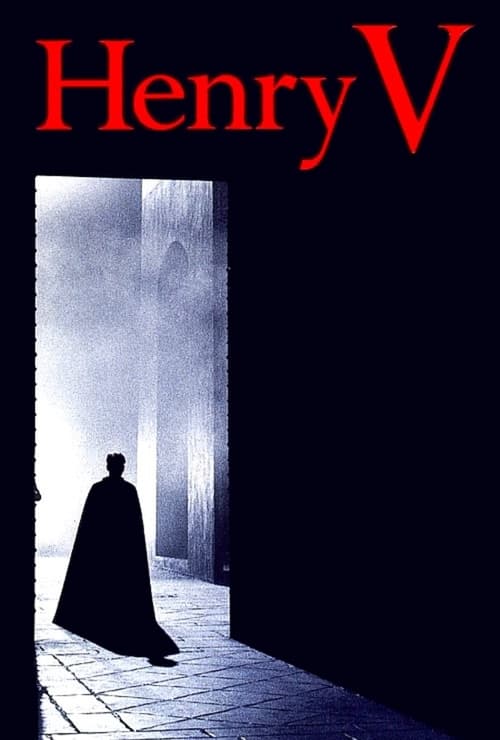
Henry V
1989 · Kenneth Branagh
For when you want to be swept up — rousing oratory, high stakes, and a young leader growing into an impossible job — without the history-lesson stiffness. Accessible even if Shakespeare usually scares you off.
What it's about
In 1415, the young King Henry V of England — recently a wayward prince, now untested on the throne — launches an invasion of France in the midst of the Hundred Years' War. Shakespeare's play follows him from the council chamber to the exhausted, outnumbered English lines before the battle of Agincourt, weighing the glory of conquest against its human cost.
The experience
Stirring and surprisingly gritty — the great speeches still raise the hair on your arms, but they're delivered by men standing in mud and rain, and the battle plays as grueling, chaotic labor rather than pageantry. It leaves you moved and a little sobered.
Performances
Kenneth Branagh, just twenty-eight, directs himself to an Oscar-nominated performance — making the verse sound like living speech and building the St. Crispin's Day rally into one of cinema's great get-up-and-fight moments.
The craft
Branagh's direction trades heraldic spectacle for rain, mud, and exhaustion, so the poetry lands against real physical misery; the swelling score turns the battle's aftermath into the film's emotional summit. The costumes won an Academy Award, and the whole thing plays far more muscularly than "filmed Shakespeare" suggests.
Why it matters
It made Branagh an international figure overnight and kicked off the 1990s revival of Shakespeare on screen, proving the plays could be visceral popular cinema rather than heritage theater.
Snapshot
Kenneth Branagh's Henry V was the debut feature of a twenty-eight-year-old actor-director already being marketed, to his own visible discomfort, as "the new Olivier." That framing was unavoidable: Laurence Olivier's 1944 Henry V was the canonical screen Shakespeare, a wartime morale film of pageantry and Technicolor heraldry. Branagh's task was to make a second screen Henry V that could justify its own existence, and he did so by inverting Olivier's terms almost point for point. Where Olivier offered spectacle and patriotic uplift, Branagh offered mud, blood, exhaustion, and moral doubt — a post-Vietnam, post-Falklands reading of Shakespeare's most ambivalent war play. The film made Branagh an international figure, earned Academy Award nominations for Best Actor and Best Director (with a win for Phyllis Dalton's costumes), and effectively launched the cycle of commercially viable Shakespeare adaptations that ran through the 1990s. It remains, with Olivier's, one of the two reference points against which any Henry V on film is measured.
Industry & production
The film emerged not from a studio but from Branagh's own Renaissance Theatre Company, the troupe he co-founded in 1987 as a vehicle for actor-led classical work. Branagh had played Henry on stage for the Royal Shakespeare Company in Adrian Noble's 1984 production, a performance widely credited with establishing his reputation, and the film grew directly out of that theatrical engagement rather than from a film-industry development process. Producing a serious-minded Shakespeare adaptation as a directorial debut, on a modest budget, was an unfashionable proposition in late-1980s British cinema, and the project's financing was correspondingly lean; the film was made for a low budget by feature standards, a constraint that shaped its aesthetic of intimacy and enclosure as much as any directorial choice did.
The production drew heavily on the talent and goodwill Branagh had accumulated in the theater. The cast assembled a roster of senior British stage actors — Derek Jacobi as the Chorus, Paul Scofield as the French King, Judi Dench as Mistress Quickly, Ian Holm as Fluellen, Robbie Coltrane as Falstaff (seen in flashback), Brian Blessed as Exeter — lending the film an authority disproportionate to its means. Branagh also surrounded himself with experienced film craftspeople, a deliberate strategy by a first-time director who knew the limits of his own technical command. The film was shot in England, largely on soundstages and controlled locations rather than expansive exteriors, a decision again partly economic and partly aesthetic.
Technology
Henry V is a conventionally produced 35mm color feature of its period, and it makes no claim to technological novelty; its innovations are interpretive and tonal rather than instrumental. The relevant technical fact is its restraint. The Agincourt battle, the film's centerpiece, was achieved without the scale of armies that the subject might seem to demand — a limitation the production turned into an expressive virtue through slow motion, tight framing, smoke, rain, and mud. Rather than the wide tableaux of Olivier's stylized Agincourt (itself shot in Ireland with hundreds of extras), Branagh's battle is a churned, near-monochrome scrum, its violence registered through bodies, faces, and impact rather than through grand spatial geography. The slow-motion photography that closes the battle sequence is the film's most conspicuous technical device, and it is deployed for elegiac rather than kinetic effect.
Technique
Cinematography
The film was photographed by Kenneth MacMillan (the cinematographer, not to be confused with the choreographer of the same name). The visual scheme is low-key and tonally desaturated, built on firelight, candlelight, overcast skies, and the encroaching dark of the English camp before battle. Interiors are often lit from within the frame — torches, hearths, tapers — giving faces a chiaroscuro modeling appropriate to a film preoccupied with private conscience. The Agincourt sequence is shot close and wet, the camera kept down among the soldiers; the contrast with Olivier's bright, legible, heraldic battlefield is the film's defining visual argument. The post-battle tracking shot, in which Branagh's Henry carries the dead boy across the field while the soundtrack swells, is the cinematographic and emotional summit of the picture, sustained and unbroken in a way that demands the audience absorb the cost of victory.
Editing
Edited by Mike Bradsell, the film moves between the chamber rhythms of its court and tavern scenes and the deliberately decelerated tempo of combat. The Agincourt montage compresses the battle's chaos and then arrests it: the shift into slow motion is an editorial decision as much as a photographic one, converting action into lament. The film also makes structural use of flashback — the Boar's Head tavern material involving Falstaff is reorganized and inserted as memory, threading the Henry IV plays' Eastcheap world into a play that, in Shakespeare's text, only reports it. This is an adaptive intervention executed in the cutting room and the script, and it deepens the sense of Henry's reformation as a personal cost rather than a political abstraction.
Mise-en-scène / staging
Branagh's staging is grounded and physical where Olivier's was emblematic. The film opens not on a recreated Globe but on a bare, dark soundstage, with Derek Jacobi's Chorus walking through the modern apparatus of filmmaking before flinging open doors into the fiction — a self-conscious gesture that acknowledges the theatrical frame while insisting on cinematic immersion. Costumes by Phyllis Dalton (Oscar-winning) favour worn leather, wool, and mail over ceremonial brightness; the world looks lived-in, damp, and cold. The French court is staged as decadent and complacent against the English camp's hungry severity, a visual class-and-nation contrast that does interpretive work.
Sound
Patrick Doyle's score — his first film score, written for his friend and colleague from the Renaissance company — is fundamental to the film's effect. Its most celebrated cue, the choral setting of "Non Nobis, Domine" that accompanies the long walk across the Agincourt field, transforms the sequence into a requiem; Doyle himself appears on screen as the soldier who begins the song. The score is romantic, swelling, and unembarrassed by sentiment, and it carries much of the film's emotional argument. The St. Crispin's Day speech is staged for the voice above all, Branagh trusting Shakespeare's language and Doyle's underscoring rather than visual spectacle.
Performance
The performances are the film's deepest resource, the dividend of Branagh's theatrical network. Branagh's own Henry is younger, rawer, and more visibly burdened than Olivier's confident monarch — given to sudden cold rage (the order to kill the prisoners, the unmasking of the traitors) as much as to inspiration. Derek Jacobi's Chorus is conversational and modern, a guide rather than a herald. Paul Scofield brings weary gravity to the French King, Ian Holm a vivid regional particularity to Fluellen, Judi Dench a brief devastating grief to Mistress Quickly's account of Falstaff's death. Emma Thompson's Katherine grounds the courtship in genuine wariness. The ensemble's stage-trained command of the verse is the film's bedrock.
Narrative & dramatic mode
Henry V is a history play, and Branagh preserves Shakespeare's structure: the Chorus's apologetic invocations, the council scenes that manufacture a legal pretext for war, the comic and low-life interludes, the night before Agincourt, the battle, and the wooing that seals the peace. The dramatic mode is one of sustained moral ambivalence. Branagh's reading foregrounds the play's darker undertow — the cynical churchmen who urge war to protect Church lands, the execution of Bardolph (a scene Branagh dramatizes, with Henry forced to witness an old companion hang), the threat to slaughter the children of Harfleur, the killing of the prisoners. The Chorus's repeated insistence that the stage cannot contain the war becomes, in Branagh's hands, an honest admission that war itself resists heroic representation.
Genre & cycle
The film sits at the intersection of the war film and the Shakespeare adaptation, and it self-consciously engages both lineages. As a war film it belongs to a post-Vietnam sensibility that distrusts martial glamour; its mud and exhaustion owe as much to the war cinema of the 1970s and 1980s as to any theatrical tradition. As a Shakespeare film it is the hinge of a cycle. Before it, screen Shakespeare in English was dominated by Olivier's and Orson Welles's mid-century work and by filmed-theater television. After it — and substantially because of its critical and commercial success — came a wave of accessible, star-driven Shakespeare features: Branagh's own Much Ado About Nothing (1993), Hamlet (1996), and Love's Labour's Lost (2000); Zeffirelli's Hamlet (1990); Luhrmann's Romeo + Juliet (1996); and the prestige Shakespeare in Love (1998). Branagh's Henry V demonstrated that Shakespeare could be both serious and saleable.
Authorship & method
Branagh is the film's clear author — director, star, and adaptor of the screenplay from Shakespeare — but his method was collaborative and theatrical in origin. His adaptation cuts and rearranges the text for cinematic pace while retaining the major speeches intact, and its key invention is the integration of Falstaff flashbacks to import the emotional history of the Henry IV plays. He worked with a deliberately experienced crew: cinematographer Kenneth MacMillan, editor Mike Bradsell, costume designer Phyllis Dalton, production designer Tim Harvey (a long-term Branagh collaborator), and composer Patrick Doyle, whose debut score began a decades-long partnership with the director. The pattern established here — Branagh as actor-manager translating his stage company to the screen, surrounded by trusted artisans — would define his subsequent Shakespeare films.
Movement / national cinema
The film belongs to British cinema and specifically to a tradition of actor-led classical adaptation that runs from Olivier through the postwar stage-to-screen transfers. It also participates in the broader revival of quality British filmmaking in the late 1980s, alongside the heritage cinema of Merchant Ivory and others, though Branagh's Henry V is pointedly grittier than the polished period surfaces of that movement. It is best understood as a deliberate dialogue with a single national-cinematic precursor — Olivier's wartime Henry V — which it answers, revises, and in some measure displaces.
Era / period
Released in 1989, the film is legible as a product of its late-Cold-War, late-Thatcher moment. Critics at the time and since have read its disenchantment with the rhetoric of national glory against the recent memory of the 1982 Falklands War and the longer shadow of Vietnam, in conscious contrast to Olivier's 1944 film made to steel a nation for the Normandy landings. The two films thus bracket a half-century's change in how Anglophone culture could represent war: 1944's necessary myth-making against 1989's chastened skepticism. The dating of these contextual readings is critical consensus rather than documented authorial statement, and should be taken as interpretation.
Themes
The film's governing theme is the moral cost of leadership and war. It dwells on the burden of kingship — the long night soliloquy on "ceremony," Henry moving in disguise among his soldiers, the question of where responsibility for the dead finally rests. It interrogates the manufacture of just-war justifications, staging the clergy's self-interest plainly. It weighs camaraderie against command, dramatized in Henry's severance from his Eastcheap past and the hanging of Bardolph. And it sets the language of heroism — the Crispin's Day speech, genuinely stirring as Branagh delivers it — against the visible reality of the slaughter that follows, refusing to let either cancel the other. The closing wooing of Katherine and the Chorus's reminder that Henry's son would lose all he won leave the film's triumph deliberately provisional.
Reception, canon & influence
Henry V was received as a remarkable debut and a genuine event. It drew strong reviews on both sides of the Atlantic, with particular praise for Branagh's performance, Doyle's score, and the film's success in making the play immediate and emotionally legible. It earned Academy Award nominations for Best Actor and Best Director and won the Oscar for Best Costume Design (Phyllis Dalton), an extraordinary showing for a low-budget Shakespeare film by a first-time director; it was likewise recognized at the BAFTAs, where Branagh won for direction. The inevitable comparisons to Olivier dominated its press, and the critical verdict largely held that Branagh had earned the comparison without being crushed by it.
Its influences run backward to two screen precedents above all: Olivier's 1944 film, which it answers, and Orson Welles's Chimes at Midnight (1965), whose mournful, mud-bound Shakespearean battle and elegiac treatment of Falstaff anticipate Branagh's tonal choices. Its theatrical parentage in Adrian Noble's RSC staging is equally direct.
Looking forward, the film's legacy is twofold. It launched Branagh's own career as the era's foremost screen Shakespearean and inaugurated his collaboration with Patrick Doyle. More broadly, it is widely credited with reopening the commercial possibility of Shakespeare on film, helping make the 1990s the richest decade for Anglophone Shakespeare cinema since the silent era. The "Non Nobis" sequence in particular became a touchstone, frequently cited as a model for how music and the moving camera can convert a battle's aftermath into mourning. Among adaptations of the play, Branagh's remains the standard modern reference — the version that decisively shifted Henry V on screen from pageant to elegy.
A Deleuzian reading
A king walks the length of a battlefield carrying a dead boy in his arms, and the camera refuses to cut.
The full Deleuzian reading of Henry V →
Reception
Greeted in 1989 as the arrival of 'the new Olivier' — a 28-year-old unknown taking on the play Olivier had made a wartime monument — it's now remembered as the film that single-handedly relaunched the Shakespeare movie, kicking off the 90s Branagh boom.
How Henry V was received, from release to now →
Influences: the films it descends from and the films it influenced
- Henry V (1944) — Branagh keeps Olivier's framing device of a theatrical Chorus introducing the play on a bare soundstage, then deliberately inverts its bright heraldic pageantry into a muddy, doubt-ridden register.
- Chimes at Midnight (1965) — Welles's rapid-cut, mud-and-mire handheld Battle of Shrewsbury and his mortality-shadowed Falstaff are the direct models for Branagh's chaotic close-quarters Agincourt and his interpolated Falstaff flashbacks.
- Hamlet (1948) — Its deep-focus monochrome chiaroscuro and prowling long-take camera through stone interiors establish the actor-director-adaptor authorship template Branagh consciously assumes.
- Othello (1952) — Welles's high-contrast expressionist lighting and low-budget resourcefulness — making a handful of sets and bodies read as epic — model Branagh's economical chiaroscuro staging.
- Ran (1985) — The siege rendered in near-silent slow motion under a mournful orchestral lament, with diegetic battle sound suppressed, is the formal template for Branagh's 'Non Nobis' elegy.
- The Wild Bunch (1969) — Peckinpah's cross-cut slow-motion editing that lyricizes battlefield death feeds Branagh's slow-motion treatment of the Agincourt carnage.
- Culloden (1964) — Its mud-level, rain-soaked, you-are-there reportage of pike-and-musket slaughter anticipates Branagh's 'close-wet-battle' handheld immersion in the melee.
- Richard III (1955) — Olivier's direct-to-camera soliloquizing and the translation of a stage star's vocal command into screen intimacy feed Branagh's actor-manager screen address.
- Much Ado About Nothing (1993) — Branagh re-runs the exact method — Doyle score, Tim Harvey design, a stage-trained ensemble built around himself — translating it from battlefield elegy to sunlit Tuscan comedy.
- Hamlet (1996) — He scales the same authorship engine to a full-text 70mm production, extending the moving-camera-as-emotion device into sweeping Steadicam long takes over another Doyle score.
- Othello (1995) — A direct product of the cycle Branagh launched, built on the same British-actor-led adaptation pipeline — with Branagh himself cast as Iago.
- Richard III (1995) — It rides the commercial reopening Branagh achieved, keeping the star-actor-led adaptation model (McKellen's stage Richard) while relocating the text to a fascist 1930s setting.
- Romeo + Juliet (1996) — It exploits the proven box-office viability of screen Shakespeare Branagh restored, retaining the original verse intact over radically recontextualized contemporary imagery.
- Looking for Richard (1996) — Pacino extends Branagh's premise that an actor-manager can make the verse immediately legible to a modern audience, foregrounding the rehearsal-room work of decoding the text.
- Titus (1999) — Taymor pushes the visceral, elegiac screen-Shakespeare Branagh legitimized into stylized slow-motion battlefield ritual and tableau.
- Shakespeare in Love (1998) — It is the commercial capstone of the Shakespeare-on-film decade Branagh's surprise hit made bankable, trading on the same revived popular appetite for the playwright on screen.
- Braveheart (1995) — Branagh's staging of the pre-battle oration as a rhetorical set-piece — the outnumbered hero's speech transforming a dispirited army into a symbolic community — established the theatrical register Gibson's Stirling battle speeches inherit, including the formal shift from intimate address to collective charge.
- Murder on the Orient Express (2017) — Launched the Branagh–Patrick Doyle scoring partnership and his stage-trained declamatory direction of large casts, the ensemble method transplanted onto Christie here.
- The Merchant of Venice (2004) — Branagh codified the prestige-Shakespeare film grammar Radford works within: full spoken verse, naturalistic screen-scaled acting over stage declamation, and lush tangible period production as the default register.
- Harry Potter and the Goblet of Fire (2005) — Patrick Doyle's folk-inflected, choral-romantic orchestral idiom, forged in his long Branagh partnership, reimagines the franchise's sound while grafting itself onto Williams's retained 'Hedwig's Theme.'
- Indochine (1992) — Linked through composer Patrick Doyle, whose surging romantic orchestral writing here defines the same emotion-driving scoring method he brings to Indochine.
Similar films
- Hamlet (1996) — influence & lineage · same viewing thread
- Hamlet (1948) — influence & lineage · same viewing thread
- Ran (1985) — influence & lineage · same viewing thread
- Chimes at Midnight (1965) — influence & lineage · same viewing thread
- Richard III (1995) — influence & lineage · same viewing thread
- Titus (1999) — influence & lineage · same viewing thread
- Macbeth (1971) — same viewing thread
- Throne of Blood (1957) — same viewing thread
All the films related to Henry V →
Watch it with: curated runs of related films
- Shakespeare's Kings and Killers — Watch these near each other and the same machinery keeps turning in new tongues — the murdered king, the usurped crown, the prophecy and the ambition that curdles into slaughter — as Olivier, Welles, Kurosawa, Polanski and Branagh each bend Shakespeare to the screen.