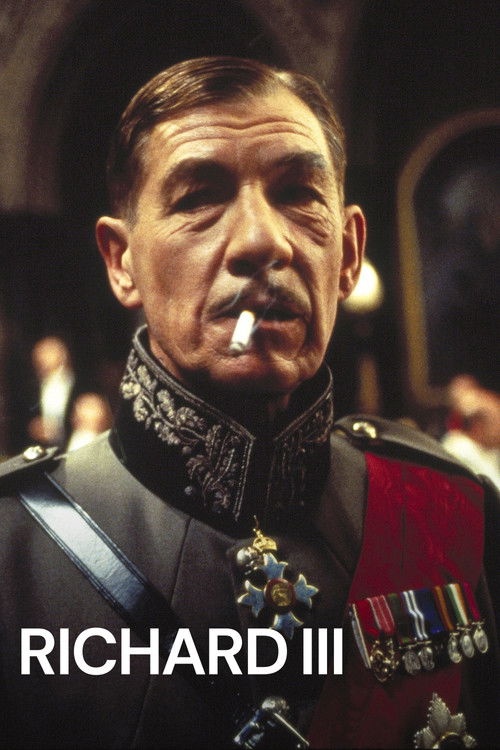
Richard III
1995 · Richard Loncraine
For when you want Shakespeare that feels dangerous rather than dutiful — a smart, stylish evening in that's part gangster picture, part history lesson, and entirely entertaining.
What it's about
Shakespeare's most charismatic villain, transplanted to a fantasy 1930s England: Richard of Gloucester, having helped his brother seize the throne, sets about murdering his way to the crown — and does it as a rising fascist strongman, complete with rallies, uniforms, and a court too polite to stop him. He seduces, lies, and kills, and he tells you exactly how he's doing it, straight to camera.
The experience
Wicked fun with a cold aftertaste — it plays like a stylish political thriller, fast and darkly funny, and Richard's direct-to-camera confessions make you feel complicit in every scheme. The Shakespearean language goes down easily because the imagery does half the work.
Performances
Ian McKellen, adapting the role from his acclaimed stage production, is magnetic — a charming, reptilian Richard who wins you over while doing monstrous things. Around him: Annette Bening, Robert Downey Jr., Maggie Smith, Jim Broadbent, and Kristin Scott Thomas in a stacked ensemble.
The craft
The 1930s transposition is carried through with dazzling design — art-deco palaces, military parades, period cars and cigarettes — so the play's politics snap into focus as the rise of a dictator. Loncraine keeps it moving like a thriller, trimming the text to muscle and menace.
Why it matters
It became one of the benchmark modern-dress Shakespeare films, proof that resetting the plays in a new era can sharpen rather than dilute them, and it preserved one of the great stage Richards on screen.
Snapshot
Richard III is a film of audacious conceptual transposition: Shakespeare's history play, written around 1592–93, relocated to an imagined England of the 1930s in which Richard of Gloucester rises not as a medieval usurper but as a fascist dictator in the manner of Europe's interwar strongmen. Adapted by Ian McKellen and director Richard Loncraine from a celebrated Royal National Theatre stage production, the film hands McKellen the role he had already made his own on stage and turns it into one of the great screen Richards — a serpentine, charming, physically twisted predator who confides his schemes directly to the camera and makes the viewer his accomplice. Around him the film assembles a remarkable Anglo-American ensemble (Annette Bening, Robert Downey Jr., Jim Broadbent, Kristin Scott Thomas, Maggie Smith, Nigel Hawthorne, John Wood) and a meticulously realized art-deco-and-jackboot mise-en-scène that draws on the iconography of Oswald Mosley's Blackshirts, Nuremberg rallies, and the abdication-era British royal household. Radically cut and freely re-staged, it is at once one of the boldest of the 1990s Shakespeare-film boom and a sleek, blackly comic study of how a charismatic monster seizes a modern state — its argument carried as much by design and performance as by the surviving verse.
Industry & production
The film originated not as a screen project but as a stage production. Richard Eyre directed McKellen as Richard III at the Royal National Theatre in 1990, in a staging that set the play in a 1930s totalitarian milieu; the production toured internationally, and it was during this run that McKellen conceived a film adaptation and began drafting a screenplay. The 1930s-fascist conceit — the single most consequential interpretive decision in the film — is therefore inherited from Eyre's theater work rather than invented for the camera, and the film is properly understood as a transposition of that stage vision into cinematic terms.
To direct, McKellen turned to Richard Loncraine, a filmmaker with a background in television and commercials rather than in Shakespeare; the pairing deliberately matched McKellen's textual and theatrical authority to Loncraine's visual and cinematic instincts, and the two share the adaptation credit. The production was mounted as a British independent feature with United Artists involvement and backing associated with British Screen, produced by Lisa Katselas Paré and Stephen Bayly. The casting strategy mixed senior British stage actors with American stars — most conspicuously Annette Bening as Queen Elizabeth and Robert Downey Jr. as her brother Rivers — a choice that both widened the film's commercial reach and, by coding the Woodville family as glamorous American outsiders, reinforced the film's social geography. The shoot made extensive use of real London locations whose period architecture supplied the film's look. Released in the United Kingdom in late 1995 and in the United States in 1996, it was a critical success and an awards contender rather than a major box-office performer; precise commercial figures are not something the established record makes it useful to assert here.
Technology
Richard III is a 35mm production whose interest lies not in any technical novelty but in the orchestration of conventional means toward a stylized period vision. There are no significant optical or digital effects of note; the film's spectacle is achieved through location, production design, costume, and lighting. Its most distinctive "technology" is essentially architectural and curatorial — the recruitment of London's surviving interwar and industrial structures (art-deco interiors, monumental institutional buildings, decommissioned power stations) as ready-made fascist-modern sets, dressed and lit to read as the apparatus of a 1930s dictatorship. To claim more elaborate technical apparatus than the production employed would be invention; its sophistication is one of design intelligence rather than hardware.
Technique
Cinematography
The cinematography is by Peter Biziou, an accomplished British director of photography whose credits include Pink Floyd — The Wall, Mississippi Burning, and later The Truman Show. Biziou photographs the film with a glossy, controlled elegance that suits its world of uniforms, ballrooms, and monumental interiors, exploiting the geometry of art-deco and institutional architecture for compositions of cold grandeur. The camera is McKellen's confederate: it holds on him as he addresses it directly, sharing Richard's asides, and the film repeatedly uses the apparatus of the lens to implicate the spectator in his conspiracy. The palette moves from the burnished warmth of the court's interiors toward harsher, smokier registers as the regime consolidates and the killing proceeds, culminating in the inferno of the climax. Throughout, Biziou's work prizes clarity and surface sheen — the seductive good looks of power — over expressionist distortion, which makes the underlying brutality land all the harder.
Editing
Edited by Paul Green, the film is, above all, a feat of compression. Richard III is one of Shakespeare's longest plays, and the adaptation cuts it drastically to roughly feature length, excising whole strands (the role of Queen Margaret, for instance, is removed) and redistributing or transposing lines into new settings. The editing must therefore do narrative work that the full text would carry in dialogue, and it does so through brisk, often wittily juxtaposed scene-transitions that propel Richard's ascent with the momentum of a thriller. The cutting also sustains the film's signature device — the pivot between public performance and private confession — by moving fluidly from Richard addressing a room to Richard addressing the camera. The pace is deliberately modern and propulsive, trading the theater's expansiveness for cinematic economy.
Mise-en-scène / staging
The film's design is its argument. The production design by Tony Burrough and costumes by Shuna Harwood — both Academy Award–nominated — construct an alternate-historical 1930s Britain in which the visual grammar of fascism (black uniforms, red-and-black banners, lightning-flash insignia, rally architecture) is grafted onto the trappings of the British establishment and the abdication-era monarchy. The staging relocates Shakespeare's set-pieces into vivid modern equivalents: Richard delivers his opening claim to power at a public victory celebration; the wooing of Lady Anne unfolds amid the institutional sterility of a hospital mortuary rather than at an open coffin in the street; the court is a world of cigarettes, cocktails, motorcars, and military pomp. The use of real monumental locations gives the invented regime a disquieting plausibility. Costuming carries social meaning throughout — the Americans' fashionable glamour against the British court's stiffer formality, and Richard's own progression from war hero's uniform to the full regalia of dictatorship.
Sound
The score is by Trevor Jones, a composer known for The Last of the Mohicans and In the Name of the Father, whose music supports the film's blend of period pastiche and mounting menace. The film's most pointed sonic gesture is its deployment of period-style popular song: a jazz-club setting of Christopher Marlowe's lyric "Come live with me and be my love" is performed as a 1930s dance number, a witty Elizabethan-text-in-modern-idiom flourish that doubles as an emblem of the film's whole method. The climax is famously scored to Al Jolson's recording of "I'm Sitting on Top of the World," its grinning optimism set against Richard's fiery fall — an ironic juxtaposition that crystallizes the film's sardonic tone. Sound design otherwise grounds the action in the textures of the period: dance bands, public-address oratory, the machinery of war and state.
Performance
The film is, finally, a vehicle for one of the signature Shakespearean performances of its generation. McKellen's Richard — refined over years on stage and then recalibrated for the camera's intimacy — is seductive, mordantly funny, and genuinely frightening, a manipulator whose physical deformity (a withered arm, a limp, the labor of lighting a cigarette one-handed) becomes both grievance and weapon. His direct address makes complicity the film's central transaction: the audience laughs with him before recoiling from what he does. Around him, Kristin Scott Thomas plays Lady Anne's seduction and ruin with brittle anguish; Jim Broadbent's Buckingham is a smoothly opportunistic enabler; Nigel Hawthorne brings pathos to the doomed Clarence; Maggie Smith's Duchess of York supplies maternal loathing; John Wood is the ailing King Edward; and Bening and Downey Jr. lend the Woodvilles a contrasting transatlantic charisma. The ensemble's mixture of register — classical British stage technique alongside American screen naturalism — is itself part of the film's design.
Narrative & dramatic mode
Dramatically the film is a black political comedy that curdles into tragedy, organized around the most theatrically self-aware of Shakespeare's villains. Its engine is Richard's direct, confiding relationship with the audience: he announces his villainy, demonstrates his virtuosity in seduction and murder, and invites admiration for his nerve, so that the spectator is drawn into a queasy alliance that the accumulating bodies progressively poison. The structure tracks a rise-and-fall arc — the methodical elimination of every obstacle between Richard and the crown, followed by the unraveling that begins almost the moment power is achieved, as fear, betrayal, and the vengeance of those he has wronged close in. By cutting the choric, prophetic figure of Margaret and tightening the dynastic web, the adaptation streamlines the play into something closer to a gangster's-rise narrative, in which the protagonist's charm is inseparable from his monstrousness and his isolation at the summit is the source of his ruin.
Genre & cycle
Richard III belongs squarely to the 1990s renaissance of Shakespeare on film, the cycle ignited by Kenneth Branagh's Henry V (1989) and sustained through the decade by Branagh's Much Ado About Nothing (1993) and Hamlet (1996), Oliver Parker's Othello (1995), Trevor Nunn's Twelfth Night (1996), Al Pacino's Looking for Richard (1996), and — most kindred in spirit — Baz Luhrmann's Romeo + Juliet (1996). Within that cycle it is among the most aggressive in its modernization, abandoning period-medieval fidelity for a fully reimagined alternate-historical setting. It thus also participates in a longer tradition of politically resituated Shakespeare — productions and films that map the histories and tragedies onto twentieth-century totalitarianism — and it borrows freely from the iconography of the political thriller and the war film. The result is a hybrid: Shakespearean tragedy staged in the visual language of 1930s European dictatorship and 1990s cinematic genre.
Authorship & method
Authorship of Richard III is genuinely shared, and unusually well documented, because McKellen published the screenplay together with an extended commentary on its making — an account that records the choices behind the cuts, transpositions, and modern settings. McKellen is the film's textual and conceptual author: the carrier of the stage interpretation, the adapter of the verse, and the performer whose conception of Richard shapes everything. Loncraine is its cinematic author: a director schooled in commercials and television whose contribution is the film's sleek visual storytelling, its pace, and its translation of theatrical effects into camera terms. The collaboration is best read as a deliberate division of labor, with Richard Eyre's National Theatre production as the originating source. Among key collaborators, Peter Biziou supplied the glossy, complicit cinematography; Trevor Jones the period-inflected score; Paul Green the drastic, propulsive cutting; and the design team of Tony Burrough and Shuna Harwood the alternate-historical world that makes the concept legible frame by frame. It would overstate the record to parcel out specific inventions beyond what McKellen's published account establishes, but the film's creative center is unmistakably the meeting of his Richard with Loncraine's eye.
Movement / national cinema
The film is a product of 1990s British cinema and of that decade's confident traffic between the British stage and the international screen. It draws on the deep reservoir of British classical theater — McKellen and his fellow stage actors, the National Theatre lineage — and routes it through a transatlantic production model that imports American stars and aims at a global art-house and prestige audience. As national cinema it sits within the British tradition of literary and Shakespearean adaptation, but its modern-dress political reimagining distinguishes it from the heritage mode, aligning it instead with a more interventionist, design-forward strand of British filmmaking. It is also, inescapably, an artifact of British self-examination: a "what if fascism had taken England" fantasy that mobilizes specifically British imagery — the monarchy, the 1930s aristocracy, Mosley's Blackshirts — to imagine the nation's own susceptibility to tyranny.
Era / period
Two periods are in play, and the film's meaning lives in their collision. The text is Elizabethan, a 1590s dramatization of the late-fifteenth-century Wars of the Roses written under the Tudor dynasty that Richard's defeat inaugurated. The setting is a counterfactual 1930s Britain saturated with the period's real history: the rise of European fascism, the British Union of Fascists, the abdication crisis, and the looming approach of the Second World War. By staging a medieval dynastic bloodbath in the aesthetic of interwar dictatorship, the film makes Shakespeare's study of tyranny speak to the twentieth century's, and implicitly to any era in which a charismatic strongman exploits a fragile political order. The 1995 moment of production — a decade engaged in modernizing the classics for contemporary audiences — frames the whole.
Themes
The governing theme is the seductiveness of tyranny: the film's direct-address structure forces the audience to experience how a monster charms, and how charm, wit, and apparent candor grease the machinery of murder. Closely bound to this is the theme of performance and political theater — Richard as consummate actor, power as spectacle, the rally and the broadcast as instruments of rule — which the modern setting renders explicit. The film explores deformity and grievance, treating Richard's body both as the play's ancient emblem of inner corruption and as a wellspring of resentment that he weaponizes. It dramatizes the corruption of the family and the state alike, as kin destroy kin and institutions collapse before a determined predator. And, through its fascist transposition, it advances a historical-political argument about the vulnerability of even an established order — a monarchy, an aristocracy, a parliamentary nation — to the man who will stop at nothing. Beneath the wit runs an unsentimental vision of how easily admiration for audacity shades into complicity with evil.
Reception, canon & influence
Richard III was received as a critical success and a striking reinvention of its source, with praise concentrated on McKellen's performance and on the intelligence and visual flair of the modern-fascist conceit. The film was an awards presence: it earned two Academy Award nominations, for Tony Burrough's art direction and Shuna Harwood's costume design, recognition that fittingly honored the design work at the heart of its achievement, and McKellen drew further nominations and honors for his performance; Loncraine's direction was recognized at the Berlin International Film Festival. (Where the precise tally of nominations and wins is concerned, the safest claim is that the film and especially McKellen were widely fêted on the prestige circuit.)
Influences on the film run backward to several sources. The dominant cinematic precedent is Laurence Olivier's Richard III (1955), the definitive screen Richard whose relish, direct address, and shaping of the role every subsequent interpreter must answer; McKellen's performance is in conscious dialogue with it. Behind the film lies Richard Eyre's National Theatre production, the immediate origin of its concept, and behind that the longer tradition of politically modernized Shakespeare. The 1930s setting draws on the documented iconography of European and British fascism, the Nuremberg aesthetic, and the abdication-era royal household.
Its influence forward is felt in the continued vitality of the radically modernized Shakespeare film — it stands, alongside Luhrmann's Romeo + Juliet, as proof that wholesale resetting of the plays could be both artistically serious and accessible, helping license the bolder adaptations and stage-to-screen transpositions that followed. For McKellen, the film consolidated an international screen profile that would soon expand enormously with Gods and Monsters and the X-Men and Lord of the Rings franchises. For the study and teaching of Shakespeare on film it became a standard text, frequently invoked as a model case of how setting, design, and direct address can carry interpretive argument. And it endures as one of the most quoted and admired of modern Shakespeare films — a demonstration that the oldest of stage villains could be made to feel like a live warning about the twentieth century's, and our own, appetite for charismatic tyranny.
A Deleuzian reading
A man steps up to a microphone at a victory party and tells the room that the winter of their discontent is over, made glorious summer by this son of York.
The full Deleuzian reading of Richard III →
Reception
Critically admired on release in 1995 — awards attention for its design, a Silver Bear in Berlin for Loncraine — but only a modest theatrical footprint; it has since settled in as one of the great screen Shakespeares, routinely name-checked whenever anyone modernizes the Bard.
How Richard III was received, from release to now →
Influences: the films it descends from and the films it influenced
- Richard III (1955) — The definitive screen Richard whose conspiratorial direct address and savored relish McKellen consciously answers — the camera-as-confidant Machiavel template the 1995 film inherits and updates.
- Henry V (1944) — Established the actor-author model in which a stage Shakespearean reconceives the play for the camera through bold stylized design, the prestige-Shakespeare lineage McKellen/Loncraine extend.
- Chimes at Midnight (1965) — Aggressive conflation and cutting of Shakespeare's text into a propulsive narrative of power, the precedent for Paul Green's drastic compression of the play into gangster rise-and-fall.
- Triumph of the Will (1935) — Supplies the Nuremberg vocabulary — banners, podium framing, massed-rally geometry — directly quoted to make Richard's coronation read as fascist spectacle.
- Cabaret (1972) — Model for 1930s decadence and creeping fascism rendered through Art Deco design and glossy surface, where production design carries the political menace.
- The Damned (1969) — Operatic treatment of an aristocratic power-bloc devouring itself amid Nazi-era opulence, the design-led 'fascism as family intrigue' aesthetic the film transposes onto the royal household.
- Scarface (1932) — The gangster rise-and-fall arc — ruthless climber liquidating rivals to the top, then collapse — mapped structurally onto Richard's ascent and fall.
- Dr. Strangelove (1964) — The ironic upbeat period song over catastrophic violence (Vera Lynn) is the device echoed in the Al Jolson 'Sitting on Top of the World' finale scored against Richard's death.
- Pink Floyd – The Wall (1982) — Shot by Peter Biziou with the same glossy menace, and a key source of fascist-rally crowd iconography that the cinematographer carries into Richard III.
- Henry V (1989) — It rides the commercial reopening Branagh achieved, keeping the star-actor-led adaptation model (McKellen's stage Richard) while relocating the text to a fascist 1930s setting.
- Titus (1999) — Extends the fascist/Mussolini-era design-led transposition, using anachronistic mashup and Art Deco-imperial iconography so that setting itself argues the interpretation.
- Hamlet (2000) — Corporate-Manhattan resetting with surveillance-glossy surfaces, the bolder modern transposition Richard III helped license.
- Coriolanus (2011) — Modern-dress, militarized, news-media Shakespeare directed by its star — the actor-author translating a political stage role into hard contemporary cinematic terms.
- Macbeth (2015) — Drastically cut, design-and-texture-led Shakespeare carried by cinematographic sheen and atmosphere over full text, continuing the compression-plus-surface approach.
- The Gathering Storm (2002) — Loncraine's own prior reframing of English history establishes his self-effacing, actor-first method — building the film's grammar around a single magnetic lead (McKellen) the way he later builds everything around Finney.
- House of Cards (1990) — Francis Urquhart's direct-to-camera Machiavellian conspiracy is explicitly modeled on Richard III, making the viewer complicit — the same address McKellen weaponizes on screen.
- Romeo + Juliet (1996) — The parallel proof-of-concept for wholesale modern transposition of Shakespeare through pop-maximalist design, sharing the wager that resetting can be both serious and accessible.
- Looking for Richard (1996) — A contemporaneous actor-led interrogation of the same play for the screen, popularizing Richard's direct-address villainy through performer-driven framing.
- The Merchant of Venice (2004) — Loncraine relocates the play to a 1930s fascist Britain precisely to foreground its political subject — the same strategy of using a historicizing frame to make an uncomfortable theme explicit that Radford's documentary prologue performs for antisemitism.
Similar films
- Chimes at Midnight (1965) — influence & lineage · same viewing thread · often watched together
- Titus (1999) — influence & lineage · same viewing thread
- Ran (1985) — same viewing thread · often watched together
- Hamlet (1996) — same viewing thread · often watched together
- Macbeth (1971) — same viewing thread · often watched together
- Hamlet (1948) — same viewing thread · often watched together
- Henry V (1989) — same viewing thread
- The Lion in Winter (1968) — same viewing thread
All the films related to Richard III →
Watch it with: curated runs of related films
- Shakespeare's Kings and Killers — Watch these near each other and the same machinery keeps turning in new tongues — the murdered king, the usurped crown, the prophecy and the ambition that curdles into slaughter — as Olivier, Welles, Kurosawa, Polanski and Branagh each bend Shakespeare to the screen.