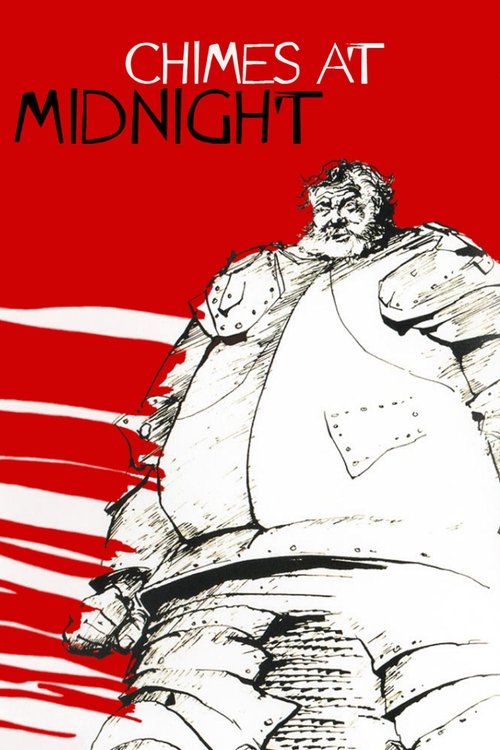
Chimes at Midnight
1965 · Orson Welles
For when you want something rich and autumnal — a film about friendship, aging, and betrayal to sit with on a quiet night, more moving than any homework-sounding 'Shakespeare adaptation' has a right to be.
What it's about
Orson Welles stitches Shakespeare's history plays into a single story: King Henry IV holds a stolen throne against rebellion while his heir, Prince Hal, wastes his nights drinking in taverns with the fat, roaring, endlessly self-inventing knight Falstaff. It's the tale of a young man caught between two fathers — the cold king who needs him and the disreputable old rogue who loves him — as war forces him to choose who he'll become.
The experience
Bawdy and boisterous for long stretches, then suddenly wintry and heartbreaking — the laughter keeps curdling into loss. The battle scenes are brutal, muddy chaos, and the ending lands like a door closing on a warmer world.
Performances
Welles himself plays Falstaff as the role he was born for — enormous, hilarious, and devastating, a con man whose love is the one thing about him that isn't a lie. John Gielgud's icy, exhausted Henry IV is the perfect counterweight.
The craft
Shot in stark black and white on a shoestring, it turns poverty into style: cavernous castles, low angles, and a battle sequence cut into a churning nightmare of mud and steel that filmmakers have been borrowing from ever since. The tavern scenes have a warmth and depth of frame that make you feel the candlelight.
Why it matters
Widely considered the greatest Shakespeare film ever made and, by many, Welles's own finest achievement — the late-career vindication of a director who spent decades scraping together money to work.
Snapshot
Orson Welles's adaptation of Shakespeare's Henriad — drawing principally on Henry IV Parts 1 and 2, with material woven in from Henry V, The Merry Wives of Windsor, and Richard II — is widely regarded as both the finest Shakespeare film ever made and Welles's own most fully realized work. Its ostensible subject is the deposition and dying of Henry IV, the education of his wayward heir Prince Hal, and the rebellion of Hotspur; its true subject is Sir John Falstaff, the "huge hill of flesh" who serves simultaneously as surrogate father to Hal, as spokesman for a vanishing world of appetite and festivity, and as the film's emotional conscience. Welles structures the Shakespeare material so that the rejection of Falstaff at Hal's coronation — a moment Shakespeare disperses across the end of 2 Henry IV — becomes an Aristotelian catastrophe: the decisive, irreversible blow that unmakes a man. In no other film is the price of political becoming felt so personally.
Industry & production
The film emerged from two decades of frustrated attempts. Welles had first staged the material as Five Kings in 1939, a theatrical condensation of the entire Henriad that collapsed during its pre-Broadway tryout in Boston and never reached New York. He returned to the project in 1960 with a Dublin stage production featuring himself as Falstaff, which played with greater success. The film version was financed as a Spanish–Swiss co-production, with the Spanish producer Emiliano Piedra providing the infrastructure for a low-budget shoot in Spain that stood in for medieval England. Welles assembled an exceptional international cast: Keith Baxter as Prince Hal (carrying over from the Dublin stage production), John Gielgud as Henry IV, Jeanne Moreau as Doll Tearsheet, Margaret Rutherford as Mistress Quickly, and Norman Rodway as Hotspur. The production was characteristically turbulent. Scenes were shot out of sequence over an extended period, with cast members sometimes called in at different times; much of the dialogue was post-dubbed in controlled conditions rather than recorded live on set, a pragmatic necessity of the international co-production model that Welles turned into an expressive tool. Distribution proved difficult: the film had limited release in the United States, and rights complications and distributor indifference kept it from wide audiences for years. Its rehabilitation came gradually, accelerating after Welles's death in 1985 and substantially aided by home-video and eventually high-definition releases.
Technology
Chimes at Midnight was shot on 35mm black-and-white, a deliberate choice against the Eastmancolor that was by 1964–65 the commercial default for prestige productions. The decision locates the film aesthetically with the monochrome grandeur of classic Hollywood and with Italian neorealism rather than with the Technicolor medievalism of productions like Becket (1964). The Spanish locations — the Bardenas Reales, a semi-arid plateau that reads under winter light as an abstract northern landscape, along with various Castilian castles and fortresses — were deployed without extensive set construction, giving the film a spatial austerity unusual for Shakespeare adaptations of the period. The use of non-synchronous sound recording throughout was a technological constraint that Welles reframed as aesthetic freedom: the post-dubbed voices create a slight temporal gap between image and sound that contributes to the film's quality of memory, of history half-recovered.
Technique
Cinematography
The cinematographer was Edmond Richard, who would later collaborate with Welles again on F for Fake (1973). The visual strategy divides sharply between registers. The Boar's Head Tavern sequences — Falstaff's domain, the world of low comedy and warm fellowship — are shot in close quarters with deliberately cluttered deep-focus compositions, the camera fluid and intimate among bodies. The court sequences around Henry IV are shot in contrast as cold, geometrically severe spaces: high ceilings, distant figures, shafts of light cutting across stone floors, Henry IV himself often filmed from below against architectural verticals that dwarf him even as he occupies the throne. This formal bipolarity is not merely decorative; it encodes the film's central argument. The warmth of the tavern world is a physical fact of the photography, not merely an implication of the dialogue.
Editing
The editing is the film's most technically daring element. The Battle of Shrewsbury sequence — roughly five to six minutes of screen time depicting the clash between the royal forces and Hotspur's rebels — remains one of the most studied battle sequences in cinema history. Welles cuts with extreme rapidity, fragmenting the action into shards of close-up, mid-shot, and wide shot that refuse to resolve into a coherent spatial map. The effect is not confusion for its own sake but a phenomenological argument: battle is not a chess problem legible from above but a crushing, grinding, disorienting physical experience. Slow motion is used selectively to isolate moments of impact, lending individual deaths a weight the rapid cutting otherwise denies. The editing of the non-battle sequences moves in the opposite direction, holding long takes that allow performance — especially Welles's own — to unfold in real time. The editor of record was Fritz Mueller, though the complexities of the production make precise attribution of individual decisions difficult.
Mise-en-scène / staging
Welles stages the film's dramatic ironies in space with a precision that rewards close analysis. The mock-trial scene in the Boar's Head — in which Falstaff and Hal play-act the coming interview between Hal and his royal father — is staged so that the humor and the grief are simultaneous: the fat knight's performance of Henry IV is too accurate, the prince's performance of himself too knowing, and the joke collapses at its center when Hal announces, in character, that he will banish Falstaff. The rejection at the coronation is staged in an immense, echoing exterior space; Falstaff is a small figure pressing forward against ceremony, and Hal-now-Henry V passes him in profile without turning his head. The spatial register shifts from the film's warm interiors to something close to a public execution.
Sound
The post-dubbed sound is the film's most contested technical feature and, on consideration, one of its most interesting. The slight asynchrony — bodies moving in a space their voices don't quite inhabit — creates a dream-register appropriate to material that Welles frames as elegy from the start. Ralph Richardson's narration, drawn from Holinshed's Chronicles and spoken in a tone of measured historical distance, establishes from the opening frames that what we are watching is already past, already loss. The Holinshed text, chronologically anterior to Shakespeare's dramatization of the same events, produces a layered temporality: history, then drama, then film, all at different removes from the events.
Performance
Welles's Falstaff is the performance that holds everything else in place. He plays the character not as a comic grotesque but as a man of genuine intelligence and feeling whose enormous appetites are inseparable from his enormous capacity for affection. Gielgud's Henry IV, shot from below and surrounded by stone, is the formal counterweight: every inch the legitimate king, every inch the lonely usurper. Keith Baxter's Hal navigates the gap between them with a performance that withholds as much as it reveals — the prince's detachment is played not as coldness but as a kind of necessary self-anesthesia.
Narrative & dramatic mode
Welles compresses four and a half Shakespeare plays into roughly an hour and forty-five minutes without creating the sensation of summary. The compression is achieved by ruthless selection of what to dramatize and what to render through Richardson's narration: the political scaffolding — Lancaster's treachery, the Gaultree Forest betrayal — is largely narrated over images, while the emotional center is dramatized at full length. The result is a film structured around its final act: everything points toward and is colored by the knowledge that Hal will become Henry V, that Falstaff will be rejected, that the world of the Boar's Head must end. Welles opens the film with the image of Falstaff and Shallow as two old men in a wintry landscape — already at the close of things — and returns to the same image at the end. The circular structure transforms the entire middle section into analepsis, into remembered life.
Genre & cycle
Chimes at Midnight belongs to the tradition of literary adaptation but works against the prestige-picture Shakespeare film as practiced by Olivier in Henry V (1944) and Hamlet (1948). Where Olivier's Shakespeare films foreground theatrical heritage, pageantry, and national myth, Welles's is anti-monumental. It is also a war film, an anti-war film, and a comedy that ends in tragedy. The Shrewsbury sequence is one of the most powerful anti-war statements in the medium, arriving two years before The Dirty Dozen and three years before MASH*. The generic plurality is characteristic of Welles but also of Shakespeare; the film's achievement is in holding the genres in productive tension rather than resolving toward any one of them.
Authorship & method
Welles wrote the adaptation himself, constructing the screenplay over years as an evolving stage and then cinematic project. His method of adaptation — treating multiple plays as source material for a single dramatic text organized around a figure Shakespeare distributed across several works — reflects a directorial approach to authorship that absorbs rather than transcribes. The collaboration with Edmond Richard shaped the visual grammar; the composer Angelo Francesco Lavagnino (records on this point are not fully detailed in accessible documentation, and precise score attribution should be confirmed against production archives) supplied a medieval-inflected score. The film is best understood as the work of an auteur at maximum coherence: form, subject, and personal preoccupation in complete alignment.
Movement / national cinema
The film resists national categorization almost entirely. It is a Spanish–Swiss co-production directed by an American in European exile, shot in Spain, based on English historical drama written by a sixteenth-century English playwright. What it belongs to is Welles's own late-exile cinema — the period that produced The Trial (1962), Chimes at Midnight itself, and F for Fake (1973): low-budget, formally radical, made outside the Hollywood system and largely distributed outside it. This body of work constitutes its own movement of one.
Era / period
The mid-1960s context matters: the film's anti-heroic view of the political world — its insistence that the making of a great king is inseparable from an act of personal betrayal — reads differently after the Kennedy assassination (1963) and against the building Vietnam War. Welles was not a polemicist, but Chimes at Midnight arrives at a moment when the culture had reason to look skeptically at the relationship between charismatic leadership and the human costs it requires. The film's refusal of triumphalism about Henry V's kingship placed it outside both conservative and liberal mythologies of heroic politics.
Themes
The film is organized around the opposition between two orders of value that cannot be reconciled: the warm, bodily, present-tense world of appetite and fellowship represented by Falstaff and the Boar's Head, and the cold, temporal, future-oriented world of political power and dynastic succession represented by Henry IV and eventually by Henry V. Falstaff's tragedy is that he cannot believe, until it is too late, that the prince he loves will choose the second world over the first. The film frames this not as Falstaff's naivety but as his greatness: he has the capacity to believe that human connection matters more than political necessity. The line from which the title comes — "We have heard the chimes at midnight, Master Shallow" — condenses the film's mood: the acknowledgment of time's passage, of a world that was and is not, of nights of revelry that belong now only to memory.
Reception, canon & influence
Critical reception: The film competed at Cannes in 1966. Initial critical reception was respectful but uneven; some reviewers found the sound problems distracting and the compression of the source material difficult to follow. In the years since Welles's death the reassessment has been comprehensive. Chimes at Midnight now appears routinely on critical tallies of the greatest films ever made, and the consensus — articulated by critics including Jonathan Rosenbaum and others in the Welles scholarly literature — treats it as the fullest realization of his gifts.
Influences on the film (backward): The debt to Eisenstein is most legible in the Shrewsbury sequence, where the editing logic of Alexander Nevsky (1938) and Ivan the Terrible (1944–46) is absorbed and radicalized. Welles's own formal vocabulary from Citizen Kane (1941) and The Magnificent Ambersons (1942) — deep focus, low-angle staging, the architecture of memory — is present throughout. The theatrical productions of 1939 and 1960 provided a long incubation that is unusual even by the standards of adaptation.
Legacy (forward): Kenneth Branagh's Henry V (1989), the most commercially successful Shakespeare film of its generation, takes the anti-heroic Shrewsbury sequence as a direct reference point: Branagh's own battle sequence acknowledges Welles while softening the critique. Gus Van Sant's My Own Private Idaho (1991) lifts the Hal-and-Falstaff relationship wholesale into a contemporary American setting. The Battle of Shrewsbury has informed every large-scale pre-gunpowder battle sequence in subsequent cinema; its influence on Akira Kurosawa's Ran (1985) is frequently noted by scholars, though the exact lines of transmission are difficult to document precisely given the overlap in production periods. More broadly, the film's demonstration that Shakespeare could be made cinematically without theatrical reverence opened possibilities that the Branagh and (later) Baz Luhrmann Shakespeare cycles exploited. Among filmmakers who have cited Welles as a foundational figure — Francis Ford Coppola, Martin Scorsese, Peter Bogdanovich — Chimes at Midnight is the work they tend to name when they mean the Welles who was most fully himself.
A Deleuzian reading
Two old men trudge across a field of snow, talking about the bells they heard at midnight long ago.
The full Deleuzian reading of Chimes at Midnight →
Reception
Dismissed by many American critics on its 1966 release (Bosley Crowther panned it) and then nearly impossible to see for decades due to rights disputes, it's now widely ranked among Welles's greatest films — a status cemented by its 2016 restoration and Criterion release.
How Chimes at Midnight was received, from release to now →
Influences: the films it descends from and the films it influenced
- Citizen Kane (1941) — Welles carries Gregg Toland's deep-focus technique and characteristic low-angle framing against interior ceilings directly into Chimes, where the same grammar encodes spatial power relations in the tavern and court sequences.
- The Magnificent Ambersons (1942) — The retrospective narrator's voice bridging ellipses to conjure a world already gone is the direct template for Ralph Richardson's Holinshed passages in Chimes, which frame the historical action as chronicle already closed.
- Macbeth (1948) — Welles's first Shakespeare feature develops the expressionist low-budget staging method — using frame geometry to substitute for absent sets, rapid cuts to cover spatial discontinuity — that he refines and deepens in Chimes.
- Othello (1952) — The entire production methodology of Chimes is a direct continuation: international cast post-dubbed in controlled sessions, real-location architecture substituting for built sets, Shakespeare reorganized around visual elision rather than theatrical staging.
- Battleship Potemkin (1925) — The Odessa Steps sequence establishes the formal device Welles inherits for Shrewsbury: selective slow-motion that isolates individual deaths within an overall rapid-montage rhythm, giving weight to the particular inside the anonymous mass.
- Alexander Nevsky (1938) — Eisenstein's ice battle uses multi-angle rapid cutting that refuses to establish a stable spatial map of combat — the exact strategy Welles deploys in the Battle of Shrewsbury to argue that war is phenomenological experience, not tactical spectacle.
- Henry V (1944) — Olivier's Technicolor Henriad is the formal counter-model Welles consciously inverts: where Olivier uses theatrical framing and primary-color heraldry for nationalist celebration, Welles uses monochrome austerity and anti-heroic fragmented editing to read the same material as elegy.
- The Rules of the Game (1939) — Renoir's deep-focus ensemble staging — holding foreground performance and background action simultaneously so that social ironies emerge from composition rather than cutting — is the compositional logic Welles applies to the Boar's Head sequences.
- Seven Samurai (1954) — Kurosawa's rain-soaked final battle uses multi-angle rapid cutting and selective slow-motion impact shots to deny legible heroism to feudal combat, making a parallel formal argument to the Battle of Shrewsbury that shares the same Eisenstein inheritance.
- The Wild Bunch (1969) — Peckinpah scales the Shrewsbury battle's logic — multi-angle rapid fragmentation intercut with slow-motion isolated impacts — into the Western's climactic violence, extending the phenomenological argument that combat is sensory catastrophe rather than legible action.
- F for Fake (1973) — Welles extends the rapid-fragmentation editing he developed for Shrewsbury into essay-film form, combining the same alternation between rapid cuts and held images with an asynchronous narrator's voice now applied to questions of authorship and authenticity rather than dynastic betrayal.
- Ran (1985) — Kurosawa's central battle strips diegetic sound and replaces it with Takemitsu's score — using the same device as Shrewsbury to argue that feudal massacre exceeds human comprehension — while inheriting the formal bipolarity between intimate interiors and vast, indifferent exteriors.
- My Own Private Idaho (1991) — Van Sant transplants Chimes's structural core — the Falstaff surrogate as surrogate father whose public rejection by the bourgeois-returning prince is the film's moral catastrophe — while inheriting the formal bipolarity between the vagrant world and the world of property and succession.
- Henry V (1989) — Welles's rapid-cut, mud-and-mire handheld Battle of Shrewsbury and his mortality-shadowed Falstaff are the direct models for Branagh's chaotic close-quarters Agincourt and his interpolated Falstaff flashbacks.
- Richard III (1995) — Aggressive conflation and cutting of Shakespeare's text into a propulsive narrative of power, the precedent for Paul Green's drastic compression of the play into gangster rise-and-fall.
- Monty Python and the Holy Grail (1975) — Welles's mud-caked, chaotically real battlefield staging modeled the straight-faced period grandeur that Bedford's camera lends Grail even as the script undercuts it.
- Queen Margot (1994) — The Battle of Shrewsbury's fragmentary, spatially disorienting, close-cut carnage is the editing template for the St. Bartholomew's massacre delirium.
- Romeo and Juliet (1968) — The Battle of Shrewsbury's fragmented, whirling combat montage is the editing model for Reginald Mills's kinetic sword-duel cutting between Mercutio, Tybalt and Romeo.
- Macbeth (1971) — The Battle of Shrewsbury's hand-held, mud-churned, bodies-in-the-mire chaos is the concrete model for putting Shakespearean combat on screen as filthy physical struggle rather than choreographed pageantry.
- Jabberwocky (1977) — Welles builds a medieval world on no money from bare stone, smoke and crowded low-ceilinged interiors; Jabberwocky's tavern and castle scenes use the same substitution of packed wide-angle texture for production value.
- Hard to Be a God (2014) — Welles's foreground-obstruction deep focus — bodies, pikes and beams shoved into the near plane so the frame is read through clutter — married to a Rabelaisian world of taverns, grease and mud that is the same literary substrate German draws from.
- King Lear (1971) — Brook's black-and-white Shakespeare, shot on the Jutland plain, strips theatrical convention from the text and uses spatial austerity — empty landscape, bare stone — to produce the same irony of power against inhospitable reality that Welles encodes in the Spanish Bardenas locations.
- King Lear (1971) — Kozintsev's Soviet adaptation uses post-dubbed dialogue to create the same temporal gap between image and voice that Welles achieves in Chimes, lending both films a quality of history half-recovered from archival record rather than witnessed live.
- Hamlet (1948) — Actor-auteur Shakespeare that aggressively cuts and rearranges the texts into a new dramatic whole, sharing Olivier's view of the plays as raw material to be reshaped cinematically.
- Mr. Arkadin (1955) — Product of the same European method — improvisational, underfunded, location-driven, post-synchronized dubbing patched over asynchronous production.
Similar films
- Ran (1985) — influence & lineage · same viewing thread · often watched together
- Macbeth (1948) — influence & lineage
- Citizen Kane (1941) — influence & lineage
- The Magnificent Ambersons (1942) — influence & lineage
- Othello (1951) — same viewing thread · often watched together
- Hamlet (1948) — same viewing thread · often watched together
- Macbeth (1971) — same viewing thread · often watched together
- Hamlet (1996) — same viewing thread · often watched together
All the films related to Chimes at Midnight →
Watch it with: curated runs of related films
- Shakespeare's Kings and Killers — Watch these near each other and the same machinery keeps turning in new tongues — the murdered king, the usurped crown, the prophecy and the ambition that curdles into slaughter — as Olivier, Welles, Kurosawa, Polanski and Branagh each bend Shakespeare to the screen.