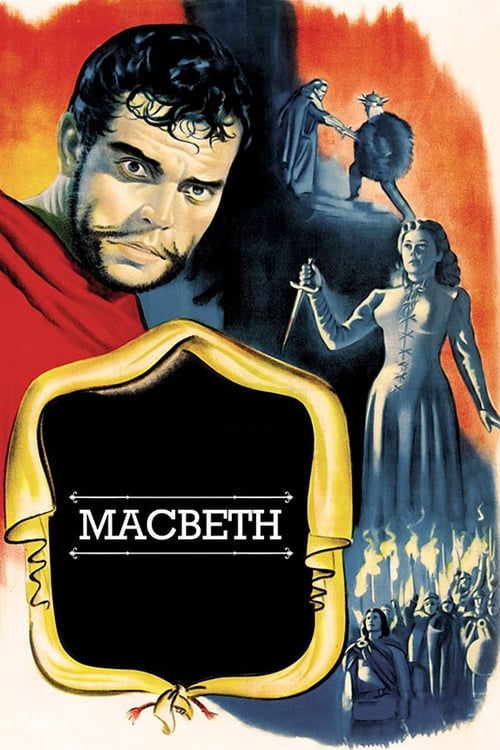
Macbeth
1948 · Orson Welles
For when you want Shakespeare with the prestige stripped off and the dread turned up — a moody, gothic night rather than a polished one. It's a challenge, but a short, potent one.
What it's about
A Scottish warlord meets three witches on a blasted heath who tell him he'll be king, and with his wife pushing him on, he decides not to wait for fate to deliver. What follows is the crime, the crown, and the spiraling paranoia of holding onto both. It's Shakespeare's darkest tragedy staged as a primitive nightmare of mud, fog, and crude stone.
The experience
Raw, feverish, and strange — less a costume drama than a bad dream you can't wake from. The papier-mâché crags and dripping caverns shouldn't work, but they do; the whole thing feels carved out of guilt.
Performances
Orson Welles plays Macbeth as a man already half-damned, sweating and hollow-eyed, his voice doing as much of the haunting as the sets.
The craft
Shot in about three weeks on standing Western-studio sets for almost no money, and Welles turns poverty into style: expressionist shadows, pagan idols, fog that swallows the frame. It looks like no other Shakespeare film — closer to a horror movie than a stage record.
Why it matters
Savaged on release and long dismissed as a folly, it has been steadily rehabilitated and now stands with Welles's other Shakespeare films as proof that vision beats budget.
Snapshot
Orson Welles's Macbeth is the most disreputable and the most pungent of the great mid-century Shakespeare films — a low-budget, fast-shot expressionist fever-dream made for Republic Pictures, a studio better known for Roy Rogers Westerns and serials than for verse drama. Where Laurence Olivier's contemporaneous Hamlet (1948) aimed at prestige and won Academy Awards, Welles aimed at something rawer: Shakespeare's bleakest tragedy rendered as a primitive nightmare of mud, fog, papier-mâché crags, and crude pagan idols, with the king-killing couple trapped in a claustrophobic stone universe. Shot in roughly three weeks on standing sets, it was savaged on release, partly recut and re-dubbed, and long dismissed as a folly. Its reputation has since climbed steadily; it is now widely regarded, alongside Othello (1951) and Chimes at Midnight (1965), as part of Welles's idiosyncratic and profoundly cinematic engagement with Shakespeare. Macbeth is the cheapest and most theatrical of the three, but also in some ways the purest distillation of Welles's instinct for the play as ritual, dread, and the corruption of a soul.
Industry & production
Macbeth was made under unusual auspices. Herbert J. Yates, the head of Republic Pictures, wanted to lift his Poverty Row studio's prestige and gave Welles an opportunity that no major studio would: to direct, produce, and star in a Shakespeare film, but on Republic's terms — a tight schedule and a low budget by the standards of literary prestige pictures. Welles, whose Hollywood career had been a series of struggles with studios since Citizen Kane (1941) and the recut The Magnificent Ambersons (1942), seized the chance to work fast and with relative autonomy.
His strategy for absorbing the constraints was theatrical. Welles first mounted Macbeth on stage at the Utah Centennial Festival in Salt Lake City in 1947, explicitly using the production as a rehearsal laboratory for the film, so that his cast arrived already drilled in their blocking and line readings. The shoot itself was famously rapid — commonly cited at around three weeks (frequently given as 21 to 23 days) — accomplished on a handful of recycled, cavernous interior sets. To save time, Welles had the entire soundtrack pre-recorded and the actors mime to playback during filming, allowing him to shoot long, fluid takes without the technical burden of live sound.
The reception was poor enough to trigger post-production intervention. The Scottish brogues Welles insisted his cast adopt baffled and irritated American audiences and critics; the film's premiere at the Venice Film Festival was withdrawn (Welles pulling it from competition, with Olivier's Hamlet also in the field). Republic subsequently shortened the film substantially from Welles's roughly 107-minute cut to around 85 minutes and had much of the dialogue re-dubbed in softened accents. For decades that truncated version was the only one in circulation. A restoration in the late 1970s/1980 — associated with the work of the Folger Shakespeare Library and film archivists — reconstructed Welles's longer cut with the original Scottish-accented soundtrack, and it is this version that grounds the film's modern critical standing.
Technology
The film is a study in what could be wrung from limited means with conventional black-and-white technology. It was shot on standard 35mm monochrome stock — Welles, unlike Olivier, never seriously entertained color or the wide formats that prestige Shakespeare would later embrace. The decisive technological choice was the pre-scored, pre-recorded soundtrack to which performers lip-synced on set: a practice borrowed from musical production and from Welles's radio background, it freed the camera from the noise constraints of live recording and enabled the sweeping, unbroken takes that define the film's visual rhythm. The trade-off was the persistent, slightly disembodied quality of voices that never quite sit inside the spaces — a flaw to some, an eerie asset to others. The sets themselves were a kind of low-tech special effect: rough sculptural forms, dripping rock, and an enveloping studio fog that disguised the budget and converted poverty into atmosphere.
Technique
Cinematography
The cinematography, by John L. Russell (later the director of photography on Hitchcock's Psycho), is the film's most celebrated technical achievement. Russell and Welles built a world of deep shadow, low and tilted angles, and looming foreground objects, with the camera frequently craning and tracking through the cramped sets to generate a sense of oppressive, continuous space. Welles favored extended long takes — most famously a sustained, near-unbroken passage covering the murder of Duncan and its immediate aftermath — that fuse staging and camera movement into a single dramatic gesture. The lighting is harshly contrasted, faces emerging from and dissolving into blackness, and the recurring fog gives every exterior the quality of a half-remembered dream. The visual debt to German Expressionism is explicit and unembarrassed; this is Shakespeare filmed as if by the makers of The Cabinet of Dr. Caligari.
Editing
Edited by Louis Lindsay, the film's cutting is shaped fundamentally by Welles's preference for the long take: where many scenes play out in sustained camera movement rather than découpage, the editor's role becomes one of joining large blocks of staged action rather than building tension shot-by-shot. The result is a rhythm that alternates between hypnotic continuity and abrupt, harsh transitions. It should be noted that the surviving form of the film is complicated by Republic's post-release re-editing; the shortened release version and the restored longer cut differ meaningfully in pacing, and discussion of the film's "editing" is inseparable from the textual history of which version one is watching.
Mise-en-scène / staging
Mise-en-scène is where Macbeth most fully expresses its director. The sets — credited to art director Fred Ritter — are deliberately anti-realistic: crude, womb-like caverns of rock, a throne room like a pit, dripping walls, and primitive forked crowns and idols that evoke a pre-Christian Scotland of mud and superstition. Welles invented a character, "A Holy Father" (played by Alan Napier), to embody the Christian order pressing against this pagan darkness, and he opens the film with the witches molding a clay figure of Macbeth — a literalization of the idea that the protagonist is a thing shaped by malevolent forces. Costumes are heavy and barbaric; Macbeth's spiked crown is iconic. The staging keeps the human figures small and trapped within crushing architecture, a spatial correlative for the moral entrapment of the drama.
Sound
Sound is both the film's boldest experiment and its original liability. The pre-recorded track lends the verse a declamatory, incantatory quality well suited to a play obsessed with prophecy and curse, but the synchronization is imperfect and the voices float uneasily over the images. The Scottish accents — Welles's bid for a rough, regional authenticity — alienated 1948 audiences and prompted the studio's re-dubbing; the restored version returns them, and modern viewers tend to find them integral to the film's strangeness rather than a defect. The score, by the French composer Jacques Ibert, supplies a brooding orchestral undertow that reinforces the atmosphere of doom.
Performance
Welles's own Macbeth is a massive, brooding, increasingly hollowed-out presence — less a study in psychological nuance than a portrait of a man being eaten alive by what he has done, declaimed in Welles's unmistakable resonant register. Opposite him, Jeanette Nolan, a radio actress making her film debut, plays Lady Macbeth as a figure of cold will curdling into madness; her casting was unconventional and the performance has divided critics, though her sleepwalking scene has admirers. The supporting cast includes Dan O'Herlihy as a vigorous Macduff and a young Roddy McDowall as Malcolm. The acting throughout is pitched theatrically, consonant with the stylized world; this is not naturalistic screen acting but performance scaled to ritual.
Narrative & dramatic mode
The film compresses and rearranges Shakespeare's text aggressively, as all of Welles's Shakespeare films do, treating the play as raw material to be shaped cinematically rather than a script to be reverently transcribed. Welles's interpolations — the Holy Father, the clay effigy, the framing of the action as a contest between paganism and an emergent Christianity — push the tragedy toward allegory and rite. The dramatic mode is interior and oneiric: rather than a chronicle of Scottish politics, Macbeth becomes a near-expressionist projection of one man's guilt, the external world warping to mirror his disintegration. The long takes encourage a sense of inexorable forward motion, the protagonist swept along by the prophecy he half-resists and wholly fulfills.
Genre & cycle
Macbeth sits at the intersection of two cycles. It belongs, first, to the postwar wave of prestige Shakespeare on film — bracketed by Olivier's Henry V (1944) and Hamlet (1948) — though Welles's entry is the anti-prestige outlier, made cheap and fast where Olivier's were lavish. Second, it belongs to Welles's personal Shakespeare cycle, the first of the three films (with Othello and Chimes at Midnight) in which he reworked the plays as cinema. Visually and tonally it also draws on the vocabulary of horror and the Gothic, and its shadowed, fatalistic world rhymes with the contemporaneous American film noir, of which Welles was himself a major practitioner.
Authorship & method
Macbeth is a near-total authorial statement: Welles directed, produced, adapted, and starred, and the film bears his fingerprints in every department. His method here was inseparable from his theatrical practice — the Salt Lake City stage production as dress rehearsal, the pre-recorded sound as a way to keep the camera supreme, the willingness to convert budgetary poverty into stylistic asset. The key collaborators are essential to the result: cinematographer John L. Russell, whose deep-focus, high-contrast images realize Welles's expressionist conception; composer Jacques Ibert, supplying the score's atmosphere of dread; editor Louis Lindsay; and art director Fred Ritter, whose primitive caverns are arguably the film's true star. The adaptation of the text is Welles's own. Behind it all lies the longer arc of his Macbeth obsession, reaching back to the legendary "Voodoo Macbeth" he staged in 1936 for the Federal Theatre Project in Harlem with an all-Black cast — a production that first marked the play, for Welles, as a vehicle for ritual and the supernatural.
Movement / national cinema
Though produced in Hollywood by an American studio, the film's aesthetic allegiances are European, drawing deeply on German Expressionism of the 1920s. It stands somewhat apart from any national movement: it is a Hollywood product made against the Hollywood grain, by a director increasingly at odds with the American studio system and soon to decamp for Europe, where he would shoot Othello over several improvised years. Macbeth can thus be read as a hinge in Welles's career — his last Hollywood-financed film of the 1940s before his long European exile.
Era / period
The film is firmly of the immediate postwar moment: 1948, the year of Olivier's Hamlet, a period of renewed cultural ambition for Shakespeare on screen, and a moment when the visual language of film noir had saturated American cinema with shadow and fatalism. It also belongs to the late phase of the studio system, and specifically to the curious world of Poverty Row, whose economic logic shaped the entire production. Welles's career, post-Kane and post-Ambersons, was at a low ebb in terms of studio confidence, and Macbeth reflects the pressures of an artist making the most of a diminished position.
Themes
The film's governing themes are ambition, guilt, and the corruption of the will — Shakespeare's, intensified by Welles into something close to a fable of a soul deformed by evil. The added pagan-versus-Christian framework introduces a theme of spiritual struggle absent from the play's surface, casting Macbeth's fall as the triumph, however temporary, of an older darkness over the light of a young faith. Fate and prophecy press throughout: the clay effigy molded by the witches suggests a man without true agency, shaped and damned from the start. And running beneath everything is a meditation on power as a kind of self-consuming madness, the throne room imagined as a pit from which there is no clean ascent.
Reception, canon & influence
On release, Macbeth was a critical and commercial disappointment. Reviewers balked at the Scottish accents, the cardboard-and-fog sets, and the sheer strangeness of the conception; the comparison with Olivier's polished Hamlet worked against it, and Republic's confidence collapsed into the cutting and re-dubbing that disfigured the film for thirty years. Welles himself withdrew it from the Venice competition. For a long time it was filed under Wellesian folly — evidence of a profligate talent squandered on a botched experiment.
The influences on the film run backward to German Expressionist cinema, to the Gothic and horror traditions, to Welles's own theatrical Macbeths (the 1936 Harlem "Voodoo" production and the 1947 Utah staging), and to the noir sensibility he had helped shape. Its legacy forward has grown as the restored cut has circulated and as Welles's Shakespeare trilogy has come to be seen whole. Macbeth anticipates the darker, more expressionist screen Shakespeares to come — its shadowed brutality is part of the lineage that runs toward Akira Kurosawa's Throne of Blood (1957), itself a Macbeth, and toward Roman Polanski's bloody Macbeth (1971), even where direct influence is hard to document. Among scholars and cinephiles it is now valued precisely for what once damned it: its refusal of prestige decorum, its conversion of poverty into a coherent and disturbing vision, and its insistence that Shakespeare on film could be primitive, dreamlike, and wholly cinematic. It remains the rough, fascinating first panel of Welles's Shakespearean triptych — flawed, unmistakably his, and impossible to forget.
A Deleuzian reading
Before a single line of verse, three pairs of hands are working a lump of clay.
The full Deleuzian reading of Macbeth →
Reception
Mocked in 1948 — Welles even pulled it from Venice competition rather than face Olivier's Hamlet, and Republic later cut 21 minutes and re-dubbed away the Scottish accents. Since the 1980 restoration of Welles's cut, it's been reappraised as feverish expressionist Shakespeare rather than a cheap embarrassment.
How Macbeth was received, from release to now →
Influences: the films it descends from and the films it influenced
- The Cabinet of Dr. Caligari (1920) — Fred Ritter's cardboard caverns and warped, jutting architecture descend directly from Caligari's painted anti-realist sets that externalize a diseased mind as physical space.
- Nosferatu (1922) — Establishes the low-key Expressionist grammar of shadow-as-menace — figures defined by raking key light against engulfing black — that John L. Russell's photography reproduces in the castle interiors.
- Faust (1926) — Its fog-drenched supernatural prologue and cosmic chiaroscuro model the witches' world and the film's treatment of evil as a weather of light and smoke.
- The Passion of Joan of Arc (1928) — Pioneers the theatrical-pitch performance sustained in close-up against stripped, abstracted architecture, the register Welles asks his cast to hold throughout.
- Vampyr (1932) — Supplies the oneiric mode — drifting fog, dissociated space, dread carried by sound rather than event — that governs Macbeth's dream-logic continuity.
- Love Me Tonight (1932) — Codifies pre-recorded playback in musical filmmaking; Welles borrows the technique literally, recording the entire soundtrack first and shooting the actors miming to playback to keep the camera unchained from live sound.
- Citizen Kane (1941) — Welles's own deep-focus, low-ceiling entrapment staging (the Toland method) is here pushed past realism into flat-out Expressionism on a fraction of the budget.
- The Magnificent Ambersons (1942) — Extends Welles's long-take chiaroscuro blocking — figures moving through deep, shadow-pooled interiors in unbroken takes — that structures Macbeth's set-pieces.
- Othello (1951) — The trilogy's next panel turns Macbeth's poverty-born method into principle — fragmentary editing and architectural entrapment (arches, grilles, cages) constructing Shakespearean space from disparate scraps.
- Throne of Blood (1957) — Recasts Macbeth through Noh stylization and a fog-shrouded fortress, sharing Welles's conversion of the play into entrapment architecture and ritual rather than psychological realism.
- Psycho (1960) — Shot by John L. Russell, Macbeth's cinematographer, who carries his hard low-key, high-contrast contrast scheme and budget-driven Expressionism directly into the Bates house.
- Carnival of Souls (1962) — Russell again supplies oneiric monochrome and dread architecture — vacant, light-strafed interiors — extending the Macbeth visual idiom into low-budget horror.
- Chimes at Midnight (1966) — The triptych's culmination perfects Macbeth's radical text-compression, fusing speeches and scenes into a freely cut Shakespeare assembled around performance and depth-staged space.
- Macbeth (1971) — The bloody, location-shot realist rebuttal to Welles — same play, opposite craft thesis, replacing anti-realist abstraction with mud, weather, and explicit violence.
- Macbeth (2015) — Renders the witches and prophecy through fog-and-fire landscape and saturated oneiric color, inheriting Welles's commitment to atmosphere-as-supernatural over textual fidelity.
- The Tragedy of Macbeth (2021) — The most direct heir: explicitly revives Welles's anti-realist soundstage abstraction, German-Expressionist geometry, and stark 35mm-style monochrome as the deliberate visual language of the play.
- Hamlet (1964) — Shot in 23 days with the company from Welles's Utah Centennial stage production, dialogue pre-recorded so blocking could stay theatrical — the repertory-speed method (cast assembled for a short run, camera fitted to an existing staging) that Papp's three-week Delacorte schedule repeats.
- Hamlet (1948) — The contemporaneous prestige counter-model: a deep-focus roving camera prowling a studio-gothic Elsinore, against which Welles consciously pitched his anti-decorum, primitive conception.
- The Seventh Seal (1957) — Stages fate-and-prophecy as stark medieval allegory in high-contrast monochrome and abstracted landscape, the same Expressionist-theatrical fusion applied to a knight's death-game.
Similar films
- Macbeth (1971) — influence & lineage
- Othello (1951) — influence & lineage
- Throne of Blood (1957) — influence & lineage
- Hamlet (1948) — influence & lineage
- Citizen Kane (1941) — influence & lineage
- The Magnificent Ambersons (1942) — influence & lineage
- Faust (1926) — influence & lineage
- Nosferatu (1922) — influence & lineage