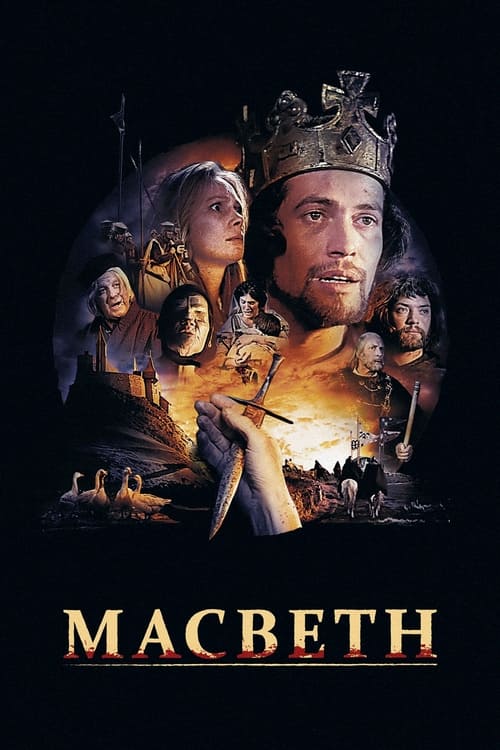
Macbeth
1971 · Roman Polanski
For when you want your tragedy pitch-black — a challenging, violent watch for a night when you'd rather stare into the abyss than be comforted. Not one for a light evening.
What it's about
Eleventh-century Scotland: a brave, battle-hardened warlord hears three witches prophesy that he will be king. Goaded by his wife's ruthless ambition and his own hesitant hunger, Macbeth betrays his king and his brothers in arms — and each crime demands another to cover it, dragging the couple down a path of suspicion, guilt, and blood from which there is no way back.
The experience
Grim, muddy, and genuinely frightening — this is Shakespeare stripped of theatrical polish and rendered with brutal physical realism. It grinds rather than soars, and it leaves you with a chill that has nothing to do with the Scottish weather.
Performances
Jon Finch and Francesca Annis play the Macbeths unusually young, which makes their ambition feel hot-blooded rather than stately — less royal monsters than a couple you can imagine talking each other into the unthinkable.
The craft
Polanski, co-writing with critic Kenneth Tynan, drags the play into caked mud and gray daylight, favoring naturalism over declamation. The violence is unflinching and the eleventh-century world is built with tactile, weather-beaten detail — bleak imagery that gains real power on a big screen.
Why it matters
Made in the shadow of the director's personal tragedy and controversially financed by Playboy Productions, it became a benchmark for brutal, demystified Shakespeare on film and reshaped what a screen adaptation of the classics could look like.
Snapshot
Roman Polanski's Macbeth is among the most physically brutal and psychologically bleak screen adaptations of Shakespeare ever produced — a mud-caked, blood-soaked eleventh-century Scotland rendered with unsparing naturalism. It arrived charged with extra-textual weight: it was Polanski's first feature after the 1969 Manson Family murder of his pregnant wife, Sharon Tate, and its unusually graphic violence was read by contemporaries, often reductively, through that catastrophe. It was also the first (and, for a long time, most conspicuous) film financed by Hugh Hefner's Playboy Productions, a fact that colored both its notoriety and its reception. Working from a screenplay co-written with the influential theater critic Kenneth Tynan, Polanski cast young, un-starry leads — Jon Finch and Francesca Annis — to recover the Macbeths as an ambitious young couple rather than seasoned tragedians. The result is a Shakespeare film that plays as horror-inflected historical realism, ending on a cyclical note of dread that is Polanski's most distinctive interpretive stroke.
Industry & production
The production is inseparable from its unlikely financing. After the commercial disappointment of A Knife in the Water's art-house circuit and the mixed fortunes that followed his Hollywood breakthrough with Rosemary's Baby (1968), Polanski found the door narrowing in the immediate wake of the Tate murders. The project came together through Playboy Enterprises, with Hugh Hefner backing it as an early venture of Playboy Productions; Columbia Pictures handled distribution. The Playboy association proved double-edged — it supplied the money for an ambitious, location-heavy Shakespeare, but it also framed the film's frank nudity (notably Lady Macbeth's sleepwalking scene, played by Annis unclothed, and the naked witches' coven) as titillation rather than interpretation, a charge the film has never fully shaken.
Casting departed pointedly from stage tradition. Rather than the middle-aged, magisterial Macbeths of the theatrical canon, Polanski chose Jon Finch and Francesca Annis, both in their twenties or early thirties and neither a marquee name, foregrounding youth, sensuality, and the couple's shared, almost erotic complicity in ambition. Martin Shaw played Banquo and Terence Bayler played Macduff.
Principal photography took place largely on location in Britain — in Wales (Snowdonia) and Northumberland, using medieval sites including Bamburgh Castle and Lindisfarne, with studio work at Shepperton. The shoot was famously difficult: bad weather, mud, and a protracted schedule ran the production over, and the physical hardship of the locations fed directly into the film's aesthetic of cold and privation. Precise budget and box-office figures vary across sources, and I won't assert a specific number; what is well established is that the film was a commercial underperformer on release and did not recoup easily, contributing to the sense that it was a critical and cultural event more than a business success.
Technology
Macbeth was shot in anamorphic widescreen, giving Polanski a broad, horizontal frame well suited to landscape and to staging deep, populated compositions. (The exact anamorphic process and precise aspect ratio are the kind of technical credit that varies in secondary sources, so I'll flag rather than overstate it; the film is unambiguously a scope-format production.) There is nothing technologically avant-garde in the apparatus — no optical trickery of note — and that restraint is itself a choice: the film's power comes from natural light, real weather, real castles, and practical gore effects rather than from any novel machinery. The blood, viscera, and the on-screen decapitation of Macbeth were achieved with the makeup and effects craft of the period, and their impact derives from unflinching framing and duration rather than from technical innovation.
Technique
Cinematography
The cinematography is by Gilbert Taylor, one of the great British craftsmen of the era, whose earlier work included Stanley Kubrick's Dr. Strangelove and Polanski's own Repulsion and Cul-de-sac (and who would later shoot Star Wars). Taylor gives Macbeth a muted, overcast naturalism — gray skies, sodden earth, torch-lit interiors — that grounds the supernatural material in tactile reality. The palette is drained and wintry; the witches and battlefields are shot in flat, cold daylight that refuses the gothic stylization one might expect. Taylor and Polanski favor wide compositions that place figures against oppressive landscape and stone, and they use handheld and mobile framing in the violence to implicate the viewer. The much-noted first-person device — the world seen briefly through Macbeth's eyes, and the subjective staging of hallucination — is executed with photographic restraint rather than spectacle.
Editing
Edited by Alastair McIntyre, the film's cutting is patient and accretive rather than flashy, letting scenes of dread build in duration. The most discussed editorial-directorial decision is Polanski's handling of the soliloquies: rather than have actors declaim to the camera or air, much of Macbeth's interior speech is delivered as voiceover interior monologue over a quiet, watchful face. This choice reframes Shakespeare's rhetoric as private thought, and it required tight coordination between performance, image, and sound in the cut. The violence, by contrast, is edited to withhold relief — Duncan's murder and the slaughter of Macduff's household are held long enough to become genuinely disturbing.
Mise-en-scène / staging
This is the film's crowning achievement. Polanski and production designer Wilfred Shingleton reconstruct a plausible, lived-in Dark Age Scotland: smoky halls, animal pens, rough timber and stone, mud everywhere. The staging insists on the ordinariness surrounding atrocity — servants, dogs, feasts, weather — so that horror erupts within a fully material world. The witches are not stagey crones but a large coven of naked women of varying ages in a subterranean lair, an image that strips the supernatural of theatrical dignity and makes it grubby and carnal. Polanski repeatedly literalizes what the stage leaves offstage: we see the murders Shakespeare's text reports secondhand, a decision that reorients the whole tragedy from rhetoric toward act.
Sound
The score is by the Third Ear Band, an experimental British ensemble working in a folk/early-music/psychedelic idiom. Their spare, drone-inflected, medieval-tinged music avoids Romantic orchestral swell and instead produces an unsettling, archaic atmosphere consonant with the film's realism. Diegetic sound — wind, rain, ravens, the clatter of arms, the ambient noise of the hall — carries much of the mood, and the interior-monologue voiceovers depend on a carefully layered sound design that distinguishes spoken dialogue from thought.
Performance
Jon Finch's Macbeth is deliberately unheroic: a handsome, pliable young soldier whose weakness and suggestibility are as legible as his ambition, closer to the "weak and hesitant" figure of the synopsis than to a titanic tragic hero. Francesca Annis's Lady Macbeth is youthful and sensual rather than dragon-like, which makes her unraveling — and the coldness of the marriage's shared guilt — more intimate. The naturalistic, un-declamatory acting style, pitched to the camera rather than the gallery, is central to the film's argument that this is a story of ordinary people doing monstrous things. Supporting performances (Shaw's Banquo, Bayler's Macduff) sustain the same grounded register.
Narrative & dramatic mode
Polanski and Tynan trim and rearrange Shakespeare's text for cinema, but the film's boldest narrative interventions are interpretive rather than structural. First, the interiorized soliloquies convert public rhetoric into private psychology, tilting the play toward a study of a mind. Second, the relentless externalization of violence shifts the dramatic mode from tragedy-of-language toward something adjacent to horror and historical realism. Third — and most famously — the film adds a coda: after Macbeth's fall, Donalbain (Malcolm's younger brother) is shown riding, alone, toward the witches' lair. This wordless invention converts the play's restoration of order into a warning that the cycle of ambition and murder is about to begin again, an interpretation with no basis in Shakespeare's ending and everything to do with Polanski's bleak worldview. The overall mode is subjective realism: we are anchored in Macbeth's perception, and the supernatural is presented as ambiguously real and psychological at once.
Genre & cycle
Nominally a Shakespeare adaptation and a historical war-drama, the film sits at the intersection of several currents. It belongs to the tradition of serious literary Shakespeare on film, but it deliberately imports the grammar of the horror film — Polanski's own métier after Repulsion and Rosemary's Baby — into that tradition. It also participates in the broader early-1970s cycle of screen violence, in which filmmakers (Peckinpah, Kubrick's near-contemporaneous A Clockwork Orange) pushed graphic bloodshed to new thresholds. Within the specific micro-history of Macbeth on screen, Polanski's film stands between Orson Welles's expressionist 1948 version and later realist and stage-derived adaptations, defining the "realist, violent, disenchanted" pole of that lineage.
Authorship & method
The film is a strong instance of Polanski's recurring preoccupations: claustrophobia and paranoia, the intrusion of evil into domestic intimacy, the moral vertigo of a protagonist losing his grip on the real. His method here — subjective camera, ambiguous supernaturalism, unsentimental violence — extends the psychological horror of his "apartment" films onto a historical canvas.
The screenplay collaboration with Kenneth Tynan is the key authorial partnership. Tynan, then among the most powerful theater critics in the English-speaking world and literary manager of Britain's National Theatre, brought dramaturgical authority and a modern, demythologizing sensibility; the well-documented creative tension between the two men — including debate over just how much blood the film should show — shaped the final tone. Gilbert Taylor's cinematography supplied the naturalistic visual language; Wilfred Shingleton's production design built the material world; Alastair McIntyre cut it; the Third Ear Band scored it. Producer credit belongs to Andrew Braunsberg, with Hugh Hefner and Playboy Productions behind the financing. It is very much a director's film, but one whose interpretation was forged in the Polanski–Tynan dialogue.
Movement / national cinema
Polanski is a Polish émigré filmmaker (a product of the Łódź Film School and the Polish new wave that produced A Knife in the Water) working here within the British film industry, with American Playboy money and Columbia distribution. The film thus belongs to no single national cinema cleanly: it is a British-made, internationally financed art film directed by a cosmopolitan auteur. Its realist treatment of the medieval past connects it to a British tradition of location-shot historical film, while its psychological and formal daring reflects Polanski's continental art-cinema formation. This hybridity — European sensibility, British craft, American capital — is characteristic of the transnational auteur cinema of the late 1960s and early 1970s.
Era / period
Macbeth is a quintessential artifact of its moment, roughly 1970–71 — the period when the collapse of the Hollywood Production Code and the new ratings system permitted an unprecedented explicitness of sex and violence, and when a generation of directors tested those freedoms. It shares its year and much of its cultural temperature with Kubrick's A Clockwork Orange and follows Peckinpah's The Wild Bunch and Straw Dogs; the debate about screen violence that raged around all of these is the film's native climate. The Playboy financing likewise marks the era's blurring of "adult" respectability and exploitation. And unavoidably, the film is dated by its proximity to the Manson murders, an event that suffuses its reception even where it does not touch the text.
Themes
The film's governing themes are the corrosive interdependence of ambition and murder; the collapse of the boundary between prophecy and self-fulfilling will; guilt as a physical, ineradicable stain (literalized in blood and mud); and the fragility of order. Polanski's distinctive emphasis is on the banality and recurrence of evil: by making the Macbeths young and ordinary, by showing rather than reporting atrocity, and by ending with Donalbain's ride to the witches, he argues that the tragedy is not a singular fall of a great man but a repeatable human pattern. Fate and free will are held in productive ambiguity — the witches may be real prophets or projections of a mind already inclined to murder. Beneath it all runs a bleak, arguably nihilistic vision of political power as an endless cycle of usurpation.
Reception, canon & influence
Contemporary reception was sharply divided. Many reviewers were repelled or distracted by the violence and by the Playboy pedigree, reading the blood as gratuitous and inevitably invoking Sharon Tate; others recognized a serious, formally rigorous, and genuinely cinematic Shakespeare. (Roger Ebert was among the film's admirers; a number of critics defended its integrity against the sensationalist framing.) I won't attribute specific quotations I can't verify, but the broad shape of the record is clear: a controversial, polarizing debut-after-tragedy that was under-appreciated on release.
Influences on the film (backward): the immovable source is Shakespeare's text itself, filtered through Tynan's modern dramaturgy. Cinematically, it stands in dialogue with Orson Welles's 1948 Macbeth and Akira Kurosawa's Throne of Blood (1957) — the great prior screen Macbeths — while defining itself against both by choosing gritty realism over Welles's expressionism and Kurosawa's Noh stylization. Polanski's own horror films (Repulsion, Rosemary's Baby) are the immediate stylistic forebears, and the era's new-violence cinema set the permission and the terms.
Legacy (forward): over subsequent decades the film has been substantially reappraised and is now widely regarded as one of the essential Shakespeare films and a key entry in the director's body of work. Its realist, mud-and-blood approach to the medieval past and its treatment of Shakespeare as material for genuine horror anticipated later grim, physical historical filmmaking and influenced how directors imagined bringing Shakespearean violence fully onto the screen rather than leaving it in report. Justin Kurzel's 2015 Macbeth, with its bleak landscapes and battlefield brutality, is frequently discussed as an heir to Polanski's conception. Within Polanski's career, Macbeth marks the pivot from his Hollywood ascendancy to the darker, more fatalistic register that would culminate in Chinatown (1974). Its enduring critical stature — earned slowly, against an initially hostile and sensationalizing reception — is itself the clearest measure of its influence.
A Deleuzian reading
Mud.
The full Deleuzian reading of Macbeth →
Reception
Dismissed by many in 1971 as a grim, blood-soaked provocation — and a box-office flop — it's now widely rated among the finest Shakespeare films ever made, a clear ancestor of every mud-and-blood Macbeth since.
How Macbeth was received, from release to now →
Influences: the films it descends from and the films it influenced
- Macbeth (1948) — The prior sound-era screen Macbeth Polanski defines himself against — Welles's studio-bound papier-mâché crags and voodoo-mist expressionism are exactly the theatrical abstraction Polanski replaces with location mud and overcast daylight.
- Throne of Blood (1957) — Kurosawa's Noh-mask stylization and drifting-fog spirit forest established the template of Macbeth-as-fate-horror that Polanski inherits (the tactile menace of prophecy) while stripping out the formal ritual for naturalism.
- Repulsion (1965) — The subjective camera locked to a disintegrating mind — hallucinated intrusions bleeding into 'real' space — is the exact device Polanski transfers to Macbeth's dagger and blood visions.
- Rosemary's Baby (1968) — Ambiguous supernaturalism and evil rendered as banal, domestic ordinariness (the chatty coven) directly seeds Macbeth's demystified witches and its 'banality of evil' treatment of murder as household business.
- Chimes at Midnight (1965) — The Battle of Shrewsbury's hand-held, mud-churned, bodies-in-the-mire chaos is the concrete model for putting Shakespearean combat on screen as filthy physical struggle rather than choreographed pageantry.
- The Seventh Seal (1957) — Bergman's flat overcast medieval landscape as a theater of spiritual desolation supplies the 'naturalistic-overcast' visual grammar of a Dark Age emptied of divine order.
- The Wild Bunch (1969) — Peckinpah's post-Production-Code squib work and lingering, detailed bloodletting set the permission and the terms for Polanski to stage Duncan's murder and Macduff's beheading as explicit on-screen atrocity.
- Hamlet (1948) — Olivier's technique of delivering soliloquy as interior-monologue voiceover over a still, listening face is precisely the device Polanski adopts for 'Is this a dagger' and 'Tomorrow and tomorrow.'
- Andrei Rublev (1966) — Tarkovsky's grimy, unsentimental medieval physicality and its unflinching staging of the Tatar raid model the mud-and-cruelty historical realism Polanski brings to eleventh-century Scotland.
- Chinatown (1974) — Extends Macbeth's fatalist, evil-triumphant closing — the cyclical coda where corruption simply continues — into Polanski's mature register of doom that cannot be reversed.
- Ran (1985) — Kurosawa returns to Shakespeare now willing to show full battlefield carnage on screen rather than leaving it in report — the shift toward fully visualized tragic slaughter that Polanski pioneered.
- Excalibur (1981) — Boorman's rain-slicked, blood-and-mud Dark-Age physicality applies Polanski's material realism to mythic Arthurian material, treating armor, gore, and weather as tactile fact.
- Come and See (1985) — Pushes the subjective camera and on-screen atrocity to their limit, holding the guilt-as-stain on a single traumatized face — the immersive-POV-through-carnage lineage Polanski's Macbeth opens.
- Valhalla Rising (2009) — Overcast dark-age realism scored to a low drone (a direct Third Ear Band descendant) turns wordless medieval violence into ritual dread, extending Polanski's mud-realism-plus-avant-garde-score formula.
- Macbeth (2015) — The most frequently cited heir: bleak Scottish battlefield brutality, weather-scoured landscapes, and Shakespeare staged as visceral combat film rather than declaimed theater.
- The Green Knight (2021) — Naturalistic-overcast medieval imagery inflected toward folk horror, treating the Arthurian past as a damp, uncanny physical world — the horror-inflected Dark-Age-realism strain Polanski helped legitimize.
- Jabberwocky (1977) — Polanski's British-shot medieval fixed the template of real castles in real rain with blood and filth treated as continuity elements; Jabberwocky inherits both the location discipline and the flat, unheroic staging of violence.
- Aguirre, the Wrath of God (1972) — Shares the on-location, weather-beaten historical realism charting a power-seeker's descent into madness within an indifferent landscape, evil observed with documentary coolness rather than moralized.
- The Tragedy of Macbeth (2021) — The counter-move — Coen returns to Wellesian monochrome abstraction and stylized voids, defining itself precisely against Polanski's location realism to prove the play can go the opposite formal direction.
- The Hunger Games: The Ballad of Songbirds & Snakes (2023) — Supplies the classical tragic-corruption structure the dossier names — ambition and circumstance grinding a protagonist toward villainy in staged acts — that the tripartite Snow arc reproduces.
- Romeo and Juliet (1968) — Location-shot, viscerally naturalistic Shakespeare with young age-appropriate leads (Finch, Annis), extending Zeffirelli's emotional-over-declamatory delivery into darker realism.
Similar films
- Hamlet (1948) — influence & lineage · same viewing thread · often watched together
- Chimes at Midnight (1965) — influence & lineage · same viewing thread · often watched together
- Ran (1985) — influence & lineage · same viewing thread · often watched together
- Throne of Blood (1957) — influence & lineage · same viewing thread
- Macbeth (1948) — influence & lineage
- Rosemary's Baby (1968) — influence & lineage
- Chinatown (1974) — influence & lineage
- Othello (1951) — same viewing thread · often watched together
All the films related to Macbeth →
Watch it with: curated runs of related films
- Shakespeare's Kings and Killers — Watch these near each other and the same machinery keeps turning in new tongues — the murdered king, the usurped crown, the prophecy and the ambition that curdles into slaughter — as Olivier, Welles, Kurosawa, Polanski and Branagh each bend Shakespeare to the screen.