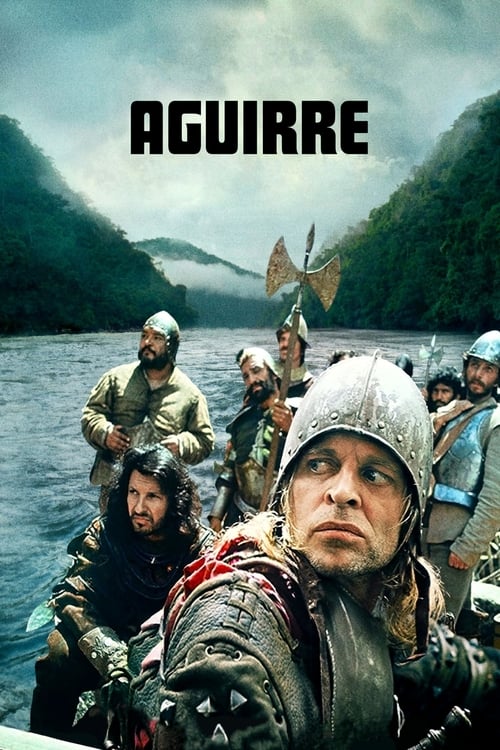
Aguirre, the Wrath of God
1972 · Werner Herzog
For when you want to be transported somewhere genuinely strange and don't mind working for it — a challenge, not a comfort. Best watched late, alone or with someone who won't check their phone.
What it's about
Decades after the fall of the Inca Empire, a Spanish expedition sets off down the Amazon in search of the golden city of El Dorado. As rafts break apart and the jungle closes in, the ruthless Aguirre seizes control, and the quest for gold curdles into mutiny, delusion, and a slow drift toward oblivion.
The experience
Hypnotic and dread-soaked — less an adventure than a fever dream you float through. The pace is slow and trance-like, punctuated by sudden violence, and the sense that everything on screen was genuinely dangerous to film gives it an eerie, documentary weight.
Performances
Klaus Kinski is terrifying as Aguirre, playing madness not as ranting but as a coiled, lopsided stillness — one of cinema's great portraits of megalomania.
The craft
Herzog shot on location in the Peruvian rainforest under famously punishing conditions, and it shows in every frame: real rapids, real jungle, real exhaustion on the actors' faces. The drifting camera and unearthly choral score make the river feel like a passage out of history and into myth.
Why it matters
A foundational film of the New German Cinema and a landmark of extreme location shooting, it made Herzog's international reputation and became the template for stories of colonial ambition devouring itself.
Snapshot
A Spanish conquistador leads a doomed expedition down the Amazon in search of El Dorado, his grandiosity metastasizing into open mutiny and messianic delusion as the jungle swallows everyone around him. Werner Herzog's fourth feature is one of the foundational texts of the New German Cinema and among the most radical deployments of location filmmaking in the medium's history. Seventy-five minutes of physical and psychological extremity, it turns the colonial adventure film inside out, transforming its protagonist's monologue of conquest into an emblem of Western hubris consuming itself.
Industry & Production
Aguirre was made under conditions that were extreme even by the standards of New German Cinema, a movement that prized low-budget independence as a point of honor. Herzog wrote the screenplay in a matter of days and shot the film in the Peruvian Amazon and on the Huallaga and Urubamba rivers during the 1971 wet season. The budget has been reported at approximately 370,000 Deutsche Marks — modest by any standard, nearly prohibitive given the location demands. The film was co-produced by Werner Herzog Filmproduktion and the German public broadcaster Hessischer Rundfunk (HR), the television co-production model that sustained much of the New German Cinema throughout the 1970s.
The shoot was relentless. Rapids, torrential rainfall, equipment failures, and hostile terrain were constants. Herzog assembled a cast mixing established figures (Klaus Kinski, Helena Rojo, the Brazilian filmmaker Ruy Guerra) with non-professionals. The relationship between Herzog and Kinski — always combustible — reached extremes on the Peruvian set that Herzog would later document and mythologize in his 1999 essay film My Best Fiend (Mein liebster Feind). The stories from production — Kinski threatening walkouts, Herzog allegedly threatening to shoot him, extras recruited from local communities — have entered film legend to a degree that sometimes overshadows the film itself. The record is reliable that the shoot was genuinely punishing, and that the on-screen chaos has a clear material cause.
Technology
Herzog shot on 35mm using a relatively small camera package suited to handheld jungle work. The principal camera was a Arriflex, which allowed the mobility essential to the film's visual grammar. Because equipment had to be transported by raft and on foot through dense rainforest, the crew operated with a stripped-down toolkit by the standards of commercial production. No sync-sound playback was possible in most locations; dialogue was partially post-synchronized in the German version, and the film uses this looseness strategically — sound and image are not always tightly sutured, which contributes to the dreamlike disorientation.
The opening sequence, which follows a Spanish column descending a near-vertical Andean slope through cloud cover, was filmed in the Machu Picchu region. Hundreds of extras were involved; this is one of the most logistically demanding sequences in Herzog's career and one of the most visually stunning in 1970s world cinema. The production's ability to achieve it with available budget reflects both the relative cheapness of Peruvian labor in the period and the extraordinary commitment Herzog demands of his collaborators.
Technique
Cinematography
Thomas Mauch, who had shot several earlier Herzog features, served as director of photography. His work here defines the film's visual contract: handheld instability as psychological correlative, the camera perpetually negotiating between stability and drift. Wide-angle lenses compress the jungle's density while exaggerating spatial distortions on the rafts, making the already-claustrophobic vessels feel even more precarious. The film refuses the wide, clean vistas of conventional historical epic; instead, foliage crowds every frame, the horizon rarely visible, geography constantly withheld. This is a film in which the world cannot be surveyed or mastered.
The light is almost uniformly natural — flat, equatorial, humidity-diffused — and Mauch works with it rather than against it. There is no glamour lighting for Kinski; his face is often half-shadow, catching whatever ambient light the jungle permits. The final image — Aguirre alone on a spinning raft overtaken by monkeys, delivering his deranged soliloquy — is composed as a slow, encircling camera movement that formally mirrors the madness of its subject.
Editing
Beate Mainka-Jellinghaus, who edited most of Herzog's major features through the 1970s, cut Aguirre with a rhythm that might be described as suspended. Scenes breathe for longer than genre convention permits; the pacing resists the urgency the subject matter might seem to demand. This deliberateness is part of the film's hypnotic effect. The editing does not subordinate itself to narrative momentum; instead it accumulates — dread, entropy, the weight of a journey going nowhere.
Mise-en-scène / Staging
Herzog's staging consistently denies the heroic compositions of classical epic. Bodies are wet, hunched, spatially disordered. The raft — the expedition's prison and vehicle — becomes the film's primary stage, and Herzog uses its cramped, floating instability as a condition that is also a metaphor. Characters slip in and out of the frame; blocking is improvised around physical reality. The famous image of a balsa raft lodged high in a riverside tree — a genuine discovery during location scouting that Herzog incorporated into the film — typifies his method of treating found reality as expressive material.
Sound
Popol Vuh's score is inseparable from the film's identity. Founded and led by keyboardist Florian Fricke, the ensemble brought an approach rooted in kosmische Musik and devotional drone: slow melodic figures over sustained harmonic fields, using Mellotron, acoustic instruments, and voices in arrangements that suggest ritual rather than narrative accompaniment. The music does not underscore specific scenes in the classical Hollywood sense; it infiltrates the film's texture, emerging and receding as a second environmental presence alongside the river. Aguirre inaugurated the most sustained director-composer partnership in the New German Cinema: Fricke and Popol Vuh would score six Herzog features. The result here established a template for what ambient, non-diegetic scoring could accomplish in the service of altered states and ecological menace.
The diegetic sound design foregrounds water — constant, impassive, indifferent to human suffering — and the absence of conventional civilization sounds. The jungle is loudest in its silences.
Performance
Kinski's performance is one of cinema's defining acts of controlled excess. Aguirre rarely shouts; what Kinski gives is a performance of compressed, sidelong intensity — the slight forward tilt of the head, eyes that never quite track the person being addressed, a stillness that reads as barely suppressed catastrophe. Whether this performance was "directed" in any conventional sense or simply extracted from Kinski's own pathologies is a question the film deliberately refuses to answer. The result is a characterization that feels genuinely unhinged rather than theatrical.
The supporting performances are deliberately underplayed by contrast, giving Kinski's work room to occupy its own register. Helena Rojo as Inez de Atienza brings a quiet, watchful dignity to a role that could easily have been merely decorative. Ruy Guerra's Pedro de Ursúa registers authority and doubt with economy.
Narrative & Dramatic Mode
The film's narrative engine is the expedition journal of friar Gaspar de Carvajal (Del Negro), rendered in voiceover with a flat, documentary affect that is almost immediately undermined by events. Carvajal records official reality — the proclamations, the legitimations, the fictions of purpose — while the camera records something else entirely. This gap between spoken record and visual evidence is the film's central dramatic irony and the source of much of its horror.
The structure is a spiral rather than an arc. The expedition does not travel toward resolution; it degenerates. Characters disappear, are killed, or lose coherence. The raft's forward motion generates no narrative progress. By the film's final scenes, the only forward movement is rhetorical — Aguirre's monologue of dominion delivered over a scene of total ruin. This is the colonial imaginary made visible: the language of conquest persisting after all material basis for it has been annihilated.
Genre & Cycle
Aguirre belongs formally to the historical adventure film and to a specific 1970s cycle of European art cinema that used colonial and imperial history as a lens for critiquing Western rationality and will. The film converses with the jungle adventure subgenre and systematically inverts its conventions: there is no mastery, no discovery, no rescue, no triumphant return. The genre's pleasure structures are present and then progressively withheld.
In the broader context of world cinema, it participates in a cycle of "journey into darkness" narratives with roots in Joseph Conrad (particularly Heart of Darkness, 1899) and connecting forward through Francis Ford Coppola's Apocalypse Now (1979), the parallels between the two films — river journey, colonial madness, a single man's imperial delusion consuming everything around him — are sufficiently close that Aguirre is routinely cited in discussions of Coppola's film; the degree to which Coppola directly drew on Herzog is documented less definitively than the thematic overlap would suggest, and critics should be cautious about stating a direct acknowledged influence without a verifiable source.
Authorship & Method
Herzog's concept of what he has termed "ecstatic truth" — the idea that factual accuracy and emotional truth are distinct, and that cinema's obligation is to the latter — is inseparable from Aguirre. The film is not a historical reconstruction; it is a dream of history. The screenplay draws loosely on Gaspar de Carvajal's actual account of the 1560–1561 Ursúa–Aguirre expedition but treats it as raw material rather than document. Lope de Aguirre was a historical figure, genuinely feared and genuinely dangerous; Herzog's film extrapolates a psychological archetype from the historical record rather than dramatizing the record itself.
Thomas Mauch's cinematography realizes Herzog's vision while bringing its own roughness — Mauch's background in documentary work means the camera responds to events rather than anticipating them. Beate Mainka-Jellinghaus's editing creates the film's distinctive temporal grammar. Florian Fricke/Popol Vuh supply its sonic metaphysics. Kinski provides the human vehicle. The film is a genuine collaboration under a strong authorial vision.
Movement / National Cinema
Aguirre is a cornerstone of the New German Cinema (Neues Deutsches Kino), the movement that emerged in the late 1960s and reached its international peak in the 1970s. Though Herzog did not sign the 1962 Oberhausen Manifesto that formally declared the movement's intentions, he belongs to the same generation and shares its commitment to authorial cinema outside the commercial mainstream. Where Rainer Werner Fassbinder excavated West German social pathology and Wim Wenders pursued road-movie alienation, Herzog oriented himself toward extremity — physical, psychological, historical — and toward locations at the margins of civilization. Aguirre is the first major statement of that orientation.
The German television co-production structure (here via Hessischer Rundfunk) was the economic infrastructure that made such films possible and connects Aguirre to the broader conditions of 1970s European art cinema.
Era / Period
Made in 1971–72 and released in 1972, Aguirre arrived in the middle of international art cinema's most expansive decade. The early 1970s were the moment of Bertolucci's The Conformist, Kubrick's A Clockwork Orange, Coppola's first Godfather, Tarkovsky's Solaris, Bergman's Cries and Whispers — a period when the ambitions of auteur cinema and the conditions of production briefly aligned. Within this context, Aguirre stands as an anomaly: cheaper and more physically extreme than almost anything in its peer group, yet reaching for the same heights of vision.
Themes
The film's dominant themes cluster around hubris, colonial violence, and the encounter between European rationality and non-European nature. Aguirre's project is domination — of the land, of his companions, of history itself — and the film is a systematic demonstration of that project's madness. The jungle is not presented as threatening in the manner of the adventure film; it is simply indifferent, which is worse. Human purpose means nothing to it.
The colonial gaze is consistently turned on itself. The expedition's rituals of legitimacy — the proclamations, the elections, the written orders — are performed with absurd fidelity even as the material conditions for their relevance dissolve. Herzog shows the machinery of Western self-authorization operating in a void. The Catholicism of the expedition (embodied by Carvajal) is shown to be complicit rather than redemptive.
There is also a sustained meditation on leadership and its pathologies. Aguirre is less a villain than a type — the man for whom will has become entirely disconnected from reality, who commands a world that no longer exists.
Reception, Canon & Influence
Aguirre was not an immediate international sensation. It screened at the 1972 Berlin International Film Festival and received distribution in West Germany and, gradually, in other European markets and North America, though it circulated initially in art-house and festival contexts. The film's reputation grew substantially through the 1970s and was consolidated during the years when New German Cinema attracted serious critical attention internationally. It is now routinely ranked among the greatest films of its decade and among the finest in the medium's history; lists compiled by Sight & Sound, critics' polls, and canonical surveys of world cinema reliably include it.
Looking backward, the film draws on the visual and physical daring of Roberto Rossellini's location-based neorealism, on the existential journey structure of Bergman and the Antonioni of L'Avventura, and on a tradition of German expressionist image-making in which landscape externalizes psychological states. The influence of documentary filmmaking — particularly the unstable, participant camera of direct cinema — is visible in Mauch's work.
Looking forward, Aguirre shaped the aesthetics and ambitions of several major works. The ecological horror film's tradition of treating nature as an overwhelming force rather than a backdrop owes something to it. Its influence on the jungle-madness subgenre is clear whether or not any particular filmmaker offers direct acknowledgment. Herzog's own Fitzcarraldo (1982) returns to the Amazon, to Kinski, and to the figure of the European obsessive — it is the closest thing to a sequel in his filmography. The collaboration with Popol Vuh established a model for spiritually inflected, drone-based film scoring that has had lasting currency in art cinema and beyond.
Kinski's performance established a template for charismatic instability in the actor's image that all his subsequent work was understood against, and that actors working in registers of controlled excess have been measured against since.
A Deleuzian reading
The film opens with a line of figures roping down a near-vertical Andean slope, lost in cloud.
The full Deleuzian reading of Aguirre, the Wrath of God →
Reception
Barely made a ripple in Germany on release, but a marathon run in a Paris arthouse turned it into a European sensation, and by its late-70s US release it was hailed as a masterpiece — now it's a fixture on greatest-films lists and the standard entry point to New German Cinema.
How Aguirre, the Wrath of God was received, from release to now →
Influences: the films it descends from and the films it influenced
- The Treasure of the Sierra Madre (1948) — Huston establishes the narrative grammar of masculine greed metastasizing into paranoid megalomania through a wilderness expedition — the spiral-degeneration structure in which a quest for gold becomes a vehicle for self-destruction that Herzog radicalizes, strips of moral resolution, and refuses to close with death.
- Land Without Bread (1933) — Buñuel's narrator maintains the dry bureaucratic register of colonial survey while the images systematically contradict it — the irony-by-dissociation device Herzog inherits directly for the ship's log narration, where formal written language chronicles a collapse it refuses to register as such.
- Chronicle of a Summer (1961) — Rouch's cinéma vérité method — embedding the camera within authentic situations and treating found behavior, real environments, and discovered events as dramatic material — is the direct methodological ancestor of Herzog's staging of the Amazon expedition in actual river conditions with non-professional participants.
- The Battle of Algiers (1966) — Marcello Gatti's handheld, natural-light cinematography applied to historical drama in authentic locations, with post-synchronized dialogue in multiple languages, gives Thomas Mauch the specific technical grammar for rendering the Amazon expedition as actuality rather than period reconstruction.
- Andrei Rublev (1966) — Tarkovsky's refusal to subordinate image duration to narrative momentum — sustained takes and slow assembly cuts that accumulate weight over incident — is the direct predecessor of Beate Mainka-Jellinghaus's suspended editing rhythm, while Vyacheslav Ovchinnikov's ambient choral scoring precedes Popol Vuh's non-diegetic atmospheric function.
- Even Dwarfs Started Small (1971) — Thomas Mauch carries his hand-held grammar directly from Even Dwarfs into the Amazon; the physical ordeal method — subjecting the cast to actual extreme conditions as an extension of Herzog's direction — and the anti-narrative structure of entropy accumulation are unbroken formal continuations of Even Dwarfs' laboratory.
- Tabu: A Story of the South Seas (1931) — Pushes Tabu's location ethic to its limit — shooting in remote untamed nature with the environment itself as co-author and the instrument of inexorable doom.
- Nosferatu the Vampyre (1979) — Herzog transfers the Aguirre production apparatus wholesale into a genre film — Thomas Mauch's natural-light cinematography, Kinski's controlled-excess performance mode, and Popol Vuh's kosmische scoring all reappear intact, demonstrating that the methods developed on the Amazon were a portable formal system rather than a one-time expedient.
- Apocalypse Now (1979) — Coppola adapts the colonial river journey as spiral degeneration, with Willard's increasingly unreliable voiceover and non-diegetic atmospheric scoring (Wagner, the Doors, synthesizer passages) functioning in the same register as Popol Vuh; Coppola has cited Aguirre directly as the structural model for the Kurtz-bound journey.
- Fitzcarraldo (1982) — Herzog deploys the entire Aguirre apparatus — Mauch's cinematography, Mainka-Jellinghaus's editing, Kinski's performance method, Popol Vuh's score — in a second Amazonian production, elevating the found-reality staging principle to operatic scale by using an actual steamship crossing an actual mountain.
- Cobra Verde (1987) — The third and final Herzog-Kinski film extends the colonial-adventure-inversion structure into West Africa while retaining wide-angle natural-light cinematography and Kinski's controlled-excess performance mode — now visibly metabolizing into actual physical deterioration — as the film's primary expressive instrument.
- Beasts of the Southern Wild (2012) — Ben Richardson's handheld natural-light cinematography with wide-angle distortion, an entirely non-professional cast including a six-year-old lead performing in the register of controlled emotional excess, and Dan Romer's ambient scoring deploy the Aguirre grammar of psychological location filmmaking, displaced from the Amazon to the Louisiana bayou.
- Embrace of the Serpent (2015) — Guerra's Colombian Amazon journey in high-contrast black-and-white explicitly inherits the Aguirre grammar: handheld instability in authentic river locations, found-reality staging with indigenous non-professional performers, a colonial-hubris narrative structured as spiral degeneration, and voiceover drawn from ethnographic field notes that the images systematically ironize.
- Sirāt (2025) — Drives obsessive bodies through real punishing terrain and winnows an expedition by attrition toward annihilation, the body-in-real-landscape ordeal Sirāt restages.
- The Blue Trail (2025) — Originates the Amazonian river expedition as mounting delirium, with ambient jungle sound treated as an integral, near-musical sonic field.
- Magellan (2025) — Establishes the template Diaz openly borrows: the conquistador expedition framed in static or slowly-drifting wide shots where the tropical landscape physically grinds down the European mind, letting environment and duration—not editing—dramatize colonial delirium.
- Woyzeck (1979) — Aguirre establishes the Herzog-Kinski production protocol in which wide environmental framing places Kinski's volatile physicality as a small, diminished figure within overwhelming architectural scale — a compositional relationship Woyzeck directly reproduces using the enclosing baroque geometry of Telč's garrison town.
- The Revenant (2015) — On-location jungle cinematography in which the environment's physical extremity becomes the film's formal texture, establishing landscape-as-antagonist as a mode where wilderness devours European colonial ambition—the staging logic Iñárritu applies to the American frontier.
- Society of the Snow (2023) — Herzog's cinematographic treatment of the Amazon as impersonal force that frames and dwarfs human will without metaphor provides Bayona's formal template for the Andes as existential antagonist rather than dramatic backdrop.
- Black God, White Devil (1964) — Rocha's Cinema Novo project of inverting colonial genre conventions through formal radicalism — location filming in hostile Brazilian backlands with ambient scoring derived from devotional music and messianic protagonists consumed by landscape — represents an independent but structurally parallel solution to the same problem of filming colonial hubris from inside its logic.
- Walkabout (1971) — Roeg's wide-angle natural-light cinematography in Australian desert terrain — shot by Roeg himself — with post-synchronized dialogue and colonial protagonists literally absorbed by an ancient landscape they cannot survey or master, arrives independently at the same formal solution Herzog deploys in the Amazon.
- Badlands (1973) — Malick's use of Holly's diary-register voiceover — maintaining the formal distance of a teenager's written account while the images systematically undercut its emotional register — is a structural sibling to Aguirre's ship's log device; both films use a written, documentary voice that the camera contradicts without editorial comment.
- Picnic at Hanging Rock (1975) — Russell Boyd's diffused natural-light cinematography and Gheorghe Zamfir's pan-flute score function in precisely the same register as Popol Vuh — non-diegetic, kosmische atmosphere converting landscape into psychological force — while the colonial protagonists are dissolved by an environment that refuses their categories of mastery.
- Stalker (1979) — Herzog films his pilgrimage entirely inside actual Amazon terrain, using the physical duress of location as material the actors must submit to rather than perform around — the same principle by which Tarkovsky's cast and crew were subsumed into the Zone's genuine contaminated ruin, making environment a co-author of performance.
- Days of Heaven (1978) — Thomas Mauch's handheld location cinematography renders the Amazon as an overwhelming, indifferent natural force — not background but antagonist — and Herzog's non-synchronised ambient sound design arrives at the same position as Days of Heaven's nature-indifference thesis through documentary urgency where Malick uses lyric stillness; both films reconceive landscape as the true subject of the drama.
- Heart of Glass (1976) — Both films extract non-naturalistic performance states through extreme physical conditions and share the structural grammar of a community dissolving into a single obsessive figure's delusion, with identical authorial method overriding naturalistic performance conventions entirely.
- Das Boot (1981) — Shares the post-New-German-Cinema method of chronological shooting and real physical deterioration of an ensemble trapped in a confined vessel, privileging endured experience over staged spectacle.
- Deliverance (1972) — Stages a river journey as descent into wilderness madness with a cast subjected to genuine on-location peril, parallel to Boorman's literal physical-risk shooting on the Chattooga.
- Dersu Uzala (1975) — Subordinates staging to an environment the director cannot control — jungle as overwhelming force filmed in real conditions — the same surrender of perfectionism to weather and terrain that defines Dersu's method.
- Antonio das Mortes (1969) — Herzog, an admirer of Rocha, extends the operatic colonial allegory with hieratic tableaux and a musical, ritual tempo governing the descent into violence.
- In a Year with 13 Moons (1978) — A New German Cinema companion sharing the era's late-1970s German-Autumn milieu and the long-take, real-location intensity where the camera holds on a disintegrating figure without dramatic cutaway.
Similar films
- Apocalypse Now (1979) — influence & lineage · same viewing thread
- Fitzcarraldo (1982) — influence & lineage
- Embrace of the Serpent (2015) — influence & lineage
- Black God, White Devil (1964) — influence & lineage
- Nosferatu the Vampyre (1979) — influence & lineage
- Sorcerer (1977) — same viewing thread
- The Wages of Fear (1953) — same viewing thread
- Burden of Dreams (1982) — shared sensibility
All the films related to Aguirre, the Wrath of God →
Watch it with: curated runs of related films
- Into the Heart of Darkness — A run of grueling journeys into hostile country — jungle, ice, desert, occupied forest — where the ordeal strips men down to something primal, hallucinatory, and often unrecoverable.