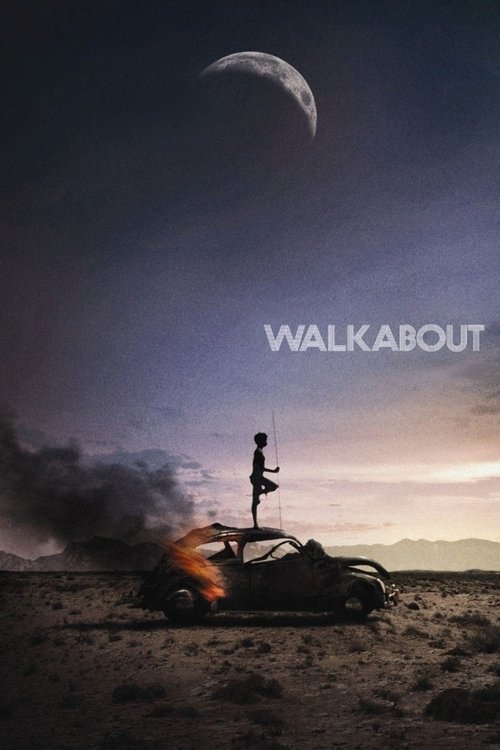
Walkabout
1971 · Nicolas Roeg
When you want to be transported somewhere vast and strange and come back a little changed — a film to fall into rather than follow. More hypnotic challenge than easy comfort, and worth surrendering to.
What it's about
A teenage girl and her small brother are driven into the Australian outback by their father for a picnic that turns violently wrong, leaving the two city children stranded alone in the desert in their school clothes. A young Aboriginal man on his walkabout — a ritual solo journey — finds them and keeps them alive, and between the three of them, without a shared language, something like a fragile Eden takes shape. It's a survival story that's really about two worlds meeting and failing to understand each other.
The experience
Fever-bright and dreamlike — gorgeous, brutal images of desert life cut together in startling, associative bursts. It's sensual and unsettling at once, an adventure movie that keeps sliding into reverie, and it leaves behind a strange, aching sense of something lost.
Performances
David Gulpilil, in an incandescent screen debut, communicates whole worlds without translated dialogue, and Jenny Agutter grounds the film's dreaminess with a performance of guarded, dawning awareness.
The craft
Nicolas Roeg, a cinematographer turned director, shoots the outback like nobody before or since — teeming close-ups of lizards and insects, shimmering heat, jagged cross-cutting that rhymes wilderness with city life. It's one of the great-looking films of its era and begs for the biggest screen you can find.
Why it matters
A commercial disappointment on release that grew into a touchstone of art cinema, launching Roeg's run of visionary features and introducing David Gulpilil, a landmark figure for Aboriginal presence on screen.
Snapshot
Walkabout is Nicolas Roeg's first solo feature, a fever-bright survival fable in which two white city children, abandoned in the Australian outback after their father's murder-suicide, are kept alive by a young Aboriginal man on his ritual "walkabout." From a slender premise Roeg — a cinematographer turning director — builds an associative, image-driven meditation on civilization and wilderness, on the failures of language and desire, and on a paradise glimpsed and irretrievably lost. Adapted by playwright Edward Bond from James Vance Marshall's 1959 novel, the film is remembered as much for its rapturous, fragmentary style as for David Gulpilil's incandescent screen debut and Jenny Agutter's performance as the unnamed girl. Initially a commercial disappointment, it has since become a touchstone of art cinema and a foundational text for thinking about landscape, colonialism, and adolescence on film.
Industry & production
Walkabout sits at an unusual crossroads: a British-conceived, internationally financed production shot entirely on Australian locations several years before the Australian New Wave proper arrived. The project originated with American producers Si Litvinoff and Max L. Raab, who held the rights to Marshall's slim novel; the screenplay was entrusted to the English dramatist Edward Bond, whose adaptation was famously spare — widely described as only a handful of pages — leaving the bulk of the film to be realized visually and on location. Roeg, who had a decade-plus of distinguished work as a director of photography behind him and had just co-directed Performance (shot 1968, released 1970) with Donald Cammell, took the assignment as his first wholly authored film.
Production centered on the Northern Territory, with shooting in and around the country near Alice Springs and the central desert. The relatively small crew, location-bound logistics, and harsh environment shaped the film's improvisational, observational texture. The film was selected for competition at the 1971 Cannes Film Festival, which gave it international visibility, but it did not perform strongly on initial release and was for years more discussed than seen. Its reputation was rebuilt over subsequent decades through repertory screenings and home-video restoration, including a Criterion Collection edition that returned the film to wide critical circulation. Precise budget and box-office figures are not something I can responsibly assert here; the consensus account is simply that it underperformed commercially at first and accrued its standing later.
Technology
Walkabout was shot on 35mm in color, and its technological interest lies less in novel equipment than in how Roeg deployed conventional tools with a photographer's command. Working in the extreme light and heat of the central Australian desert, he exploited long telephoto lenses for compression and isolation, macro photography for the teeming insect-and-reptile life of the outback floor, and natural light for the landscape's overwhelming scale and color. The film's palette — saturated reds, ochres, and the hard blue of the desert sky — depends on location cinematography rather than studio control. Roeg's background metering and exposing for harsh contrast gives the imagery its characteristic intensity. The editing, too, is a kind of technology of meaning: the film's montage relies on rapid graphic and thematic cutting that anticipates the elliptical structures Roeg would refine in Don't Look Now. None of this required exotic gear; the achievement is one of craft and sensibility applied to an unforgiving environment.
Technique
Cinematography
Roeg served effectively as his own cinematographer, and Walkabout is first and last a photographed film. The camera oscillates between two registers: the vast, almost abstract grandeur of the desert — figures dwarfed against escarpments, salt pans, and horizon lines — and an intimate, near-microscopic attention to the living detail of the land, lizards, scorpions, ants, birds, and the play of water. This dialectic of macro and macrocosm is the film's visual argument: the wilderness is at once sublime and crawling with life, indifferent and abundant. Roeg uses telephoto lenses to flatten and isolate, lens flare and heat shimmer to dissolve solidity, and slow motion to lyricize the body in motion (the hunting sequences especially). The recurring image of the girl in her school uniform and the boy in shorts, incongruous against the desert, is composed for maximum irony of culture against nature.
Editing
Editing (credited to Antony Gibbs and Alan Pattillo) is the film's signature technique and the clearest expression of Roeg's authorship. Rather than linear continuity, the film proceeds by association, juxtaposition, and ironic counterpoint. The most discussed instances cut between worlds: the Aboriginal boy butchering a kangaroo intercut with a white butcher at work in a shop; the natural hunt set against images of urban consumption and labor; flash-forwards and flashbacks that fracture chronology. The opening montage establishes the city's grids, walls, and routines before the desert shatters them. This collage method — using the cut to make conceptual rather than spatial connections — would become Roeg's stylistic hallmark, and Walkabout is where it crystallizes.
Mise-en-scène / staging
The staging foregrounds incongruity and scale. Costuming is pointed: the girl's prim school uniform persists deep into the wilderness, a visual insistence on the children's inability to shed their conditioning, while the boy's near-nakedness reads as ease within the land. The film stages bodies in landscape so that the human figure is repeatedly subordinated to environment, then suddenly thrust into erotic or violent proximity. Roeg withholds names from all three central figures — the Girl, the (white) Boy, the (Black) Boy — universalizing them into emblematic types even as the performances individuate them. Civilization's detritus (a weather balloon, surveyors, an abandoned homestead, a road) recurs as intrusions that mark the wilderness as already colonized, never truly pristine.
Sound
The soundtrack juxtaposes John Barry's lush, romantic orchestral score against the dense field sound of the desert — insect drone, wind, animal cries — and against fragments of radio voices and recorded speech that signal the encroaching modern world. Barry's music lends the imagery an elegiac, swelling lyricism that pushes against the film's harsher content, sentimentalizing the idyll in a way the narrative will ultimately undercut. Crucially, language itself is staged as broken: the white children and the Aboriginal boy share no common tongue, and the film's central tragedy turns on a failure of communication that sound design and the absence of translation make palpable. The closing voiceover of A. E. Housman's verse ("Into my heart an air that kills…") supplies the film's final, mournful key.
Performance
Jenny Agutter, then a teenager, anchors the film as the girl, registering a guardedness and a dawning, unspoken sexuality that the camera observes with a frankness that has drawn both admiration and critique. Roeg cast his own young son, Luc Roeg (billed as Lucien John), as the little boy, whose unselfconscious openness to the Aboriginal world contrasts with his sister's reserve. The revelation is David Gulpilil — here at the start of a career that would make him the pre-eminent Aboriginal actor in Australian cinema — whose physical grace, hunting prowess, and the heartbreaking courtship dance of the final act give the film its emotional center. John Meillon appears briefly but indelibly as the father whose breakdown launches the story.
Narrative & dramatic mode
Walkabout operates in a poetic-allegorical mode rather than a conventional dramatic one. Its plot is elemental — abandonment, survival, encounter, separation — but its meaning is carried by image, juxtaposition, and symbol. Roeg fractures time with flashbacks and flash-forwards, framing the central journey within a retrospective consciousness, so that the outback interlude is experienced as memory even as it unfolds. The dramatic engine is not suspense but irony: the children are saved by the very figure their civilization cannot accommodate, and the climax hinges on a courtship the girl fails (or refuses) to read, with fatal consequences. The film resists resolution; its coda — the girl years later as a married woman, recalling the desert as a lost Eden — converts the whole into an elegy for an unrecoverable paradise, complicating any simple reading of the events we have witnessed.
Genre & cycle
Nominally an adventure-survival drama, Walkabout belongs more truly to the art-cinema tradition of the late 1960s and early '70s, in which narrative is loosened in favor of psychological and symbolic exploration. It can be situated within a cycle of "wilderness encounter" films and within the broader European-influenced art film as practiced by an English émigré sensibility. It also participates in the long cultural lineage of the "noble savage" and Edenic-paradise narratives, which it both invokes and interrogates. Within Australian screen history it is frequently grouped with subsequent films of landscape and unease — most often paired with Peter Weir's Picnic at Hanging Rock (1975) and The Last Wave (1977), the latter also starring Gulpilil — as part of a strain that renders the continent's interior as numinous, dangerous, and resistant to white comprehension.
Authorship & method
Walkabout is decisively a Roeg film, and its method reflects his formation. Before directing he was one of Britain's most accomplished cinematographers, with credits including second-unit work on Lawrence of Arabia and photography on Fahrenheit 451, Far from the Madding Crowd, and Petulia — a résumé that explains both his command of the image and his appetite for fragmentation (Petulia in particular foreshadows his cutting style). Having co-directed Performance, he used Walkabout to consolidate a personal grammar: associative montage, temporal dislocation, an obsession with mortality and the collision of incompatible worlds, and an erotically charged attention to the body. His key collaborators shaped the result: Edward Bond's deliberately minimal screenplay ceded authority to images; John Barry's score supplied romantic counterpoint; and editors Antony Gibbs and Alan Pattillo helped realize the film's collage logic. The casting of his own son and of the untrained Gulpilil underscores a method that prized presence and authenticity over conventional craft. The recurring concerns here — broken communication, the irreversibility of time, paradise lost — run straight through Roeg's subsequent masterworks, Don't Look Now (1973) and The Man Who Fell to Earth (1976).
Movement / national cinema
The film's national identity is productively ambiguous. It is, by authorship and financing, a British/international production directed by an Englishman; yet it is wholly Australian in setting and has been retrospectively absorbed into the prehistory of the Australian New Wave, the renaissance of Australian filmmaking that gathered force from the early-to-mid 1970s. Walkabout preceded and arguably helped license that movement's fascination with landscape, isolation, and the unsettling encounter between European settlement and an ancient land. Through David Gulpilil it also stands at the threshold of Aboriginal representation in Australian cinema, inaugurating a screen presence that would recur for half a century. Within Roeg's own trajectory it belongs to the cosmopolitan British art cinema of the period, distinct from social-realist contemporaries.
Era / period
Made at the turn of the 1970s, Walkabout is steeped in its moment. Its anti-civilizational current — the critique of urban modernity, the romance of the natural and the "primitive" — resonates with the era's counterculture and ecological awakening, while its frank treatment of adolescent sexuality reflects the loosening censorship of the period. Formally it belongs to the high-water mark of international art cinema, when elliptical editing, narrative ambiguity, and authorial self-consciousness were ascendant. It also registers, however obliquely, a growing postcolonial awareness: the film's persistent reminders that the "wilderness" is bounded by roads, surveyors, mines, and homesteads acknowledge a dispossessed continent rather than an empty one, even if its politics remain refracted through allegory rather than stated directly.
Themes
The film's governing opposition is nature against civilization, but Roeg refuses easy primitivism: the desert is beautiful and lethal, the city ordered and deadening, and neither offers an unproblematic home. Communication and its failure form a second axis — the unbridgeable gap of language between the children and their rescuer, culminating in the misread courtship that destroys him, indicts the white characters' incapacity to receive what is offered. Sexuality and the body run throughout, in the girl's watchful self-consciousness and the charged physicality of the Aboriginal boy. Mortality is everywhere: the father's suicide, the hunted animals, the boy's death. Above all the film is about paradise and its loss — the retrospective frame and Housman's verse recast the entire outback episode as an Eden the adult girl can only mourn, suggesting that what is most fatal is not the wilderness but the return to the world that cannot hold its memory. The colonial subtext — a land already marked, a people already displaced — shadows every frame.
Reception, canon & influence
On release Walkabout divided critics and found only a modest audience; its competition slot at Cannes in 1971 conferred prestige without translating into commercial success, and the film's reputation grew slowly over the following decades. The reasons are familiar for art cinema of its kind: a loose narrative, a frankness about the young body that unsettled some viewers, and a refusal of moral and dramatic closure. Time has been kind to it. Restoration and reissue — notably through the Criterion Collection — returned it to circulation, and it is now widely regarded as a classic and as one of Roeg's finest achievements.
Looking backward, the film draws on Marshall's source novel, on the European art-cinema currents of its day, and on Roeg's own decade of cinematographic practice (the fractured montage of Petulia is a direct antecedent), as well as on the deep cultural reservoir of Edenic and "noble savage" myth, which it consciously engages and complicates. Looking forward, its influence is broad. It helped open the imaginative terrain that the Australian New Wave would cultivate, with Peter Weir's landscape mysteries the clearest kin. It launched David Gulpilil, whose subsequent career — across Storm Boy, The Last Wave, Crocodile Dundee, Rabbit-Proof Fence, and Charlie's Country — made him the defining Aboriginal screen actor of his generation and a touchstone for later Indigenous filmmaking. And within Roeg's own filmography it is the seedbed for the elliptical, image-first method that flowered in Don't Look Now and beyond, securing his standing as one of the most distinctive stylists in postwar British cinema. Its imagery and its central concerns — the body in landscape, the lost idyll, the catastrophe of failed understanding across cultures — continue to echo in films and criticism that grapple with wilderness, colonialism, and memory.
A Deleuzian reading
Start with the image that won't leave: a teenage girl in a gray pleated school uniform and knee socks, picking her way across red rock that goes on forever.
The full Deleuzian reading of Walkabout →
Reception
Met with polite puzzlement in 1971 — it competed at Cannes but flopped in Australia, where audiences didn't know what to make of it — Walkabout has since been fully canonized: a Criterion staple, a founding text of Australian cinema (made by a Brit), and one of the great directorial debuts-in-spirit.
How Walkabout was received, from release to now →
Influences: the films it descends from and the films it influenced
- Petulia (1968) — Roeg shot it; its fractured flash-forward/flashback cutting and elliptical scene fragmentation is the direct technical antecedent of Walkabout's associative montage.
- Performance (1970) — Roeg's co-directing debut where he forged the collage editing and intercut-bodies grammar — disjunctive image rhymes across spaces — that Walkabout systematizes solo.
- Tabu: A Story of the South Seas (1931) — Treats landscape as fate and casts a nonprofessional indigenous performer, staging the clash of innocence and civilization entirely through real-location imagery.
- Don't Look Now (1973) — Extends Walkabout's image-first method into premonitory cross-cutting and temporal dislocation, editing by color/object rhyme so chronology dissolves into association.
- The Man Who Fell to Earth (1976) — Carries forward the collision-of-incompatible-worlds theme and fragmented, time-collapsing montage, with an alien stranded in landscape echoing the children's displacement.
- The Last Wave (1977) — Recasts Gulpilil and dramatizes white incomprehension of Aboriginal cosmology, extending Walkabout's failed-cross-cultural-communication and colonial subtext.
- The Proposition (2005) — Roeg's contre-jour Australian desert cinematography — halation and blown-out highlights rendering the landscape as an active hostile presence overwhelming European subjects — is the visual grammar Delhomme inherits directly for The Proposition's outback photography.
- EO (2022) — Associative, elliptical montage that intercuts animals, landscape and human cruelty to decenter the human gaze — Roeg's editing grammar anticipates Glińska's cutting.
- Into the Wild (2007) — Roeg's elliptical, associative editing that cross-cuts wilderness immersion against images of civilization prefigures Cassidy's chaptered, contrapuntal structure and its critique of consumer society.
- Lion (2016) — Founds the Australian-cinema grammar of a child stranded in overwhelming landscape, with god's-eye and sun-flared imagery translating disorientation into visual scale.
- The Black Stallion (1979) — Roeg's long-lens compression of children against hostile landscape plus associative cross-cutting between wilderness and civilization gives Ballard both the optical grammar of the island and the structural logic of intercutting it against the mainland.
- Lawrence of Arabia (1962) — Roeg worked second unit; its telephoto-compressed desert verticals and tiny human figures dwarfed by landscape model Walkabout's figure-in-landscape framing.
- Far from the Madding Crowd (1967) — Roeg's cinematography here — natural-light pastoral landscapes shot wide and with long lenses — directly feeds Walkabout's available-light outback photography.
- L'Avventura (1960) — Establishes the art-cinema device of placing alienated bodies against indifferent barren terrain and refusing narrative/moral closure, the formal license Walkabout takes to the outback.
- The Naked Prey (1965) — Strips a European down to bare survival in untranslated wilderness with an indigenous Other, pioneering the language-barrier-as-structure and nature-vs-civilization survival mode Walkabout inherits.
- Black Narcissus (1947) — British forebear of erotically-charged, color-saturated landscape filmmaking where environment and repressed sexuality fuse through expressive cinematography rather than plot.
- Picnic at Hanging Rock (1975) — The clearest Australian New Wave kin — sun-drenched telephoto landscape mysticism, unresolved disappearance, and nature as erotic/uncanny force, opened by Walkabout's terrain.
- Storm Boy (1976) — Builds on Gulpilil's debut presence, pairing an untrained Aboriginal performer with a child against landscape in the natural-light Australian idiom Walkabout launched.
- Rabbit-Proof Fence (2002) — Reunites with Gulpilil and renders the outback as a vast figure-in-landscape canvas for an explicit Indigenous-colonial trek, descending from Walkabout's body-crossing-country structure.
- Charlie's Country (2013) — Late Gulpilil vehicle that closes the actor's lineage begun in Walkabout, foregrounding an Aboriginal man caught between bush and white civilization.
- Wake in Fright (1971) — Contemporaneous Australian outback film stripping a civilized man to primal collapse, sibling in the nature-vs-civilization and colonial-unease terrain Walkabout maps.
- Days of Heaven (1978) — Inherits the natural/magic-hour light, telephoto figures-in-landscape, and elliptical associative montage with ironic voiceover counterpoint that Walkabout pioneered.
- The Tree of Life (2011) — Pushes Walkabout's associative montage and macro nature photography (insects, water, sun-through-leaves) into a fully image-driven, non-linear poetic grammar.
Similar films
- Wake in Fright (1971) — influence & lineage
- Rabbit-Proof Fence (2002) — influence & lineage
- The Last Wave (1977) — influence & lineage
- Picnic at Hanging Rock (1975) — influence & lineage
- Lawrence of Arabia (1962) — influence & lineage
- Meek's Cutoff (2011) — shared sensibility
- Gallipoli (1981) — shared sensibility
- The Proposition (2005) — shared sensibility