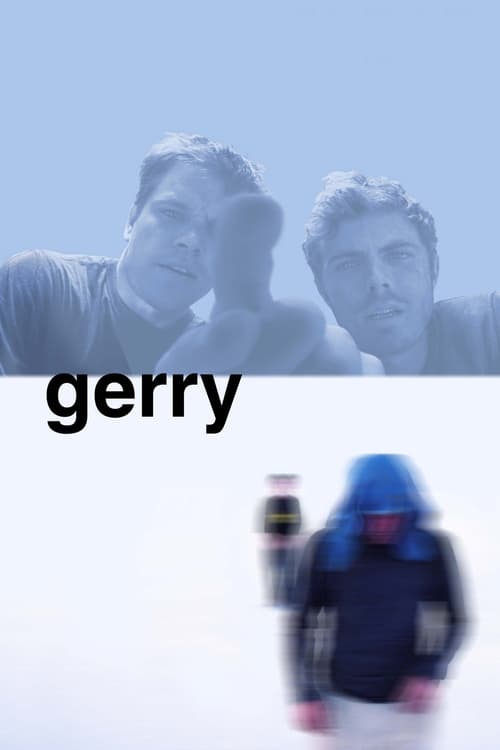
Gerry
2002 · Gus Van Sant
For when you want to surrender to a film rather than be entertained by it — a slow, meditative, almost physical experience. Definitely a challenge; bring patience and don't check your phone.
What it's about
Two friends, both named Gerry, pull off a desert highway to hike out to some landmark, drift off the trail, and get lost. That's the whole story — and the film commits to it completely, following them across salt flats, canyons, and empty horizons as banter gives way to exhaustion and the landscape stops being scenery and starts being the antagonist.
The experience
Hypnotic and demanding: long wordless stretches, footsteps on gravel, two figures shrinking against enormous terrain. It works on you like a trance — some viewers find it transcendent, others maddening — and the dread accumulates so gradually you barely notice it tightening.
Performances
Matt Damon and Casey Affleck carry the film with almost no dialogue, letting fatigue, sunburn, and silence do the acting — it's movie stars stripped down to bodies moving through space.
The craft
Van Sant builds the film from extraordinary long takes — the camera walking with, circling, or simply watching the two men against Death Valley vistas that look both gorgeous and hostile. The sound design of wind and footfall matters as much as any line of dialogue. On a big screen the landscapes are overwhelming; that's the point.
Why it matters
The film where Gus Van Sant walked away from Hollywood success and reinvented himself as a minimalist — the first of his 'Death Trilogy' and a touchstone for American slow cinema.
Snapshot
Gerry is the film with which Gus Van Sant, fresh off the studio successes of Good Will Hunting (1997) and Finding Forrester (2000), abruptly abandoned mainstream narrative and reinvented himself as an avant-garde minimalist. Two young men, both named Gerry, played by Matt Damon and Casey Affleck, leave a desert trailhead to see an unnamed "thing," wander off the path, and become hopelessly lost. That is essentially the entire plot. Over roughly 103 minutes, the film tracks their disorientation, exhaustion, and physical disintegration across a sequence of vast, depopulated landscapes, told largely through extended wordless takes of walking. The film is the first installment of what came to be called Van Sant's "Death Trilogy," followed by Elephant (2003) and Last Days (2005), a triptych unified by long takes, drifting camera movement, ambient stillness, and an interest in mortality approached obliquely rather than dramatized. Gerry is best understood not as a survival thriller but as a deliberate importation of European "slow cinema" grammar into American independent filmmaking, an experiment in duration, landscape, and the erosion of narrative.
Industry & production
Gerry was a small, self-generated independent production made well outside the studio system, conceived collaboratively by Van Sant, Damon, and Affleck, who share the writing credit. The project grew out of a desire among the three to make something loose, improvisational, and free of conventional script obligations after the comparatively buttoned-down studio films Damon and Van Sant had been making. The shoot was itinerant, moving among desert locations to assemble a landscape that reads as a single continuous nowhere; the production filmed in Argentina (including salt-flat terrain), Death Valley in California, and Utah, cutting these geographically distant places into one imaginary desert. The budget was modest and the crew small, in keeping with a production designed around walking, waiting for light, and capturing long uninterrupted takes rather than building sets or staging coverage.
Commercially, the film was a non-event by design and by reception. It circulated on the festival circuit in 2002 before receiving a very limited US theatrical release (handled by a small specialty distributor) in early 2003. It played to tiny audiences and generated no meaningful box office; I won't cite specific grosses, as the film's commercial footprint was negligible and precise figures are not worth asserting with confidence. Its significance was always cultural and authorial rather than financial: it functioned as a statement of intent, a reset of Van Sant's career, and a calling card for a more rigorous, European-inflected mode of American art cinema.
Technology
Gerry belongs to the celluloid tradition rather than the digital one. It was shot on 35mm film by cinematographer Harris Savides, and its aesthetic depends on the rich tonal range and grain structure of photochemical capture in extreme natural light, from blown highlights on salt flats to deep dusk and dawn gradients. The film's defining technical demand was duration: shots that run for many minutes without a cut require careful management of film magazines, exposure, and continuity of light, and they place enormous pressure on camera operation and on the actors' stamina within a single roll. Camera movement is achieved through smooth, patient tracking and Steadicam-style following rather than rapid handheld coverage, and several of the film's most celebrated images are essentially feats of sustained operating. There are no visual effects of note; the technology on display is the old technology of the moving camera, long lenses, and natural light, deployed with unusual rigor. The film is also notable for how little it relies on conventional sound technology — much of its "score" is silence, footfalls, and wind, with sparse interpolations of pre-existing music.
Technique
Cinematography
Harris Savides's cinematography is the film's center of gravity. Working in widescreen with long lenses and natural light, Savides treats the desert as an abstract field rather than a picturesque backdrop, flattening the two figures against immense planes of sky, sand, and salt. The most discussed image is a prolonged tracking shot of the two Gerrys walking in near-lockstep, photographed in tight profile so that their heads bob against a shifting ground, the rhythm of their gait becoming almost musical and hypnotic. Elsewhere Savides holds on extreme long shots in which the men are reduced to specks crossing the frame, dramatizing scale and insignificance. Light is allowed to do narrative work: the famous dawn sequence, with the sky cycling through gradations of color behind the silhouetted figures, conveys the passage of time and the indifference of nature more powerfully than any line of dialogue. The compositions are patient, frequently static or slow-moving, and they refuse the establishing-and-coverage logic of conventional cinema in favor of duration and contemplation.
Editing
Van Sant edited the film himself, and the cutting is defined by restraint and by the integrity of the long take. Shots are permitted to run far past the point at which a conventional film would cut, so that editing becomes less a matter of assembling action than of deciding when, finally, to release a held image. The film cuts between distinct landscapes — desert, salt flat, scrub — to construct a single impossible geography, using the edit to disorient rather than to orient the viewer. The cumulative effect is a temporality in which the audience experiences something analogous to the characters' own loss of bearings: time stretches, landmarks fail to accumulate, and progress becomes impossible to measure. The editing is thus structurally expressive, making duration itself the subject.
Mise-en-scène / staging
The mise-en-scène is radically stripped down: two bodies, the clothes they wear, and an overwhelming natural environment. There are virtually no props, no production design in the built sense, and no other characters. Staging consists largely of choreographing how the two men move through and stand within the landscape — walking together, splitting apart, sitting in exhaustion. One memorable set piece strands one Gerry atop a tall rock ("the dirt mattress"), with the other coaching him down, a sequence that finds absurd comedy and genuine peril in a minimal physical predicament. The human scale is constantly dwarfed by the frame, and the staging's refusal of incident — long stretches in which nothing "happens" — is precisely the point, foregrounding the void against which the men's dwindling agency is measured.
Sound
Sound design is among the film's most expressive elements. For long passages there is no music at all, only the amplified intimacy of footsteps, breathing, wind, and the vast ambient silence of open country, which makes the rare spoken exchanges feel startling and the men's isolation acoustically palpable. Against this near-silence, Van Sant deploys the spare, devotional minimalism of the Estonian composer Arvo Pärt, whose pieces (associated with his "tintinnabuli" style) appear at key moments to lend the wandering a liturgical, elegiac weight. The contrast between near-total silence and Pärt's crystalline tones organizes the film's emotional register, withholding conventional scoring and then administering music as a kind of grace note. Dialogue, when it occurs, is naturalistic, fragmentary, and often inane, deliberately failing to provide the exposition or psychology a viewer might expect.
Performance
Damon and Affleck give performances built on endurance and behavioral minimalism rather than on dramatic arcs. Much of their interaction was improvised, and the early scenes have a loose, almost mumbled quality — in-jokes, shorthand, the verb "to gerry" deployed as private slang for screwing something up. As the ordeal deepens, performance becomes increasingly physical: the acting is in the trudging, the stumbling, the cracked lips and depleted bodies. Affleck in particular registers a haunted vulnerability, and the film's devastating turn depends on the two actors having established a wordless intimacy that makes its rupture legible without explanation. These are not showcase performances in the conventional sense; they are studies in fatigue, presence, and the gradual emptying-out of personality under physical extremity.
Narrative & dramatic mode
Gerry operates in an anti-narrative or minimal-narrative mode. It withholds nearly everything a conventional drama supplies: backstory, motivation, character names beyond the shared "Gerry," stakes articulated in dialogue, and even basic geography. The dramatic engine is reduced to a single situation — lost, and getting more lost — and the film refuses to resolve it through plot mechanics. This places it closer to existential parable than to genre storytelling. The narrative's central event, when it arrives, is shocking precisely because the film has trained the viewer to expect nothing to happen; its meaning is left deliberately ambiguous and morally unresolved. The mode is contemplative and durational, asking the audience to read mood, landscape, and bodily decline rather than to follow a plot. In this it courts boredom as an aesthetic strategy, trusting that attention itself, sustained over emptiness, becomes a form of meaning.
Genre & cycle
Nominally the film touches the survival/wilderness drama and the road movie, but it systematically empties those genres of their usual machinery — there is no ticking clock, no rescue subplot, no competent-survivor heroics. It is more productively located within "slow cinema" or contemplative cinema, an international art-film tendency emphasizing long takes, real-time duration, and minimal incident. Within Van Sant's own filmography it inaugurates the Death Trilogy cycle, sharing with Elephant and Last Days a formal vocabulary of drifting long takes, ambient soundscapes, depopulated spaces, and death approached as a quiet, almost accidental fact rather than a dramatic climax. Gerry can also be read against the existential wandering tradition — films in which landscape becomes a metaphysical condition rather than a setting.
Authorship & method
Gerry is an auteur statement and a genuine collaboration at once. Gus Van Sant is the controlling sensibility — director, co-writer, and editor — and the film represents his most decisive break from commercial filmmaking, a return to the experimental impulses of his earlier work pushed to a far greater extreme. He has spoken of the influence of the Hungarian director Béla Tarr, whose epic long takes and walking figures (in Sátántangó and Werckmeister Harmonies) are the most direct formal model for Gerry's method. The cinematographer Harris Savides is the indispensable co-author of the film's look and would remain Van Sant's key collaborator across the trilogy; his name is inseparable from the film's achievement. Matt Damon and Casey Affleck are co-writers and co-creators as well as stars, having helped originate the loose, improvisatory method by which scenes were generated on location rather than scripted in advance. There is no traditional composer; the "score" is curated from the existing work of Arvo Pärt, whose minimalist sacred music supplies the film's spiritual undertone. The method — improvised performance, long-take photography, location-built geography, and editing as the management of duration — is the film's true authorial signature.
Movement / national cinema
Though an American film, Gerry is in dialogue primarily with European and international art cinema rather than with any American movement. Its lineage runs through the Hungarian long-take tradition of Béla Tarr, the structural durational cinema associated with Chantal Akerman, the landscape-as-existential-void of Michelangelo Antonioni's Italian modernism, and the spiritual slowness of Andrei Tarkovsky. By transplanting these sensibilities into the American desert with American movie stars, Van Sant performs a kind of translation, making Gerry a hinge between European slow cinema and a nascent strain of rigorous American independent filmmaking. It is less a product of a national movement than a deliberate act of cross-pollination.
Era / period
The film arrives at a specific early-2000s juncture, when a director with hard-won studio capital could leverage that standing to fund an uncommercial experiment, and when digital tools were beginning to lower the barriers to non-commercial production even as Gerry itself remained committed to celluloid. It sits at the front edge of a period in which "slow cinema" became a recognizable critical category and an international festival staple. Within Van Sant's career it marks the precise pivot from his mainstream phase to his most formally adventurous decade, and it anticipates the broader 2000s art-film embrace of duration, minimalism, and ambient mood.
Themes
The film's dominant themes are disorientation, mortality, and the indifference of nature to human life. The desert functions as a metaphysical space, a place outside society where the markers of identity and purpose dissolve; the men's shared name strips them of individuality and suggests interchangeability, even a single divided self. Friendship and its limits under extremity form the emotional core, building toward a terrible test of intimacy. The film meditates on time, futility, and the absurd — the Beckettian comedy and horror of two figures trudging toward nothing — and on the body as the final ground of experience once language, knowledge, and direction have failed. Death is present throughout as a slow horizon rather than a sudden event, consistent with the trilogy's larger preoccupation. Crucially, the film refuses to convert these themes into moral lessons, leaving them as conditions to be experienced rather than meanings to be decoded.
Reception, canon & influence
Critical reception was sharply divided, as the film intended. To detractors it was static, self-indulgent, and punishingly empty — an endurance test mistaking tedium for profundity. To admirers it was a hypnotic, courageous reinvention, a genuine extension of cinematic language into duration and landscape, and the boldest work of Van Sant's career to that point. This polarization is itself part of the film's identity; it is a deliberately difficult object that sorts its audience.
Its influences run backward to a well-documented set of sources: Béla Tarr above all, whose method Van Sant openly acknowledged; Chantal Akerman's durational structuralism; Antonioni's existential landscapes; Tarkovsky's spiritual slowness; and, more loosely, the absurdist minimalism of Samuel Beckett, whose two waiting figures Gerry's pair strongly evoke. The narrative premise is also widely understood to draw on a real-life incident in which two young friends became lost in the New Mexico wilderness with fatal consequences, though Van Sant abstracts the event almost beyond recognition rather than dramatizing it.
Forward, the film's legacy is substantial relative to its tiny audience. It launched the Death Trilogy, the most critically esteemed phase of Van Sant's career, and Elephant would go on to win the Palme d'Or at Cannes in 2003 — a vindication of the formal experiment Gerry initiated. More broadly, Gerry became a touchstone in critical conversations about slow cinema in an American context and helped legitimize duration, minimal narrative, and landscape-driven contemplation within US independent filmmaking, anticipating later austere American works set in wilderness and built on walking, waiting, and elemental hardship. Its lasting influence is less a matter of imitation than of permission: it demonstrated that an American film with movie stars could be radically slow, narratively withholding, and formally rigorous, and survive as a serious object of study. Today it is regarded chiefly as the austere overture to one of the more remarkable mid-career reinventions in American cinema.
A Deleuzian reading
You remember the walk before you remember anything else.
The full Deleuzian reading of Gerry →
Reception
Booed and walked out on at Sundance 2002 — plenty of first-wave reviews called it an endurance test — but it's since been reclaimed as the audacious start of Van Sant's 'Death Trilogy,' the reset that led straight to Elephant's Palme d'Or.
How Gerry was received, from release to now →
Influences: the films it descends from and the films it influenced
- Sátántangó (1994) — The directly acknowledged model: extended walking long takes that track trudging figures across desolate, featureless terrain, making the duration of locomotion itself the dramatic event.
- Werckmeister Harmonies (2000) — Choreographed Steadicam/dolly that follows bodies walking through empty space in unbroken takes, the camera bound to the pedestrian rhythm of the actors rather than to plot — the precise template for Savides's mobile long-lens tracking.
- Jeanne Dielman, 23 quai du Commerce, 1080 Bruxelles (1975) — Durational structuralism — holding real time at fixed length until repetition and emptiness become the content, the formal permission Van Sant cites for letting scenes run far past their narrative usefulness.
- L'Avventura (1960) — Landscape as existential void with figures dwarfed and dispersed in widescreen, plus a narrative built on a search that simply dissolves — withholding resolution as a deliberate formal choice.
- The Passenger (1975) — Long-take wandering through arid desert geography where the environment swallows character psychology, modeling the elemental drift and dilated camera movement Gerry adopts in its salt-flat passages.
- Stalker (1979) — A handful of figures moving on foot through a hostile, disorienting zone in slow, spiritually weighted long takes — duration treated as a vehicle for metaphysical hush, echoed in Gerry's Arvo Pärt–scored silence.
- Lawrence of Arabia (1962) — Freddie Young's long-lens, heat-haze extreme-long-shots that reduce human figures to specks shimmering against vast desert — the deep-focus telephoto vocabulary for filming bodies lost in landscape.
- Wavelength (1967) — Structural-film insistence on a single sustained formal gesture across real time, normalizing duration and minimal incident as a rigorous compositional system rather than a failure of event.
- Days of Heaven (1978) — Harris Savides's long-lens compression of two figures traversing desert landscape — takes held far past narrative utility, the camera observing ambulatory bodies without psychological commentary — directly cites the compositional patience of Days of Heaven's wheat-field walking sequences, where duration and landscape displace incident as the unit of meaning.
- Two-Lane Blacktop (1971) — Two men, near-zero dialogue, figures dwarfed in landscape across punishingly long takes ending in unresolved erasure — an explicit revival of the Antonioni-via-Hellman austerity Two-Lane embodies.
- Damnation (1988) — The named Anglo-American transmission of Tarr's grammar — extended tracking takes of figures walking across austere landscape with stripped narrative, Van Sant citing Tarr directly.
- My Own Private Idaho (1991) — Pushes Idaho's elliptical, near-plotless landscape drift to an extreme, with long takes and time-lapse skies replacing conventional narrative scaffolding.
- Elephant (2003) — Death Trilogy successor that extends Gerry's method directly — Savides's long Steadicam takes trailing bodies through corridors and grounds, with overlapping/repeated time and ambient silence.
- Last Days (2005) — Closes the trilogy with the same Savides durational drift around a single wandering figure, improvised performance, and a near-plotless structure organized by walking, waiting, and elapsed time.
- Old Joy (2006) — Imports Gerry's austere American minimalism — two men, a wilderness walk, sparse dialogue, ambient sound, and contemplative duration — into Pacific Northwest landscape as quiet character study.
- Meek's Cutoff (2010) — Builds a frontier drama from walking, waiting, and elemental hardship across empty terrain, withholding narrative payoff — the survival-deconstruction and landscape-as-ordeal that Gerry licensed for US indies.
- An Elephant Sitting Still (2018) — Unbroken steadicam follows of drifting figures, holding on the back of the head while the world blurs — the shallow-focus following aesthetic Fan Chao adopts for Hu Bo.
- The Long Walk (2025) — Pioneered the durational walking two-hander shot in long lateral and trailing tracks, proving a film can run on bodies moving through space rather than plot — the subtraction method the Walk inherits.
- The Brown Bunny (2003) — Contemporaneous American durational road minimalism — long unbroken takes of solitary motion through open landscape, narrative withheld, endurance of the viewer made part of the form.
- Los Muertos (2004) — Tracks a lone figure walking through wilderness in patient long takes with minimal mise-en-scène and ambient-only sound, the same slow-cinema reduction of story to embodied movement through terrain.
- Silent Light (2007) — Tarr-descended long takes and natural-light landscape compositions that hold on duration and stillness, sharing Gerry's transposition of European slow-cinema rigor onto wide, contemplative exteriors.
- Liverpool (2008) — Extends the walking-protagonist slow-cinema template into frozen, depopulated landscape, using extreme-long-shot framing and anti-narrative structure where geography and endurance replace plot.
- Sirāt (2025) — Makes the landscape itself the antagonist as figures are attrited toward death across barren wides with near-zero dialogue and durational walking — Sirāt's subtractive, attrition method.
- Taste of Cherry (1997) — Van Sant, who has cited Kiarostami as a direct formal influence, applies the compressed landscape cinematography, durational gaze, and diegetic-only sound design to the Mojave Desert; the suppressed performance mode and strategic ellipsis translate the Taste of Cherry method into an American register while preserving its withholding of psychological interiority.
- Walkabout (1971) — Reduces narrative to bodies walking/lost in vast wilderness shot in natural light, distilling Walkabout's survival-in-landscape minimalism to pure duration.
Similar films
- Elephant (2003) — influence & lineage · same viewing thread · often watched together
- Sirāt (2025) — influence & lineage
- Satantango (1994) — influence & lineage
- My Own Private Idaho (1991) — same viewing thread · often watched together
- Paris, Texas (1984) — shared sensibility
- Stranger Than Paradise (1984) — shared sensibility
- The Banshees of Inisherin (2022) — shared sensibility
- Twinless (2025) — shared sensibility
All the films related to Gerry →
Watch it with: curated runs of related films
- Adrift and Coming Apart — A run of solitary souls drifting through motels, deserts, and empty apartments and quietly dissolving — they rhyme on stillness, loneliness, and dread.