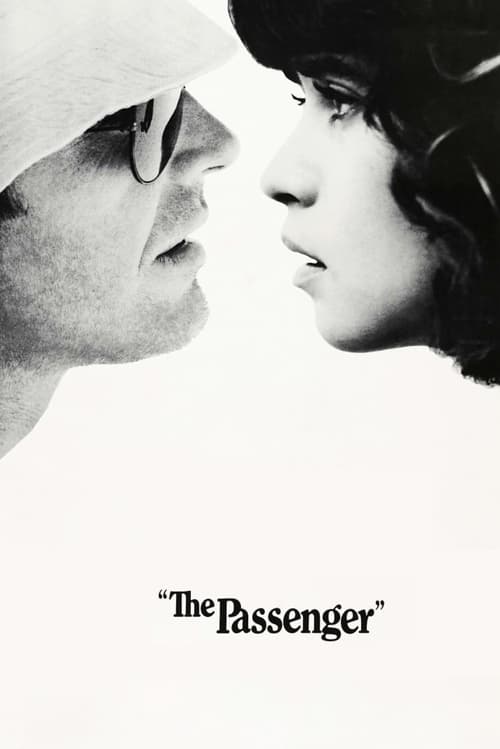
The Passenger
1975 · Michelangelo Antonioni
For a contemplative night when you want atmosphere and open road instead of plot mechanics — a film to sink into slowly and carry around for days. Choose it when you're up for a challenge, not a thrill ride.
What it's about
A burned-out television journalist, stalled in the Sahara while failing to land the story he was sent for, finds a fellow hotel guest dead in his room — a man who happens to resemble him. On impulse he swaps their identities and lets the world believe he's the one who died. But the dead man was an arms dealer with appointments to keep, and as the journalist drifts across Europe keeping them, a woman he meets along the way joins him — while the dead man's business, and his own abandoned life, both close in.
The experience
Slow, sun-bleached, and mesmerizing — less a chase than a long exhale, with danger humming quietly underneath. It works on you like heat: you come out of it dazed, moved, and thinking about what you'd shed if you could walk out of your own life.
Performances
Jack Nicholson gives one of his most restrained performances, all fatigue and quiet longing with the famous grin switched off, and Maria Schneider brings a bright, unforced ease as the student who joins his flight.
The craft
Antonioni composes in long, patient takes across deserts, Gaudí rooftops, and empty Spanish towns, letting landscape carry the emotion — and the film builds to one of the most celebrated single camera shots ever filmed. It's ravishing on a big screen, where the light and space can do their work.
Why it matters
A high-water mark of 1970s art cinema and a legendary meeting of a European master with a Hollywood star at his peak, its closing minutes are still studied and argued over by filmmakers.
Snapshot
The Passenger — released in Italy as Professione: reporter — is Michelangelo Antonioni's 1975 study of a man who tries to escape himself by stepping into a dead stranger's life. David Locke, a burned-out Anglo-American television journalist, is in north Africa failing to make contact with the guerrillas he has been sent to film. In a remote desert hotel he finds a fellow guest, Robertson, dead on the bed; the two men resemble each other, and on impulse Locke swaps passport photographs and assumes the dead man's identity, letting the world believe that Locke himself has died. He soon discovers that Robertson was a gunrunner with appointments to keep, and that inheriting a stranger's name means inheriting a stranger's enemies. As Locke follows the dead man's diary across Europe — London, Munich, Barcelona, the dust-blown south of Spain — he is joined by an unnamed young woman, an architecture student, and pursued at a distance by his wife, by the men Robertson was selling weapons to, and by their opponents. The film ends with one of the most discussed shots in cinema, a slow seven-minute movement out through the bars of a hotel window into an empty plaza and back, during which Locke is, off-screen and almost unremarked, killed. It is at once a thriller, an existential parable, and a culminating statement of Antonioni's lifelong preoccupations with alienation, identity, and the unbridgeable gap between a self and the world it moves through.
Industry & production
The Passenger was the third and final film of Antonioni's English-language, internationally financed period, following Blow-Up (1966) and Zabriskie Point (1970) — a body of work made possible by his association with producer Carlo Ponti and a multi-picture arrangement with MGM. Ponti produced The Passenger; the picture was a European co-production (Italian, French, and Spanish elements are involved in its financing and crewing) released through MGM. The casting of Jack Nicholson, then at the height of a remarkable run that included Five Easy Pieces, Chinatown, and One Flew Over the Cuckoo's Nest, gave the project genuine commercial weight and an American star at the center of an art film. Maria Schneider, cast as the girl, had become internationally known — and notorious — through Bernardo Bertolucci's Last Tango in Paris (1972); her presence linked the film to the most controversial European art cinema of the decade.
The production was geographically ambitious, shooting on location across Algeria and the Sahara, London, Munich, and Spain, including Barcelona and the arid southern province of Almería. This itinerant shoot, moving the unit from African desert to Catalan modernist architecture to Andalusian flatlands, is itself central to the film's meaning, which is bound up with travel, borders, and dislocation.
The most consequential fact of the film's later industrial history is its long disappearance. Nicholson acquired rights to the film, and for many years it was effectively unavailable in many markets. It was returned to circulation in a restored theatrical re-release in 2005, distributed by Sony Pictures Classics, with the participation of the elderly Antonioni (who died in 2007). That re-release substantially shaped the film's modern reputation, introducing it to a generation of cinephiles who had been unable to see it. Specific budget and box-office figures for the original 1975 release are not something I can state reliably, and I will not invent them; what is clear is that the film was a prestige art-house release built around a major star rather than a commercial blockbuster.
Technology
The Passenger was shot on 35mm film in the mid-1970s, and its technological significance lies almost entirely in a single feat of camera engineering: the famous penultimate shot. To execute Antonioni's conception — a continuous, unbroken move that begins inside Locke's hotel room, travels forward to and through the iron grille of a barred window, out into the open plaza beyond, and then reverses to look back at the hotel — the production required a camera that could glide smoothly forward, pass through a window whose bars had to part and reseal, and remain perfectly stable throughout. The solution was a specially built, gyroscopically stabilized camera mount suspended and guided so that the operator did not physically carry the rig through the aperture; the window's grille was constructed to open and allow the camera to pass, then close again before the camera turned to frame it from outside. The shot, planned and rehearsed over days, depended on choreographing actors, vehicles, and the changing exterior light to a moving camera that could not stop. It stands as a landmark in the pursuit of the long, fluid, untethered take, anticipating the kind of liberated camera movement that stabilization systems would later make routine. Beyond this set piece, the film's technology is the conventional photochemical apparatus of its era; the innovation is one of ambition and rigging rather than of new instruments.
Technique
Cinematography
The cinematography is by Luciano Tovoli, and it is among the defining achievements of his career. Tovoli renders Antonioni's world in long lenses and patient, observational compositions, with a palette that shifts decisively with geography: the bleached, glaring whites and ochres of the Sahara and Andalusia; the muted grays of northern Europe; the warm, organic curves of Antoni Gaudí's Barcelona architecture, where Locke and the girl meet amid the undulating stone of the modernist buildings. The film privileges wide, deep spaces in which human figures are small and often turned away, and it favors a restless but unhurried camera that drifts, reframes, and lingers after the ostensible action has ended. Light is frequently hard and overexposed in the desert sequences, expressing both literal heat and the dissolution of Locke's old self. The visual program is one of detachment: the camera observes its protagonist with the same cool, inquiring distance with which Locke once observed his journalistic subjects, and the great final shot is the logical extreme of this aesthetic — the camera finally leaving the human story entirely to contemplate the indifferent world outside.
Editing
The film was edited by Franco "Kim" Arcalli, one of the most important Italian editors of the period and a key collaborator of Bertolucci's. The editing is elliptical and contemplative, holding shots well past conventional length and trusting duration to generate meaning. Its most celebrated device is a set of audacious transitions that collapse time and space: most famously, a flashback in which the camera pans from the present-day Locke to a wall, and the soundtrack and image dissolve seamlessly into a recorded conversation between Locke and the living Robertson on the same hotel terrace, the present and the past sharing a single continuous-seeming movement. This refusal of clean temporal markers — letting past and present, the living man and the dead, occupy the same frame and breath — is the editing's signature and one of the film's deepest formal expressions of its theme: that identities and times bleed into one another. The cutting throughout resists the propulsive grammar of the thriller, deliberately slackening suspense in favor of mood and reflection.
Mise-en-scène / staging
Antonioni's staging treats environment as the primary dramatic agent. Architecture and landscape are not backdrops but co-protagonists: the emptiness of the desert externalizes Locke's spiritual exhaustion; Gaudí's curvilinear, almost biomorphic buildings supply a setting at once beautiful and disorienting; the dusty Spanish plaza of the finale is a near-vacant stage across which cars and figures move with ritual slowness. Characters are repeatedly placed against expanses that dwarf them, framed through grilles, windows, railings, and cable-car wires that suggest entrapment and partition. Props carry the plot — passports, a diary, photographs, the tools of identity and documentation — and Antonioni stages the act of identity-swapping with deliberate, almost clinical calm. The recurring motif of the barred window culminates in the final shot's passage through the grille, the staging literally moving from inside a confinement to the open world beyond.
Sound
The Passenger largely eschews a conventional orchestral score in favor of an environmental, predominantly diegetic soundtrack — wind, traffic, footsteps, radios, the ambient noise of the various locales — consistent with Antonioni's mature practice of using real-world sound to build mood and to underline silence and isolation. Music tends to arrive from within the world of the film rather than overlaid as commentary. This restraint heightens the documentary texture of the location shooting and the sense of a man adrift in indifferent space; the absence of an emotive score throws the burden of feeling onto image, duration, and the sparse, often oblique dialogue.
Performance
Jack Nicholson gives a deliberately interiorized, muted performance, suppressing the volatile charisma associated with much of his American work to play a man defined by passivity, fatigue, and the wish to disappear. Locke is a character who acts decisively only once — in assuming the dead man's name — and thereafter mostly drifts, and Nicholson plays this dissolution with watchful restraint. Maria Schneider, as the unnamed girl, supplies an enigmatic, free-floating counterpoint: she is curiosity and openness where Locke is withdrawal, and her refusal to be fully explained is part of the design. The performances are pitched away from psychological exposition and toward opacity, in keeping with Antonioni's distrust of conventional motivation; the actors embody states of being rather than dramatize clear objectives.
Narrative & dramatic mode
The film borrows the skeleton of a thriller — a stolen identity, an arms-dealing intrigue, pursuers closing in — and systematically drains it of suspense, converting genre machinery into existential parable. The mode is contemplative and ironic rather than propulsive: information is withheld or delivered obliquely, the "plot" of the gunrunning is kept deliberately vague, and the questions that a thriller would foreground (who is chasing Locke, will he be caught) are subordinated to a metaphysical question (can a person escape the self by adopting another's life). Antonioni structures the narrative around Locke's attempt to keep a dead man's appointments, so that the protagonist surrenders agency and follows a script written by someone else — a literalization of the film's fatalism. The famous ending refuses both the catharsis of an on-screen death and the closure of explanation: the act of violence happens off-frame while the camera attends to the ordinary world, leaving the audience to assemble the event from its aftermath. This is dramatic understatement raised to a principle.
Genre & cycle
Nominally a drama-mystery-thriller, The Passenger belongs less to any commercial cycle than to the tradition of 1960s–70s European art cinema's interrogation of the thriller and the road movie. It can be situated among films of the era that use the apparatus of suspense or crime to explore identity and alienation, and it shares DNA with the existential travel narrative. Within Antonioni's own filmography it forms a loose continuity with his "alienation" works — L'Avventura, La Notte, L'Eclisse, Il Deserto Rosso — and especially with Blow-Up, with which it shares a protagonist whose profession is image-making (photographer, then television reporter) and a meditation on the unreliability of recorded reality. It is best understood as auteur cinema operating within, and against, genre rather than as part of a market cycle.
Authorship & method
The Passenger is a quintessential auteur film, and Antonioni's sensibility — the privileging of landscape and architecture, the dedramatized narrative, the long take, the theme of incommunicability — governs every level. But it is also the product of significant collaboration. The screenplay is credited to Mark Peploe and Peter Wollen, working from a story by Peploe, with Antonioni; Wollen was also a major film theorist, and Peploe would go on to a notable screenwriting career (later co-writing The Last Emperor). Their script supplied the thriller armature that Antonioni then subordinated to his own contemplative ends. Cinematographer Luciano Tovoli was a crucial creative partner, realizing both the film's geographic palette and the engineering of the final shot. Editor Franco Arcalli shaped the elliptical, time-folding structure that is among the film's most distinctive features. Producer Carlo Ponti enabled the international, star-driven production. The method was one of extensive location shooting across multiple countries, meticulous pre-planning of complex camera movements, and a directorial willingness to let scenes run long and meaning accrue through duration and environment rather than through plot mechanics.
Movement / national cinema
The film sits at the intersection of national cinemas rather than within one. Antonioni is a central figure of postwar Italian cinema and of the broader European modernist art film, yet The Passenger is an English-language, multinational co-production shot across Africa and Europe with an American star — a hallmark of the internationalized art cinema of the late 1960s and 1970s, when figures like Antonioni worked across borders with Anglo-American financing and casts. It is thus simultaneously an Italian auteur's film, a product of the MGM/Ponti arrangement, and a deliberately stateless work whose very subject is the crossing of national boundaries and the slipperiness of nationality and identity. Its engagement with a north African anti-colonial conflict and with European intrigue places it within the period's consciousness of decolonization and political violence, refracted through Antonioni's characteristically oblique lens.
Era / period
The Passenger is deeply of the mid-1970s. Its weary, drifting protagonist and its skepticism toward grand narratives reflect a post-1968 European mood of political disillusionment; its depiction of a Western journalist failing to comprehend or contact African revolutionaries engages the era's anxieties about decolonization, media, and the limits of Western witness. It belongs to the high-water mark of the international art film, when ambitious, slow, philosophically serious cinema could still command major stars and studio distribution. Stylistically it embodies the period's confidence in the long take, location realism, and narrative ambiguity. Watched today, it reads both as a culminating document of that moment and — through its themes of surveillance, recorded images, and manufactured identity — as strikingly anticipatory.
Themes
Identity is the film's central preoccupation: the fantasy that one might escape an exhausted self by literally becoming someone else, and the discovery that a new name only delivers new entrapments. Locke's swap dramatizes Antonioni's enduring conviction that the self is inescapable and that authentic communication and self-knowledge are nearly impossible — the theme of alienation and incommunicability that runs through his entire body of work. The film also reflects on the act of witnessing: Locke is a professional observer, a maker of images and reports, and the film questions whether such mediation can ever grasp reality, echoing Blow-Up's doubts about the photographic record. Travel, borders, and rootlessness recur as both literal action and metaphor. Determinism and fatalism shadow the plot, as Locke surrenders his future to a dead man's diary. And in the desert and the African scenes the film touches on politics, colonialism, and the Western inability to truly engage the other. Above all there is the theme of seeing itself — the final shot's serene departure from the human drama insists that the world continues, indifferent, beyond any single self.
Reception, canon & influence
On its 1975 release The Passenger was received as a major work by a master, though, like much of late Antonioni, it divided viewers between those who found it profound and those who found it slow or opaque; its reputation has risen markedly over time. I will not attribute specific contemporary reviews or awards verdicts that I cannot verify precisely, but it is well established that the 2005 restoration and re-release prompted a substantial critical reappraisal that secured the film's standing as one of Antonioni's finest and as a canonical work of 1970s art cinema, with particular and near-universal admiration for its penultimate shot.
Looking backward, the film draws on Antonioni's own prior cinema, especially Blow-Up's image-maker protagonist and the alienation tetralogy; on the European modernist tradition of dedramatized, ambiguous narrative; and on the existential and political currents of postwar European thought, with Peter Wollen's theoretical sensibility informing the screenplay.
Looking forward, its influence is felt wherever filmmakers pursue the long, fluid, seemingly impossible take and the existential thriller. The final shot in particular became a touchstone reference for directors and cinematographers attempting ambitious continuous camera movements, and the film is frequently cited by later auteurs drawn to slow cinema, narrative ambiguity, and themes of identity and disappearance. Jack Nicholson long counted it among his own most valued films, and his stewardship of the rights — and the eventual 2005 restoration — became part of its legend. Within the canon it now stands as both the capstone of Antonioni's English-language trilogy and one of the defining achievements of international art cinema in the 1970s: a thriller that dissolves into a meditation, and a meditation that ends by quietly turning the camera away from us toward the world.
A Deleuzian reading
Start with the photographs.
The full Deleuzian reading of The Passenger →
Reception
Met with respectful but divided reviews in 1975 — many found it opaque even by Antonioni standards — it then spent decades nearly impossible to see before a 2005 theatrical re-release triggered a full reappraisal as one of the great films of the 70s.
How The Passenger was received, from release to now →
Influences: the films it descends from and the films it influenced
- L'Avventura (1960) — Establishes Antonioni's dedramatized disappearance plot and off-screen vanishing, where a missing person is abandoned by the narrative itself — the deflated-thriller logic The Passenger inherits and pushes to its endpoint.
- Blow-Up (1966) — Direct precursor named in the dossier: the image-maker protagonist (photographer/reporter) whose professional looking dissolves into existential doubt, plus the elliptical, environment-driven mystery that refuses resolution.
- The Eclipse (1962) — Its closing montage of empty locations — the camera lingering on the world after the characters have left — anticipates The Passenger's strategy of letting architecture and landscape become the true protagonist over plot.
- The Red Desert (1964) — Antonioni and his cinematographer's chromatic treatment of industrial environment as psychological state directly feeds Tovoli's geographic palette method of binding alienation to location.
- Rope (1948) — Pioneers the engineered near-continuous take as a structural feat, the technical lineage of meticulously pre-planned camera choreography that the penultimate reframe-through-the-bars shot perfects.
- Touch of Evil (1958) — Its celebrated opening crane-and-track long take demonstrates the ambitious continuous-movement-through-space that The Passenger's final shot quotes and extends by passing the camera through a physical barred window.
- The Passenger sibling — Professione: reporter context aside, The American Friend (1977) — Extends the wandering-protagonist-through-international-locations thriller where genre armature is subordinated to landscape, alienation, and the unstable identity of an expatriated man.
- Paris, Texas (1984) — Carries forward the slow-cinema use of vast environment as protagonist and a man erasing/remaking his identity through movement across terrain, Tovoli's environment-as-character method in a new register.
- The Player (1992) — Its bravura unbroken opening tracking shot is an explicit homage tradition descending from these engineered long takes, foregrounding the take itself as a self-conscious feat of choreography.
- Touch of the impossible take — Children of Men (2006) — Cuarón and Lubezki's elaborately rigged 'seemingly impossible' continuous takes are the modern fulfillment of The Passenger's penultimate-shot ambition: hidden engineering producing an unbroken survey of space.
- Gerry (2002) — Pure slow-cinema descendant: long-take wandering through landscape with deflated narrative and an off-screen/ambiguous death, distilling Antonioni's duration-and-environment-over-plot method.
- The Limits of Control (2009) — A thriller deliberately drained of suspense — a courier moving through architecture and landscape where plot mechanics dissolve into contemplation, the explicit deflated-thriller inheritance.
- The Passenger's heir in identity-swap drift — The American (2010) — A taciturn expatriate assassin observed through long-lens compositions and barred/framed windows in European towns, reviving the barred-window motif and environment-bound alienation.
- Sirāt (2025) — Renders the North African desert as an existential void in which identity dissolves through long depopulated takes, prefiguring Sirāt's landscape-as-antagonist framing.
- Nostalgia (1983) — Tonino Guerra co-scripted both; Antonioni's seven-minute continuous tracking shot ending the film — the camera slowly evacuating Nicholson's hotel room through a barred window and returning to find him dead — establishes the long-take as a mechanism for metaphysical revelation that Tarkovsky extends in the nine-minute candle-crossing, where duration itself becomes the argument for transmission between souls.
- Under the Skin (2014) — Documentary capture of real landscapes and crowds around a drifting, opaque protagonist, rendering alienation through architecture and patient long observation rather than psychology.
- Morvern Callar (2002) — A protagonist appropriates a dead man's identity and life, the film treating that theft as an opaque, unexplained act — the same withheld-motive engine as Morvern claiming her dead boyfriend's novel as her own.
- The End of Violence (1997) — Supplies the dedramatized, drifting thriller architecture in which a man abandons his identity and the plot dissolves into wandering — the loose structure reviewers flagged in Wenders is lifted from this mode.
- The Conformist (1970) — Shares editor Franco Arcalli's signature time-folding, elliptical cutting that braids past and present, the same associative structural method Arcalli brings to The Passenger.
- Last Tango in Paris (1972) — Contemporary Arcalli-edited, internationalized art film built around an American star (Brando) adrift in European space and identity — the same star-driven existential-drift template Carlo Ponti's production used with Nicholson.
- Le Samouraï (1967) — Parallel European stripping-down of the thriller into behavioral minimalism and diegetic-environmental sound over score, a kindred dedramatization of genre into existential observation.
- The Passenger of stillness — Stalker (1979) — Contemporary art-cinema commitment to extreme long takes and landscape-as-metaphysical-space, letting meaning accrue through duration and environment rather than plot, the same temporal aesthetic.
- Mr. Klein (1976) — A man assumes a dead stranger's identity and drifts to an implacable, unresisted death — the same existential dissolution and refusal of a rescuing climax.
Similar films
- Blow-Up (1966) — influence & lineage · same viewing thread
- L'Avventura (1960) — influence & lineage · often watched together
- Last Tango in Paris (1972) — influence & lineage
- Paris, Texas (1984) — influence & lineage
- Last Year at Marienbad (1961) — same viewing thread
- L'Eclisse (1962) — often watched together
- Ulysses' Gaze (1995) — often watched together
- The English Patient (1996) — often watched together
All the films related to The Passenger →
Watch it with: curated runs of related films
- The Fractured Self — A run of art films where identity, memory, and sanity refuse to stay solid — watch them near each other and the faces, silences, and doublings start to rhyme.