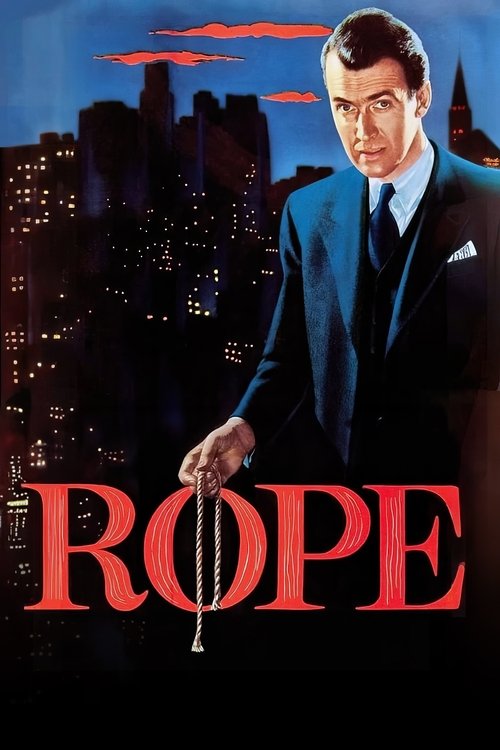
Rope
1948 · Alfred Hitchcock
For a night when you want suspense that works like a held breath rather than a jump scare — a tight, talky, single-room thriller you can watch leaning forward with someone who likes to whisper theories. Short, wicked, and endlessly rewatchable.
What it's about
Two brilliant, arrogant young men strangle a former classmate minutes before the opening credits settle — then hide his body in a chest in the middle of their Manhattan penthouse and host a dinner party on top of it, with the dead man's family and fiancée among the guests. They've killed to prove a philosophical point: that superior people are above the rules. Also invited is their old prep-school mentor, the one man sharp enough to smell what they've done.
The experience
A slow, exquisite tightening — you know everything, the guests know nothing, and every canapé served off that chest ratchets the dread. It plays out in near-real time with almost no visible cuts, so there's no relief valve: you're locked in the room with the crime, half horrified, half guiltily thrilled.
Performances
James Stewart, cast against his nice-guy grain as the mentor whose clever dinner-table provocations start curdling into suspicion, and John Dall and Farley Granger as the killers — one purring with self-delight, the other visibly coming apart, a nervous duet that carries the whole film.
The craft
Hitchcock shot it to look like one continuous take — long, roving ten-minute camera moves through a single apartment set, with a Manhattan skyline that shifts from afternoon to neon night outside the window. The refusal to cut away is the whole trick: the camera drifts toward the chest at exactly the moments you wish it wouldn't. Elegant, theatrical, and sneakily experimental for a 1948 studio picture.
Why it matters
It's the granddaddy of the single-take, single-location thriller — every real-time, 'one continuous shot' film since owes it a debt — and it remains a landmark of coded queer subtext in studio-era Hollywood.
Snapshot
A throttled classmate lies folded inside a wooden chest in the center of a Manhattan penthouse. Brandon Shaw and Phillip Morgan — two Harvard men, former pupils of the charismatic Rupert Cadell — have committed what they consider a philosophically mandated murder, a real-world exercise in Nietzschean superhumanism. To celebrate their triumph, they host a dinner party for the victim's family and friends, the chest serving as the buffet table. Rope is Hitchcock at his most theatrical and formally audacious: a near-real-time, single-location thriller constructed to resemble one unbroken take, a film that turns the suppression of editing into its central dramatic argument. It is also, encoded in studio-era ambiguity, one of Hollywood's earliest sustained explorations of queer desire, intellectual arrogance, and the seduction of transgression.
Industry & production
Rope was the first production of Transatlantic Pictures, the independent company Hitchcock formed with British producer Sidney Bernstein in 1946. The venture gave Hitchcock unusual creative autonomy — full control over subject matter and form — in exchange for the commercial risk of self-financing. Warner Bros. agreed to distribute, providing studio infrastructure without dictating content.
The source material was Patrick Hamilton's 1929 stage play Rope, which had run successfully in London and on Broadway the same year. Hamilton based the play on the Leopold and Loeb case: in 1924, Nathan Leopold and Richard Loeb, two University of Chicago students convinced of their own Nietzschean superiority, murdered fourteen-year-old Bobby Franks as a demonstration of their exemption from ordinary moral law. Hamilton transplanted the setting to upper-class London; Hitchcock and screenwriter Arthur Laurents shifted it to New York.
Laurents, hired for his facility with theatrical dialogue, was himself a closeted gay man; the implicit homosexual relationship between Brandon and Phillip — never named, never acted upon on screen, but unmistakable in gesture, jealousy, and the logic of their shared secret — was a deliberate authorial layer. The Production Code required that this subtext remain subtext. The Breen Office reviewed the script and flagged concerns; surviving correspondence indicates negotiation over how explicitly the men's relationship could be coded. The film passed censorship, but Rope was subsequently banned in several American cities — Chicago, Atlanta, and Seattle among them — specifically on grounds of implied homosexuality. These bans were eventually lifted.
Transatlantic produced only two films before dissolving: Rope and Under Capricorn (1949). Neither was a commercial success. The experiment in independent production proved financially untenable, and Hitchcock returned to the conventional studio system.
Technology
Rope was Hitchcock's first color film, shot in three-strip Technicolor. The process imposed severe constraints: the cameras were enormous, and the arc lamps required to achieve proper exposure generated extraordinary heat on a sealed interior set. Crew members reportedly lost significant weight during production; the temperature on stage reportedly climbed well above 100 degrees Fahrenheit. These physical conditions shaped every decision about where equipment could go and how performers could move.
The film's central formal ambition — to simulate one continuous take — required a purpose-built set. The single penthouse apartment was constructed on the Warner Bros. soundstage with walls on motorized wheels that could silently roll away to let the camera pass and then close again behind it. The furniture was similarly mobile. The New York skyline visible through the panoramic windows was an elaborate composite: a painted backing supplemented by miniature skyscrapers and working neon signs, engineered to change from late-afternoon gold to twilight blue to full nighttime illumination across the film's running time, tracking the real-time passage of approximately eighty minutes.
Standard 35mm reels held roughly ten minutes of film. Hitchcock's solution to the ten-minute ceiling — the structural constraint that made the long-take illusion technically possible — was to push the camera into dark surfaces (a dinner jacket, a piece of furniture) at the end of each reel so that the cut, made in optical printing, would be invisible. The film contains ten such transitions.
Technique
Cinematography
The directors of photography were Joseph Valentine and William V. Skall. Valentine, who had worked with Hitchcock on Shadow of a Doubt (1943) and Saboteur (1942), fell ill during production; Skall completed the work. The cinematographic challenge was without precedent: a camera that never stopped, choreographed across a living room in a dance with actors, furniture, and retractable walls.
The lighting had to be both dramatically motivated and technically sufficient for Technicolor. Windows were used as practical light sources justified by the time-of-day backdrop; indoor fixtures supplemented. Because the camera sometimes needed to pass through a space a lamp had just occupied, lighting rigs were themselves mobile. The resulting images have a slightly overlit theatrical brightness that is neither naturalistic nor quite stylized — a Technicolor sheen that sits uneasily with the chamber-drama claustrophobia Hitchcock was seeking.
The camera's movement is itself expressive. It lingers on the chest while conversation swirls around it. It tracks Brandon with an almost fawning intimacy that reflects his domineering energy, while Phillip's movements are followed with something closer to surveillance. The reframings and slow prowls through the apartment function as a substitute for editorial emphasis: a held close-up on a knotted rope, a slow drift toward a hat in a coat pocket, achieve what a cut to close-up would ordinarily accomplish.
Editing
Editing is the film's structural paradox: the whole enterprise is designed to suppress it, yet the suppression is itself a form of editing. The ten reel-change cuts are invisible; there are no other cuts. William H. Ziegler received the editing credit, a largely technical role given the nature of the footage. The "editing" of Rope happens in pre-production — in the choreography of each ten-minute take — and in the relationship between the camera's attention and the dramatic action it chooses to observe or withhold.
Hitchcock later told François Truffaut that the experiment was a mistake. He argued that the cut is the fundamental unit of film language, and that eliminating it did not liberate cinema but merely photographed theater. The admission is revealing: Rope exposes the degree to which Hitchcock's virtuosity depended on montage and cross-cutting, tools he had spent two decades refining. Rope is the exception that proves his rule.
Mise-en-scène / staging
The staging is the film's great achievement. Hitchcock and his designers had to block the film like a stage production and shoot it like a feature simultaneously. The blocking serves dramatic and camera-logistical purposes at once: when Brandon maneuvers Janet and Kenneth toward the window to discuss their relationship, he is simultaneously clearing the frame for the camera to drift toward the chest, which David and Mrs. Wilson are about to open.
The chest is the film's staging fulcrum. Every scene configuration either delays the moment someone will open it or builds tension around the proximity of oblivious characters to the body inside. Rupert's final confrontation occurs not when he deduces the murder abstractly but when he physically opens the chest and sees.
The penthouse set is simultaneously luxurious and imprisoning. The skyline backdrop — real, artificial, changing — gives the apartment a membrane of connection to the larger world that the characters cannot actually reach. As night falls during the party and the city lights ignite outside, the trap tightens.
Sound
The sound design reinforces the film's theatrical tensions without calling attention to itself. Diegetic music plays a crucial structural role: Phillip, whose guilt renders him increasingly undone, is a pianist, and he plays Francis Poulenc's Mouvement Perpétuel No. 1 on the apartment's piano. The mechanical, relentless circularity of that piece — a perpetual motion exercise that cannot resolve — functions as an aural correlative to the film's circular tension. Brandon repeatedly asks Phillip to play; the piano becomes both display and symptom.
Party noise, clinking glasses, and the hum of forced social conversation layer over the silences that Brandon works so hard to fill. When Rupert begins to suspect, the ambient social sound recedes into a kind of focused clarity. The film's climax, when Rupert fires Brandon's revolver from the window to summon the police, is one of its few moments of violent sonic rupture.
Performance
James Stewart as Rupert Cadell is in significant tension with his own star image. Cast against type — this is neither the naive idealist of Capra nor the uncomplicated hero — Stewart plays a man whose intellectual seductiveness has had lethal consequences. His drawling, lounging ease in the early scenes curdles into something harder as suspicion accumulates. The final confrontation scene, in which Rupert confronts Brandon and Phillip with their crime and then confronts himself with his own culpability in theorizing the ideas they enacted, is among Stewart's most complex work of the period.
John Dall as Brandon is all controlled surface pleasure — the murderer as party host, the Nietzschean as social charmer. Dall plays the performance-within-the-performance with relish: Brandon wants to be caught, wants Rupert specifically to understand what they have done and acknowledge its audacity. Farley Granger as Phillip provides the moral and psychological counterweight — guilt physically inhabiting the body, drink failing to anesthetize, the piano piece becoming compulsive. Granger's performance is more conventionally sympathetic and correspondingly more fragile.
Narrative & dramatic mode
Rope inverts the standard Hitchcockian suspense structure. Ordinarily Hitchcock generates suspense through dramatic irony — the audience knows something the characters do not. Here the audience knows everything from the first frame: the murder has already occurred, the body is in the chest, the dinner guests are unwitting. The suspense is not "will they find the body" but "when, and who will open the chest, and will Brandon enjoy it."
The film unfolds in real time — approximately the same eighty minutes pass on screen as in the theater — which is structurally closer to theater than to classical Hollywood narrative. There are no flashbacks, no ellipses, no cross-cutting to another location. This compression intensifies the chamber drama quality and focuses attention on dialogue and performance as dramatic engines. The film is almost entirely talk; the murder itself occurs in the opening seconds and is not replayed.
Genre & cycle
Rope occupies a specific and narrow generic position: the aristocratic-crime thriller with a philosophical inflection. Its closest generic relatives are films like Laura (1944) and Compulsion (1959), the latter a more direct Leopold-and-Loeb treatment. More broadly it belongs to the postwar American cycle of psychologically complex crime films that explored aberrant mentality through high-culture frames — a cycle that includes Hitchcock's own Strangers on a Train (1951) and, in a darker register, the noir films of the same period.
The theatrical-film hybrid has its own micro-history: adaptations of single-location stage plays including The Letter (1940), Dial M for Murder (1954), and 12 Angry Men (1957) share Rope's interest in cinematic staging of theatrical material. Rope is the most formally extreme of these, using the single-location constraint not as a practical adaptation of a stage source but as an aesthetic program in its own right.
Authorship & method
Hitchcock approached the adaptation as a formal problem: how to use cinema's tools to do something cinema had not done. His collaboration with Sidney Bernstein at Transatlantic gave him the freedom to frame the film as an experiment rather than a commercial product. Hitchcock's working method on Rope was unusually dependent on pre-production choreography — he worked out each ten-minute block like a sequence in a ballet, with the camera's path plotted against the actors' movements before shooting began.
Arthur Laurents's contribution extended beyond the dialogue. The coding of Brandon and Phillip's relationship as implicitly sexual — and Rupert's relationship to Brandon as one of paternal-erotic investment — was Laurents's deliberate layering. Laurents later wrote openly about the queer subtext as intentional; the film's homosexual coding is not incidental but structural to its themes of transgression and complicity.
Joseph Valentine's illness and the substitution of William V. Skall mid-production introduced a degree of uncertainty into the cinematographic vision. Whether the two cinematographers achieved a stylistically consistent result is debated; the existing print does not show obvious discontinuities.
Movement / national cinema
Rope is a product of the Hollywood studio system operating under independent production conditions — a hybrid position that was relatively unusual in 1948. It is neither a European art film nor a routine genre product. Hitchcock's British formation — his years at Gaumont-British and the direct influence of German Expressionist staging absorbed during his time at UFA in the 1920s — shapes the film's theatrical sensibility and its willingness to treat the single set as a dramatic arena rather than a location.
The Leopold-and-Loeb source carries American cultural freight: the case had been a national sensation, the 1924 trial prosecuted by Clarence Darrow, whose summation against the death penalty was widely reprinted. By relocating the material to a fictional New York and dressing it in British dramatic conventions, Hitchcock and Laurents created a film whose American content was processed through a transatlantic aesthetic.
Era / period
The immediate postwar context inflects Rope in specific ways. The Nietzschean superman argument — that exceptional individuals stand above conventional morality — was, by 1948, inseparable from its most recent catastrophic application. Brandon's dinner-table speech about the right of superior men to dispose of inferiors carries a horror in 1948 that it could not have carried in 1929, when Hamilton wrote the play. Hitchcock does not make this explicit, but the audience of 1948 would have heard the resonance.
The film also arrived at the beginning of what would become the postwar Hollywood interrogation of conformity, suburban anxiety, and the dark underside of American prosperity — a preoccupation that would intensify through the 1950s in films from Rear Window (1954) to Rebel Without a Cause (1955). Rope's penthouse milieu, its surface of educated leisure concealing violence, belongs to this developing cultural mood.
Themes
The film's central philosophical inquiry concerns the aestheticization of murder: whether the intellectual framing of an act can morally recontextualize it, and whether the teacher bears responsibility for the student's literalization of a metaphor. Rupert has theorized freedom from moral constraint as a kind of parlor-room provocateur; Brandon and Phillip have acted on the theory. The film's final turn — Rupert's horrified self-recognition — is its moral pivot.
Running beneath the Nietzschean argument is a sustained exploration of queer desire and its relationship to transgression. Brandon and Phillip's relationship is coded as romantic or sexual; their crime is the act that binds them, the shared secret that constitutes their intimacy. The film treats the homosexual relationship and the murder as structurally parallel forms of illicit action — a conflation that reflects 1948's pathologizing framework while simultaneously humanizing the two men in ways that the period's conventions worked against.
Class, privilege, and the insulation of the educated elite from consequence run through the staging: these are men who have been taught to believe their refinement grants exemption. The chest as buffet table — the body as furniture at a party attended by the victim's own family — is the film's most visceral image of this insulation made literal.
Reception, canon & influence
Contemporary reviews were mixed. Critics acknowledged the formal audacity while dividing on whether the experiment served the drama. The box office was disappointing. Rope was not a failure, but it was not the commercial vindication Transatlantic needed.
Hitchcock's own retrospective verdict, as recorded in the extended interviews with François Truffaut published in 1966, was frankly negative. He described the long-take experiment as a self-indulgent mistake that worked against cinema's essential nature. This self-deprecation influenced the film's critical standing for years: scholars trusted Hitchcock's own dismissal and treated Rope as a curiosity rather than a major work.
Influences on the film: Patrick Hamilton's play is the immediate source. Hamilton drew on the Leopold-and-Loeb case and on a British theatrical tradition of high-society crime drama. The German Expressionist theater of the 1920s — particularly in its use of confined space and choreographed staging — shaped both Hamilton's play and Hitchcock's formal instincts. Hitchcock's own silent-era work in Germany, and his admiration for F. W. Murnau's fluid camera, informs the ambition of the continuous-shot concept. The theatrical adaptation tradition of the 1940s (film versions of stage plays retaining theatrical spatial logic) provided the immediate industrial context.
Legacy and forward influence: Rope's long-take ambition became a reference point for every subsequent filmmaker who pursued extended single-take or pseudo-single-take effects. Tarkovsky's meditative long takes and Jancsó's elaborately choreographed sequences operate in a different register but share the philosophical investment in uncut duration. More directly, Mike Figgis's Timecode (2000) pursued real-time split-screen single takes as an explicit formal experiment; Alexander Sokurov's Russian Ark (2002) achieved a genuine single-take feature. Alejandro González Iñárritu's Birdman (2014) simulates a single take through invisible digital stitching — the same logic as Hitchcock's reel-change transitions, technologically extended. Sam Mendes and Roger Deakins's 1917 (2019) applied the technique to action cinema at large scale.
The film's queer-coded subtext has become central to its retrospective canonical position. Beginning with Robin Wood's influential Hitchcock criticism in the 1980s and developing through queer theory's engagement with Hollywood cinema in the 1990s, Rope has been extensively analyzed as a key text in the history of coded homosexual representation in classical Hollywood. The deliberate legibility of Brandon and Phillip's relationship — and the film's structural alignment of queerness with transgression, however complicated — makes it an unavoidable reference point in film history's account of gay representation under the Production Code.
Rope has been unavailable for decades at a stretch: it was among the films Hitchcock withdrew from circulation around 1960, and was not re-released until the 1980s, which delayed scholarly reassessment. Its current canonical standing — as a flawed but extraordinary formal experiment and a pivotal text in the history of queer cinema — is the product of that belated critical recovery.
A Deleuzian reading
The chest sits in the middle of the room, and they serve dinner off it.
The full Deleuzian reading of Rope →
Reception
Dismissed on release as a stagy gimmick — Hitchcock himself later shrugged it off as a 'stunt' — and then pulled from circulation for decades as one of the 'five lost Hitchcocks' until the 1983-84 re-release. Now it's read as one of his boldest formal experiments and a landmark of coded queer cinema.
How Rope was received, from release to now →
Influences: the films it descends from and the films it influenced
- M (1931) — Lang's inverted-suspense architecture — the audience knows Beckert is the killer from the film's opening minutes, watching an entire city tighten around a known culprit — establishes the guilty-knowledge dramatic structure that Rope's dinner-party format inherits directly.
- La Règle du jeu (1939) — Renoir's fluid ensemble choreography in continuous takes — the camera threading through corridors and rooms as social revelation rather than editorial punctuation — establishes the mobile-camera-as-editorial-substitute grammar that Rope systematizes into its unbroken-take experiment.
- Citizen Kane (1941) — Welles and Toland's deep-focus long-take choreography through Kane's Inquirer offices and Xanadu halls demonstrated that sustained camera movement and held framings could replace the cut as a structuring device — the formal argument Rope takes to its logical unbroken-take extreme.
- Shadow of a Doubt (1943) — Cinematographer Joseph Valentine, later co-DP on Rope, here developed the sustained tracking camera as Hitchcock's psychological instrument — following Charlie in slow drifts that hold on faces rather than cutting away — establishing the mobile choreography Valentine would apply on Rope without the relief of conventional cuts.
- Lifeboat (1944) — Hitchcock's self-imposed constraint of confining all action to a single vessel deck — choreographing a nine-person ensemble through one continuous physical space without location changes — is the direct spatial precursor to Rope's single-penthouse-set experiment.
- Lady in the Lake (1947) — Montgomery's commercial feature built entirely around suppressed cutting — sustained first-person POV that eliminates the editor's conventional authority — established the Hollywood precedent that a film could make the erasure of the cut its central formal premise, the experiment Rope adapts from POV to choreographed long-take.
- Strangers on a Train (1951) — Hitchcock and screenwriter Czenzi Ormonde encode the same homoerotic subtext under Breen Office censorship that Arthur Laurents built into Rope — Bruno's obsessive pursuit of Guy is desire barely coded as menace — applying Rope's queer-subtext-under-Production-Code methodology to a cross-cutting thriller format.
- Dial M for Murder (1954) — Hitchcock's next theatrical adaptation deploys Rope's single-location, prop-as-dramatic-fulcrum architecture — the telephone cord, the scissors, the latchkey — with inverted suspense (the audience knows the planned murder from scene one), extending Rope's chamber-thriller grammar into Technicolor 3D.
- Twelve Angry Men (1957) — Lumet's single-room, real-time adaptation of Reginald Rose's teleplay adopts Rope's thesis that chamber compression — one space, one sustained moral argument — can sustain feature-length tension, using the gradual drop in camera height across the film as a formal substitute for the editorial pressure Rope achieves by refusing to cut.
- Touch of Evil (1958) — Welles's celebrated opening crane shot — a continuous take of over three minutes threading a car bomb through a border town — translates Rope's long-take ambition from theatrical soundstage to outdoor geography, demonstrating that the suppression of cutting could survive architectural scale rather than confinement to a room.
- Compulsion (1959) — Fleischer's dramatization of the same Leopold-and-Loeb intellectual-murder case makes explicit the Nietzschean superhumanism that Rope keeps as dinner-party philosophy — Orson Welles's closing courtroom summation functions as the formal rebuttal to the Brandon Shaw argument Hitchcock left deliberately unresolved.
- Sleuth (1972) — Mankiewicz's two-hander theatrical adaptation uses Rope's chamber-thriller architecture precisely — a single estate interior, objects as weapons, a murder as intellectual game between class antagonists — extending Rope's aristocratic-crime-thriller model into a meta-theatrical structure where genre conventions themselves become the trap.
- Swoon (1992) — Kalin's New Queer Cinema adaptation of the same Leopold-and-Loeb case foregrounds the homosexual relationship Rope's Production Code subtext could only encode in gesture and jealousy, making the queer love story the explicit dramatic center that Laurents's script was prohibited from naming.
- Funny Games (1997) — Haneke adopts Rope's inverted-suspense structure and its aesthete-murderers-as-philosophers framework, pushing both to meta-cinematic extremes — the remote-control scene literalizes the audience complicity that Rope's dinner-party format merely implies, making the viewer's own generic pleasures the film's explicit subject.
- Russian Ark (2002) — Sokurov's 96-minute film shot in a single unbroken digital take fulfills the continuous-shot ambition that Rope's ten-reel ceiling forced Hitchcock to fake — the Hermitage's 33 rooms functioning as an architectural equivalent of Rope's motorized-wall penthouse, with history replacing guilt as the spatial pressure organizing movement.
- Birdman or (The Unexpected Virtue of Ignorance) (2014) — Iñárritu and Lubezki conceal edits in rapid pans and dark-frame transitions — Rope's exact technique of hiding reel changes in optical printing — making the simulated single-take a formal correlative for theatrical performance anxiety, extending Hitchcock's suppressed-cutting methodology from crime thriller to backstage drama.
- 1917 (2019) — Roger Deakins's continuous-take simulation hides transitions in occlusions and momentary blackouts — Rope's foundational dark-frame technique — at battlefield scale, proving that the hide-the-cut method pioneered on a Manhattan penthouse soundstage could survive open terrain and sustained forward motion.
- Blue Moon (2025) — The foundational proof that the classical unities can be a camera strategy: a single apartment played in near-real time out of disguised long takes.
- Under Capricorn (1949) — Hitchcock's direct follow-up to Rope continued the long-take research program with takes exceeding eight minutes in period costume interiors, testing whether mobile-camera choreography could replace editing without the containment of a single room — establishing the technique as a sustained directorial investigation rather than a one-film stunt.
- Key Largo (1948) — Released the same year, Rope independently adapts a stage play into a real-time theatrical siege using deep-focus staging to track moral authority across a single confined space — an independent parallel solution to the same formal problem of translating theatrical power dynamics into cinematic grammar.
- Bound (1996) — Model for wringing suspense from a single confined apartment and a body-disposal problem, forcing tension entirely out of who-knows-what within four walls.
- Kind Hearts and Coronets (1949) — Near-contemporary study of aesthete killers who treat murder as a refined art performed with cultivated poise and after-dinner wit.
- The Father (2020) — Play-to-screen single-location chamber piece that sustains its whole running time inside one apartment, proving theatrical confinement can be pure cinema.
- Tatami (2024) — Compresses an entire drama into one continuous location in near real-time, generating suspense purely from confinement — the single-location pressure chamber Tatami inherits.
- The Set-Up (1949) — A contemporaneous experiment in classical unities and near-real-time continuity, matching story time to running time within a single confined setting.
Similar films
- Strangers on a Train (1951) — influence & lineage
- Shadow of a Doubt (1943) — influence & lineage
- Dial M for Murder (1954) — influence & lineage
- Lifeboat (1944) — influence & lineage
- The Rules of the Game (1939) — influence & lineage
- Rear Window (1954) — shared sensibility
- Vertigo (1958) — shared sensibility
- Psycho (1960) — shared sensibility
All the films related to Rope →
Film essays and courses that include it
- One Continuous Breath: Masters of the Unbroken Shot
- Alfred Hitchcock
- The Unbroken Take: From Camera Liberation to Single-Shot Cinema
- Four Walls, Infinite Pressure: The Chamber Cinema Canon
- The Unbroken Hour: Real Time as Form
- On the Edge: Cinema's Grammar of Suspense
- Until Morning: The Dusk-to-Dawn Film
- Unspeakable to Unmistakable: Queer Cinema's Century
- The Shot That Won't Cut