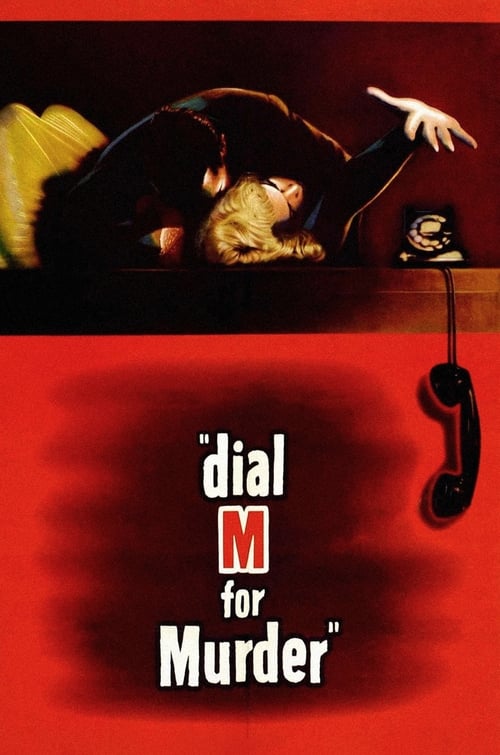
Dial M for Murder
1954 · Alfred Hitchcock
For a night when you want a classy, cerebral thriller you can sink into with a drink — comfort viewing for people who like watching a perfect plan meet imperfect luck. Great with company; everyone plays armchair detective.
What it's about
Tony Wendice, a suave retired tennis champion in London, has discovered his wealthy wife Margot's affair with an American crime writer — and rather than divorce, he engineers what he believes is the perfect murder, blackmailing an old acquaintance into doing the deed while he builds an airtight alibi. Then the plan meets reality, and Tony has to improvise against a wife, a lover, and a very patient detective.
The experience
Pure clockwork pleasure — talky, elegant, and screw-tighteningly tense, with one genuinely nerve-shredding set piece at its center. The suspense comes not from wondering what will happen but from watching a scheme flex and strain under pressure.
Performances
Ray Milland is deliciously smooth as the plotting husband — charming enough that you catch yourself half-rooting for him — and Grace Kelly brings real vulnerability to a role that could have been a pawn. John Williams nearly steals the film as the drily meticulous inspector.
The craft
Hitchcock confines almost the entire film to one London flat and turns the limitation into a masterclass in blocking, props, and point of view — a latchkey carries more suspense than most car chases. Shot during the early-'50s 3D boom, it uses depth with unusual restraint, and Frederick Knott's stage-honed script is a machine of setups and payoffs.
Why it matters
A cornerstone of the single-location thriller and a fixture of the 3D era's brief first life, arriving just as Hitchcock and Grace Kelly began the run that produced his mid-'50s masterworks.
Snapshot
A meticulous, largely single-set thriller adapted from Frederick Knott's stage hit, Dial M for Murder follows Tony Wendice (Ray Milland), a retired tennis champion who engineers the murder of his unfaithful wife Margot (Grace Kelly) to secure her fortune — only to watch his plan unravel through a chain of minutely observed contingencies. Shot during the brief early-1950s 3D boom and released mostly flat, the film occupies an unusual position in the Hitchcock canon: technically audacious in its production context, deliberately theatrical in its staging, and unusually cerebral in its dramaturgy. It belongs neither to the expressionist suspense of his British period nor to the vertigo-inflected masterworks immediately ahead; it is instead a clinical chamber piece whose pleasures are those of precision — of argument, of staging, and of a villain whose downfall arrives not through heroism but through the logic of objects.
Industry & production
Hitchcock made Dial M for Murder for Warner Bros., where he had been producing films since Strangers on a Train (1951). The assignment was shaped in part by the studio's commercial interest in the Natural Vision 3D process, which had scored an enormous hit with House of Wax in 1953. Hitchcock was not an enthusiastic convert to the format — by most accounts he regarded 3D as a gimmick — but he adapted to the constraint with characteristic professionalism, designing several shots specifically to exploit depth projection (most famously, the murder attempt in which Grace Kelly's arm thrusts forward toward the lens). The decision to shoot in 3D also reinforced the production's confined, stage-like logic: the camera had to maintain careful distance relationships, which suited a story already committed to a single interior.
Frederick Knott's source play had opened in London's West End in 1952 and transferred successfully to Broadway, where it ran into 1954. Hitchcock purchased the rights promptly, and Knott himself wrote the screenplay, preserving the play's architecture almost intact. The budget was modest and the schedule relatively tight; the near-total reliance on a single standing set — the Wendice flat — kept costs controlled while enforcing a spatial discipline the director could exploit rather than merely endure.
By the time the film reached wide release, the 3D cycle had already crested. Many theaters showed it flat in standard WarnerColor. This meant that a picture whose design had been calibrated for stereoscopic exhibition was received predominantly as an ordinary wide-screen film — a circumstance that contributed to early critical assessments of the work as competent but minor, without the spectacular visual grammar reviewers might have expected from Hitchcock in peak form.
Technology
The Natural Vision two-strip 3D process required twin interlocked cameras and imposed significant physical constraints on set design, lighting, and movement. Hitchcock and cinematographer Robert Burks worked with lower camera angles than the material would otherwise have demanded, and the composition of key sequences — particularly the strangulation attempt and the later reconstruction of events by Inspector Hubbard — was calculated to create meaningful depth planes for a stereoscopic audience. Whether this constitutes a genuine synthesis of form and content or merely a technical accommodation remains a point of discussion among scholars; the counterargument is that the shallow-focus conventions the process encouraged actually served the film's theatrical register.
The film was lensed in WarnerColor, a single-strip Eastmancolor process the studio had adopted to compete with Technicolor. Like many WarnerColor productions of the period, prints faded badly over decades; archival restoration work has been necessary to recover the film's intended palette. A notable 3D restoration was screened at various retrospectives in the early 21st century, giving audiences the experience of the work as Hitchcock designed it.
Technique
Cinematography
Robert Burks had been Hitchcock's director of photography since Strangers on a Train (1951) and would remain so through Marnie (1964), a collaboration remarkable for its duration and consistency. On Dial M, Burks worked to make confinement expressive rather than simply restrictive. The apartment is lit with a deliberate shift over the course of the film: early scenes favor the warm, domestic light of a comfortable upper-class interior; as the conspiracy tightens, the lighting grows cooler and more directional, isolating figures within the frame. The murder-attempt sequence is the film's visual climax — a low-angle shot tracks the attacker's advance while a later overhead position makes the space legible as a diagram of power, with Margot trapped beneath the telephone cord. Burks manages the 3D constraints without allowing them to dominate, and the photography never feels merely functional.
Editing
Rudi Fehr edited the film at Warner Bros., working within Hitchcock's habitual preference for pre-cut shooting. Hitchcock storyboarded sequences in detail and filmed with editing in mind, leaving editors relatively little latitude. The pacing of Dial M is deliberate rather than propulsive: Hitchcock holds on faces, objects, and the geometry of the apartment in ways that build tension through duration rather than montage rhythms. The murder scene relies on sustained takes and controlled rhythmic pressure rather than rapid cutting — a choice that intensifies the physical reality of the struggle.
Mise-en-scène / staging
The apartment set is the film's central instrument. Edward Carrere's production design created a detailed, cluttered, middle-class-affluent London interior whose geography becomes legible over the course of the story until audiences can track the significance of every door, key, and position. Hitchcock exploits the theatrical provenance without simply photographing a stage play: camera placement creates perspectives unavailable to any theater audience, and the repeated staging of the same physical space in different emotional registers — dinner party, conspiracy, assault, interrogation — gradually transforms familiarity into unease. The famous stocking scene, in which Tony's alibi depends on a pair of his wife's stockings, exemplifies the method: ordinary domestic objects loaded with catastrophic import.
Sound
Dimitri Tiomkin composed the score, delivering a relatively spare orchestral accompaniment that allows silence and ambient sound to do considerable work. The telephone ring — the instrument of the film's title and the trigger for the murder attempt — is one of cinema's most loaded sound cues, arriving after Tony has calculated the exact moment his wife will be alone in the flat. The functional, domestic sound of a ringing telephone becomes, through context, the sound of premeditated death. Hitchcock and his sound team use the moments before the ring — quieter, clock-ticking — to calibrate the viewer's anxiety.
Performance
Grace Kelly carries the film's emotional center in a role that requires her to move from comfortable domesticity to mortal terror to patient legal jeopardy. Her performance in the murder sequence — the physical struggle, the gasped breath, the reaching arm — is viscerally convincing and constitutes one of the most purely kinetic moments in the Hitchcock-Kelly collaboration. Ray Milland's Tony Wendice is a study in calibrated charm over cold sociopathic calculation: Milland underplays with precision, projecting the ease of a man who believes he has thought of everything. Robert Cummings as Mark Halliday, Margot's American lover, was a somewhat limited choice — his affability lacks depth — but the film's structural design ensures that dramatic weight sits with Tony and Inspector Hubbard rather than with the romantic interest. John Williams (the British actor, not the composer) as Chief Inspector Hubbard delivers the film's most quietly pleasurable performance: methodical, gently ironic, always slightly ahead of everyone else in the room.
Narrative & dramatic mode
Dial M for Murder is an inverted mystery, a form in which the audience knows the identity of the criminal from the outset and dramatic tension derives not from detection but from dramatic irony — from watching the gap between what the criminal believes and what the audience perceives. This mode, associated in literary tradition with R. Austin Freeman's Dr. Thorndyke stories, was relatively uncommon in 1950s cinema but well established in theatrical crime drama; Knott's play had applied it rigorously to a narrative where the villain's cleverness is eventually undone by the very precision of his scheme. Hitchcock was drawn to dramatic irony as a structural device throughout his career — the bomb-under-the-table principle — and the inverted mystery gave him the device in its purest form. The audience watches Tony construct his alibi in meticulous detail, which means every subsequent scene charges the viewer with an uncomfortable knowledge: we wait not to discover the truth but to see whether it will be discovered.
Genre & cycle
The film inhabits the theatrical crime thriller, a genre with deep roots in the interwar British stage and a line running through Agatha Christie, Emlyn Williams, and Patrick Hamilton. Its closest generic neighbor in the Hitchcock filmography is Rope (1948), another confined-space, premeditated-murder drama with theatrical origins, though the two films differ radically in formal ambition. Dial M also belongs to the brief early-1950s cycle of prestige 3D productions that studios used to distinguish theatrical exhibition from the growing competition of television; by this measure it sits alongside House of Wax and Kiss Me Kate as a document of Hollywood's technological anxiety about the living room screen.
Authorship & method
Hitchcock's authorial signature is legible throughout, but this is a film in which he reportedly approached the assignment with more professional obligation than personal investment — a quality he acknowledged in interviews. He was in transition: Rear Window, To Catch a Thief, The Trouble with Harry, and The Man Who Knew Too Much all followed in rapid succession, and in retrospect Dial M reads as the last film of a productive but somewhat contingent Warner Bros. phase before the extended Paramount partnership that would yield his most celebrated work.
Frederick Knott's contribution is central: the screenplay retains the play's structural elegance almost entirely, and the mechanisms of Tony's plot — the key under the stair carpet, the latchkey, the specific timing of the call — are Knott's inventions. Hitchcock's role was primarily one of translation: finding cinematic equivalents for theatrical exposition, managing confined space with a camera rather than a proscenium, and casting against the material's tendency toward illustration.
Robert Burks, Tiomkin, and editor Rudi Fehr constituted a competent studio team rather than a deeply personal creative nucleus. The Hitchcock-Burks axis would deepen considerably in the films that followed.
Movement / national cinema
The film occupies an Anglo-American hybrid position. Set entirely in a London flat, performed with British conventions of understatement and class behavior, adapted from a London stage hit, and featuring a strong British supporting cast, it registers as a British crime film in many of its cultural registers. Yet it was produced by Hollywood, financed by Warner Bros., and filtered through the sensibility of a director who had spent over a decade in California. It belongs to a strand of mid-century Hollywood Anglophilia — the prestige London crime picture produced at a comfortable remove — that includes Stage Fright (1950) and anticipates the British location filming of The Man Who Knew Too Much (1956). Inspector Hubbard is an archetypal British procedural figure, and much of the film's third act is effectively a Conan Doyle-adjacent exercise in deductive reconstruction.
Era / period
The film is a product of early 1950s Hollywood in the shadow of the Paramount Decrees, the HUAC investigations, and the television challenge — a moment when studios were experimenting with format, color, and spectacle to differentiate theatrical film from the small screen. The 3D boom was one such experiment; the confined, theatrical prestige adaptation was another, trading novelty for quality signaling. The film's upper-middle-class London setting, with its tennis-match world and comfortable flat, also reflects the period's appetite for a certain fantasized transatlantic British sophistication.
Themes
The film's central preoccupation is the perfectibility of planning and the ways in which material contingency defeats even the most rigorous human calculation. Tony's scheme fails not because of superior detective work but because of a key — literally, an object: its placement, its discovery, its pocket. Hitchcock returns obsessively to this motif: the world is full of things, and things do not stay where they are put. Related to this is the film's interest in guilt distributed asymmetrically: Margot is being murdered to conceal her adultery, and for much of the film she is on trial for the killing of her attacker. The law is a mechanism that processes evidence rather than truth. Inspector Hubbard is not a moral agent but a logical one; his recovery of the correct account is satisfying precisely because it is procedural rather than heroic.
Reception, canon & influence
Influences on the film. Knott's stage play is the primary source, but its logic descends from the tradition of the inverted mystery and from the specifically British theatrical crime drama that flourished between the wars. Hitchcock's own Rope (1948) — a confined-space, premeditated-murder film shot in long takes on a single set — is a clear formal predecessor, even if the two films use their premises very differently. The cold, scheming husband plotting against a comfortably-off wife carries faint echoes of Gaslight and other mid-century domestic-threat narratives.
Critical reception. Contemporary reception was generally favorable without being enthusiastic. Critics acknowledged Hitchcock's professional command but tended to note the film's theatrical origins as a limitation. The flat 3D presentation that most audiences received left the film's one major technical ambition invisible, and reviewers measured it against a Hitchcock standard it was not attempting to meet. Over subsequent decades, assessments stabilized: the film is consistently classed as secondary Hitchcock — accomplished, watchable, somewhat cold — while Grace Kelly's performance draws consistent admiration.
Legacy. The most direct descendant of the film's narrative architecture is the television series Columbo (1971–2003), which systematized the inverted mystery format for weekly crime drama: the audience witnesses the murder, knows the murderer, and watches the detective construct proof. Whether the producers were directly influenced by Knott's structure or arrived at it independently through the broader inverted-mystery tradition is not definitively established, though the structural affinity is clear. The film was remade as A Perfect Murder (1998), directed by Andrew Davis with Michael Douglas and Gwyneth Paltrow transposing the action to contemporary New York; the remake is generally considered inferior. Dial M for Murder's most durable legacy may be its contribution to Grace Kelly's swift consolidation of stardom in the years before her retirement: appearing in Mogambo, Dial M, Rear Window, The Country Girl, and To Catch a Thief across 1953–1955, she became one of the decade's defining screen presences, and Hitchcock's three films with her are central to that record.
A Deleuzian reading
Watch the telephone.
The full Deleuzian reading of Dial M for Murder →
Reception
In 1954 it was treated as a solid but minor entry — Hitchcock himself shrugged it off, telling Truffaut he was basically 'running for cover' by filming a hit stage play. Now it's widely reappraised as a masterclass in single-room suspense, boosted by 3D restoration screenings that revealed how carefully he composed it.
How Dial M for Murder was received, from release to now →
Influences: the films it descends from and the films it influenced
- Lifeboat (1944) — Hitchcock confines the entire film to a single floating set, working out the spatial grammar — how camera position, character placement, and objects diagram power within a bounded space — that he systematizes in Rope and codifies as the foundation of Dial M's apartment staging.
- Rope (1948) — Patrick Hamilton's stage play filmed in sustained 10-minute takes within one apartment where a chest conceals the murder victim; establishes the method — theatrical source fidelity, minimal cutting, domestic objects as plot instruments — that Dial M inherits wholesale.
- Gaslight (1944) — Cukor's Victorian London domestic interior — a husband systematically manipulating objects (gas jets, letters, jewels) to trap and destabilize his wife — establishes the grammar of the confined marital space in which a husband's criminal plot operates through the domestic object itself, the template for Dial M's apartment logic.
- Sorry, Wrong Number (1948) — A woman confined to her apartment learns of a murder plot through a telephone connection; the telephone as surveillance instrument, death mechanism, and physical link between the trapped woman and her assassin is the precise device Dial M's central plot machinery depends on.
- Double Indemnity (1944) — Wilder codifies the inverted-mystery structure — the murder conspiracy disclosed in full to the audience before execution — as the engine of dramatic irony over whodunit suspense; Dial M's entire dramaturgy builds on this architecture, including the financial-inheritance motive driving a cold-blooded husband.
- Strangers on a Train (1951) — Inaugurated Hitchcock's decade-long collaboration with DP Robert Burks; the low-angle menace compositions, precise interior lighting, and the prolonged strangling sequence's physical staging that Burks developed here carry directly into Dial M's murder-attempt cinematography.
- Sudden Fear (1952) — Extends the perfect-murder counter-plot with full audience foreknowledge of the mechanics, plus recorded/telephonic evidence — the spouse-plots-spouse architecture Sudden Fear had just refined.
- Wait Until Dark (1967) — Frederick Knott's next produced stage thriller transplants his exact dramaturgical method — a woman terrorized by criminals in her own apartment, with household objects (fuses, refrigerator, light sources) systematically converted into weapons and defenses — directly extending Dial M's domestic-objects-as-plot-instruments grammar.
- Sleuth (1972) — Anthony Shaffer's theatrical crime puzzle filmed in a cluttered country-house interior with sustained dialogue takes over cutting; the object-saturated single-space and cat-and-mouse dramaturgy in which the criminal plan is repeatedly reversed extends Dial M's chamber-thriller tradition of architecture-as-trap.
- Deathtrap (1982) — Ira Levin's stage-to-screen crime puzzle deploys the inverted-mystery structure (the audience knows the murder is planned before it occurs), a single domestic interior whose every object is a potential weapon, and small-cast chamber dramaturgy — explicitly in the lineage of Knott's Dial M architecture.
- A Perfect Murder (1998) — Direct remake transplanted to contemporary New York; preserves the inverted murder-for-hire structure intact — husband hires hitman to kill wife via a prearranged apartment signal — with the telephone trigger updated to a keypad code, carrying Dial M's domestic-objects-as-plot-instruments logic into a modernized register.
- Panic Room (2002) — Fincher deploys overhead diagram shots to chart criminal intrusion through a single domestic space in sustained takes, the house's architecture — its locks, doors, mechanisms — functioning as the film's central plot instrument; the spatial logic of a pre-planned perfect crime undone by the contingencies of what the space actually contains is structurally identical to Dial M's climactic reversal.
- Trap (2024) — Single-set theatrical suspense driven by a criminal improvising information control as the net tightens, mirroring Cooper reading exits and adjusting his story in real time.
- Drishyam (2013) — The template for the choreographed-alibi inverted thriller — the audience is shown the murder plan first, so tension migrates from 'whodunit' to whether one overlooked physical detail will unravel a meticulously staged cover-story.
- Drishyam (2015) — Structures an entire film as an alibi assembled and then dismantled through physical paper — latchkeys, letters, stub receipts — so the climax is an evidentiary chain reasoned aloud; Drishyam runs the identical mechanism in reverse, with the amateur building the paper trace the professionals must accept.
- Rear Window (1954) — Made the same year with Grace Kelly and DP Robert Burks; shares Dial M's overhead-diagram shots that chart criminal geography in a single bounded space, and the identically structured dramatic irony — the audience witnesses evidence of a murder that cannot be legally proved — while Kelly's transition from decorative presence to decisive actor mirrors her arc in both films.
- Les Diaboliques (1955) — The nearest contemporary European peer; Clouzot adapts a theatrical crime source using the inverted-mystery structure, maps the crime in precise spatial diagrams of a confined institutional space, and builds its climax on the logic of contingency defeating a perfect plan — the exact structural logic Dial M enacts with Tony Wendice's unraveling scheme.
- Witness for the Prosecution (1957) — Wilder adapts Agatha Christie's stage play with near-total architectural fidelity, the courtroom functioning as a single bounded space whose geometry the camera diagrams; dramatic irony operates through the audience's foreknowledge of the defendant's guilt, deploying the same inverted-mystery machinery as Dial M in a legal rather than domestic register.
- The Invisible Guest (2017) — Demonstrates architectural plotting — a murder scheme diagrammed like blueprint geometry within one apartment — the meticulous spatial-alibi engineering Paulo's script fetishizes.
Similar films
- Rear Window (1954) — influence & lineage
- Strangers on a Train (1951) — influence & lineage
- Double Indemnity (1944) — influence & lineage
- Rope (1948) — influence & lineage
- Gaslight (1944) — influence & lineage
- Black Bag (2025) — same viewing thread
- The 39 Steps (1935) — shared sensibility
- The Lady Vanishes (1938) — shared sensibility
All the films related to Dial M for Murder →
Watch it with: curated runs of related films
- Elegant Betrayals — Watch these back-to-back for couples and beautiful people whose polished surfaces — a London flat, a Riviera villa, a spies' dinner party — hide a betrayal, a surveillance, and a body, each turning intimacy into a crime scene.