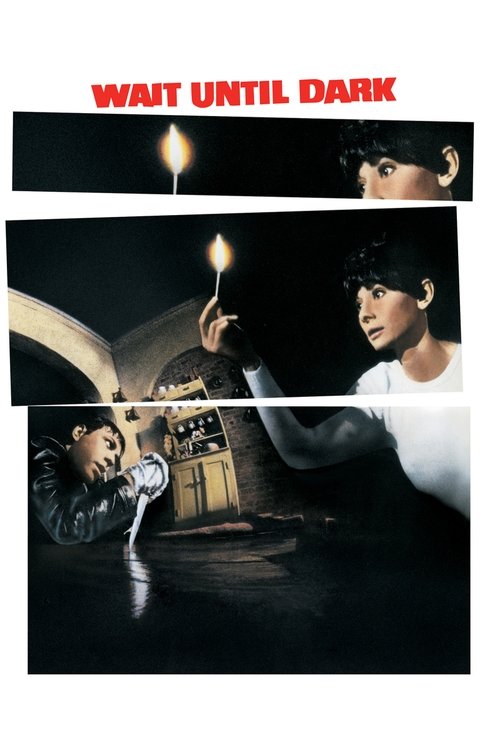
Wait Until Dark
1967 · Terence Young
When you're craving a real scare of the old-school kind — suspense built from craft rather than gore. Perfect with the lights off, which is exactly how it wants to be watched.
What it's about
Sam Hendrix flies home with a doll he picked up innocently along the way — not knowing it's stuffed with heroin, and that ruthless criminals want it back. When Sam leaves on business, three men con and stalk their way into his Greenwich Village apartment, where his wife Susy, recently blinded, is home alone. What follows is a battle of wits fought room by room, in a space she knows by touch and they only know by sight.
The experience
A slow, coiling tightening that pays off in one of the most famous nerve-shredding climaxes of its era — the kind of suspense that has you holding your breath in a single apartment for two hours. Lean, cruel, and ruthlessly efficient.
Performances
Audrey Hepburn, Oscar-nominated, strips away her polish for something raw and physical — she prepared with blind students, and her performance is a study in listening. Alan Arkin, soft-spoken and reptilian behind dark glasses, gives one of the era's great unsung villain turns.
The craft
Terence Young, fresh off building the James Bond franchise, tightens Frederick Knott's stage play until every lamp, refrigerator bulb, and window blind becomes a weapon. The climax plunges into near-total blackness — theaters famously dimmed their lights for it — so watch it in a genuinely dark room for full effect.
Why it matters
A touchstone of the single-location thriller whose blackout climax became a legend of showmanship, and the template for decades of home-invasion suspense that followed.
A chamber thriller of almost geometric cruelty: three criminals, one Greenwich Village apartment, and a blind woman who must map the space better than the men stalking her through it. Terence Young, who had just built the James Bond franchise with Dr. No and From Russia with Love, brings that same cool professionalism to Frederick Knott's stage play, tightening the single set until every lamp, refrigerator bulb and window blind becomes a weapon. Audrey Hepburn, Oscar-nominated, strips away her gamine polish for something rawer — she prepared by working with blind students, and her performance is a study in listening. Against her, a young Alan Arkin gives one of the era's great unsung villains, soft-spoken and reptilian in dark glasses. The climax, plunged into near-total blackness, was famous enough that theaters dimmed their aisle lights to house-level darkness for the final eight minutes — a showman's gimmick that still works at home with the lights off. Half a century of home-invasion thrillers descend from this blueprint.
A Deleuzian reading
There are a few light sources in that Greenwich Village basement apartment: a couple of lamps, a window with a blind on it, and the bulb inside the refrigerator.
The full Deleuzian reading of Wait Until Dark →
Reception
A solid hit in 1967 that earned Audrey Hepburn her fifth and final Oscar nomination, it's since been reclaimed by horror fans as a proto-home-invasion thriller whose final minutes still play like gangbusters with modern audiences.
How Wait Until Dark was received, from release to now →
Influences: the films it descends from and the films it influenced
- Dial M for Murder (1954) — Also a Frederick Knott stage play adapted almost intact within a single apartment, building suspense from the choreography of ordinary props (keys, scissors, telephone) turned lethal — the exact template Young reuses for the flat-bound plot.
- Rope (1948) — Establishes the confined single-apartment stage-adaptation as a suspense engine, where all tension is generated by movement and sightlines within one continuous domestic space rather than by cutting away.
- Gaslight (1944) — Codifies the isolated, sensorially-undermined woman terrorized inside her own home by men manipulating what she can and cannot perceive — the psychological engine Young transposes onto literal blindness.
- Sorry, Wrong Number (1948) — A housebound, physically helpless woman whose terror escalates in near real-time through the telephone, making immobility and information starvation the source of dread.
- The Spiral Staircase (1946) — Weaponizes a disabled heroine's specific sensory deficit (muteness) against her in a shadowed house, using subjective camera and killer's-eye framing to dramatize what she cannot register.
- Les Diaboliques (1955) — Model for the plunge-into-darkness climax and the methodical audience-manipulation of a vulnerable woman, where withholding light from the viewer delivers the final shock.
- Rear Window (1954) — Builds an entire thriller around a protagonist's physical incapacity dictating the geometry of suspense — the immobilized observer whose limitation the antagonist can exploit.
- The Desperate Hours (1955) — Provides the home-invasion template of criminals occupying and controlling a domestic interior while holding innocents hostage, staged as a single-location pressure cooker.
- Night Must Fall (1937) — Stage-play blueprint for the charming psychopath who ingratiates himself into a household through performance and disguise — the con-man intrusion Arkin's Roat weaponizes.
- Cape Fear (1962) — Tightens the home-invasion thriller into a single-set siege of a defenseless innocent, distilling Cape Fear's intrusion-into-domestic-space tension.
- Sudden Fear (1952) — Purest heir to the imperiled-woman-becomes-counter-plotter design — a vulnerable heroine engineering her own trap inside a single apartment, suspense keyed to what she alone perceives.
- See No Evil (1971) — Directly extends the blind-heroine-stalked-in-her-home thriller, staging dread around what the sightless protagonist fails to detect about the killer already inside her space.
- Straw Dogs (1971) — Escalates the domestic-siege into the victim actively converting the home's architecture and household objects into weapons — extending the light-as-weapon reversal into full spatial counterattack.
- Panic Room (2002) — Recasts the besieged woman-and-home thriller as pure spatial mechanics, turning domestic architecture and controlled darkness against invaders in a single-location cat-and-mouse.
- Hush (2016) — Transposes the sensory-deprivation-as-vulnerability premise onto a deaf woman under home siege, generating suspense from the gap between the audience's perception and hers.
- Don't Breathe (2016) — Explicitly inverts the climactic blackout: a blind man kills the lights to level the field against sighted intruders, making Wait Until Dark's light-as-weapon device the whole film's engine.
- A Quiet Place (2018) — Extends the single-sense economy of the finale into a household siege where the governing perceptual channel (sound) is simultaneously the family's vulnerability and their means of survival.
- Misery (1990) — Stages a single-domestic-space siege between a vulnerable victim and an intruder, extracting suspense from clean spatial blocking and restraint — the chamber-thriller staging discipline Reiner adopts.
- Bring Her Back (2025) — Pioneers subjective-blindness staging that withholds sight from both character and audience and weaponizes darkness and sound design as the terrain of threat.
- Die Hard (1988) — Pioneers information-asymmetry as suspense engine within one apartment — the audience and protagonist tracking who knows what — the exact cat-and-mouse epistemics McClane exploits by radio against the terrorists.
- Black Christmas (1974) — Confines terror to a single domestic interior invaded by an intruder, modeling the besieged-home spatial logic Clark verticalizes across the sorority house.
- Andhadhun (2018) — Codifies the blind-protagonist single-set constraint piece in which the camera grants the audience spatial knowledge the protagonist lacks — objects placed just outside their reach, intruders held in frame behind them — the exact grammar Raghavan runs through the Sinha flat sequence.
- Lady in a Cage (1964) — A physically trapped, incapacitated woman besieged by intruders in her home, mining suspense from her inability to move or flee — the same vulnerability mechanic run concurrently.
- Funny Games (1997) — Distills the home-invasion into theatrical, single-location chamber cruelty with performing intruders staging a game inside domestic space — the stage-play intimacy of Knott's premise turned self-aware.
- How to Steal a Million (1966) — Charles Lang photographing Hepburn again in a single-set confinement piece where the geography of one room is taught to the audience in advance and then exploited in darkness — the suspense inverse of the broom-closet scenes' comic confinement.
Similar films
- Rear Window (1954) — influence & lineage
- Rope (1948) — influence & lineage
- Diabolique (1955) — influence & lineage
- Possession (1981) — shared sensibility
- Marnie (1964) — shared sensibility
- Psycho (1960) — shared sensibility
- Oddity (2024) — shared sensibility
- Rosemary's Baby (1968) — shared sensibility