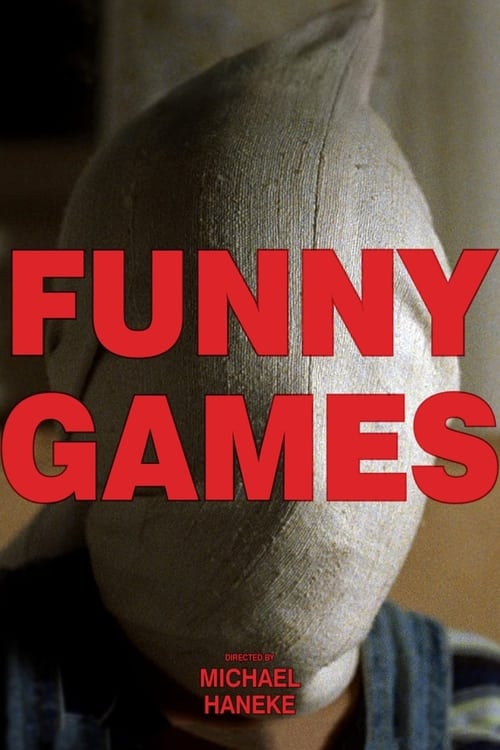
Funny Games
1997 · Michael Haneke
For when you want to be genuinely disturbed rather than entertained — a film to argue about afterward, not a popcorn scare. This is pure challenge, zero comfort; do not reach for it on a fragile night.
What it's about
A mother, father, and young son arrive at their lakeside vacation home, where two polite young men in tennis whites appear at the door with a small favor to ask. Within the hour the family is held hostage in their own house, forced into a night of sadistic 'games' staged purely for their captors' amusement. It's a home-invasion thriller that keeps turning around to ask why you're watching one.
The experience
Almost unbearably tense, but not in the fun way — the dread is slow, quiet, and cruel, with the worst moments kept just out of sight so your imagination does the damage. The killers occasionally look straight into the camera, and the film keeps needling you about what you came here hoping to see. You leave rattled and a little accused.
Performances
Susanne Lothar and Ulrich Mühe are devastating as the parents, playing terror and grief with almost documentary rawness, while Arno Frisch's smirking, courteous tormentor is one of cinema's most chilling villains precisely because he never stops being pleasant.
The craft
Haneke directs with icy precision: long unbroken takes, no score to cue your feelings, and violence staged offscreen so the sound design and the actors' faces carry it all. The film's most notorious moves break the rules of the thriller itself, turning the genre's machinery against the audience. It plays best with full attention and no phone — its power is in what it refuses to show.
Why it matters
A scandal at Cannes and a landmark of confrontational European cinema, it cemented Haneke's reputation as film's great moral provocateur — he later remade it shot-for-shot in English, doubling down on the dare.
Snapshot
Funny Games is Michael Haneke's most notorious provocation: a home-invasion thriller engineered to indict the very audience that came to watch it. Two clean-cut young men in tennis whites, Peter and Paul, insinuate themselves into the lakeside holiday home of Georg, Anna, and their son Georgie, then hold the family captive and torture them across one long night under the rubric of "games." The premise is the most disreputable in genre cinema; Haneke's treatment is its inversion. He withholds nearly all the violence the genre promises, stages the worst events offscreen, and has one of the killers turn to the camera and address the viewer directly — at one point literally rewinding the film with a remote control to undo the family's single moment of resistance. The result is less a horror film than a polemic about horror films, a "slap in the face" (Haneke's own framing in interviews) aimed at the consumer of screen cruelty. Austere, controlled, and deliberately unpleasurable, it remains a touchstone for debates about violence, spectatorship, and the ethics of representation, and it is unusual among art films in having been remade shot-for-shot by its own director a decade later.
Industry & production
Funny Games was an Austrian production, made through Wega Film, the Vienna company run by producer Veit Heiduschka that backed most of Haneke's early features. By 1997 Haneke had built a critical reputation with his "glaciation of feeling" trilogy — The Seventh Continent (1989), Benny's Video (1992), and 71 Fragments of a Chronology of Chance (1994) — and had begun to attract festival attention, though he was still primarily known within German-language and festival circles rather than internationally. The film was supported by the Austrian film-funding apparatus and the broadcaster ORF, the typical financing pattern for Austrian auteur cinema of the period, which depended heavily on public subsidy and television co-production rather than commercial returns.
The film premiered in competition at the 1997 Cannes Film Festival, where it became one of the festival's signal scandals — reports of walkouts and of audiences shouting at the screen are well documented in the contemporaneous coverage, though specific figures vary by account. It did not win a prize. Commercially it was a marginal release, as Haneke's work generally was at this stage; precise box-office figures are thin and I will not invent them, but it is uncontroversial to say the film was a critical and festival event rather than a commercial one. Its enduring industrial significance is twofold: it consolidated Haneke's standing as European cinema's foremost moralist of violence, and it generated, eleven years later, the English-language Funny Games U.S. (2007), which Haneke directed himself for an American/European co-production with Naomi Watts and Tim Roth — a near-exact replica intended to deliver the original's critique to the Hollywood-genre audience he felt was its proper target.
Technology
The film was shot on 35mm color stock, the standard professional format of its moment, and its technological profile is conventional by design — Haneke's radicalism lies in his use of the apparatus, not in any novel hardware. The one technological motif that matters is diegetic and thematic rather than productional: the videocassette remote control that Paul uses to rewind the film. This is a gesture about media technology — the home-video remote as the instrument of the desensitized consumer, the device that lets the viewer replay and master violent images at will — folded into the narrative as a literal, reality-breaking power. The film thus belongs to Haneke's recurring preoccupation, already central to Benny's Video, with how recording and playback technologies mediate and anesthetize our relation to suffering. The work predates the digital-cinema transition; Haneke's own 2007 remake, made on the cusp of that shift, reproduces the same images on newer stock, underscoring that the film's argument was never about the medium's technical evolution.
Technique
Cinematography
The cinematography is by Jürgen Jürges, an experienced German cameraman. The visual strategy is one of severe restraint: long takes, a largely static or minimally mobile camera, frontal and frequently symmetrical framings, and an even, undramatic light that refuses the chiaroscuro and shock-cutting grammar of the horror genre. Haneke and Jürges deny the viewer the visual pleasures the material would conventionally supply — there are no fetishizing close-ups of wounds, no expressionist distortion, no suspense-building camera movement toward a threat. The most discussed single shot is the aftermath of the offscreen killing of the child: an extended, near-motionless take that holds on the living room — the blood-spattered television still on, the surviving parents in shock — for an almost unbearable duration, forcing the audience to sit with consequence rather than spectacle. The camera's neutrality is itself an argument: it positions the viewer as a coolly observing accomplice rather than an adrenalized participant.
Editing
Edited by Andreas Prochaska, the film favors duration over fragmentation. Where genre cinema accelerates and chops to manufacture fear, Haneke lets scenes run, refusing the relief of the cut. The editing's most radical act is the diegetic rewind: when Anna seizes a shotgun and kills Peter, Paul snatches the remote and "rewinds" the film itself, restoring his dead partner and erasing the family's victory. The edit here is a deliberate violation of cinematic contract — it announces that the narrative is not a sealed reality the audience is overhearing but an artifact under the captors' (and the filmmaker's) total control, in which the viewer's hope for retributive justice will be specifically and clinically denied.
Mise-en-scène / staging
The staging is built on bourgeois orderliness turned to dread. The killers' costuming — pristine white polo shirts and gloves — codes them as members of the same comfortable class as their victims, dissolving the genre's usual otherness of the monster. The lake house, the golf clubs, the gated affluence are all the trappings of upper-middle-class security, and Haneke methodically demonstrates how little that security protects. Crucially, the worst violence is staged offscreen or at the edge of the frame: the child's death, the sexual humiliation, the final drowning all happen where we cannot quite see, while the camera attends to the spaces and reactions around them. This withholding is the central technique of the film — Haneke stages absence, making the viewer's own imagination and appetite the true subject.
Sound
The soundtrack is conspicuously bifurcated. For most of its length the film uses no non-diegetic score at all, only the flat ambient sound of the house and the lake, a silence that strips away the emotional cueing that music ordinarily provides in a thriller. Against this, the credits and certain ruptures deploy John Zorn's abrasive, screaming hardcore — Naked City's grindcore tracks — as a violent sonic assault that has no relation to the genteel images it accompanies. The dissonance is intentional: the music belongs to the killers' register, an eruption of pure aggression that mocks the bourgeois calm of the visuals. The film's most important "sound," however, may be its diegetic noise — the television sports broadcast left blaring beside the boy's corpse, mundane audio continuing indifferently over atrocity.
Performance
The performances are calibrated to Haneke's anti-sensational design. Susanne Lothar as Anna and Ulrich Mühe as Georg — both major German-language stage and screen actors, and a married couple in life — render the family's terror with a naturalism that makes the ordeal sickeningly credible; Lothar's exhaustion and grief in particular anchor the film's claim on our empathy. Against them, Arno Frisch (the disturbed teenager of Benny's Video) as Paul and Frank Giering as Peter play the killers with a chilling, affectless politeness — well-mannered, almost bored, never raising their voices. Frisch's direct addresses to the camera are delivered with an ironic, complicit charm that implicates the viewer as a fellow connoisseur. The refusal of either psychological backstory or scenery-chewing menace is itself a performance choice: these are not characters to be understood but functions of a thesis.
Narrative & dramatic mode
Structurally the film is a near-real-time chamber piece, observing the classical unities — one place, one continuous span of roughly a day and night, one action. Onto this naturalistic frame Haneke grafts a metafictional apparatus that repeatedly breaks the realist contract: Paul's looks and winks at the camera, his direct questions to the audience ("What do you think? Do you think they stand a chance?"), his explicit acknowledgment of running time and dramatic convention ("We're not up to feature-length yet"), and the rewind. The dramatic mode is therefore double — a harrowingly sincere depiction of suffering nested inside a Brechtian estrangement device that constantly reminds us we are watching a constructed entertainment. This is the film's engine: it generates genuine dread and then refuses to let us discharge it through the catharsis of a rescue or a comeuppance. Hope is raised — the escape, the seized gun — precisely so that it can be withdrawn, training the viewer to recognize their own complicity in wanting the violence to resolve in a satisfying way.
Genre & cycle
Funny Games is a home-invasion thriller and, more broadly, an entry in the long lineage of films about a family terrorized in an isolated refuge — a tradition running through Wyler's The Desperate Hours (1955), Peckinpah's Straw Dogs (1971), Wes Craven's The Last House on the Left (1972), and the wider "torture"-adjacent horror tradition. But Haneke's relation to the cycle is wholly adversarial. The film deploys the genre's structure in order to refuse its satisfactions, functioning as an anti-thriller or critical counter-film. Where Straw Dogs delivers a cathartic eruption of righteous violence, and where the rape-revenge and slasher cycles offer the audience the pleasure of both atrocity and retribution, Funny Games gives the atrocity (offscreen) and pointedly cancels the retribution. It belongs, then, to a small reflexive sub-tradition of films that turn the genre against the spectator, and it is among the most rigorous and uncompromising examples of that gesture.
Authorship & method
The film is a definitive statement of Haneke's authorship. Trained in philosophy and psychology and seasoned by years in German and Austrian television, Haneke built his cinema on a moral suspicion of the image — a conviction that mainstream film systematically lies about violence by making it consumable, legible, and pleasurable. His stated aim with Funny Games, repeated across interviews, was to make a film about violence that could not be consumed as entertainment, and to confront the spectator with their own appetite; he has said the people who walk out are the ones who didn't need the film, while those who stay are the ones it is "for." His method is formal asceticism — long takes, offscreen violence, refusal of score, refusal of psychological motive — wielded as ethics.
His key collaborators here recur across his body of work: cinematographer Jürgen Jürges, editor Andreas Prochaska, and producer Veit Heiduschka of Wega Film. Notably, the film has no original composer; in lieu of a score Haneke curates pre-existing music — the genteel classical/operatic register associated with the family against John Zorn's Naked City as the killers' sonic violence — a sound design strategy of appropriation rather than composition. The casting of Arno Frisch, carried over from Benny's Video, links the film explicitly to Haneke's earlier meditation on media and youth violence. Haneke wrote the screenplay himself, as he did throughout his career, and his authorship is unusually total: he conceived, in effect, two versions of the same film, returning in 2007 to direct an English-language replica so faithful that he reportedly reused the original's set measurements and blocking — an authorial act almost without precedent, treating the work as a fixed score to be performed for a different audience.
Movement / national cinema
Funny Games is a central document of the New Austrian Film that emerged in the late 1980s and 1990s, the wave that brought Haneke, and later Ulrich Seidl and Jessica Hausner, to international notice. This cinema is characterized by a cold, analytical formalism and an unsparing critique of Austrian (and broadly Western European) bourgeois society — its complacency, its repressions, and the violence it conceals beneath material comfort. Haneke's films persistently anatomize the affluent family unit as a site of emotional deadness and latent brutality, and Funny Games is the most direct of these dissections. The film also belongs to the broader European art-cinema tradition of reflexive, audience-implicating modernism, inheriting from Brechtian theater and from a postwar continental skepticism about mass-media spectacle. Its critique is pointedly directed outward at "American" genre cinema, a tension that Haneke would make literal by relocating the film to the United States in 2007.
Era / period
The film arrives in the mid-1990s, a moment when screen violence was a live public controversy on both sides of the Atlantic — the era of Tarantino's Pulp Fiction (1994) and Oliver Stone's Natural Born Killers (1994), films that foregrounded violence as ironic spectacle and provoked extensive debate about media desensitization. Funny Games is best read as a direct, hostile intervention in that debate: where the American films flirted with critiquing media violence while delivering its pleasures, Haneke refuses the pleasures altogether. The period's domestic-media context — the maturity of the home-video and television economy, the remote control as the emblem of consumer mastery over images — is woven into the film's very plot. It is, in short, a film of the late analog media age speaking to that age's anxieties about its own appetites.
Themes
The film's governing theme is spectatorship and complicity: the proposition that the audience for screen violence is not an innocent witness but a paying participant whose appetite the film industry exists to feed. From this flow its secondary concerns. The unrepresentability and consequence of real violence — Haneke's withholding insists that actual suffering is neither legible nor cathartic, and that to depict it pleasurably is a moral falsification. Bourgeois fragility — the speed with which class comfort and rational order collapse, and the inadequacy of the family's manners and money against motiveless cruelty. The refusal of motive — by denying the killers any explanatory psychology (Paul offers several mutually contradictory backstories, all mocking the audience's desire for one), Haneke attacks the genre's habit of making violence comprehensible and therefore safe. And the omnipotence of the fiction — the rewind dramatizes that in this constructed world there is no justice the author does not permit, collapsing the comforting boundary between the diegesis and the apparatus that controls it.
Reception, canon & influence
Reception. The film was divisive from its Cannes premiere, where it provoked the festival-scandal reception — walkouts, hostility — that has attached to it ever since. Critical response split, predictably, along the lines the film itself anticipated: admirers read it as a rigorous and necessary critique of media violence and a major work of moral modernism; detractors charged it with hypocrisy, arguing that a film lecturing the audience about its appetite for cruelty is itself a sophisticated delivery system for that cruelty, sadistic toward the very viewers it claims to be educating. This debate has never been settled and is, arguably, the film's intended afterlife. Over time the film's stature has grown; it is widely treated as a key work in Haneke's canon and a landmark of 1990s European cinema.
Influences on the film (backward). It draws on the home-invasion lineage of The Desperate Hours, Straw Dogs, and The Last House on the Left, inverting their cathartic logic; on the Brechtian tradition of estrangement and direct address; on the reflexive media critique Haneke had developed in Benny's Video; and, polemically, on the ironic-violence cinema of the mid-1990s (Tarantino, Stone) that it was built to rebuke.
Legacy (forward). The film's most concrete legacy is Haneke's own 2007 shot-for-shot English-language remake, Funny Games U.S., a near-unique instance of an auteur recreating his film for a new audience — itself a meta-statement that the original's argument was addressed to the Hollywood-genre viewer all along. More broadly, Funny Games became a permanent reference point in academic and critical discourse on violence, spectatorship, and the ethics of representation, regularly taught and cited in film and media studies. It cemented Haneke's trajectory toward the international recognition he would achieve with The Piano Teacher (2001), Caché (2005), and the Palme d'Or winners The White Ribbon (2009) and Amour (2012). And it stands as the most uncompromising model for the reflexive anti-thriller — the film that genre filmmakers and critics invoke whenever the question arises of whether you can depict atrocity without selling it.
A Deleuzian reading
The television is still on.
The full Deleuzian reading of Funny Games →
Reception
It scandalised Cannes in 1997 — walkouts, boos, accusations that Haneke was punishing his own audience — and now sits comfortably as a canonical provocation, taught in film courses and cited whenever screen violence is debated.
How Funny Games was received, from release to now →
Influences: the films it descends from and the films it influenced
- A Clockwork Orange (1971) — Prototype of the articulate, affectless sadist who addresses the camera and performs violence as a ludic game; Haneke's Paul inherits Alex's gentlemanly-monster register and the aestheticized 'play' of cruelty.
- The Seventh Continent (1989) — Establishes his formal asceticism: static framing, elliptical elision of the act itself, refusal of psychological motive, and the banal-bourgeois dread that becomes Funny Games' visual grammar.
- Henry: Portrait of a Serial Killer (1986) — Affectless killers observed with clinical, static detachment and no moralizing arc; pioneers the refusal-of-motive that Haneke makes a formal principle when Paul explicitly denies the family any 'reason.'
- Man Bites Dog (1992) — Reflexive complicity through the fourth wall — the on-screen film crew is implicated in the killer's acts, prefiguring how Funny Games conscripts the viewer as accomplice rather than witness.
- Rope (1948) — Haneke adopts Rope's inverted-suspense structure and its aesthete-murderers-as-philosophers framework, pushing both to meta-cinematic extremes — the remote-control scene literalizes the audience complicity that Rope's dinner-party format merely implies, making the viewer's own generic pleasures the film's explicit subject.
- Theorem (1968) — Two young men arrive at a bourgeois lakeside home and apply a geometrically precise, affect-less protocol of destruction — the sacred-visitor theorem transposed into horror register, with the visitors' minimal affect and the family's serial devastation inheriting Teorema's structural logic of an alien causality operating inside a bourgeois household.
- The Vanishing (1988) — Haneke radicalizes Sluizer's implication-of-the-audience strategy: where Sluizer presents Raymond's preparations without moral framing, Haneke's killers directly address the camera and deploy the remote-control rewind to reverse an act of violence, forcing the audience to acknowledge complicity rather than merely experiencing it unconsciously.
- The Exterminating Angel (1962) — Bourgeois domestic space invaded by an inexplicable force; Haneke withholds psychological explanation for the intruders and refuses catharsis with the same systematic cold withholding as Buñuel's refusal to explain the guests' paralysis.
- From the Life of the Marionettes (1980) — Structural interruption of spectator identification through formal devices that refuse psychological consolation for bourgeois domestic violence — the analytical refusal the dossier traces to Marionettes' precedent.
- Sleuth (1972) — Stages sadistic, rule-announced gamesmanship that humiliates its victims inside a single bourgeois home while breaking frame to implicate the genre and audience — the reflexive cruelty-as-game inherited from Sleuth, stripped of comfort.
- Cape Fear (1962) — Strips the home-invasion siege to its formal skeleton to interrogate the very genre of family-terrorized-by-untouchable-intruder that Cape Fear helped establish.
- Knife in the Water (1962) — Conducts cruelty through games, rules and humiliations imposed on a trapped group, sharing Polanski's ironic withholding of catharsis.
- American Psycho (2000) — Haneke's rigorously static wide-angle compositions that observe violence with formal coldness — refusing the subjective camera, withholding cathartic spectacle — and his structural indictment of the viewer's appetite for exactly what the film denies are the formal logic American Psycho inherits for its ambiguous murder sequences.
- The Piano Teacher (2001) — Haneke's anti-catharsis formal apparatus — the refusal of genre payoff, the flat editorial treatment of violence without escalating rhetorical cutting, the structural denial of viewer satisfaction — is codified here and imported directly into The Piano Teacher's climactic sequences.
- Funny Games (2008) — The 2008 film is a near shot-for-shot translation of this Austrian original; every formal device — the rewind, Paul's fourth-wall wink, the ten-minute static grieving take, the off-screen death of the child — was originated here and transplanted with only cast and language changed to reach the American audience Haneke felt the 1997 version had missed by circulating only within European art cinema.
- Creepy (2016) — The strategic withholding of antagonist motivation as formal discipline: Nishino's inscrutability shares Haneke's argument that bourgeois domestic comfort is disabled by its own codes of social compliance — the polite refusal to interfere becomes the mechanism of victimization.
- The Killing of a Sacred Deer (2017) — Haneke's implacable architecture of bourgeois household destruction that refuses cathartic release while implicating the viewer's sustained engagement as complicity provided Lanthimos the moral and formal structure Sacred Deer intensifies through mythic determinism.
- Us (2019) — Haneke stages home-invasion antagonists as mirror-doubles of the bourgeois family — same clothes, same leisure register — and deploys the threshold (the door crossed uninvited) as the structural hinge between safety and catastrophe, a formal device Peele inherits and charges with racial and class meaning.
- The Invisible Man (2020) — Haneke formalized catharsis-withholding as a political editing technique: by systematically denying genre release valves and reversing a revenge moment via remote control, he weaponized audience expectation — a structural principle Whannell's editing inherits and redirects toward feminist ends.
- The Menu (2022) — Haneke's direct-to-camera addresses — in which the killer acknowledges the audience watching violence-as-entertainment to implicate viewers in their own complicity — are the precise formal precedent for Slowik's audience-confronting monologues; The Menu borrows this fourth-wall device as both Brechtian alienation and instrument of class critique.
- Bugonia (2025) — Systematic suppression of genre catharsis through clinical staging; deadpan performance that weaponizes viewer genre-expectation against emotional release — the formal strategy Lanthimos inherits for deploying genre mechanics without genre payoff.
- Boiling Point (2021) — The refusal of catharsis as a formal-moral argument — Haneke constructs real-time escalation that denies genre release and punishes the viewer with unmediated duration; the no-catharsis principle Boiling Point shares is inherited from Haneke's polemical use of continuous real time against audience expectation.
- Weapons (2025) — Genre subversion through structural misdirection in which horror conventions are primed and then weaponized against audience expectation; formal refusal of conventional horror satisfactions deployed as a statement about the mechanics of the genre itself.
- The Zone of Interest (2023) — Keeps the killings off-screen and turns the act of representation into the film's subject, foregrounding the ethics of who is permitted to watch.
- The Desperate Hours (1955) — Establishes the home-invasion hostage template Haneke borrows wholesale — a bourgeois family held captive in its own house by intruders who weaponize domestic civility — but Wyler's intruders are desperate criminals where Haneke's are motiveless.
- The Last House on the Left (1972) — Source for the rural-bourgeois home as violation site; Haneke retains its refusal of comfort while surgically removing the rape-revenge catharsis that let audiences metabolize the horror as payback.
- Straw Dogs (1971) — The siege-of-the-home structure and the question of the pacifist pushed to kill; Funny Games is built as a direct rebuttal, denying the spectator the righteous-violence climax Peckinpah delivers.
- Weekend (1967) — Model for Brechtian estrangement inside genre — direct address, intertitles, and characters who acknowledge the cinematic apparatus to break identification, the device Paul turns on the viewer with his winks and asides.
- Persona (1966) — Ruptures the film apparatus itself (the celluloid tearing and burning) to force the viewer to register they are watching a constructed image — the formal ancestor of Funny Games' diegetic rewind, which lets a character literally rewind the film.
- Peeping Tom (1960) — Implicates the spectator's gaze in the act of filmed murder by fusing camera and weapon; Haneke extends this into accusation, making the audience's continued watching the film's true subject.
- Benny's Video (1992) — Haneke's own prototype — media-mediated youth violence, the replay of recorded death, and actor Arno Frisch carried directly into Funny Games as the killer, linking the two as one project on screen-violence.
- Funny Games U.S. (2007) — The shot-for-shot self-remake reusing the original's blocking and set measurements — a near-unique authorial act that re-aims the identical formal critique at the Hollywood-genre audience it was always addressed to.
- Caché (2005) — Extends the same craft — static long takes, the surveilling gaze, and a sudden offscreen act of violence that indicts the spectator's complicity and refuses resolution.
- Dogville (2003) — Sibling in Brechtian cruelty — a bare chalk-outline stage strips the illusion of realism to estrange the viewer, engineering audience complicity in escalating violence exactly as Funny Games does through address.
- The House That Jack Built (2018) — Sibling meta-essay that lectures the viewer on the aestheticization of murder while delivering it, sharing Funny Games' self-aware structure of implicating the audience that chose to keep watching.
- The Strangers (2008) — Inherits the motiveless masked home-invader and the chilling refusal of explanation ('because you were home') that Funny Games modeled, denying the genre its customary backstory and rationale.
Similar films
- The Seventh Continent (1989) — influence & lineage
- Caché (2005) — influence & lineage
- The House That Jack Built (2018) — influence & lineage
- Dogtooth (2009) — influence & lineage
- Force Majeure (2014) — same viewing thread
- The Celebration (1998) — same viewing thread
- Funny Games (2008) — shared sensibility
- The White Ribbon (2009) — shared sensibility
All the films related to Funny Games →
Watch it with: curated runs of related films
- When Everyone Finally Snaps — A run of films where an ordinary scene — a birthday dinner, a small town, a quiet house, a man at the end of his patience — gets pushed past its breaking point until the whole social order detonates.