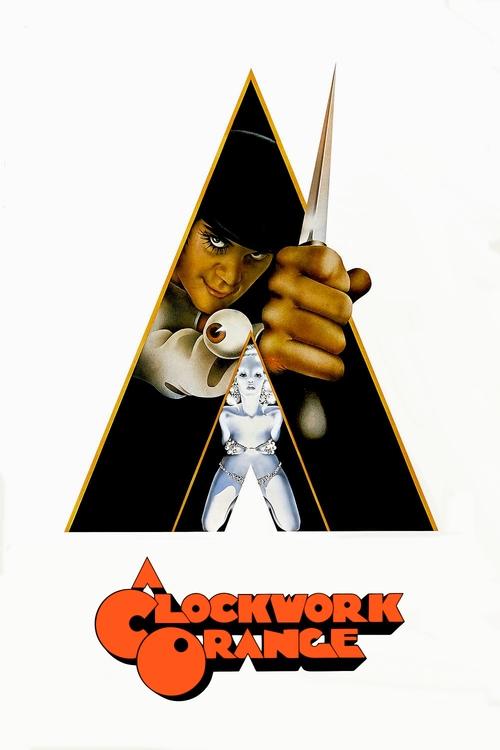
A Clockwork Orange
1971 · Stanley Kubrick
For when you want to be provoked — a bold, confrontational classic for a night when you can handle disturbing material and want a film that picks a fight with your conscience. Emphatically not a comfort watch.
What it's about
In a near-future Britain, teenage Alex and his gang roam the night committing gleeful, terrible violence — when he's not at home swooning to Beethoven. When the state finally gets its hands on him, it offers a cure: a procedure that will strip away his capacity to choose evil at all. The question the film keeps twisting is which is worse — the monster, or the machine that unmakes him.
The experience
Shocking, stylish, and blackly funny, it seduces you with its narrator's charm and then makes you queasy for enjoying it. Decades on, it still feels dangerous — you come out arguing with it and with yourself.
Performances
Malcolm McDowell's Alex is one of cinema's indelible creations — witty, vicious, and horribly likable, narrating his own crimes with a showman's relish that makes you complicit in every scene.
The craft
Kubrick composes every frame like a painting — stark white interiors, pop-art sets, wide-angle stares straight into the lens — and weaponizes classical music, wiring Beethoven and Rossini to images they were never meant to touch. The invented slang, production design, and needle-drop irony all became a visual language of their own.
Why it matters
One of the most controversial and influential films ever released, it set the terms for decades of debate about screen violence and left its fingerprints on dystopian style everywhere — the look, the slang, the bowler hat.
Snapshot
Stanley Kubrick's adaptation of Anthony Burgess's 1962 novel is among the most debated films in the English-language canon: a satirical dystopia told entirely from the perspective of its charismatic, unreliable, and unrepentant narrator-protagonist. Alex DeLarge leads a gang of "droogs" through nocturnal rituals of what the film's Nadsat argot calls "ultra-violence," until the state's therapeutic apparatus remakes him as a helpless object. The film turns the question of moral agency into a provocation that neither endorses Alex's crimes nor endorses the society that punishes them, leaving both parties indicted. Lurid, formally rigorous, and ideologically slippery, it remains a key document of the period when mainstream cinema briefly licensed itself to explore territory previously reserved for art-house imports.
Industry & production
Warner Bros. distributed the film, which Kubrick produced through his own company, Polaris Productions, shooting entirely on location in England. After the turbulent reception of 2001: A Space Odyssey (1968), Kubrick had consolidated an unusual degree of autonomy from any studio: he controlled casting, final cut, and, crucially, release decisions. That control would prove consequential. Following the British premiere in January 1972, the film received an X certificate from the BBFC; by early 1973, Kubrick himself requested that Warner Bros. withdraw the film from UK distribution. The stated reasons involved threats to his family and reported copycat incidents — a causal link the press asserted more confidently than the evidence warranted. The film would not screen theatrically in the United Kingdom again until after Kubrick's death, when Warner Bros. rereleased it in 2000. Elsewhere it continued to circulate, winning wide audiences across Western Europe and North America despite (or because of) sustained controversy.
The budget was modest by the standards of 2001, and Kubrick leveraged familiar London locations — the brutalist Thamesmead housing estate, the Brunel University interior that doubled as the Ludovico Medical Facility — to achieve a near-future look at relatively low cost. This economy was characteristic: Kubrick habitually extracted maximum visual strangeness from accessible physical spaces.
Technology
Cinematographer John Alcott — who had served as camera operator and additional photography director on 2001 — shot the film on 35mm using extremely wide-angle lenses, particularly in the range of 9.8mm (Kinoptic), to produce the bulging, distorted foreground perspectives that became the film's visual signature. These lenses exaggerate depth, make faces and objects closest to the camera loom outward, and produce an unnerving sense of space that functions as a formal correlate to Alex's self-aggrandizing narration. The combination of available-light shooting and fast film stock in certain sequences gave the image a grain structure that reinforced the film's gritty credibility even in its most stylized passages.
Walter Carlos (who later transitioned and became Wendy Carlos) employed the Moog synthesizer to arrange and perform classical repertoire — Beethoven's Ninth Symphony, Rossini overtures, Elgar's Pomp and Circumstance — alongside original electronic compositions. This was a still-novel use of synthesis applied to canonical orchestral music, and the slightly metallic, alienated timbre of the Moog versions underscored the film's depiction of a world in which culture has been mechanized and perverted.
Technique
Cinematography
Alcott and Kubrick developed a systematic use of the wide-angle perspective as a subjective instrument: the viewer is placed inside Alex's gaze. The Korova Milk Bar's statuary and the geometric violence of the opening assault on the tramp are composed as if the camera itself is a participant. Kubrick also employs the exact reverse — long telephoto shots compressing space during Alex's walks through London — to suggest the indifferent banality of his world when seen from the outside. These contrasts between extreme focal lengths are not decorative; they map the difference between Alex's interior grandiosity and the drab exterior reality he inhabits.
Editing
Kubrick supervised editing with exceptional hands-on intensity, as he did on all his films. The notorious sequences of violence are cut to musical rhythm rather than dramatic pacing: the droogs' assault on Mr. Alexander and his wife is choreographed to Alex's rendition of "Singin' in the Rain," and the editing subordinates shock to spectacle in a way that implicates the viewer's pleasure. The Ludovico conditioning sequences, by contrast, shift to the locked gaze of the film-within-the-film, denying Alex — and the viewer — the cut as relief.
Mise-en-scène / staging
The film's visual design was heavily influenced by Pop Art and the emerging aesthetic of commercialized futurism: the Korova Milk Bar's white mannequin furniture, the codpiece costumes of the droogs, the sex-shop interiors. Production designer John Barry (who had also worked on 2001) created environments that feel simultaneously satirical and plausible, the near-future signaled by exaggeration of contemporary consumer culture rather than by technological novelty. Kubrick stages violence as performance — the droogs move with the precision of a dance troupe — which is the film's central formal statement: that violence has an aesthetic dimension the culture already exploits, whether in entertainment or in state punishment.
Sound
The counterpoint between diegetic and non-diegetic sound is the film's deepest structural device. "Singin' in the Rain" is first heard as a cheerful anachronism Alex performs while committing assault; it returns much later, triggering his conditioned agony when Mr. Alexander plays the same song as psychological torture. The Beethoven Ninth — object of Alex's aesthetic rapture — becomes the instrument of his breakdown when the Ludovico treatment inadvertently conditions him against it. Carlos's electronic arrangements denature these works sufficiently to make them strange while preserving their emotional power, producing an unresolvable irony: the most sublime music in Western tradition is simultaneously weaponized and debased.
Performance
Malcolm McDowell, then 27 and known primarily from Lindsay Anderson's If.... (1968), delivers one of the period's defining screen performances. His Alex is expansive, charming, and predatory in equal measure, addressing the camera directly in a conspiratorial mode that invites complicity before it demands judgment. The famous eye-clamping during the Ludovico sequences was achieved with a modified medical speculum holding McDowell's eyelids open; he reportedly scratched his cornea during filming and endured considerable discomfort. The physical ordeal is legible in the performance. Patrick Magee as Mr. Alexander and Michael Bates as the Chief Guard are broadly satirical, situating the film's supporting cast in a register closer to Dickens than to naturalism, while McDowell alone maintains the illusion of interiority.
Narrative & dramatic mode
The film divides into three movements: Alex's dominion, his subjugation and reconditioning, and his release into a society that finds multiple uses for his helplessness. Kubrick, adapting his own screenplay from Burgess's novel, stripped away much of the verbal texture of Nadsat while preserving its estrangement effect: the argot keeps the viewer at a slight cognitive distance, translating violence into aesthetic experience before moral response can intervene. Alex narrates throughout in the first person, and the camera almost invariably gives us his perspective — making the withdrawal of that subjective position during the conditioning scenes a formal violence that mirrors the thematic one.
A significant adaptation decision concerns the novel's final chapter. Burgess's UK edition contained 21 chapters, the 21st showing Alex, now older, voluntarily choosing to abandon his violent past — a humanist resolution Burgess considered essential to the book's argument. American editions, including the one Kubrick worked from, omitted this chapter. Kubrick reportedly also found the ending unconvincing as drama. His film closes instead on Alex restored to his violent appetites, the state's correction having been reversed through political expediency. This ending is more pessimistic, more symmetrical, and more consistent with Kubrick's habitual dark ironies; Burgess, by most accounts, was ambivalent about the adaptation and troubled by the omission.
Genre & cycle
A Clockwork Orange occupies an unstable generic position that is part of its lasting fascination. It is a dystopian science fiction film in its world-building, a crime film in its structure, a black comedy in its satirical mode, and a bildungsroman (or anti-bildungsroman) in its narrative arc. The near-future setting is sparse — a few decades of cultural drift rather than technological transformation — which keeps the satirical target close enough to be recognizable. Alongside THX 1138 (1971) and later Logan's Run (1976), it belongs to an early-1970s cycle of state-control dystopias whose anxieties were clearly fed by contemporary debates about behavior modification, pharmacological control, and state power in the wake of the 1960s.
Authorship & method
Kubrick's method by this period was total: he produced, directed, adapted the screenplay, and controlled every phase of post-production. His relationship with Burgess, though formally courteous, was not close; Kubrick used the novel as raw material rather than as a sacred text. John Alcott's collaboration was crucial in translating Kubrick's spatial and psychological ideas into specific lens choices and lighting approaches. Wendy Carlos was approached because Kubrick had heard Switched-On Bach (1968) and recognized in her work exactly the quality he needed: classical authority made uncanny by technological mediation. The film's sound design, including the layering of music over violent action, was realized in post-production under Kubrick's direct supervision.
Movement / national cinema
The film is both and neither: an American director working in Britain, adapting a British novel, producing a critique of British social institutions. It belongs to the tradition of British social satire — the Swiftian mode of Burgess himself — while its aesthetic allegiances are pan-European, absorbing the formal boldness of the French New Wave and the visual excess of contemporaries like Ken Russell. It shares with Lindsay Anderson's If.... a concern with British institutional violence and repression, but where Anderson's anger is explicitly political, Kubrick's is more aesthetically aloof, concerned with complicity as much as critique. The film neither belongs comfortably to the British New Wave, which had largely exhausted itself by 1971, nor to the New Hollywood movement, though it was released in the same cultural moment and shared its appetite for transgression.
Era / period
The early 1970s witnessed a brief window in which major distributors in the US and UK permitted films engaging directly with sexual violence, institutional critique, and the aesthetics of transgression without demanding resolution or redemption. This window was partly opened by the collapse of the Hollywood Production Code and the introduction of the MPAA ratings system in 1968. A Clockwork Orange — rated X in the US on initial release — belongs to this moment alongside Straw Dogs (1971), The Wild Bunch (1969), and Last Tango in Paris (1972). The window would begin to close by the mid-decade as political backlash and commercial calculation reasserted more conventional parameters.
Themes
Free will and moral identity anchor the film. The Ludovico Technique removes Alex's capacity to choose evil, but in doing so removes the conditions of moral agency altogether; the prison chaplain who objects to the procedure is the film's unlikely moral voice. The state is shown to be more interested in managing behavior than in fostering conscience, and Alex's cure is reversed not out of ethical scruple but political convenience. The film also interrogates art's relationship to violence: the classical music Alex loves is not ennobling him; his aesthetic sensibility coexists with his brutality without contradiction. This is a direct challenge to Enlightenment assumptions about the humanizing function of culture.
Reception, canon & influence
The film received four Academy Award nominations, including Best Picture and Best Director, winning none. Critical reception was sharply divided: many reviewers recognized its formal mastery while objecting to what they saw as a morally evasive aestheticization of sexual violence. Pauline Kael's negative response was among the most sustained and influential dissenting readings; she argued the film was fascinated by what it claimed to critique. The opposing view, articulated by critics including Roger Ebert, held that the film's distancing devices were precisely its moral mechanism, preventing identification where a more naturalistic treatment would have invited it.
The films that fed into it include If...., Godard's Weekend (1967) in its satirical treatment of violence as spectacle, and the broader tradition of literary dystopia extending from Huxley and Orwell through Burgess. Its influence forward is vast and difficult to map cleanly. The use of incongruously cheerful music over scenes of violence — since become a cliché of commercial cinema — was not invented here but was codified by this film into a stable idiom. Ridley Scott, David Fincher, and Darren Aronofsky have all acknowledged the film's formal influence. Kubrick's self-imposed UK ban became, paradoxically, a guarantor of its mystique: A Clockwork Orange circulated for three decades in Britain primarily as bootleg and legend, which intensified rather than diminished its cultural presence. Its rehabilitation in 2000 confirmed what the decades of controversy had already demonstrated: it is one of the most formally inventive and morally serious films produced in the English language.
A Deleuzian reading
Start with the eye.
The full Deleuzian reading of A Clockwork Orange →
Reception
So controversial on release — copycat-crime headlines, an X rating, moral panic on both sides of the Atlantic — that Kubrick himself pulled it from UK distribution in 1973, where it stayed effectively banned until after his death in 1999. Now it's unassailable canon, the scandal part of the legend.
How A Clockwork Orange was received, from release to now →
Influences: the films it descends from and the films it influenced
- The Cabinet of Dr. Caligari (1920) — Established the grammar of architecturally distorted mise-en-scène as externalized subjective psychology — the direct formal precedent for Alcott's 9.8mm wide-angle distortion, which functions not as realistic photography but as a visual correlate of Alex's narcissistic grandiosity, making the physical world bulge outward in response to his self-aggrandizing consciousness.
- M (1931) — Lang structures the entire film around inhabiting a criminal's consciousness while simultaneously indicting the vigilante mob that punishes him as a second moral horror — the precise narrative architecture A Clockwork Orange inherits: neither Alex nor the state apparatus conditioning him escapes the film's double indictment.
- Peeping Tom (1960) — Powell built an entire film on subjective POV cinematography that makes the viewer occupy the killer's perspective so consistently that complicity becomes structurally unavoidable — the direct formal model for Alcott's first-person wide-angle framing of Alex's assaults, which denies the viewer the moral distance of an observing camera.
- Bonnie and Clyde (1967) — Penn and editor Dede Allen developed the post-Production Code grammar of violence-as-spectacle: slow-motion death sequences staged and cut to be simultaneously horrifying and aesthetically thrilling, generating viewer pleasure that implicates rather than reassures — the editing logic A Clockwork Orange inherits for its choreographed assault sequences.
- If.... (1968) — Anderson cast Malcolm McDowell as Mick Travis — a charismatic, anarchic British youth who addresses the camera directly and commits institutional violence as anarchic climax — and Kubrick transplanted this performance register wholesale, hiring McDowell himself; the direct-address performance style and satirical-transgressive framing of British institutional violence pass through the actor's body from one film to the other.
- The Wild Bunch (1969) — Peckinpah and editor Lou Lombardo invented multi-camera slow-motion violence cutting that transforms combat into formal ballet, with the editorial rhythm set by the visual choreography rather than dramatic logic — the specific principle Kubrick adopts for the droogs' assault sequences, where the editing subordinates shock to spectacle and violence becomes performance.
- Lolita (1962) — Extends Lolita's seductive unreliable first-person voice-over that lures the viewer into complicity with a charming monster, paired with ironically deployed classical scoring.
- Singin' in the Rain (1952) — Kubrick grimly inverts the title number by having Alex sing 'Singin' in the Rain' as diegetic accompaniment to assault, weaponizing the song's association of performance and joyous self-expression.
- Funeral Parade of Roses (1969) — Its fast-motion and stylized set-pieces are the technique most often traced back to Funeral Parade of Roses' undercranked comic sequences (an anecdotal but widely cited debt).
- Brute Force (1947) — Elevates Brute Force's music-brutality juxtaposition — Munsey beating a prisoner to Wagner on the phonograph — into a governing formal device, scoring atrocity to beloved music for maximum ironic dissonance.
- Brighton Rock (1948) — Kubrick's extreme wide-angle interiors and the articulate, undersized young man addressing us over his own violence extend the Pinkie type and Waxman's distorting optics; the violence is again stylized and elided rather than anatomically shown.
- Brazil (1985) — Gilliam's production design directly inherits ACO's logic of near-future rendered through exaggerated consumer and bureaucratic kitsch — retro-futurist objects that satirize contemporary culture by extrapolation — while the narrative double-indictment structure (helpless protagonist and the punishing state equally condemned) reproduces ACO's political argument within a fully systematized satirical world.
- Reservoir Dogs (1992) — The 'Stuck in the Middle with You' ear-cutting sequence is a direct structural appropriation of ACO's central technique: a cheerful, recognizable pop song played diegetically while violence is committed, so that the viewer's pleasure in the music and the pleasure of the spectacle fuse into a single uncomfortable experience that refuses moral comfort.
- Natural Born Killers (1994) — Stone and editor Hank Corwin extend ACO's music-driven cutting of violence into a fully fragmented mixed-format grammar, while the film's media-saturation argument is ACO's central claim — that entertainment culture aestheticizes and reproduces violence — brought forward and made explicit as subject matter rather than formal provocation.
- Trainspotting (1996) — Boyle and cinematographer Brian Tufano deploy 12mm wide-angle lenses for drug-state subjective distortion in direct descent from Alcott's technique, while the film's pop-music counterpoint structure — recognizable songs used against scenes of squalor and desire — replicates ACO's diegetic-music-as-psychological-instrument; the direct-address unreliable narrator is McDowell's Alex transposed to Renton's register.
- Funny Games (1997) — Haneke constructs a systematic meta-critique of ACO's viewer-implication strategy: the killers' repeated direct address to camera, the remote-control scene that literally rewinds the film to deny cathartic violence, and the refusal to aestheticize harm are a formal argument against the pleasurable complicity that ACO generates and leaves unresolved — a descendant that turns its inheritance into a polemic.
- Requiem for a Dream (2000) — Aronofsky and cinematographer Matthew Libatique use extreme macro and wide-angle lenses for addiction-state subjective distortion as a direct descendant of ACO's focal-length-as-psychology technique, while Clint Mansell's score is cut to obsessive rhythmic editing — sequences structured entirely by musical pulse — that descends from Kubrick's principle of subordinating the image to the music's rhythm.
- Enter the Void (2009) — Noé and cinematographer Benoît Debie push ACO's subjective wide-angle strategy to its logical formal limit: an entire feature shot in strict first-person POV with fisheye distortion, making Alcott's 9.8mm technique — which occupied only certain sequences in ACO — the total and unrelenting grammar of the film's consciousness-camera.
- Fight Club (1999) — Kubrick's use of formal visual elegance and diegetic pop music to aestheticize violence while embedding simultaneous ideological critique gave Fincher the template for Fight Club's seductive-yet-condemning treatment of Project Mayhem's choreographed destruction.
- Full Metal Jacket (1987) — Wendy Carlos's synthesizer reworkings of classical pieces paired against institutional conditioning sequences established the synthesizer-score/ironic-cultural-artifact formula that Abigail Mead's FMJ score directly inherits — transposing the device from criminal to military correction, with the same effect of making the institution sound inhuman.
- American Psycho (2000) — Kubrick's technique of staging choreographed violence in precise rhythmic alignment with diegetic popular and classical music — generating simultaneous horror and dark comedy through aesthetic incongruity — is the direct structural template for Bateman's Phil Collins commentary and the formally balletic murder sequences.
- We Need to Talk About Kevin (2011) — The canonical cinematic model for deploying cheerful licensed popular music against images of violence to produce cognitive estrangement — Ramsay's use of Buddy Holly's 'Everyday' and similar tracks over scenes of domestic dread works directly in this tradition.
- Eyes Wide Shut (1999) — Established the ironic counterpoint of classical music against staged sex and violence, plus the masking and stylization of bodies that returns at the orgy.
- Performance (1970) — Produced simultaneously in Britain, the film deploys rock music (Mick Jagger, Randy Newman) as an alienating counterpoint to violence and identity dissolution at the same moment ACO uses Rossini and Beethoven against the same materials; Roeg's fragmented, destabilizing cinematography serves the same function as Alcott's wide-angle distortion — externalizing a subjective state rather than observing it.
- THX 1138 (1971) — Released the same year, Lucas independently develops the same generic core — behavioral conditioning by the state as the central horror of a near-future dystopia — while his white-void production design represents the minimalist pole of the same pop-art futurist logic that ACO's Korova Milk Bar exploits through maximalist consumer excess.
- 1984 (1956) — Kubrick extends the interrogation/re-conditioning climax — the state strapping a dissident down to forcibly remake his will — the same coercive set-piece that anchors Room 101 and O'Connor's inquisition.
- Sleeper (1973) — Kubrick shoots real brutalist/modernist buildings as a found near-future dystopia — the same use of existing radical architecture as ready-made set that Sleeper exploits.
- Titus (1999) — Milena Canonero's costuming of stylized brutality — violence rendered as designed, choreographed performance — is the costume-driven aestheticization of cruelty she extends in Titus.
- Tron (1982) — Wendy Carlos's Moog realizations of orchestral material here defined her orchestra-plus-electronics signature, which she ports directly onto Tron's score to fuse digital coldness with symphonic weight.
- O Lucky Man! (1973) — Released two years earlier, it crystallized McDowell's ironic anti-hero persona — direct-to-camera complicity and Brechtian stylization — that O Lucky Man! deliberately extends and inverts into wide-eyed innocence.
- Beautiful Thing (1996) — The direct debt named in the film's own DNA: the Thamesmead brutalist walkways Kubrick coded as dystopian menace are deliberately reclaimed and re-lit as a site of first love, inverting the earlier film's charge.
Similar films
- Brazil (1985) — influence & lineage
- THX 1138 (1971) — influence & lineage
- Performance (1970) — influence & lineage
- Trainspotting (1996) — influence & lineage
- Nineteen Eighty-Four (1984) — same viewing thread
- The Devils (1971) — often watched together
- 2001: A Space Odyssey (1968) — shared sensibility
- 1984 (1956) — shared sensibility
All the films related to A Clockwork Orange →
Watch it with: curated runs of related films
- Discipline and Defiance — A run of men pitted against total institutions — prisons, wards, camps, the state — where the only freedom left is refusing to break.
Film essays and courses that include it
- From Riot to Trial: A Century of Banned Cinema
- Stanley Kubrick
- The Comedy of Catastrophe: How Dark Cinema Learned to Laugh at the Abyss
- The Tyranny of Reason: Cinema Inside the Breaking Mind
- Steel and Soul: A Century of Cinema Behind Bars
- The Architecture of Ruin: Ninety Years of Dystopian Cinema
- The Frame as a Trap
- The Rules That Shaped a Cinema by Forbidding It