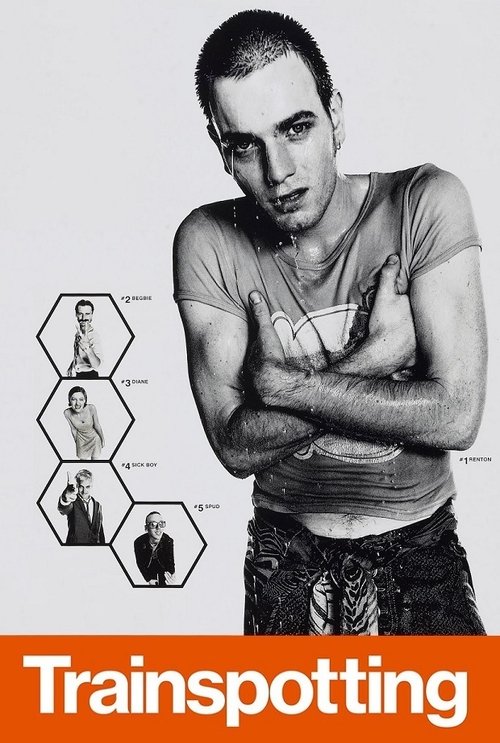
Trainspotting
1996 · Danny Boyle
For when you want something with a pulse — bold, loud, and confrontational. Not a comfort watch: it goes to genuinely dark places, but you'll come out buzzing.
What it's about
Mark Renton is a young heroin addict in Edinburgh, cycling through highs, cold-turkey horrors, and half-serious attempts to choose a normal life, all narrated with corrosive wit. Around him orbit his unreliable friends — the scheming Sick Boy, hapless Spud, and the terrifying, drug-free psychopath Begbie — and even a clean start in London can't keep them from turning up at his door.
The experience
Ferociously fast and blackly funny, cut to one of the great soundtracks, then suddenly nightmarish — it swings from euphoria to horror without warning and makes you feel the whiplash of addiction itself. Exhilarating and harrowing in the same breath.
Performances
Ewan McGregor's star-making turn as Renton is all charisma and self-loathing, and Robert Carlyle's Begbie is one of cinema's most frightening portraits of pure violence — funny until he absolutely isn't.
The craft
Danny Boyle directs at full tilt: surreal set pieces (an infamous toilet, a hallucinated withdrawal), freeze-frames, and a needle-drop soundtrack from Iggy Pop to Underworld that fused the film to 90s British music culture. Made for around £1.5 million, it looks and moves like ten times that — and it demands good speakers.
Why it matters
It became the defining British film of the 1990s, launched Boyle and McGregor internationally, and set the style — voice-over, soundtrack, velocity — for a generation of youth cinema.
Snapshot
A kinetic, formally audacious adaptation of Irvine Welsh's 1993 novel, Trainspotting follows Edinburgh heroin addict Mark Renton through cycles of use, withdrawal, and attempted escape, framed by a wry, self-implicating voice-over and a soundtrack that announced a generational shift in British popular culture. Produced on a budget of approximately £1.5 million, it became one of the most commercially successful British films of the decade relative to its cost, and remains the defining document of a specific moment in 1990s British cultural life: post-Thatcher, pre-Millennium, saturated with class resentment and chemical euphoria in equal measure. Its reputation has proved durable; the film continues to anchor discussions of national cinema, addiction narratives, and the aesthetics of the MTV era.
Industry & production
Trainspotting was the second collaboration between producer Andrew Macdonald, writer John Hodge, and director Danny Boyle, following their debut Shallow Grave (1994). The trio operated under Figment Films, with financing from Channel 4 Films and PolyGram Filmed Entertainment handling UK distribution; Miramax acquired US rights. The Channel 4 connection placed the film within a lineage of British social-realist production that stretched back to the 1980s, though Trainspotting aggressively distinguished itself from the kitchen-sink gravity that lineage implied.
Despite being set in Edinburgh, the film was shot principally in Glasgow for budgetary reasons—a pragmatic substitution that occasionally surfaces in background detail but rarely disrupts the film's constructed geography. The shoot lasted roughly seven weeks. Casting centered on a group of young Scottish actors largely unknown to international audiences: Ewan McGregor as Renton, Ewen Bremner as Spud, Jonny Lee Miller as Sick Boy, Robert Carlyle as Begbie, Kevin McKidd as Tommy, Kelly Macdonald as Diane, and Peter Mullan as Swanney. Carlyle's Begbie in particular drew attention for its controlled menace, and Macdonald's Diane—in her first screen role—was widely noted.
The film's commercial performance in Britain was remarkable for its scale and budget ratio, and its US release, though initially limited, expanded substantially on word of mouth. American distributor Miramax reportedly required minor cuts and a subtitle track for certain US theatrical prints to address concerns about the density of Scottish dialect—a fact that itself became a small cultural talking point. Exact worldwide grosses have been reported in various sources, but the film is broadly understood to have returned many multiples of its production budget.
Technology
Trainspotting was shot on 16mm film, a choice that directly shaped its visual register. 16mm offered a grainier, more agitated image than 35mm, suited both to the production's budget constraints and to its aesthetic ambitions: the format lent itself to handheld operation, low-light shooting in cramped locations, and a texture that connoted documentary immediacy while simultaneously permitting expressionistic distortion. The 16mm negative was then blown up to 35mm for theatrical release, amplifying the grain into something tactile and slightly unstable—appropriate for a film whose narrative world is itself unreliable.
The "Worst Toilet in Scotland" sequence required practical construction of an oversized lavatory set to allow McGregor to dive fully into the bowl and emerge in a surreal underwater space. This transition from grotesque social realism into hallucinatory fantasy was achieved through set design and in-camera work rather than heavy optical post-processing, reflecting the production's low-budget ingenuity.
Technique
Cinematography
Brian Tufano served as director of photography. His work on the film is characterized by a restless, opportunistic handheld style that keeps Renton's body under pressure: the camera crowds, follows, and occasionally rushes ahead of its subjects. Tufano and Boyle established a visual grammar of destabilised perspective—Dutch angles, extreme close-ups of faces and drug paraphernalia, ceilings that appear to descend—that renders the heroin experience as a distortion of ordinary spatial logic rather than simply as degradation. Certain sequences deploy a near-opposite stillness: the death of baby Dawn is filmed with horrifying directness, the locked-off frame refusing the kinetic escape available elsewhere.
Lighting is frequently harsh and fluorescent in interiors, greenish and unflattering, while the film's fantasies and memories receive a different, sometimes warmer key—a visual shorthand for the seductive unreality of intoxication versus the harshness of the world it temporarily replaces.
Editing
The editing establishes a rhythm calibrated to both the film's musical infrastructure and to the altered temporality of addiction—sequences compress and dilate, days blur into nights, withdrawal is represented as horrific temporal extension. Jump cuts and graphic matches connect disparate spaces and moments in a manner that owes something to the French New Wave's disdain for classical continuity but also to the fast-cut logic of music video. The film's opening run—Renton sprinting down Princes Street over "Lust for Life," the voice-over's "Choose Life" litany crashing against the images—is among the most efficiently constructed opening minutes of 1990s cinema, establishing character, tone, irony, and cultural context in under two minutes.
Mise-en-scène / staging
Boyle and his collaborators committed to a production design that is simultaneously squalid and heightened. The flat shared by Renton and his associates is genuinely squalid; the shooting galleries are genuinely dim and cramped. Yet the film consistently exaggerates physical space to reflect psychological state—the toilet that swallows Renton becomes an abyss, the room in which he withdraws contracts and tilts, the dead baby's crawl across the ceiling transforms grief into waking nightmare. This oscillation between observed realism and expressionist distortion is the film's central formal strategy: it refuses to stabilize into either social document or pure surrealism.
The staging of Begbie is worth separate note. Carlyle was encouraged to improvise within scenes, and the threat he generates derives partly from unpredictability in rehearsal and performance: other actors and the camera itself seem genuinely uncertain where he will move.
Sound
The soundtrack is one of the most culturally significant elements of the film and one of the most carefully constructed. Music supervisor was a critical role; the selections range from Iggy Pop's "Lust for Life" and "Night Clubbing," through Underworld's "Born Slippy .NUXX" (closing the film and launching the track to massive commercial success in the UK), to Pulp's "Mile End," Blur, Elastica, Sleeper, Brian Eno, Lou Reed, and Primal Scream. The soundtrack album became a commercial phenomenon in its own right. The music functions not merely as atmosphere but as ideological framing: "Lust for Life" is a song about staying alive, used ironically over images of destruction; "Born Slippy" is euphoric and annihilating simultaneously.
Diegetic sound is deployed with similar intelligence. The contrast between the muffled, subjective interiority of Renton's drug states and the abrasive, over-loud clarity of the outside world—traffic, voices, his mother's television—enacts in acoustic terms the dissociation that addiction produces.
Performance
The ensemble is exceptional by any standard. McGregor's Renton is the film's moral center and unreliable narrator simultaneously—charming, self-aware, culpable, readable—and his physical commitment to the withdrawal sequences (his body reportedly lost visible weight during production) grounded the film's more extravagant passages in credible suffering. Carlyle's Begbie became a landmark of screen menace; his violence is never glamorized but is shot through with a comedy of aggression that makes him more frightening, not less. Bremner's Spud is the film's conscience by negation—too gentle for the world he inhabits, his jobcentre interview and subsequent conviction among the film's most compassionate passages. Kelly Macdonald, in her film debut, brings a self-possession to Diane that cuts against any reading of the film as simply male in its sympathies.
Narrative & dramatic mode
The film adapts Welsh's episodic, polyphonic novel into something more linearly driven—centered on Renton, with the other characters as satellites—while retaining the novel's structural looseness, its sense that scenes are events in an ongoing, unresolved life rather than steps in a plot. The voice-over is central: Renton's narration is witty, self-aware, and explicitly unreliable, and its tone modulates between stand-up cynicism, genuine anguish, and a peculiar lyric tenderness. This voice establishes an ironic distance from the film's more extreme sequences while simultaneously implicating the viewer in the pleasures it describes.
The dramatic arc—such as it is—concerns Renton's attempts to leave, his failures, his complicity, and his final, ambiguous escape: the theft of drug money from his friends, including the one who trusted him most. The ending is deliberately unresolved in moral terms. Renton "chooses life"—the consumer life he earlier satirized—and the film holds open whether this constitutes redemption, pragmatism, or simply a different form of anesthesia.
Genre & cycle
Trainspotting belongs to the addiction film as a mode but radically alters its conventions. Where the classical addiction narrative (from The Lost Weekend onward) is structured as fall, degradation, and recovery, Trainspotting subverts the recovery arc and refuses the genre's traditional moral architecture: it presents heroin's pleasures as real before presenting its costs, declining to pretend the trade-off is simple. The film also operates within British social realism—it is set in poverty, shaped by class, concerned with the limits of individual escape—but this too is subverted by its formal energy, its comedy, and its refusal of documentary sobriety.
More broadly it sits within a cycle of 1990s British films that combined gritty subject matter with post-Tarantino stylistic aggression: Shallow Grave, Lock, Stock and Two Smoking Barrels, Human Traffic. Trainspotting is the most formally accomplished and culturally resonant of these.
Authorship & method
Danny Boyle is the film's controlling sensibility, but the creative unit should be understood collectively. John Hodge's screenplay compresses and restructures Welsh's novel with considerable skill: the decision to focus on Renton as protagonist and narrator, and to give the film a propulsive closing act built around the heroin deal, is a screenwriting achievement as much as a directorial one. Brian Tufano's cinematography and the film's music architecture are co-equal contributors to its identity.
Boyle's method in this period—characterized by kinetic visual energy, a democratic approach to genre (he would follow Trainspotting with the zombie film 28 Days Later and the science fiction of Sunshine)—is already legible here: a willingness to use pop-cultural materials seriously, an interest in altered states of consciousness as cinematic problems, and a preference for physical performance and practical construction over post-production solution.
Movement / national cinema
Trainspotting is a Scottish film in the specific sense that its cultural identity—its class politics, its relationship to Englishness, its language and landscape—is Scottish rather than generically British. The film appeared in the same year as Braveheart (1995) had revived questions of Scottish national identity, and its meditation on what it means to "choose" a national as well as personal life resonates in that context. The opening monologue's list of consumer choices—culminating in "Choose rotting away at the end of it all"—was read by some critics as an attack on Thatcherite individualism, a reading the film neither confirms nor denies.
More broadly it belongs to a renewal of British cinema in the mid-1990s—overlapping with but not identical to the "Cool Britannia" cultural moment—in which low-budget, Channel 4-financed productions from outside the London mainstream found international audiences. The Boyle/Hodge/Macdonald unit was the most successful instance of this tendency.
Era / period
The film captures a specific moment of British cultural life: after the devastation of de-industrialisation and the Thatcher years, before the Blair government and Millennium optimism. Edinburgh's heroin epidemic of the 1980s and early 1990s—among the most severe in Western Europe, linked directly to unemployment and social collapse—is the film's historical ground, though the film is not a social-problem document. The mid-1990s Britpop musical context infuses the soundtrack and the film's self-presentation; it arrived at a moment when British youth culture was asserting a confident, ironic self-image.
Themes
The film's central preoccupation is the logic of escape: from poverty, from boredom, from Scotland, from one's own history, from consciousness itself. Heroin is presented not as aberration but as rational response to a world offering few compelling alternatives—the voice-over's famous enumeration of bourgeois life is savage precisely because its critique is accurate. The film is simultaneously skeptical of the escape it diagnoses and honest about its appeal.
Beneath this runs a concern with male friendship and its limits: the group's solidarity is real and is also the mechanism of mutual destruction. Begbie's violence is the friendship's darkest truth; Spud's passive suffering is its conscience. The betrayal that closes the film is legible as survival or as moral failure depending on whether one reads the friendship as genuine.
Scottish identity, class, the body (violated, pleasured, destroyed by drugs), and the seduction and unreliability of self-narration are all sustained concerns.
Reception, canon & influence
Critical reception. The film was received with considerable enthusiasm on its British release and entered the critical mainstream rapidly. It won the BAFTA for Best Adapted Screenplay (John Hodge) and received other BAFTA nominations. It was included in various end-of-decade and end-of-century critical lists as among the most significant British films of the 1990s, and it remains in regular rotation on critical best-of polls.
The initial American critical response was complicated by debates about the film's moral stance on drug use—charges of glamorization were raised by some commentators, particularly in the wake of the US release. The film's defenders noted that these charges reflected a misreading of its ironic mode; the film does not endorse what it depicts.
Influences on the film (backward). The most direct cinematic precursors are Boyle's own Shallow Grave, which established the working unit and its aesthetic sensibility, and the early films of the French New Wave—particularly Godard's use of jump cuts, direct address, and the subordination of narrative continuity to rhythm and idea. The influence of A Clockwork Orange (1971) is pervasive: the unreliable, charismatic, first-person narrator embedded in a violent subculture, the gap between the narrator's self-presentation and moral reality, the formal audacity. American independent cinema of the early 1990s—particularly Tarantino's popularization of non-linear structure and cultural-referential dialogue—is also present. Martin Scorsese's Goodfellas (1990) established a template for voice-over narration that implicates the listener in the pleasures of transgression; Trainspotting inherits this strategy.
The source novel's formal innovations—multiple narrators, demotic Scots orthography, the episodic refusal of linear plot—posed challenges that Hodge's adaptation resolved by simplification rather than direct transposition, and the novel's influence is most felt in the film's linguistic confidence.
Legacy and forward influence. The film's most immediate legacy was commercial and cultural rather than purely cinematic: it established the viability of low-budget British production for international markets, confirmed the Boyle/Hodge/Macdonald unit as a significant force, and launched or substantially advanced the careers of McGregor, Carlyle, McKidd, and Macdonald. The soundtrack model—a curated selection of contemporary acts in dialogue with the film's emotional logic—influenced the construction of British film soundtracks through the late 1990s and into the 2000s.
Cinematically, the film's formal vocabulary—its energy, its ironic voice-over, its integration of music as structural element—entered the mainstream of British youth cinema. Films including Human Traffic (1999) and aspects of Guy Ritchie's early work bear its influence, though neither achieves the formal coherence of the original. Internationally, the film contributed to a broader early 2000s interest in addiction narratives that engaged with the phenomenology of intoxication rather than simply its social costs—including, in different registers, Requiem for a Dream (2000) and Christiane F. retrospective reassessments.
The sequel T2 Trainspotting (2017), reuniting the principal cast and creative team, performed creditably and demonstrated the original's durability as a cultural object while necessarily foregrounding the nostalgia and loss that any return to 1996 must now involve. Its reception confirmed the original's canonical status even as it complicated that status with elegy.
A Deleuzian reading
Renton runs.
The full Deleuzian reading of Trainspotting →
Reception
It exploded out of Cannes 1996 as the defining shot of Cool Britannia — dogged by tabloid and political hand-wringing that it glamorized heroin — and has since settled comfortably into the canon, regularly ranked among the greatest British films ever made.
How Trainspotting was received, from release to now →
Influences: the films it descends from and the films it influenced
- À bout de souffle (1960) — Godard's axiom of cutting on emotional energy rather than spatial continuity—the jump cut as rhythmic punctuation rather than continuity error—is the direct formal ancestor of Trainspotting's editorial grammar, particularly the compressed, headlong Princes Street opening sequence.
- Kes (1969) — Loach's use of 16mm handheld to document British working-class life with documentary immediacy established the formal grammar—grain, unstable framing, near-amateur performance registers—that Trainspotting inherits and then deliberately electrifies and subverts.
- Performance (1970) — Roeg's cross-cutting between objective and subjective reality to render drug-altered perception—walls that breathe, identities that dissolve across cuts—established the British cinema vocabulary for filming intoxication as spatial disorientation that Boyle inherits for Renton's hallucinations and the withdrawal-room sequences.
- A Clockwork Orange (1971) — Kubrick's deployment of an unreliable British first-person narrator who aestheticizes his own criminality while pop music plays ironically against violent imagery—'Singin' in the Rain' against assault—directly precedes Trainspotting's structure of Renton's wry voice-over counterpointed against 'Lust for Life.'
- Mean Streets (1973) — Scorsese's use of rock tracks as expressions of a protagonist's first-person interiority—not composed underscore but licensed pop functioning as interior monologue (the 'Be My Baby' credits, the 'Jumping Jack Flash' bar sequence)—established the grammar Trainspotting applies when 'Lust for Life' and 'Perfect Day' operate as Renton's emotional register rather than background music.
- Christiane F. (1981) — Edel's Berlin heroin narrative pairs a curated David Bowie soundtrack with physically committed performance through cold-turkey withdrawal—a sequence of genuine bodily degradation in a locked room—constituting the direct structural and aesthetic precursor to Renton's withdrawal confinement and the film's pop-as-salvation motif.
- Withnail and I (1987) — Robinson's literary first-person narration applied to a British substance-dissolution narrative—wry, self-aware, simultaneously inside and above the protagonist's ruin—is the direct tonal ancestor of Renton's 'Choose Life' voice-over, which inherits the ironic distance while transposing it from alcohol to heroin.
- Sid and Nancy (1986) — Cox achieved physical-commitment performance from Gary Oldman through a preparation process that grounded documentary bodily rawness within a heightened visual framework—the same balance of stylization and authentic physicality that Boyle sought from McGregor and Carlyle in their respective descent sequences.
- Drugstore Cowboy (1989) — Van Sant's non-moralizing addiction voice-over inhabits the user's logic without judgment—the protagonist articulates a coherent pharmacological philosophy that the film refuses to correct—directly shaping Renton's 'Choose Life' monologue, which similarly declines the redemption arc implicit in the genre while reasoning from inside it.
- Shallow Grave (1994) — The first collaboration of Boyle, writer John Hodge, producer Andrew Macdonald, and cinematographer Brian Tufano established the shared visual grammar—Dutch-angle wide lenses, handheld pursuit shots, genre-subversion through black comedy—that Trainspotting then intensifies and applies to the heroin milieu.
- GoodFellas (1990) — Boyle modeled Trainspotting's unreliable first-person voiceover narrator, freeze-frame punctuation of the narration, and licensed music as counterpoint to a criminal-adjacent lifestyle directly on GoodFellas, applying the formal grammar to Scottish heroin culture including the elegiac no-moral-resolution ending.
- Natural Born Killers (1994) — Carries NBK's MTV-aesthetic mixed-format cutting and aggressive needle-drop soundtrack collage into the subculture film.
- Human Traffic (1999) — Kerrigan's Welsh club-culture film directly inherits Trainspotting's formal toolkit: music-video editing cut to an electronic and rave soundtrack, self-aware unreliable narration that breaks the fourth wall, and a structural refusal to moralize—the most immediate British descendant applying Boyle's grammar to the adjacent chemical subculture of MDMA.
- Requiem for a Dream (2000) — Aronofsky inherits and radicalizes Trainspotting's addiction expressionism: the split-screen, extreme close-up drug-ritual sequences, and distortion of domestic space through compulsive need are intensifications of Boyle's techniques—where Trainspotting allows moments of kinetic euphoria to coexist with degradation, Requiem forecloses the euphoria entirely.
- City of God (2002) — Meirelles and Lund transpose the jump-cut/handheld/music-video formal grammar to the Brazilian favela: the opening chicken-chase sequence—handheld pursuit, rapid cutting to a percussive soundtrack, freeze-frame introduction—mirrors the formal logic of Trainspotting's Princes Street run, demonstrating how Boyle's grammar became an internationally available system for social-underclass cinema.
- Slumdog Millionaire (2008) — Boyle transposes his own Trainspotting formal toolkit—handheld pursuit through cramped urban corridors, music-video editing rhythm, curated pop functioning as character interiority (M.I.A.'s 'Paper Planes')—to Mumbai poverty, confirming that the grammar developed in Edinburgh was a reusable system rather than a period-specific document.
- Urchin (2025) — Fuses an electronic/techno-driven score and stylized magical-realist set-pieces (the carpet-dive, baby-on-ceiling) onto grim addiction realism — the same realism-to-reverie modulation Torres Calderón cuts in Urchin.
- Amores Perros (2000) — Boyle and editor Masahiro Hirakubo integrated music-video montage syntax — the cut as sonic event, rhythm as primary driver of sequence structure — into social-realist subject matter, establishing the template for kinetic editing within scenes of violence that Iñárritu deployed in the dogfighting sequences, drawing on his own commercial-directing background.
- Snatch (2000) — Boyle pioneered the British dialect voice-over as structuring device for a kinetically edited film — Renton's Edinburgh Scottish narrating criminal misadventure to a licensed pop soundtrack whose tempo drives editorial rhythm — a formal package Ritchie absorbs and redirects toward ensemble London crime comedy.
- The World of Kanako (2014) — The commercial-director's kinetic vocabulary — freeze-frame title cards, ironic pop scoring over degradation, restless handheld — that Nakashima's generation absorbed and Kanako escalates.
- 28 Years Later (2025) — Boyle's signature needle-drop kinetic montage and subjective, music-driven cutting is the editing method the Young Fathers-scored sequences here directly extend.
- Lock, Stock and Two Smoking Barrels (1998) — Immediate British precedent for freeze-frame character introductions, kinetic music-video cutting and a jukebox soundtrack scoring working-class lowlife energy.
- 28 Days Later (2002) — Boyle's own template of music-driven montage, kinetic fragmented cutting, and needle-drop set-pieces marrying image to score — the stylistic DNA reused in the infected-attack sequences.
- 101 Reykjavik (2000) — Establishes the template of ironic first-person slacker voiceover laid over a pop needle-drop soundtrack to narrate a young man's dissolution, the exact voice-plus-music architecture 101 adopts.
- Naked (1993) — Leigh's improvisation-based method produced a physically committed performance from David Thewlis as a contradictory, verbally dazzling British working-class protagonist whose monologue simultaneously critiques and inhabits its own world—a parallel development of the performance register Boyle sought from McGregor, with expressionist staging embedded in authentic London locations.
- Pulp Fiction (1994) — Tarantino constructs curated pop songs as structural tonal architecture—each licensed track a statement about character and irony, not ambient underscoring—alongside drug sequences handled through deadpan black comedy rather than horror, constituting a direct sibling development of the same formal strategies Boyle deploys with Iggy Pop and Lou Reed.
- The Full Monty (1997) — Boyle's ironic needle-drop scoring — chart and dance-pop cut hard against grim post-industrial life — models the same sound strategy that lets Hot Chocolate's 'You Sexy Thing' carry a Job Centre queue.
- High Fidelity (2000) — Contemporary British transatlantic-facing adaptation pairing direct-address narration with aggressive needle-drop curation and fragmented montage, the same fusion of literary voice and pop-music editing.
- Run Lola Run (1998) — Pop/electronic-scored kinetic montage, freeze-frame character intros, and voiceover-driven youth energy — the same music-video-feature fusion arriving from the UK two years earlier.
- Leaving Las Vegas (1995) — Addiction film that lets musical-rhythm editing structure the scenes and pointedly declines to moralize, emerging from the same mid-90s indie moment.
- Head-On (2004) — Pioneers the tonal whiplash between euphoria and horror driven by an eclectic compiled soundtrack, propelling non-glamorous addict bodies through unglamorous rooms with punk velocity.
- Knockin' on Heaven's Door (1997) — The contemporaneous exemplar of the pop-soundtrack-as-narrative-engine, where curated needle-drops rather than orchestral score carry the film's youthful kinetic energy and thesis.
- Brother (1997) — A contemporaneous case of needle-drop pop scoring and episodic picaresque built around a marginal youth subculture, using curated songs as the emotional through-line.
- We Are Not Angels (1992) — Deploys needle-drop pop-soundtrack-as-chorus and kinetic, music-video-trained cutting to structure a moral tale — the same technique of letting curated pop songs carry narrative and comment on conscience.
Similar films
- Slumdog Millionaire (2008) — influence & lineage · often watched together
- Shallow Grave (1994) — influence & lineage
- Naked (1993) — influence & lineage
- Christiane F. (1981) — influence & lineage
- Performance (1970) — influence & lineage
- Urchin (2025) — influence & lineage
- A Clockwork Orange (1971) — influence & lineage
- Requiem for a Dream (2000) — influence & lineage
All the films related to Trainspotting →