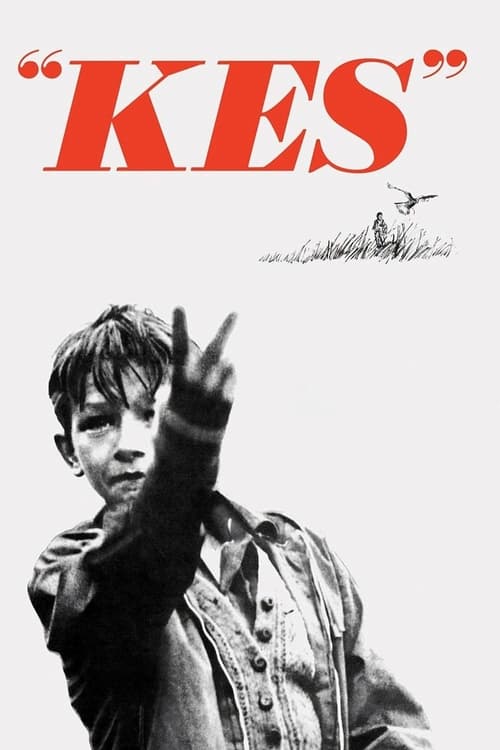
Kes
1970 · Ken Loach
For when you want a coming-of-age story with real dirt under its nails — something honest about childhood that still finds grace in it. Bring some resilience; it's moving in a way that stays with you.
What it's about
In a South Yorkshire mining town where the pit is every boy's assumed future, fifteen-year-old Billy Casper is bullied at school and belittled at home by his mother and older brother. Then he takes a young kestrel from a nest, teaches himself falconry from a stolen manual, and finds the one arena where he's capable, patient, and free. The bird becomes his voice — the thing that makes teachers, classmates, and the audience finally see him.
The experience
Tender and bruising at once: long stretches of gray-skied schoolyard cruelty broken by moments of pure lift when the falcon flies. It's funny in places — one games lesson is among the most famous comic scenes in British film — but the ache underneath never goes away.
Performances
David Bradley, a local schoolboy with no acting experience, is astonishing as Billy — guarded, quick, and utterly unperformed, the kind of face the camera believes completely.
The craft
Ken Loach shoots in natural light with a largely non-professional local cast, and Chris Menges's cinematography turns the Yorkshire moors and slag heaps into something quietly beautiful without prettifying the poverty. The broad regional accents were left intact — a radical choice at the time — and the falconry scenes are the real thing, patient and thrilling.
Why it matters
It established Loach's signature and became a cornerstone of British social-realist cinema — regularly named among the greatest British films ever made, and a formative text for generations of filmmakers about working-class life.
Snapshot
Kes is the film with which Ken Loach, already a force in British television, established the durable signature of his cinema: a working-class life observed with such patience and lack of condescension that fiction takes on the texture of witness. Adapted from Barry Hines's 1968 novel A Kestrel for a Knave, it follows Billy Casper, a fifteen-year-old in a South Yorkshire mining town for whom a future down the pit looms as a foregone conclusion. Diminished at home by a hostile half-brother and a distracted mother, humiliated and beaten at school, Billy finds the one domain of competence and dignity available to him when he takes a kestrel from a nest and trains it through the methods set out in a falconry manual he steals from a bookshop. The bird becomes the vehicle for everything the boy cannot otherwise express. The film is celebrated as one of the masterpieces of British social realism, and it is the rare canonical work whose reputation has only grown: a 1999 BFI poll of British film professionals placed it among the very greatest British films of the century, and its hold on the national imagination has remained unbroken. Its achievement is the union of an unsentimental, almost documentary surface with an emotional undertow of real force — a film about constriction that nonetheless allows a few minutes of flight.
Industry & production
Kes was produced by Tony Garnett through Kestrel Films, the production entity Garnett and Loach formed as they moved from the BBC into feature work, and it was financed and distributed by United Artists at a moment when Hollywood majors were investing in British production. The budget was modest — the figure usually cited is around £150,000, though such numbers should be treated as approximate rather than audited — and the film was shot largely on location in and around Barnsley, in the South Yorkshire coalfield where Hines had grown up and taught. Casting drew heavily on local non-professionals and regional performers, including David Bradley, the Barnsley schoolboy who plays Billy and who had no prior acting experience.
The defining industrial anecdote concerns distribution. United Artists, confronted with the density of the Yorkshire dialect, is widely reported to have despaired of the film's commercial prospects and to have considered it nearly incomprehensible — a reaction sometimes summarized in the quip that the studio would have found a film in Hungarian easier to follow. The result was a limited and hesitant release; the film's reputation was built less on an aggressive opening than on critical advocacy and a slow recognition that something exceptional had been made. That tension — between a national institution's faith in regional authenticity and a transatlantic distributor's anxiety about legibility — is itself emblematic of the conditions under which British realist cinema reached audiences.
Technology
Kes was shot on 35mm color film in the standard technology of its moment, but its interest lies in how unobtrusively that technology was deployed. This was the era in which lightweight cameras and faster film stocks, refined through documentary and television practice, made it practical to work on real locations in available or lightly supplemented light rather than on built sets. Cinematographer Chris Menges, whose background included documentary and current-affairs work, brought exactly that sensibility. The film favours natural light and real interiors — the cramped Casper house, the school corridors, the windswept fields — over the controlled environments of a studio. The technological posture is one of restraint: the apparatus is configured to disappear, to register the world as found rather than to transform it.
Technique
Cinematography
Menges's photography is the film's quiet glory and one of the foundational statements of a certain British observational style. The dominant strategy is distance and patience: the camera frequently stands back, using longer lenses to watch from across a room or a field, so that the actors are not pressed by the apparatus and behavior can unfold without the self-consciousness a close, intrusive camera invites. Loach has spoken across his career of shooting in sequence and of keeping the camera at a respectful remove precisely to protect the truthfulness of performance, and Kes is where that method first fully cohered on film. The light is soft and northern, the palette muted toward the grays and earth tones of the coalfield. The result is an image that reads as documentary even when it is composed with great care — the falconry sequences in particular, with the bird held against open sky, achieve a lyricism that never tips into the picturesque because the visual grammar surrounding them remains so plain.
Editing
The cutting, by Roy Watts, serves the same principle of observation. Scenes are allowed to run to their natural length; the film resists the propulsive, manipulative rhythms of conventional drama in favour of a pacing that lets situations breathe and accumulate. The celebrated football-match sequence is the great exception that proves the rule — there the editing quickens and sharpens into something closer to comic set-piece — but for the most part the rhythm is patient, trusting the spectator to attend. The structure is similarly undemonstrative, following Billy across what feels like an ordinary span of days, so that the gradual investment in the kestrel and the catastrophe that follows acquire their weight through duration rather than through plot mechanics.
Mise-en-scène / staging
The staging is rooted in the authenticity of real places: the terraced house, the colliery landscape, the institutional drabness of the school. Loach's method privileges what happens within the frame over the imposition of directorial style upon it. Actors are positioned and allowed to behave; the camera finds them. The famous classroom and assembly scenes draw their force from the conviction of the environment and from performances pitched at the level of recognizable life rather than theatrical projection. Costume and setting are not decorated but observed — the worn uniforms, the betting shop, the playground — so that the social world is read off surfaces rather than announced.
Sound
Sound is among the film's most discussed and most consequential elements, because the Yorkshire dialect is not a flavoring but the substance of the thing. The speech is thick, regional, and unmodified for outside ears, and the film's refusal to soften it is a statement of fidelity that carried real commercial cost (see the distribution history above). John Cameron's score is used sparingly and tellingly; its lighter, almost pastoral passages accompany Billy with the bird, lending those scenes their lift while withholding music from the harsher registers of his life, so that the contrast between freedom and constriction is partly carried in the soundtrack itself. Ambient location sound — schoolyards, streets, the domestic interior — grounds the film in its acoustic reality.
Performance
The performances are the heart of Kes and the clearest demonstration of Loach's casting and directing method. David Bradley's Billy is a study in guardedness and sudden animation, a child performance of remarkable unforced truth; he is never cute, never pathetic, and the moments in which the closed face opens — chiefly with the kestrel and in the classroom — are devastating precisely because they are rationed. Around him, Loach blends regional non-professionals with experienced performers in a way that flattens the distinction between acting and being. Colin Welland, as the sympathetic English teacher Mr. Farthing, gives the film its one sustained channel of adult kindness. Brian Glover, as the bullying PE teacher Mr. Sugden who commandeers a schoolboy football game and narrates himself as a star center-forward, delivers the comic high point — a sequence so vivid it has become detachable cultural shorthand for the petty tyrannies of British schooling.
Narrative & dramatic mode
The dramatic mode is observational realism with a tragic shape held just beneath an episodic surface. Rather than a tightly engineered plot, the film offers a sequence of incidents from a boy's days — the paper round, the school, the home, the bird — that together build a portrait of a life with the exits already closing. The narrative withholds melodrama; its emotional architecture depends on the spectator coming, almost without noticing, to care about the relationship between Billy and Kes, so that the ending lands with full force. That ending is bleak and refuses consolation, and the film's power lies in the way it has earned that bleakness through accumulated detail rather than through plotted reversal. The mode is compassionate but clear-eyed: it diagnoses a social predicament without sentimentalizing its victim or offering false uplift.
Genre & cycle
Kes belongs to the lineage of British social realism, and is best understood in relation to the British New Wave "kitchen sink" films of the late 1950s and early 1960s — works such as Saturday Night and Sunday Morning and This Sporting Life (the latter also drawn from a Northern working-class milieu) that brought regional, working-class experience to the center of British cinema. Kes both continues and revises that cycle: it shares the New Wave's locations, accents, and class concerns, but its method is plainer and more documentary, stripped of the lyrical flourish and authorial display that marked some of the earlier films. It also stands at the head of a distinct strand — the realist film centered on childhood and education — and, more broadly, inaugurates the body of work, sustained over decades by Loach himself, that would keep British social-realist cinema alive long after the New Wave dispersed.
Authorship & method
Kes is a foundational document of Ken Loach's authorship, but it is equally a product of a collaborative unit whose members recur across his career. The partnership with producer Tony Garnett, forged in television on works such as Cathy Come Home, gave Loach the conditions to pursue his method without studio interference. The source and screenplay derive from Barry Hines, whose novel supplied not only the story but the authenticity of dialect and place — Hines knew this world from the inside, and his involvement in the adaptation (with Loach and Garnett) is part of why the film never feels like an outsider's report. Chris Menges, the cinematographer, was a crucial collaborator whose observational eye helped define the visual ethic Loach would carry forward. John Cameron provided the restrained score and Roy Watts edited. The method that Kes crystallized and that Loach has described and practiced ever since — casting for authenticity, often using non-professionals; shooting in sequence; sometimes withholding script or plot information from actors to capture genuine reaction; keeping the camera at an unintrusive distance — is here already mature. Kes is thus less an apprentice work than the moment a fully formed approach met its ideal subject.
Movement / national cinema
The film is a landmark of British national cinema and specifically of its realist tradition, a current that runs from the documentary movement of the 1930s through the Free Cinema and British New Wave of the late 1950s and early 1960s and forward into the politically engaged work of Loach, Mike Leigh, and their successors. Kes is also emphatically a film of the North and of the English regions — a corrective to a national cinema long centered on London and the middle classes. Its insistence on Yorkshire speech, Yorkshire landscape, and the specific economy of the coalfield is an act of cultural representation as much as an aesthetic choice, asserting that this life merited the seriousness of feature cinema. Within Loach's own national project, Kes is the cornerstone.
Era / period
Made and released in 1970, Kes sits at the close of the long postwar British settlement and just before the industrial conflicts and decline that would reshape the regions it depicts. The mine that awaits Billy was, at the time of filming, still the ordinary destiny of boys like him; within little more than a decade the coal industry would be at the center of national confrontation and then dismantled, lending the film a retrospective poignancy its makers could not have fully foreseen. It belongs, too, to a period of relative openness in British film financing, when American studio money supported distinctly local productions — a window that would narrow as the 1970s wore on. The film's vision of education as a sorting mechanism that channels working-class children toward foreclosed futures speaks directly to the social debates of its era while remaining legible long after.
Themes
The governing theme is the constriction of working-class possibility — the sense, communicated through every institution Billy passes through, that his life has been decided in advance. Against that, the kestrel stands as the film's central and unmistakable symbol: a wild thing that cannot be owned, only worked with, and that grants Billy a mastery and a relationship denied him everywhere else. Freedom and captivity are mirrored across boy and bird. Education is examined with particular acuity, divided between the casual brutality embodied by the PE teacher and the brief humane attention of the English teacher — a contrast that asks what schooling is actually for. Family appears as another site of diminishment, with the absent father, distracted mother, and predatory half-brother. Class, masculinity, cruelty, and the precariousness of small dignities run throughout. The film's refusal of redemption — its insistence that competence and love are not, in this world, enough to alter a fate — is itself a thematic statement about the structures that hold Billy down.
Reception, canon & influence
Kes drew strong critical admiration on release even as its commercial path was hampered by distributor anxiety over its dialect, and its standing has risen steadily across the half-century since. It is routinely named among the greatest British films ever made; its placement near the top of the British Film Institute's 1999 industry poll of the century's best British films is the most cited marker of that consensus, and it remains a fixture of critical and educational canons. David Bradley's performance and Brian Glover's football sequence have both become cultural touchstones.
Looking backward, the film's influences are clear and acknowledged. It descends directly from Barry Hines's novel and from the British realist lineage — the documentary tradition, Free Cinema, and the New Wave "kitchen sink" dramas — and it carries forward the observational habits Loach had developed in television. Its plainness can be read as a deliberate paring-away of the New Wave's more lyrical impulses in favour of something closer to documentary truth.
Looking forward, Kes shaped a great deal. It set the template for Loach's own subsequent career and, with it, for the survival of British social-realist cinema as a serious and continuous practice — a line extending through filmmakers such as Mike Leigh, Shane Meadows, Andrea Arnold, and others who took working-class British life as worthy of unsentimental attention. Its specific achievement — a child's-eye realism in which a relationship with an animal opens a window onto a constrained life — has echoed in later cinema, and its method of casting non-professionals from the depicted community became an influential model. More diffusely, Kes helped legitimize regional accent and place on British screens, contributing to a broader cultural insistence that the North and the working class need not be translated or softened to be told. It remains the benchmark against which subsequent British realism is measured.
A Deleuzian reading
Billy Casper stands in a field with a lure on a string, and a kestrel falls out of the gray Yorkshire sky toward his fist.
The full Deleuzian reading of Kes →
Reception
Distributors nearly buried it — American executives famously grumbled they'd have understood the Yorkshire accents better if the film were in Hungarian — but it became a word-of-mouth hit in the North of England and is now fixed in the canon, ranked 7th in the BFI's list of the greatest British films of the 20th century.
How Kes was received, from release to now →
Influences: the films it descends from and the films it influenced
- Bicycle Thieves (1948) — Established the neorealist grammar Kes inherits — non-professional leads cast for lived authenticity, shooting in real working-class streets, and a plot pared to one small object of hope (a bicycle / a kestrel) whose loss exposes a constrained social world.
- Los Olvidados (1950) — Pioneered the unsentimental child's-eye realism of poverty — keeping the camera observational rather than pitying and refusing redemptive uplift, the bleak refusal Kes adopts for Billy's ending.
- We Are the Lambeth Boys (1959) — Free Cinema documentary that filmed ordinary northern/urban youth on location with sympathetic observation and regional voice intact — the documentary-of-everyday-life ethic Loach absorbed before fictionalizing it.
- The 400 Blows (1959) — Model of the institution-as-cage child portrait: a boy failed by school and home, observed at unintrusive distance, ending on an unresolved freedom/captivity image rather than a moral — the structural template behind Billy's arc.
- Saturday Night and Sunday Morning (1960) — Kitchen-sink New Wave that put authentic northern factory life and unsoftened regional speech on screen as serious drama — the movement Kes both descends from and strips of its lyrical flourish toward documentary plainness.
- A Taste of Honey (1961) — Walter Lassally's location shooting of Salford — real streets, canals and back-to-backs as expressive landscape rather than backdrop — the New Wave habit of staging working-class interiority against actual northern place that Menges refines in Kes.
- The Loneliness of the Long Distance Runner (1962) — Joins working-class youth, an authority institution that sorts him, and sport as the field where freedom is won and refused — Kes inverts its athletic set-piece but borrows the structure of education/discipline as class control.
- Cathy Come Home (1966) — The Loach–Garnett television crucible where the method was forged — documentary-style handheld observation, non-actors, and withholding of script to capture genuine reaction — carried directly into Kes's mature approach.
- This Sporting Life (1963) — Loach's pitch-level handheld framing of boys playing football, his embedding of non-professional social texture within actual South Yorkshire locations, and his structural refusal of sentimental resolution all derive from Anderson's formal program.
- Look Back in Anger (1959) — Loach internalizes Richardson's available-light spatial grammar and Free Cinema's observational documentary mode into fiction — the working-class child's institutional and geographic constriction extends the kitchen-sink claustrophobia into the post-New Wave generation; the refusal to exoticize or sentimentalize Barnsley, and the non-professional performance textures, are direct descendants of the Woodfall-Free Cinema commitment.
- Umberto D. (1952) — Loach's socially attentive realism — non-professional casting and a bond between a marginalized figure and an animal companion as the emotional core — is explicitly traced to the neorealist example Umberto D. crystallized.
- A Kind of Loving (1962) — Carries the compassionate observational realism into the next generation: regional accents, non-professional naturalism and undramatized northern working-class life, the social-realist tradition A Kind of Loving fed.
- Family Life (1971) — Loach's immediate next feature extends the Kes unit and method — Garnett producing, casting for authenticity, withheld plot information, unintrusive long-lens observation — applied to psychiatric institutionalization as another sorting machine.
- Nil by Mouth (1997) — Inherits Kes's refusal to translate or soften — unfiltered south-London dialect, real locations, and casting for lived truth, treating working-class family violence with the same unsentimental observational gaze.
- Ratcatcher (1999) — A child's-eye Scottish realism where a boy's bond with a small living thing (a mouse, a patch of field) opens a window onto a constricted life — the exact Kes device of animal-as-escape, shot with naturalist light and non-professionals.
- Sweet Sixteen (2002) — Loach reapplies the Kes template to a Scottish boy — non-professional lead (Martin Compston) cast from the community, shooting in sequence, thick untranslated dialect, and an unsentimental bleak close on constrained youth.
- This Is England (2006) — Carries forward the non-professional-youth, regional-Midlands realism and observational episodic structure, casting a real local boy and refusing to gloss accent or place — Meadows openly working the Loach lineage Kes founded.
- Fish Tank (2009) — Direct heir to Kes's craft — long-lens observation of a non-professional teenager (Katie Jarvis) cast off the street, natural light, real estate-block locations, and a near-wordless animal/escape motif standing in for impossible freedom.
- The Selfish Giant (2013) — Explicitly modeled on Kes — two non-professional Bradford boys, a horse instead of a hawk as the fragile object of hope, regional dialect and real scrapyard locations, ending on the same unredeemed working-class tragedy.
- Lean on Pete (2017) — Transposes Kes's boy-and-animal observational realism — a neglected teenager whose attachment to a doomed horse maps his own precarity — shot in long-lens natural light with restraint and a refusal of melodramatic uplift.
- Young Mothers (2025) — Location-shot working-class realism carried by a non-professional child, embedding social critique inside patient close observation rather than message-making.
- Urchin (2025) — Establishes the unvarnished observational grammar of British social realism — non-professional-feeling performance, institutional neglect filmed without editorial pity — that Urchin inherits and then refuses to leave in pure naturalism.
- Trainspotting (1996) — Loach's use of 16mm handheld to document British working-class life with documentary immediacy established the formal grammar—grain, unstable framing, near-amateur performance registers—that Trainspotting inherits and then deliberately electrifies and subverts.
- Secrets & Lies (1996) — Chris Menges's handheld available-light naturalism and Loach's workshop-based directing with mixed professional and non-professional casts established performance-as-documentary authenticity — real location texture replacing designed space — that Leigh formalizes into a systematic months-long pre-production method.
- L'Enfance nue (1968) — Contemporary child-realist film built on non-professional casting and a refusal of sentiment toward a difficult boy, sharing Kes's commitment to observing rather than explaining a child's emotional life.
- if.... (1968) — Loach used Free Cinema handheld documentary grammar, location sound, and non-professional casting in a school setting to portray institutional crushing of individual resistance, working from the same observational tradition Anderson inherited through the shared Free Cinema movement.
- Shoeshine (1946) — Carries the social-determinism and symbolic-object (the kestrel) tragedy of a working-class boy crushed by school and class, using a non-professional lead and observational location realism.
- Beautiful Thing (1996) — The Loach/Garnett house style of coaxing unforced, non-'acted' ensemble performance around a working-class adolescent — the exact producorial pedigree Garnett carries into this film's calibrated restraint.
- Il Posto (1961) — Loach's observational coming-of-age with a non-professional working-class boy, refusing imposed melodrama in favor of watched behavior, is the same authenticity-first casting-and-staging discipline.
- Stuart: A Life Backwards (2007) — Models the unsentimental, close-observed portrait of a marginalized underclass figure whose behavior is read as the product of environment, supplying the social-realist grammar Stuart applies to its damaged subject.
Similar films
- The Loneliness of the Long Distance Runner (1962) — influence & lineage
- Ratcatcher (1999) — influence & lineage
- Like Stars on Earth (2007) — same viewing thread
- The 400 Blows (1959) — influence & lineage · often watched together
- The Young and the Damned (1950) — influence & lineage · often watched together
- Bicycle Thieves (1948) — influence & lineage · often watched together
- Where Is The Friend's House? (1987) — often watched together
- The Tree of Wooden Clogs (1978) — often watched together
All the films related to Kes →
Watch it with: curated runs of related films
- Restless Youth, Rigid Walls — Watch these as one long walk through the school years — the teachers who crack you open, the friends who pull you off the sidelines, the first loves and the institutions you push against — where a beloved tearjerker and a surreal boarding-school revolt turn out to be cousins.
Film essays and courses that include it
- Camera on the Street: Italian Neorealism and the World It Made
- The Game and Those Outside It: A Century of Class on Film
- Unfinished Creatures: Cinema's Invention of Growing Up
- This Sceptred Isle: British Cinema's Long Reckoning
- The Institution: A Century of Cinema Inside the Classroom
- Naked: A Viewer's Guide
- The Wave That Stayed Home
- The Genre Told From After
- The Most Lucid Man in London