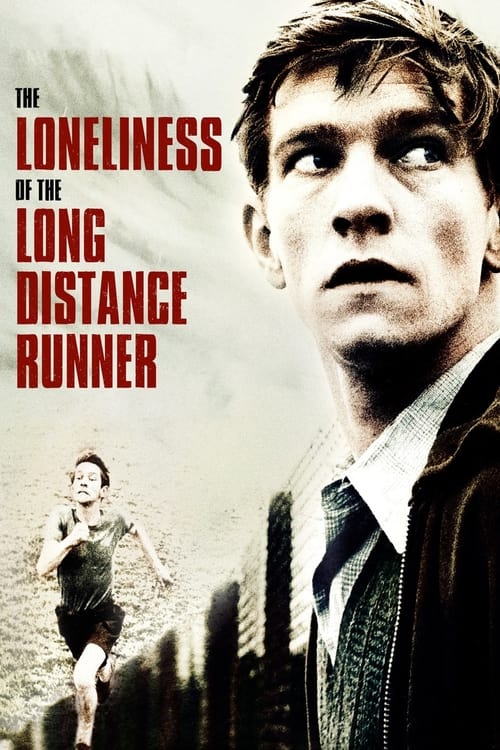
The Loneliness of the Long Distance Runner
1962 · Tony Richardson
For when you're feeling rebellious and want a film with a spine — a lean, defiant character study that leaves you arguing with yourself about what you'd have done.
What it's about
Colin Smith, a working-class Nottingham teenager, is sent to a borstal — a boys' reformatory — for robbing a bakery. When the Governor discovers he can run, Colin becomes the institution's great hope for a prestige cross-country race against a posh public school. Out on the long training runs, alone with his thoughts, he sifts through the dead-end jobs, family grief, and petty defiance that landed him here — and weighs what winning would actually mean, and for whom.
The experience
Raw, bristling, and unexpectedly lyrical — the anger of a kid who sees exactly how the system works, cut with the strange freedom of a body in motion. It simmers toward a finish with real moral force.
Performances
Tom Courtenay, in his star-making screen role, gives Colin a wary intelligence and coiled resentment that feels completely lived-in, opposite Michael Redgrave's smoothly self-serving Governor.
The craft
Shot in stark black and white on real streets and gray countryside, it splices Colin's runs with jagged flashbacks so his past and present race each other — bold, restless editing for its era. The location grit is the point: you can feel the cold.
Why it matters
A defining film of the British New Wave that gave the culture a lasting shorthand for principled refusal, and it launched Tom Courtenay as one of the faces of 1960s British cinema.
Snapshot
Tony Richardson's adaptation of Alan Sillitoe's 1959 short story is one of the defining texts of British kitchen-sink cinema: a film whose entire dramatic architecture builds toward an act of deliberate non-victory. Colin Smith (Tom Courtenay), a Nottingham delinquent sentenced to the Ruxton Towers borstal for robbing a bakery, is discovered to be a gifted runner by the institution's Governor (Michael Redgrave). Groomed to win an inter-borstal race against a public-school team, Colin uses the long training runs — and the solitary thinking time they afford — to work through the events that brought him here. In the final race, alone at the front, he stops yards from the tape and lets the rival cross first. The refusal is not impulsive; it is considered, political, and total. Few endings in British cinema carry the same charge of class consciousness made flesh.
Industry & production
The film was produced by Woodfall Film Productions, the company Richardson co-founded with playwright John Osborne in the wake of their stage and screen collaborations on Look Back in Anger. Woodfall had by 1962 already established a template for lower-budget, socially engaged British filmmaking: Look Back in Anger (1959), The Entertainer (1960), and A Taste of Honey (1961) preceded Loneliness in rapid succession, each expanding the company's ambition and critical standing. The budgets were modest and the production conditions spartan, which suited both the aesthetic ideology of Free Cinema and the economic realities of independent British production. Distribution in the United Kingdom was handled by British Lion.
Alan Sillitoe adapted his own story, which had appeared in his 1959 collection The Loneliness of the Long Distance Runner. The collection followed his breakthrough 1958 novel Saturday Night and Sunday Morning — itself filmed by Karel Reisz for Woodfall in 1960 — and Sillitoe was by that point one of the principal literary voices of the Angry Young Men formation. His involvement in the screenplay ensured that the story's aggressive first-person interiority, its sustained internal monologue of class resentment, was carried directly into the film's voiceover and flashback architecture rather than smoothed into conventional dramatic exposition.
Tom Courtenay, making his screen debut, had trained at RADA and had done stage work but arrived at Woodfall essentially unknown. The performance he gives — wiry, guarded, sardonic, physically committed — announced a new register for English screen acting. Michael Redgrave, playing the Governor with smooth patrician confidence, provides exactly the right counterweight: the face of institutional benevolence that Colin correctly identifies as a vehicle for class coercion. The casting opposition is the film's central dramatic instrument.
Technology
Loneliness was shot in black and white on 35mm, and like the other canonical Woodfall productions, it exploits the tonal range and documentary associations of monochrome deliberately. Color was available and increasingly common in British commercial cinema by 1962; its rejection here is a statement of intent, aligning the film with Italian neorealism and with the Free Cinema documentaries Richardson, Lindsay Anderson, and Karel Reisz had produced in the mid-1950s. Location work is extensive: the borstal sequences were filmed at the now-demolished Feltham Young Offender Institution in Middlesex, while the Nottingham flashback material was shot on location in the East Midlands, grounding the social world of the film in specific, legible geography. The long running sequences across open countryside — marshland, fields, pre-dawn fog — required mobile, lightweight camera work that pushed against the conventions of studio-bound British filmmaking.
Technique
Cinematography
Walter Lassally, who had shot A Taste of Honey for Richardson the previous year, lensed Loneliness with the restrained, observational eye he had developed through documentary work. His handling of the running sequences is the film's most discussed visual achievement: the camera accompanies Colin through open landscape with a freedom that contrasts sharply with the tight, surveilled spaces of the institution. Lassally's use of available or near-available light, his preference for long focal lengths that compress space and isolate the runner against his background, and his ability to work hand-held without losing compositional clarity are all in evidence. The film oscillates between this liberated exterior photography and a more constrained, deliberately claustrophobic framing within the reformatory — walls, corridors, the Governor's study — that embodies institutionalization as visual grammar.
Editing
Antony Gibbs, Richardson's regular editor during the Woodfall years, handles the film's unusually complex temporal structure with assurance. The film is essentially non-linear: Colin's present-tense runs are the frame, and the flashbacks — triggered associatively rather than chronologically — interrupt and interweave with them, so that the audience assembles Colin's backstory in fragments. This associative editing has clear debts to the French New Wave, whose practitioners were working in similar non-linear modes at precisely this moment, and the cuts can be abrupt, unmotivated by classical continuity, in ways that would have been conventionally unacceptable in mainstream British cinema only a few years earlier.
Mise-en-scène / staging
Richardson's staging choices throughout maintain a studied ambiguity between documentation and composition. The interiors of the borstal are staged with sociological precision — mealtimes, dormitories, the Governor's trophy room — while the exteriors resist any suggestion of the picturesque. The landscapes Colin runs through are neither beautified nor degraded; they simply exist, indifferent to his condition. The film's most charged piece of staging is the race itself: Richardson holds on Colin as he slows, watches his competitors approach from behind, and stands still. The duration of this pause is calibrated to be uncomfortable, the decision visible in real time on Courtenay's face before it becomes action.
Sound
John Addison's score is used selectively and strategically. The running sequences are frequently spare or nearly silent, allowing the sounds of breathing, footfall, wind, and distant birdsong to carry the weight of the soundtrack — an approach that heightens the sense of interior monologue and physical presence. The voiceover, delivered by Courtenay in a Nottingham accent without literary softening, is the film's primary sonic register for interiority; Addison's music is reserved for moments of emotional punctuation rather than continuous underscoring. The contrast between the sonic freedom of the outdoor sequences and the institutional noise of the borstal — whistles, shouted commands, collective movement — is a structural device.
Performance
Courtenay's performance is built on withholding. Colin is intelligent and his analysis of his situation is accurate, but he performs compliance well enough to be trusted with the runs that give him freedom; the performance communicates the double consciousness of a working-class subject who knows exactly what the system wants from him and has decided to give it the minimum. Redgrave's Governor is the more technically accomplished piece of work in classical terms — the benevolence is flawlessly maintained even as its controlling function becomes evident — but Courtenay's raw presence is what the film lives on.
Narrative & dramatic mode
The film works in a mode that might be called retrospective irony: we know from very early that Colin is already in the reformatory, already being shaped for the race, and the flashbacks are delivered as his private account of how the world actually works, delivered to us over the Governor's head. The storytelling structure privileges subjective interiority over objective event; what matters is not the chronology of the robbery and arrest but the formation of a consciousness that understands itself as class enemy. The film does not resolve Colin's situation — at the end he is returned to menial labor within the institution — but it resolves his selfhood: he knows who he is, and the refusal at the finish line is the act that confirms it.
Genre & cycle
Loneliness belongs centrally to the British kitchen-sink cycle that dominated prestige British filmmaking from approximately 1959 to 1963: Room at the Top (1958), Saturday Night and Sunday Morning (1960), A Taste of Honey (1961), A Kind of Loving (1962), This Sporting Life (1963), Billy Liar (1963). These films share a commitment to working-class Northern and Midlands settings, location shooting, social realism, and protagonists whose desires are in friction with the structures available to them. Within this cycle Loneliness is distinctive in its institutional setting and in the explicitness of its class-as-politics argument: Colin is not merely frustrated, he is ideologically opposed, and the film is unusual in making that opposition the dramatic endpoint rather than a background condition.
It is also a prison or borstal film, a subgenre with a long documentary lineage; and a sports film in which athletic competition is stripped of affirmative meaning and redeployed as the terrain of refusal.
Authorship & method
Richardson's method at Woodfall was collaborative in the manner of the best director-producer-writer trios: he worked closely with Sillitoe, trusted his key technicians substantially, and moved quickly. His theatrical background — he had directed John Osborne's stage premieres and was a principal at the Royal Court — gave him a strong instinct for actor-led moments and long unbroken takes, though his film work became increasingly cinematically adventurous across the Woodfall years. Loneliness benefits from his ability to get out of an actor's way.
Sillitoe's screenplay preserves the story's essential device — the runner's internal monologue — while necessarily externalizing it through voiceover and image. The collaboration is unusually seamless; Sillitoe's voice is not smoothed away in the adaptation, as Nottingham working-class idiom and class analysis remain fully present. Walter Lassally's documentary background and Free Cinema credentials were integral to the visual program of the film. John Addison, who would win the Academy Award for Best Original Score the following year for Richardson's Tom Jones (1963), demonstrates here the value of compositional restraint.
Movement / national cinema
The film is a core document of Free Cinema and British New Wave. Free Cinema — the movement announced by Richardson, Anderson, and Reisz with a series of documentary screenings at the National Film Theatre beginning in 1956 — had proposed a cinema attentive to working-class life, free from the commercial pressures that softened or sentimentalized social reality in mainstream British production. The manifesto's key terms were freedom, respect for the subject, and honesty; in practice they translated into location shooting, non-professional or stage-trained actors, and subject matter drawn from the lives of people who had rarely appeared in British films except as background. Loneliness represents the movement's fullest integration of its documentary ethics into a fiction feature of considerable narrative ambition.
The British New Wave, as a broader term encompassing the kitchen-sink cycle in fiction film, is often understood to have ended around 1963 as the counterculture, Swinging London, and new genre forms displaced social realism as the dominant modes of British prestige cinema. Loneliness sits near the end of the wave's most intense phase.
Era / period
1962 in British cinema is a year of convergence: the kitchen-sink cycle is at its peak, the Bond franchise begins with Dr No, and the first wave of Beatles-era pop culture is about to reshape the cultural landscape entirely. Loneliness appears in this moment as an almost anti-entertainment — a film that refuses the consolations of genre, resolution, and social mobility in the same year that cinema begins its pivot toward pleasure and spectacle. Its release coincides with a political moment in which class consciousness as an explicit framework was still available in British cultural discourse before being partially dissolved in the permissive optimism of the mid-decade.
Themes
The film's central thematic transaction is between the body and ideology. Colin's body is what the institution wants — specifically, his running body as a trophy to display institutional success. His refusal at the finish line is a refusal to let his body be conscripted into the Governor's narrative of rehabilitation and competition. The film is thus about autonomy as something only fully expressible in negation: Colin cannot build anything with his freedom, only refuse to surrender it.
Running itself is the film's extended metaphor for both freedom and subjugation: alone on the course, Colin is as free as he ever is; and yet the freedom is structured, permitted, purposive, ultimately in service of the institution. The flashbacks establish that his entire social formation has been one of managed unfreedom — his father's death from overwork, the brief windfall of the insurance money spent quickly on consumer goods that do not transform the underlying conditions, the petty criminality that is both rebellion and symptom.
The film is also concerned with intelligence and its social fate. Colin is not stupid — the voiceover makes this insistently clear — but his intelligence has no sanctioned channel. The Governor misreads it as a capacity for reform; Colin understands it as a capacity for analysis, and what it analyses is the mechanism of his own oppression.
Reception, canon & influence
Backward influences. The film draws directly on Italian neorealism, particularly the tradition of location-shot, social-subject filmmaking exemplified by De Sica and Rossellini; on the Free Cinema documentaries that Richardson and his colleagues had made in the mid-1950s; on the Angry Young Men literary formation and specifically on Sillitoe's prior work; and on the formal innovations of the French New Wave in its handling of time, memory, and non-linear structure. The theatrical tradition of the Royal Court, particularly Osborne's dramatization of working-class resentment, is a background condition.
Critical reception. The film was well received critically at the time of its release and was a significant critical success for Woodfall. Tom Courtenay received a BAFTA Award for Most Promising Newcomer, and the film received further BAFTA recognition. It was recognized as a key contribution to British social cinema, though its refusal of resolution made some critics uncomfortable by the standards of conventional dramatic satisfaction. Over subsequent decades its reputation has solidified considerably, and it is now routinely included in accounts of British cinema's most politically serious achievements.
Forward legacy. The film's most direct descendant in British cinema is Lindsay Anderson's If.... (1968), which takes the institution — here a borstal, there a public school — as the site of class warfare and ends in a similarly uncompromising act of violence-as-refusal. Anderson had been Richardson's colleague in Free Cinema and the thematic continuity is not coincidental. The image of the solitary, politically conscious runner became an enduring figure in British cultural iconography. The film's structural device of the sporting competition as a test of ideological allegiance rather than athletic merit recurs across later British films; this use of sport as class terrain rather than simply entertainment or drama is one of the kitchen-sink cycle's contributions to the grammar of British cinema. The deliberate act of losing — as distinct from failure — remains a comparatively rare dramatic gesture in cinema, and Loneliness is its most cited instance.
A Deleuzian reading
Before anything else, hold the sound.
The full Deleuzian reading of The Loneliness of the Long Distance Runner →
Reception
A well-received entry in the British New Wave on release, it was quickly overshadowed by Richardson's own Tom Jones the following year — but it has aged into one of the defining kitchen-sink films, its anti-establishment streak feeling sharper now than ever.
How The Loneliness of the Long Distance Runner was received, from release to now →
Influences: the films it descends from and the films it influenced
- Bicycle Thieves (1948) — De Sica's non-studio location-shooting grammar, working-class protagonist denied narrative resolution, and milieu-as-social-document approach gave Richardson and Lassally their neorealist template for the Nottingham reformatory sequences.
- Every Day Except Christmas (1957) — Anderson's Free Cinema documentary established the handheld available-light grammar of working-class labor that Richardson and Lassally imported into the reformatory's exterior running sequences, treating Covent Garden porters with the same observational attention Smith's body receives on the track.
- Look Back in Anger (1959) — Richardson's own Woodfall debut translated Royal Court class rage into cinema, establishing the production grammar — sustained performance-led takes, theatrical interiority, working-class resentment as formal energy — that Loneliness extends to its most austere register.
- The 400 Blows (1959) — Truffaut's reformatory-as-class-oppression apparatus and the culminating image of a boy running toward an impossible horizon established the structural figure Richardson inherits and inverts: where Antoine reaches the sea and freezes, Smith reaches the finish line and refuses.
- Hiroshima Mon Amour (1959) — Resnais's intercutting of present action with fragmented memory flashbacks through associative rather than causal logic gave Richardson the editorial architecture for Smith's alternation between borstal training runs and Nottingham past, where memory charges and recontextualises present meaning.
- Saturday Night and Sunday Morning (1960) — Reisz's Woodfall adaptation of Sillitoe's Nottingham fiction directly shaped the production model: same novelist-adapts-own-material method, same northern milieu, same defiant anti-hero who refuses accommodation into bourgeois norms, establishing the template Richardson took further into institutional refusal.
- A Kind of Loving (1962) — Schlesinger's contemporaneous kitchen-sink uses long-lens northern England location photography that compresses and isolates working-class characters within their social geography, treating the industrial landscape as visual argument rather than backdrop.
- Billy Liar (1963) — Schlesinger deploys associative fantasy sequences that interrupt and overlay the northern working-class present with the protagonist's interiority, structurally analogous to Smith's track-flashback alternation — the same device of subjective escape-through-imagination from social trap.
- Mouchette (1967) — Bresson takes Richardson's withholding-performance method to its formal extreme, showing a working-class girl's body conscripted and damaged by institutional forces — school, church, family — with the same refusal of cathartic resolution, ending in self-annihilation rather than defiance.
- If.... (1968) — Anderson directly transposes Richardson's borstal-as-class-warfare-site to a public school, with Mick Travis as ideological heir to Colin Smith, escalating Richardson's act of losing a race into armed insurrection as the terminal form of institutional refusal.
- Kes (1969) — Loach inherits Richardson's handheld available-light cinematography and working-class adolescent male protagonist, placing Billy Casper's kestrel in the same structural position as Smith's running — an act of individual expression that the institution will ultimately destroy.
- Ratcatcher (1999) — Ramsay imports Richardson's associative non-linear editing and ambient-over-score sound design to construct a working-class Scottish boy's subjective interiority, refusing narrative causality in favour of the same consciousness-centred fragmentary structure that organizes Smith's flashbacks.
- Sweet Sixteen (2002) — Loach extends the kitchen-sink lineage through ambient-over-score sound and Loachian naturalistic performance, where a Scottish working-class youth's social trap echoes Smith's borstal situation — but without even the symbolic agency of a deliberate loss to mark resistance.
- Fish Tank (2009) — Arnold extends Richardson's kitchen-sink grammar to a female working-class protagonist, using the same handheld available-light cinematography and ambient sound design with a withholding performance at center, updating the conscripted-body interiority for a contemporary Essex council estate.
- Naked (1993) — Models the alienated young man as a figure of principled refusal, threading subjective interiority through a realist surface that Leigh inherits and hardens.
- Meantime (1983) — Pioneers the disaffected working-class young man framed against institutional confinement (borstal/dole), the precise figure Leigh reworks through Colin and Mark's aimless estate drift.
- The Hill (1965) — British social-realist study of a punitive institution (the borstal) versus the individual, with the governor as an authority figure whose performance of discipline masks self-interest — the class-and-institution truth Rigby's script extends.
- Billy Elliot (2000) — Pairs working-class physical talent (running) with class entrapment, using lyrical slow-motion and freedom-through-the-body montage that prefigures Billy's dance-as-escape sequences.
- This Sporting Life (1963) — Anderson takes Richardson's central device — sport as class terrain rather than athletic contest — and applies it to rugby league, where the working-class body is similarly bought, managed, and ultimately broken by institutional exploitation with no compensatory victory.
- A Taste of Honey (1961) — Richardson's next Woodfall film uses Lassally's cinematography again with identical improvisatory staging, mood-driven ellipsis, and refusal of redemption, confirming that Honey's craft approach was a systematic method rather than a one-off accident.
- Inside Llewyn Davis (2013) — Richardson's protagonist deliberately loses a race he could win — a structural refusal of redemptive success that the film frames not as tragedy but as integrity — making this the British New Wave prototype for the Sisyphean sabotage of one's own potential that Llewyn enacts at every professional opportunity.
Similar films
- This Sporting Life (1963) — influence & lineage
- Look Back in Anger (1959) — influence & lineage
- Billy Liar (1963) — influence & lineage
- The 400 Blows (1959) — influence & lineage
- A Kind of Loving (1962) — influence & lineage
- Nineteen Eighty-Four (1984) — same viewing thread
- The Long Walk (2025) — shared sensibility
- A Taste of Honey (1961) — shared sensibility
All the films related to The Loneliness of the Long Distance Runner →
Watch it with: curated runs of related films
- Discipline and Defiance — A run of men pitted against total institutions — prisons, wards, camps, the state — where the only freedom left is refusing to break.