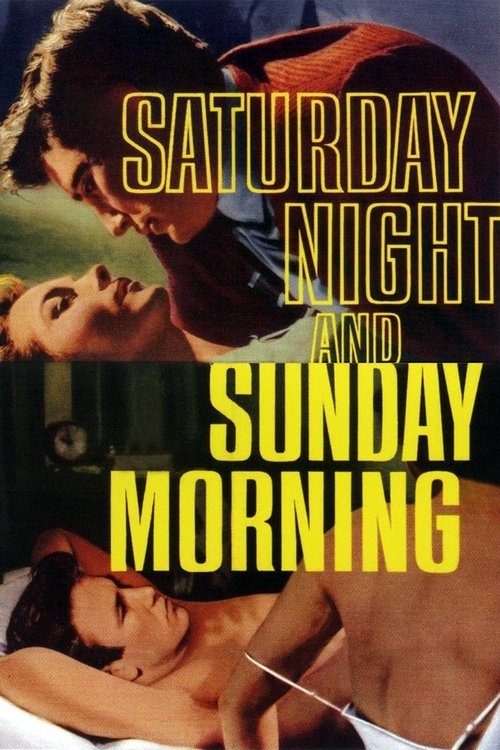
Saturday Night and Sunday Morning
1960 · Karel Reisz
For when you want grit with a pulse — a short, sharp character study about being young, broke, and furious at your lot, best on a night you're in the mood for something real rather than escapist.
What it's about
Arthur Seaton is a 22-year-old lathe operator in Nottingham who lives for the weekend: hard drinking, harder opinions, and an affair with an older married woman even as he courts a girl his own age. He's cocky, funny, and contemptuous of every boss, neighbor, and rule — until his don't-let-the-bastards-grind-you-down philosophy starts colliding with consequences.
The experience
Bracing and alive — it crackles with pub energy, factory clatter, and a young man's swagger, then deepens into something more bruised and honest about what rebellion actually costs. Funny, sexy for its era, and tough-minded without ever preaching.
Performances
Albert Finney, in the role that made him a star, is electric as Arthur — all coiled charisma and sneering charm, making a selfish young man magnetic and, by the end, quietly moving.
The craft
Karel Reisz shot it on location in Nottingham's streets, factories, and terraced houses with a documentary-trained eye, so the film has a lived-in texture British cinema simply hadn't shown before. The dialogue is salty and specific, the class detail exact; it's realism with rhythm rather than gloom.
Why it matters
The foundational film of British kitchen sink realism — it proved working-class stories told in working-class voices could be both serious cinema and a box-office hit, opening the door for a whole generation of British filmmakers.
Snapshot
Karel Reisz's debut feature is the foundational text of British Kitchen Sink cinema: a portrait of Arthur Seaton, a 22-year-old Nottingham lathe-operator who drinks hard, beds two women simultaneously, and nurses a corrosive contempt for every form of authority. Shot on location in Nottingham with a kinetic naturalism borrowed from Reisz's documentary work, and powered by Albert Finney's visceral, career-defining performance, the film transformed what British audiences expected to see on their cinema screens—working-class life filmed with the raw specificity of the streets where it was lived. Its commercial success proved that austerity-era social realism could move tickets, and its formal confidence gave an entire generation of British filmmakers a template for what serious popular cinema could be.
Industry & production
Saturday Night and Sunday Morning was produced by Harry Saltzman through Woodfall Film Productions, the independent company founded by director Tony Richardson and playwright John Osborne in the wake of their adaptation of Look Back in Anger (1959). Woodfall occupied a singular structural position in early-1960s British cinema: it was genuinely independent at a moment when the major circuits—Rank and ABC—still exercised enormous leverage over what could be distributed, yet it maintained distribution access through British Lion and, eventually, Warner-Pathe. Saltzman, a Canadian-born showman with a restless commercial instinct, optioned Alan Sillitoe's debut novel shortly after its 1958 publication, when Sillitoe was still largely unknown; his willingness to hire a first-time feature director and a stage actor with minimal screen credits reflected Woodfall's habitual appetite for risk. The budget was modest by mainstream British standards—exact figures have varied in secondary sources and the primary accounting is not readily verifiable—but the production's economies proved an aesthetic asset: location shooting in Nottingham was logistically lighter and visually richer than a studio recreation would have been. The film was shot partly at the Raleigh Cycles factory in Nottingham, whose actual industrial machinery provides the film's opening images and grounds Arthur's labor in concrete physical reality. British Lion distributed the film; it opened in the UK in October 1960 and became one of the most commercially successful British pictures of that year, demonstrating that Kitchen Sink subject matter was not the box-office liability the mainstream industry had assumed.
Technology
The film was photographed in black-and-white on 35 mm, a choice that was in 1960 still conventional for British drama but was already being coded, in the context of social realism, as a deliberate aesthetic and ideological statement—refusal of the Technicolor glamour that softened the surfaces of domestic melodrama and musical comedy. Black-and-white also suited location work: exposure latitude was more forgiving under the variable English light, and the tonal range of monochrome photography naturalized the gray textures of factory floors and terrace-house interiors. Reisz and cinematographer Freddie Francis exploited the flexibility of lighter camera configurations to shoot handheld in confined spaces, most notably in the cramped domestic interiors and pub sequences where mobility was essential to capturing spontaneous-seeming performance. No notable optical processes or experimental stocks are documented in standard accounts of the production; the technological choices were strategic rather than experimental.
Technique
Cinematography
Freddie Francis—who had already won a BAFTA nomination and was building a reputation as one of British cinema's most resourceful lighting cameramen—brought an approach that balanced documentary immediacy with compositional precision. His Nottingham location work is characterized by deep-focus compositions that embed Arthur within his social environment: rows of terrace houses, canal banks, factory gates, and fairground rides appear not as backdrop but as pressure bearing down on the protagonist. Francis found pools of available light in cramped interiors rather than flooding scenes with fill, which gives the domestic spaces a chiaroscuro that implies constriction without melodramatic overstatement. The famous opening sequence—Arthur at his lathe, the camera close on the mechanisms of industrial production—establishes a visual grammar that equates body and machine, human rhythm and factory rhythm. Francis later won Academy Awards for his work on other directors' films (Sons and Lovers, also 1960; Glory, 1989) and went on to direct a substantial body of horror films; Saturday Night and Sunday Morning sits at the beginning of his mature period.
Editing
The film's editing is attributed to Seth Holt, a veteran of Ealing Studios who later directed features of his own. The cutting enforces the film's episodic, weekend-to-weekend structure without imposing artificial momentum: scenes end at the moment of emotional completion rather than on conventional dramatic beats, and the rhythm between sequences mirrors Arthur's own cycles of energy and inertia—brawling exuberance followed by the gray Monday morning return. Holt's approach avoids the frenetic continuity cutting associated with American genre pictures; scenes breathe, and the ellipses between them carry weight. The editing's reticence is itself an argument about working-class time—the week consumed by the factory, the weekend spent in furious, repetitive release.
Mise-en-scène / staging
Reisz's staging consistently refuses the conventions of theatrical artifice that had characterized much British prestige drama. Actors inhabit real spaces rather than performing in front of them: the pub scenes are composed around actual customers, the factory sequences were filmed during shifts with real workers present, and the domestic interiors were dressed to look inhabited rather than designed. This approach, drawn directly from Reisz's Free Cinema documentary practice, produces a pervasive sense of social density—Arthur is always one figure among many, never the sole object of the frame's attention. Blocking tends toward the lateral and circular rather than the frontal compositions of theatrical staging; people move around each other in cramped rooms in ways that imply the physical texture of lives lived at close quarters.
Sound
The film's sound design is unremarkable in the sense that it does not draw attention to itself, which is itself a formal commitment: ambient industrial noise, pub chatter, and street sound are captured with documentary fidelity rather than stylized or suppressed. Johnny Dankworth composed the score, deploying jazz inflections that were characteristic of the cycle—Dankworth scored several British New Wave pictures—and which signified, to 1960 audiences, a cosmopolitan, non-establishment sensibility. The score is used sparingly; silence and ambient sound carry much of the emotional register. The decision to keep the factory noise present and unprocessed during the opening lathe sequences is notable: the sound environment establishes the violence of industrial work before any narrative information is delivered.
Performance
Albert Finney's Arthur Seaton is among the most consequential performances in British cinema history, not for its technical virtuosity—though that is considerable—but for what it made legible on screen. Finney, then 24, had trained at RADA and worked in the theater; he brought to the role a physical specificity and regional authenticity (though himself from Salford, Lancashire, he inhabited Arthur's Nottingham voice with apparent ease) that the British cinema had rarely allowed its working-class protagonists. Arthur is not redeemed, not educated out of his condition, not reconciled to middle-class norms; Finney plays him without apology or irony, allowing the character's aggression, sensuality, and self-contradiction to coexist without resolution. Rachel Roberts as Brenda—married, desperate, complicit—brings a grounded sadness that prevents her from functioning as merely a narrative complication, and her scenes with Finney achieve a tense erotic realism unusual for British mainstream cinema of the period. Shirley Anne Field as Doreen represents a softer, more accommodating femininity, and the film is honest about the ways Arthur is drawn to her ordinariness even as he resists what it represents. Finney had a small role in Richardson's The Entertainer (1960) before this film; Saturday Night and Sunday Morning made him a star.
Narrative & dramatic mode
The film follows Arthur across several weeks rather than a conventionally plotted arc, tracking the collision between his anarchic weekend life—drinking, fishing, an affair with the married Brenda, a developing attachment to the younger Doreen—and the social machinery that will eventually contain him. The dominant dramatic mode is episodic rather than causal: events accumulate rather than develop, and the climax (Arthur beaten by soldiers, Brenda's pregnancy resolved off-screen, the final image of him hurling a stone toward a new housing estate) is deliberately inconclusive. Sillitoe's screenplay, adapted from his own novel, preserves the novel's interior monologue energy through Finney's performance rather than voiceover; Arthur's philosophy—encapsulated in the repeated refrain "Don't let the bastards grind you down"—is dramatized rather than narrated. The film's refusal of the Bildungsroman's upward mobility is structurally radical: Arthur ends the film neither defeated nor transformed, only redirected.
Genre & cycle
Saturday Night and Sunday Morning is the defining instance of British Kitchen Sink cinema, a cycle running approximately from Room at the Top (1958) through to This Sporting Life (1963) and A Kind of Loving (1962). The term "kitchen sink," borrowed from a dismissive critical response to a John Bratby painting, was applied to a cluster of British plays, novels, and films that placed working-class protagonists in unglamorous domestic and industrial settings, repudiating the drawing-room drama and Ealing comedy that had dominated postwar British film. The cycle has identifiable formal and thematic signatures: Northern or Midlands settings, location shooting, black-and-white photography, male protagonists defined by frustrated energy, and a frank treatment of sexuality that tested the limits of the British Board of Film Censors. Saturday Night and Sunday Morning sits alongside Look Back in Anger and A Taste of Honey as the cycle's canonical texts.
Authorship & method
Karel Reisz was born in Czechoslovakia in 1926, came to England as a Jewish refugee in 1938, and built his critical and practical formation in postwar British film culture: he contributed regularly to Sight & Sound, co-wrote The Technique of Film Editing (1953, with Gavin Millar)—a text that remained a standard reference for decades—and was central to the Free Cinema movement alongside Lindsay Anderson and Tony Richardson. The Free Cinema screenings at the National Film Theatre between 1956 and 1959 presented short documentaries committed to the belief that observational filmmaking of ordinary life had both political and aesthetic integrity. Reisz's own Free Cinema shorts, including We Are the Lambeth Boys (1959), established the observational grammar he would bring to Saturday Night and Sunday Morning. His method was to spend extensive time with Sillitoe and with the communities being filmed before production began; the preparatory work gave the fiction a texture of documentary familiarity. Alan Sillitoe's authorship of the source novel and the screenplay is central: his decision to write the adaptation himself ensured that Arthur's interior argot—the class anger, the sexual candor, the defiant nihilism—was preserved rather than softened. Freddie Francis as cinematographer and Johnny Dankworth as composer complete the core creative partnership.
Movement / national cinema
The film is inseparable from two overlapping formations: Free Cinema and the British New Wave. Free Cinema was a documentary and manifesto movement; the British New Wave was its fictional extension, shaped also by the Angry Young Men literary movement (Sillitoe, John Osborne, Kingsley Amis, John Braine) and by the influence of Italian Neorealism and the French Nouvelle Vague—though the British filmmakers were largely developing parallel rather than derivative work. The New Wave's investment in working-class experience was also a critique of the British class system at a moment of particular instability: the late 1950s and early 1960s saw significant social mobility, rising working-class incomes, and the first sustained challenges to postwar deference. Saturday Night and Sunday Morning dramatizes this instability through Arthur, who has money (he earns good piece-work wages) but no power, sexual freedom but no autonomy, contempt for authority but no alternative to it.
Era / period
The film belongs to a specific conjuncture in British social history: the late 1950s, before the counterculture and the formal liberalization associated with the mid-1960s, but after the austerity of the immediate postwar years. The Nottingham Arthur inhabits is industrially stable—the Raleigh factory employed thousands—but the new housing estates being constructed at the film's edges anticipate the suburban dispersal that would dissolve the tight terrace-house communities the film depicts. The film is also positioned at the end of the decade-long period during which the BBFC operated under John Trevelyan's relatively reforming leadership; it secured an X certificate for its frank treatment of adultery, attempted abortion, and sexuality, which became part of its publicity.
Themes
The film's central tension is between individual freedom and social reproduction—Arthur wants to live outside the systems (marriage, factory hierarchy, military discipline) that organize working-class existence, but his resources for resistance are entirely absorbed by the very cycles—drinking, fighting, fornication—that those systems have already accommodated. The motif of fishing recurs as an image of solitary, purposeless pleasure that belongs to no social institution; it is the one activity Arthur performs without aggression. The film is also about the specific texture of mid-century working-class masculinity: the requirement to perform hardness, the homosocial codes of pub and factory, the simultaneously desired and dreaded domesticity that Doreen represents. Gender is not a secondary theme but a structural one: both Brenda and Doreen are trapped in their different ways, and Arthur's freedom is partly constituted by their entrapment.
Reception, canon & influence
Critical reception: Initial British critical response was generally enthusiastic, recognizing the film as a formal and cultural rupture; international notices followed, with French critics—already attuned to the New Wave's social realism—responding with particular attention. The film did not receive the hostile dismissal that Kitchen Sink work sometimes attracted from conservative critics; its commercial success gave it a legitimacy the cycle had not uniformly enjoyed.
Influences on the film: The Italian Neorealist tradition—De Sica's Bicycle Thieves (1948), Visconti's La terra trema (1948)—provided the formal precedent for location shooting and non-professional-texture performance. Free Cinema's own documentary work was the direct methodological precursor. Room at the Top (Jack Clayton, 1958), adapted from John Braine's novel, established that working-class Northern subject matter could achieve mainstream commercial and critical success and prepared audiences for Sillitoe's more abrasive protagonist. The influence of American Method acting—and of the theatrical revolution associated with the Royal Court Theatre from 1956 onward—shaped Finney's performance approach.
Legacy: Saturday Night and Sunday Morning established the template for virtually every British social realist film of the following three years: A Taste of Honey (Richardson, 1961), The Loneliness of the Long Distance Runner (Richardson, 1962), A Kind of Loving (John Schlesinger, 1962), Billy Liar (Schlesinger, 1963), and This Sporting Life (Lindsay Anderson, 1963) all work variations on its formal and thematic grammar. Its international influence on social realist cinema—on the emergence of comparable cycles in other national cinemas during the 1960s—is harder to trace with precision but is periodically claimed by film historians. Finney's performance established a mode of working-class masculinity on film that reverberated through British cinema and theater for decades. The film now occupies a stable canonical position: it appears regularly on BFI and critical surveys of British cinema, is taught as a foundational text in Film Studies curricula, and is treated as the decisive formal break between the Rank-era prestige picture and the New Wave that succeeded it.
A Deleuzian reading
The film opens on a lathe.
The full Deleuzian reading of Saturday Night and Sunday Morning →
Reception
A smash hit on release — X-rated, BAFTA-garlanded, and one of the biggest British box-office draws of its year — it's since settled into history as the definitive kitchen-sink film, the one that proved working-class life could carry a British picture.
How Saturday Night and Sunday Morning was received, from release to now →
Influences: the films it descends from and the films it influenced
- Bicycle Thieves (1948) — Reisz adopted De Sica's method of shooting entirely on authentic location—real streets, real factories—with a performer whose working-class physicality reads as documentary truth rather than theatrical impersonation; the Nottingham factory sequences are a direct formal inheritance.
- La terra trema (1948) — G.R. Aldo's deep-focus location photography among Sicilian fishing communities—real labor spaces rendered with compositional depth and physical density—established the precedent for Freddie Francis's depth-of-field work inside the Raleigh bicycle factory.
- Room at the Top (1958) — Freddie Francis photographed both films; his approach to available-light interiors and Northern English location work in Bradford transferred directly to Saturday Night—the craft continuity is literal, not merely stylistic, and Clayton's frank adult sexuality onscreen cleared the path Reisz followed.
- Look Back in Anger (1959) — Richardson's adaptation established the Royal Court 'Angry Young Man' performance mode on film; Burton's physically committed delivery of working-class male rage gave Reisz and Finney a direct template for Arthur Seaton's defiant embodied energy.
- We Are the Lambeth Boys (1959) — Reisz's own Free Cinema documentary, shot handheld with available light in a Stockwell youth club, established the observational grammar—unobtrusive placement, diegetic ambient sound, non-professional behavioral texture—that he transferred intact to the Nottingham locations.
- O Dreamland (1953) — Anderson's six-minute direct-sound observation of a Margate funfair established the Free Cinema principle that available light and ambient working-class leisure spaces could constitute a political aesthetic; Reisz inherited this grammar for the pub and fairground sequences.
- A Taste of Honey (1961) — Walter Lassally's handheld black-and-white location cinematography in Manchester extends the available-light grammar simultaneously; Richardson's episodic adaptation uses the same non-linear cutting structure to track a working-class girl's resistant anti-bildungsroman, the two films forming twin poles of the cycle.
- The Loneliness of the Long Distance Runner (1962) — Lassally's flash-cut editing between present borstal and past Nottingham street sequences extends Reisz's episodic structure into a subjective temporal grammar, using the physical act of running as a kinetic thread linking discontinuous memory and present rebellion.
- A Kind of Loving (1962) — Denys Coop's black-and-white Bradford location work directly replicates the Saturday Night visual grammar; the narrative of a working-class draughtsman trapped by unintended pregnancy into a dead marriage extends Reisz's anti-bildungsroman template with near-structural fidelity.
- This Sporting Life (1963) — Denys Coop's available-light cinematography combined with Anderson's non-linear flashback editing extends Reisz's episodic structure; Richard Harris's physically grueling performance in body-contact rugby sequences shot entirely on location escalates the Saturday Night grammar into expressionist territory.
- Billy Liar (1963) — Denys Coop's Bradford location work; the fantasy-sequence editing interpolates subjective escape fantasies into the kitchen-sink grammar, extending Reisz's episodic cutting with a psychological interiority that the Saturday Night template gestured at but did not fully develop.
- If.... (1968) — Miroslav Ondříček's cinematography alternating black-and-white with color sequences without realist motivation extends Free Cinema's black-and-white aesthetic by making the photographic register itself a marker of subjective versus institutional vision—a formal radicalization of the movement's grammar.
- Kes (1969) — Chris Menges's handheld location cinematography in Barnsley and David Bradley's non-professional performance directly inherit Reisz's observational grammar; Loach deepens the anti-bildungsroman of systematic working-class defeat and strips out even the jazz score, replacing it entirely with diegetic ambient sound.
- Nil by Mouth (1997) — Ron Fortunato's handheld available-light cinematography in South London council estates and the performance of physical masculine violence through behavioral naturalism rather than choreography directly extend the Saturday Night grammar across three decades into a harsher register of domestic entrapment.
- Fish Tank (2009) — Robbie Ryan's handheld available-light cinematography and the casting of non-professional Katie Jarvis extend the Saturday Night observational grammar; Arnold's episodic anti-bildungsroman of a working-class girl in an Essex estate recasts Reisz's resistant male protagonist as female, using the same structure to identical formal ends.
- Secrets & Lies (1996) — Freddie Francis's available-light cinematography in cramped working-class Nottingham interiors, refusing studio supplementation, established the visual ethics Dick Pope inherits: authentic domestic space as documentary truth-claim rather than designed mise-en-scène.
- Naked (1993) — Founds the kitchen-sink mode Naked descends from: on-location working-class settings shot with documentary plainness around a defiant, self-sabotaging antihero.
- Darling (1965) — The British New Wave's location-shot, documentary-derived observation of working life is the realist grammar Schlesinger carries upmarket into satire of the affluent.
- Beautiful Thing (1996) — British New Wave template of shooting working-class estates on location in available light, letting architecture and street stand in for exposition — the naturalistic-daylight register Seager reprises on Thamesmead.
Similar films
- This Sporting Life (1963) — influence & lineage
- A Taste of Honey (1961) — influence & lineage
- A Kind of Loving (1962) — influence & lineage
- The Loneliness of the Long Distance Runner (1962) — influence & lineage
- Look Back in Anger (1959) — influence & lineage
- Billy Liar (1963) — influence & lineage
- Nil by Mouth (1997) — influence & lineage
- Bicycle Thieves (1948) — influence & lineage
All the films related to Saturday Night and Sunday Morning →