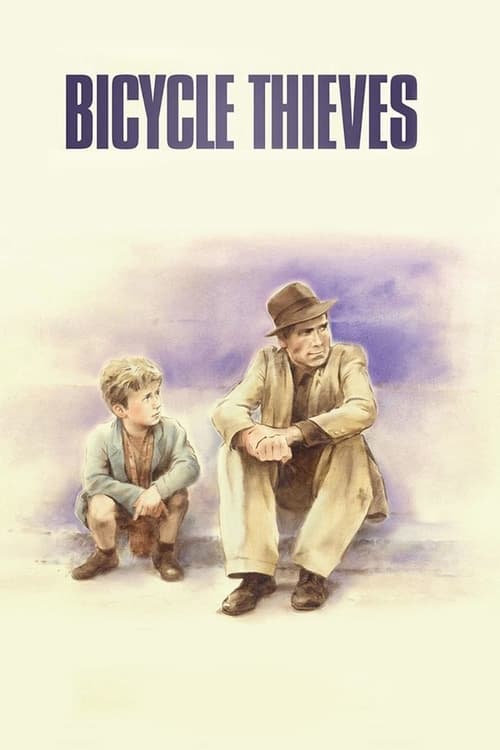
Bicycle Thieves
1948 · Vittorio De Sica
For when you want to feel something real — a short, humane film that earns its emotion without a single manipulative note. Have tissues ready; this is the good-cry pick that also happens to be one of the greatest films ever made.
What it's about
In postwar Rome, Antonio finally lands a job after months of unemployment — hanging posters around the city, work that requires a bicycle. On his first day, the bicycle is stolen. With his young son Bruno at his side, he spends a desperate day combing the streets, markets, and churches of Rome for it, because without the bike the job, and the family's fragile foothold, is gone.
The experience
Simple, immediate, and devastating — the stakes are only a bicycle, and that's exactly why it grips like a thriller and lands like a tragedy. The bond between father and son, watched hour by hour under pressure, is what breaks your heart.
Performances
Lamberto Maggiorani, a factory worker with no acting experience, carries the film with a worn, wordless dignity no star could fake, and young Enzo Staiola as his son gives one of the great child performances — watchful, proud, and heartbreaking.
The craft
Shot on real Roman streets with non-professional actors, it strips away plot machinery until drama comes from nothing but poverty persisting through a single day. The direction is invisible in the best sense: every choice serves the truth of faces, streets, and weather.
Why it matters
It became the defining film of Italian Neorealism and one of the most studied works in world cinema, hailed on release as the closest movies had come to pure realism. Generations of filmmakers across the world learned from it that ordinary life, honestly observed, is enough.
Snapshot
A Roman bill-poster has his bicycle stolen on his first day of work after months of unemployment. He and his young son spend a day combing the city for it. Nothing is recovered. Nothing is resolved. In eighty-nine minutes, Vittorio De Sica and screenwriter Cesare Zavattini stripped the postwar social problem film down to its irreducible minimum and produced what André Bazin would call the closest cinema had come to pure realism — a work in which drama arises not from plot machinery but from the simple fact of poverty persisting through time. Ladri di biciclette (the original Italian title is plural, a deliberate irony pointing toward the film's final movement) remains the canonical text of Italian Neorealism and one of the most studied films in world cinema.
Industry & production
By 1948 De Sica had already established the neorealist mode with Shoeshine (Sciuscià, 1946), a film about two shoeshine boys destroyed by the reformatory system, which won the first honorary Academy Award for foreign-language film. Bicycle Thieves was financed domestically through Produzioni De Sica (later rebranded PDS), with Giuseppe Amato serving as producer. Italian industry infrastructure had been devastated by the war; Cinecittà had been used as a refugee camp, and low-budget, location-shot production was partly a creative philosophy and partly an economic necessity.
The production's most celebrated confrontation with the market concerned casting. De Sica's refusal to populate the film with established actors led to pressure — recounted widely in Italian film history, including by De Sica himself — to cast a recognizable international star in the lead role; the name most often attached to this demand is Cary Grant. De Sica declined and instead cast Lamberto Maggiorani, a factory worker from the Breda engineering plant, as Antonio Ricci. Enzo Staiola, who plays the son Bruno, was reportedly spotted on the street near a set, his round, watchful face drawing the director's attention. Neither had film experience. Their inexperience was the point.
Luigi Bartolini's 1946 novel provided the title and the situation — a man whose bicycle is stolen — but almost nothing else. Zavattini's adaptation transformed Bartolini's picaresque, somewhat bitter first-person account into a spare, third-person chronicle. Bartolini later expressed displeasure at how far the screenplay had departed from his source; the divergence is substantial enough that the film is better understood as an original work grounded in Zavattini's poetic-realist philosophy than as an adaptation in any conventional sense.
Technology
The film was shot on 35mm, almost entirely on location across Rome: the Porta Portese market, the Piazza Vittorio Emanuele II, the Trastevere neighborhood, the San Giovanni quarter, a rain-soaked stadium approach, and the working-class outskirts of the city. Studio interiors were avoided almost entirely. Cinematographer Carlo Montuori used panchromatic black-and-white stock with lighting that supplemented — rather than replaced — ambient conditions; reflectors and portable units were deployed to balance natural light without neutralizing its quality. The result is an image that reads as documentary even while it is carefully composed.
Montuori was a veteran of Italian silent and early sound cinema, not a young experimentalist, and his contribution to the neorealist aesthetic is sometimes underemphasized in accounts that foreground De Sica and Zavattini's theoretical program. His experience gave him the technical fluency to work quickly in uncontrolled environments — crowded markets, rain, traffic — while maintaining compositional coherence. Deep-focus photography, influenced in part by the international circulation of Orson Welles's and Gregg Toland's work in the early 1940s, allowed Antonio and Bruno to remain in spatial relationship with the teeming Roman environment rather than isolated against neutral backgrounds.
Technique
Cinematography
Montuori's camera does not aestheticize poverty. The framing is functional rather than expressive in the manner of, say, German Expressionism or even French Poetic Realism — there are no tilted angles, no heightened shadows. Instead the image places bodies inside social space and holds them there. Long-shot and mid-shot dominate; close-ups are reserved for moments of psychological revelation and therefore land with accumulated force. The sequence in which Antonio's humiliation is witnessed by his son — Bruno's face registering the collapse of paternal authority — is among the most precisely timed close-up deployments in the classical period.
The crowd sequences demanded particular logistical effort. Shooting in the Porta Portese flea market — still one of Rome's largest — meant working among thousands of real market-goers largely unaware of the production. The resulting texture of anonymous, purposeful urban life is irreproducible by any other means.
Editing
Eraldo Da Roma, who edited many of the central works of Italian Neorealism (including Rossellini's Rome Open City and Paisà), assembled the film with a transparency that became definitive of the movement's style. Cuts are motivated by eyeline and action rather than by dramatic emphasis; there is no montage in the Soviet sense, no rhythm imposed on material from outside. The editing matches the film's philosophical premise: that the camera should follow reality rather than construct it. Sequences play at close to real time; ellipsis is used sparingly. The effect is of duration — the audience feels the exhaustion of the search accumulate across the day.
Mise-en-scène / staging
De Sica's staging reflects his background as a stage actor and his deep understanding of how non-professionals behave under direction. He frequently staged actions for the camera without telling the non-actors where to look or what to feel, instead engineering situations — blocking, proximity, timing — that produced natural responses. The relationship between Maggiorani and Staiola functions as much through physical proximity and distance as through dialogue: the way Bruno walks a step behind his father, or the moment when Antonio takes the boy's hand as if seeking comfort he cannot ask for directly.
The film makes expressive use of institutional space — the church, the employment office, the police station — as environments that dwarf individual need. Antonio's encounters with these institutions are staged to emphasize their indifference: crowds, paperwork, disinterested bureaucrats. The witch's apartment, where Antonio consults a fortune-teller in a moment of desperation, is a rare interior that De Sica photographs with something like unease, its bourgeois clutter contrasting with Antonio's threadbare surroundings.
Sound
Italian film production in this period relied extensively on post-synchronized dubbing, and Bicycle Thieves is no exception; the ambient sound of Rome — traffic, crowd noise, rain — was added or enhanced in post-production. This is worth noting against the film's reputation as a document of unmediated reality: the soundscape is constructed, even if constructed from plausible materials. Alessandro Cicognini's score is spare and selective, deploying orchestral music at key emotional junctures — including the distressing final sequence — without overwhelming the quieter observational passages. Cicognini had been De Sica's composer since I bambini ci guardano (1944) and would continue through Umberto D. (1952); his understanding of when to withhold music is as important as his themes.
Performance
Maggiorani's performance is one of the great instances of neorealist acting: physically specific, emotionally available without being theatrical, and entirely without the markers of trained performance. His Antonio is a man whose dignity is entirely tied to his capacity to provide — and who visibly diminishes as that capacity is stripped away. The performance communicates interiority through posture and silence rather than facial expression. Staiola as Bruno matches him, projecting a child's loyalty and growing unease in ways that feel unperformed. De Sica later reflected that his primary method with non-professionals was to ensure they understood the situation as a situation, not as something to act.
Narrative & dramatic mode
Zavattini articulated his theory of cinema as "pedinamento" — literally, tailing or shadowing — the act of following a person through ordinary time rather than compressing life into dramatic incident. Bicycle Thieves is his most complete realization of this philosophy. The plot is almost a non-plot: the bicycle is stolen in the first act, and the rest of the film is a failed search. There is no villain in any dramatic sense (the probable thief, when Antonio confronts him, is himself impoverished and possibly epileptic), no detective logic, no climax in which justice is delivered. The film's dramatic engine is the relationship between father and son, and specifically the question of what Bruno will learn about his father and about the world.
The ending — in which Antonio, in a moment of desperation, attempts to steal a bicycle himself and is caught, then released when the watching crowd sees his son's distress — refuses catharsis. It is the most famous unhappy non-ending in European cinema until the New Wave, and it shaped the grammar of what a film could leave unresolved.
Genre & cycle
Bicycle Thieves belongs to the postwar Italian Neorealist cycle (roughly 1945–1952), a movement defined by location shooting, non-professional or semi-professional performance, engagement with contemporary social conditions, and rejection of the genre conventions of Fascist-era Italian cinema. Its immediate peers include Rossellini's Rome Open City (1945) and Paisà (1946), De Sica's own Shoeshine (1946) and later Umberto D. (1952), and Luchino Visconti's La terra trema (1948). Within this cycle, Bicycle Thieves occupies the position of the movement's most internationally legible text — accessible where Visconti's film is austere, emotionally direct where Rossellini's work is episodic.
Authorship & method
The De Sica/Zavattini partnership is among the most examined writer-director collaborations in film history. Zavattini was the movement's primary theorist as well as its most prolific screenwriter; De Sica brought the actor's sensitivity to human behavior and a populist instinct that kept Zavattini's theoretical program from becoming schematic. Their collaboration extended across more than a decade and produced, in addition to Bicycle Thieves, Shoeshine, Miracle in Milan (1951), and Umberto D.
Montuori's cinematography and Da Roma's editing are essential to the film's texture, though both have received less scholarly attention than the directing-writing axis. Cicognini's score, similarly, rewards more detailed study than it typically receives in surveys focused on the movement's visual and social dimensions.
Movement / national cinema
Bicycle Thieves is the film most consistently named when Italian Neorealism is defined for international audiences. It represents the movement's social-realist strand (concerned with the conditions of urban working-class life) rather than its more politically explicit or formally experimental tendencies. Italian Neorealism as a movement was shaped by the abrupt end of Fascism, the devastation of the war and occupation, and the political culture of the immediate postwar period — a moment of contested national identity in which cinema became a medium for confronting what Italy actually was rather than what official culture had claimed.
Era / period
The film belongs to the immediate postwar period in Europe, a cultural moment defined by reconstruction, food and material scarcity, mass unemployment, and the need to reckon with wartime. It also reflects the early Cold War reorganization of Italian political life, though its politics are humanist rather than doctrinaire. The UNRRA-distributed food parcels that appear in the film, the queues at the employment office, the pawnshop where Maria Ricci's dowry sheets are surrendered for money to redeem the bicycle — these are details of a specific historical moment rendered with extraordinary precision.
Themes
The bicycle is a machine of economic survival — to own one is to have access to work; to lose one is to lose the possibility of income. De Sica and Zavattini use it to examine the narrow margin on which working-class existence in postwar Italy depended, the way in which a single material loss could precipitate disaster. Against this structural critique, the film places the father-son relationship and the question of what children learn when they watch their parents fail. Bruno's love for his father is unconditional at the film's opening; by its close it has been tested against the knowledge that his father is capable of desperate, humiliating moral compromise. The film neither condemns nor excuses Antonio. It simply records.
Institutional failure runs through the film as a secondary motif: the police will not help, the church is preoccupied with its own rituals, the union representative can offer only sympathy. The individual is isolated within a social order that has no mechanism for his specific need.
Reception, canon & influence
Bicycle Thieves received rapturous critical reception on its international release. It was awarded an honorary Academy Award for Best Foreign Language Film at the 22nd Academy Awards in 1950, before the competitive category existed in its current form. It won the BAFTA Award for Best Film. In the Sight & Sound critics' polls, it has appeared consistently in the upper reaches of the greatest-films lists since the poll's early decades; it ranked second in the 1952 poll and has remained a canonical entry across subsequent editions.
André Bazin's essays on the film, collected in What Is Cinema?, are foundational to both its reputation and to the theoretical framework through which realist cinema has subsequently been discussed. Bazin argued that Bicycle Thieves achieved a form of pure cinema precisely by refusing the dramatic and stylistic conventions that normally constitute cinema's appeal to audiences — it was, in his account, the logical destination of a realist aesthetic that had been developing throughout the sound era.
The films that shaped Bicycle Thieves include Jean Renoir's location-shot French social films of the 1930s — particularly Toni (1935), shot entirely on location with non-professionals, which De Sica and Zavattini acknowledged as a precedent — and the French Poetic Realism of Marcel Carné and Jacques Prévert, with its focus on working-class characters facing implacable circumstance. Rossellini's wartime and immediate postwar films established the production methods that De Sica refined.
Its forward influence is enormous and traceable. Satyajit Ray cited Bicycle Thieves as a transformative experience and primary inspiration for Pather Panchali (1955) and the Apu Trilogy — a direct line connecting Italian Neorealism to the emergence of Indian parallel cinema. The Brazilian Cinema Novo movement of the late 1950s and 1960s drew explicitly on neorealist methods. Iranian cinema's internationally visible phase — Abbas Kiarostami, Majid Majidi, Jafar Panahi — bears consistent formal and thematic debts to the De Sica/Zavattini model, particularly in its focus on children navigating adult social failures. The Dardenne brothers (Rosetta, The Son, Two Days, One Night) have cited De Sica as a direct precursor, and the structural similarity between Bicycle Thieves and their own stripped-down social dramas is unmistakable.
In Anglophone cinema, Ken Loach's British social realism represents the most sustained tradition working in this vein. More recently, films such as Sean Baker's The Florida Project (2017) and the Safdie brothers' work operate in a mode that can be traced, in part, back to the commitment De Sica and Zavattini made to following ordinary people through ordinary time — the conviction that cinema's highest function is the accurate, compassionate observation of how people actually live.
A Deleuzian reading
A man stares at a wall.
The full Deleuzian reading of Bicycle Thieves →
Reception
It won an honorary Oscar and topped the very first Sight & Sound greatest-films poll in 1952 — even as some in Italy grumbled that it aired the country's postwar poverty abroad. Nearly 80 years on it's still the film every 'greatest ever' list has to reckon with.
How Bicycle Thieves was received, from release to now →
Influences: the films it descends from and the films it influenced
- Toni (1935) — First French sound film shot entirely on location in Provence with a mixed cast of non-professional locals and regional theater actors, establishing the location-plus-non-professional-cast grammar that Zavattini would systematize into a theoretical program a decade later.
- Ossessione (1943) — First Italian feature to use Po Valley exteriors and working-class non-actors as expressive social material rather than picturesque backdrop, directly inaugurating the location-shooting aesthetic vocabulary De Sica and Zavattini inherited for their Roman films.
- Rome, Open City (1945) — Shot in occupied and liberated Rome on scarce raw stock with a mix of professionals and non-professionals under available light, establishing the neorealist grammar of location-as-actor; Eraldo Da Roma edited both films, applying the same transparency-of-cut doctrine that suppresses montage rhythm in favor of spatiotemporal continuity.
- Shoeshine (1946) — De Sica and Zavattini's first systematic application of the non-professional casting method — two shoeshine boys played by actual street children — that Bicycle Thieves would extend to adult subjects and formalize as the pedinamento structure, following a protagonist through a single day of social humiliation.
- Paisà (1946) — Developed the episodic, near-real-time chronicle structure and the ethnographic treatment of Italian geography that Bicycle Thieves distills into a single unbroken day-long pedinamento, establishing the principle that duration itself — not plot compression — carries dramatic weight.
- Modern Times (1936) — De Sica transposes Modern Times' picaresque episodic structure—a worker navigating Depression-era institutions (workplace, police, charity, church) as systemic antagonist—into neorealist location shooting, carrying forward the narrative template of the body moving through social machinery while inverting the formal strategy from studio long-take choreography to documentary-adjacent location staging.
- Greed (1924) — Neorealist street-location shooting with non-actors enacting pure economic determinism — the realist lineage Stroheim's uncompromising location severity helped seed.
- The Grapes of Wrath (1940) — Carries forward the social-realist journey structure of a poor man and his family moving through an indifferent economy, with the affirmative-humanist closing gesture De Sica learned from this strain of American realism.
- The Crowd (1928) — Realizes the neorealist program The Crowd anticipated: a non-professional lead, street-location shooting, an ordinary economic tragedy, and an unresolved ending swallowed by a crowd.
- Aniki-Bóbó (1942) — Builds a moral fable from non-professional actors and authentic location shooting, letting the observed rhythm of the working city surround the story — the neorealist consummation of Oliveira's premature realism.
- The Kid (1921) — Builds the whole film on the adult-and-child pair walking a hostile city, and directs a non-professional child (Enzo Staiola) primarily for reaction shots that register the father's humiliation — the Tramp-and-Kid dyad rebuilt as economic argument.
- La Terra Trema (1948) — Cast entirely of non-professional Sicilian fishermen speaking in their own dialect, shot on location in Aci Trezza over several months, radicalizing the real-time duration principle to nearly three hours and extending the non-professional casting strategy from two individuals to an entire community as collective protagonist.
- Umberto D. (1952) — Zavattini's most rigorous enactment of the pedinamento doctrine — the camera follows an elderly pensioner's daily subsistence routine in real time — extending Bicycle Thieves' formal principle from a crisis day to an ordinary day, and casting Carlo Battisti, a university professor with no film experience, using the street-discovery method De Sica had applied to both Maggiorani and Staiola.
- Pather Panchali (1955) — Ray screened Bicycle Thieves before shooting his debut and adopted its non-professional casting in rural Bengal, its long-take real-time duration accumulating a child's daily experience, and its social-problem grammar of poverty persisting through time rather than resolving through narrative — the Apu Trilogy's foundational formal decision.
- The 400 Blows (1959) — Truffaut explicitly modeled the child-protagonist urban pedinamento and the open-ending freeze frame on Bicycle Thieves; Jean-Pierre Léaud was cast through an improvised process analogous to De Sica's street-discovery of Enzo Staiola, prioritizing unguarded behavioral naturalism over trained screen performance.
- Rocco and His Brothers (1960) — Extended the neorealist social-problem grammar — location shooting in Milan's working-class periphery, non-professional and stage-trained provincial actors, a family's pedinamento through urban institutional space — into melodrama's longer duration, testing how far the neorealist social-realist mode could stretch before cracking into operatic register.
- Mandabi (1968) — Structured as a Dakar pedinamento — a man repeatedly thwarted by colonial-bureaucratic institutions while trying to cash a money order — using non-professional cast and location shooting to transpose the Bicycle Thieves grammar of institutional indifference and class precarity into a West African postcolonial context.
- Kes (1969) — Cast non-professional working-class Yorkshire schoolboys in their actual social environments using a spontaneous on-set direction style descended from De Sica's technique of staging action without telling non-actors where to look, producing the same behavioral naturalism through structured surprise that Montuori captured in the Porta Portese crowd sequences.
- Pixote (1981) — Cast actual street children from São Paulo's juvenile detention system as lead performers, applying the neorealist non-professional casting doctrine in its most radical form — the production process mirrored the social conditions it documented, making the children's performed destitution inseparable from their real destitution in the manner Zavattini had theorized as cinema's ethical obligation.
- The Florida Project (2017) — Cast actual extended-stay motel residents alongside Willem Dafoe, shooting on location at a real motel in the Disney World corridor, and used the child's-eye social-problem pedinamento and open-ending institutional-indifference refusal that Bicycle Thieves established — the closing sequence's abrupt break from naturalism mirrors Bicycle Thieves' use of close-up at the moment of maximum parental collapse.
- Young Mothers (2025) — The neorealist template the Dardennes rebuilt: a non-professional cast walking real streets, where the whole drama is a moral economy of poverty staged in actual locations rather than sets.
- The Wages of Fear (1953) — De Sica's sustained location photography rendering social humiliation as physical environment — poverty made legible in faces, streets, and labor without studio mediation — authorizes Thirard's documentary-realist approach to Las Piedras, where European drifters' desperation is filmed with the same unsparing attention to actual hardship.
- On the Waterfront (1954) — De Sica's use of telephoto lenses to compress urban crowd space while filming non-professional extras in genuine working-class environments — workers as scenic mass observed from a distance without disrupting them — directly informs Kaufman's long-lens crowd work on the Hoboken docks.
- Germany Year Zero (1948) — Shot the same year in bombed-out Berlin using an identical child-protagonist pedinamento through devastated postwar urban space — non-professional cast, location shooting, open-ended refusal of narrative resolution — transposing Bicycle Thieves' formal strategy into a German national context with the same Zavattini-adjacent poetic-realist grammar.
- The Best Years of Our Lives (1946) — Neorealist sibling sharing the non-professional casting and observational realist-domestic register that Bazin theorized across both, prizing duration and spectator freedom over montage manipulation.
- Husbands (1970) — Neorealist source — the ethic of staging drama in the unremarkable textures of ordinary life and real locations, the location-based 'ordinary people' commitment Cassavetes Americanizes.
- The Man Without a Past (2002) — Neorealism's method of shooting the destitute in real streets and workplaces with unhurried tenderness, letting economic precarity drive plot, underwrites the film's dignified attention to the unemployed and homeless.
- Biutiful (2010) — Neorealist method of casting nonprofessionals in real streets and anchoring the film to a father-and-child dyad moving through a hostile labor economy — the staging playbook for Uxbal's Barcelona underworld.
- First Cow (2020) — The neorealist ur-text Reichardt updates into 'neo-neo-realism': a whole drama pivoting on one modest economic object and the small crimes precarity forces.
- Through the Olive Trees (1995) — Ancestral neorealist template of non-professional casting and location shooting of everyday economic hardship that Kiarostami absorbed and turned reflexive.
- My Sweet Orange Tree (2012) — De Sica's neorealist device of anchoring adult economic humiliation to a non-actor child's silent witnessing gaze supplies the film's child's-eye method of registering poverty through a boy's reactions rather than expository framing.
- The Music Room (1958) — The neorealist humanism and location realism Ray openly credited as formative, carried into Jalsaghar's grounding of a stylized fable in observed material texture and behavior.
- The Wrong Man (1956) — Models the passive protagonist whose ruin follows a single trivial mischance; Fonda's affectless helplessness before the machinery of the law is De Sica's everyman transposed to Queens.
- A Tree Grows in Brooklyn (1945) — Realizes independently the neorealist impulse Kazan's film prefigures: a poverty narrative organized around a father-child pairing and observed daily hardship rather than melodramatic incident.
- The Wind Will Carry Us (1999) — The neorealist foundation Kiarostami filters through Iran: non-professional casting, real-location shooting, and dedramatized everyday duration in place of plot mechanics.
Similar films
- Umberto D. (1952) — influence & lineage · same viewing thread
- Rocco and His Brothers (1960) — influence & lineage · same viewing thread
- Obsession (1943) — influence & lineage · same viewing thread
- Shoeshine (1946) — influence & lineage
- Rome, Open City (1945) — influence & lineage
- Germany, Year Zero (1948) — influence & lineage
- Two Women (1960) — same viewing thread
- Bellissima (1952) — same viewing thread
All the films related to Bicycle Thieves →
Watch it with: curated runs of related films
- Neorealism and Its Shadows — Watch these together to see Italy from the ground up — the unemployed, the sharecropped, the compromised — from neorealism's birth to its stylish, sinister heirs.
Film essays and courses that include it
- Camera on the Street: Italian Neorealism and the World It Made
- Streets of Rubble, Faces of Truth: Italian Neorealism and Its Aftermath
- The Grammar of Shadow: Black & White Cinema from Caligari to Raging Bull
- From the Ruins: Italian Cinema's Century of Reinvention
- The Difficult Love: How Cinema Learned to See Inside the Family
- The Game and Those Outside It: A Century of Class on Film
- Nothing to Lose: A Century of Cinema at the Margins
- The Necessary Image: Italian Cinema from Neorealism to Now
- The Long Crossing: International Films That Made the World Watch
- What Comes After the Time-Image?
- Too Much Time
- When Cinema Went Outside
- The Camera at the Nape of the Neck
- When Slowness Got Big