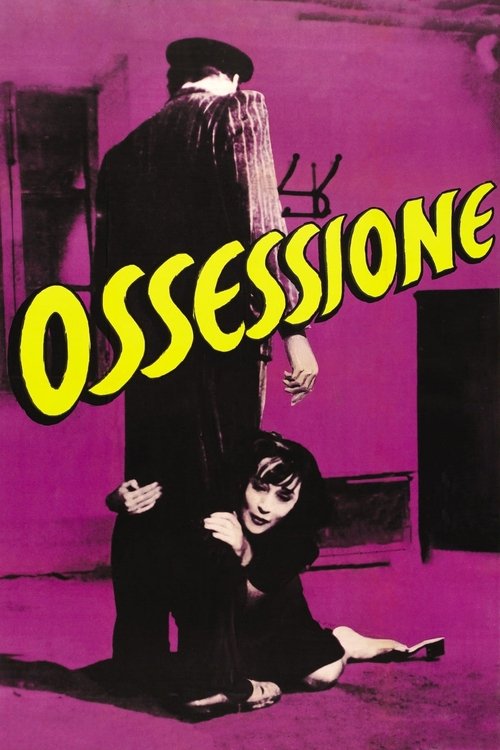
Obsession
1943 · Luchino Visconti
For a night when you want passion with consequences — doomed lovers, moral quicksand, no easy exits. A challenge in the best way: it seduces you and then makes you sit with it.
What it's about
A drifter walks into a roadside inn on the flat highways of the Po Valley and locks eyes with the owner's restless young wife. Their affair turns from heat to desperation, and soon they're circling the idea of getting rid of her older husband — a plan that promises freedom and delivers everything but. It's a doomed love triangle played out among gas pumps, kitchens, and dusty roads.
The experience
Sweaty, fatalistic, and thick with desire — you can feel the trap closing from the first glance the lovers exchange. It moves like a slow fever: sensual at first, then heavy with guilt and dread.
Performances
Massimo Girotti's Gino has a raw physical restlessness that was startling for its time, and Clara Calamai gives Giovanna a discontent that's equal parts hunger and exhaustion — you understand exactly why these two combust.
The craft
Visconti shot in real trattorias and along real roads, letting sweat, dirt, and working-class fatigue into a national cinema that had banned them — an act of aesthetic rebellion disguised as a pulp melodrama. Adapted (without permission) from an American hard-boiled novel, it fuses noir fatalism with documentary-level texture.
Why it matters
Widely counted among the founding works of Italian neorealism, it launched Visconti's career and showed that shooting ordinary life in ordinary places could be politically explosive.
Snapshot
Ossessione — released internationally as Obsession — is Luchino Visconti's directorial debut and one of the pivotal hinge-films of twentieth-century cinema: a sweaty, fatalistic melodrama of adultery and murder set along the flat roads of the Po Valley, and at the same time a clandestine act of aesthetic rebellion against the official cinema of Fascist Italy. Gino Costa (Massimo Girotti), an itinerant laborer, drifts into a roadside trattoria run by the coarse, comfortable Giuseppe Bragana (Juan de Landa) and his discontented young wife Giovanna (Clara Calamai). The affair that ignites between Gino and Giovanna curdles into a plot to murder the husband, and from that murder flows guilt, suspicion, entrapment, and a final catastrophe. The film is an unauthorized transposition of James M. Cain's American hard-boiled novel The Postman Always Rings Twice (1934), relocated from California to Emilia-Romagna — and in that relocation, in the heat and dust and idle bodies of its real locations, critics have long identified the first stirrings of Italian neorealism. It is a major film not because it is flawless but because it is foundational: a debut that announced a director, helped name a movement, and was nearly destroyed by the state it embarrassed.
Industry & production
Ossessione was produced by Industrie Cinematografiche Italiane (ICI), a Rome production entity, and shot largely on location in 1942 in and around the Po delta, Ferrara, and Ancona. The project emerged not from the studio system at Cinecittà but from the intellectual ferment surrounding the journal Cinema, the influential film magazine then edited — with some irony that protected its young contributors — by Vittorio Mussolini, the dictator's son. Visconti, an aristocrat (Duke of Modrone) who had apprenticed in France, belonged to a circle of left-leaning critics and aspiring filmmakers clustered around that magazine, several of whom collaborated on the script.
The production was difficult and, by the standards of the regime's preferred output, transgressive. Italian cinema under Fascism leaned heavily on the glossy drawing-room comedies later derided as "white telephone" films, and on patriotic or historical spectacle. Ossessione, with its squalid inn, its sexual frankness, its drifters and provincial poverty, ran directly against that grain. The film premiered in Rome in May 1943, in the last months before the fall of Mussolini and the armistice. The regime and the Catholic Church reacted with hostility; the most frequently repeated anecdote — which should be treated as durable legend rather than documented fact — holds that Vittorio Mussolini walked out of a screening exclaiming "This is not Italy!" The picture was cut, suppressed in many localities, and effectively withdrawn. Prints were ordered destroyed, and the survival of the film is generally credited to Visconti having preserved a duplicate negative. The precise mechanics of that survival are part of the film's mythology and the record is genuinely uneven on the details.
A second, longer shadow over the film's industrial life was copyright. Because Visconti had adapted Cain without securing rights, and because the screen rights to The Postman Always Rings Twice were controlled in the United States (MGM would produce the official Tay Garnett version in 1946), Ossessione could not be legally exhibited in the U.S. for decades. It did not receive an American theatrical release until 1976 — an extraordinary gap that kept one of the era's most influential films out of one of its largest markets for a generation.
Technology
Ossessione was made with the conventional technology of early-1940s European production: 35mm black-and-white film, optical sound recorded to the print, and standard Academy framing. There is nothing technologically novel in the apparatus. What matters is how that ordinary equipment was deployed outside the controlled studio. Location shooting in the Po Valley meant working with available light, real weather, real architecture, and the acoustic and logistical messiness of actual places. The technological "advance," such as it is, is really a methodological one — the decision to take the camera into the world rather than rebuild the world on a soundstage — and it anticipates the on-location, lightweight practice that postwar neorealism would adopt out of both conviction and economic necessity.
Technique
Cinematography
The photography is credited to Aldo Tonti and Domenico Scala. Their images give the film its enduring sensory signature: the wide, hazy horizontality of the Po basin, the glare of sun on whitewashed walls, the cluttered interior of the trattoria thick with the props of a working business. The camera observes bodies in heat and idleness — Girotti's first appearance, slumped in the back of a truck, is pure physical presence before it is character. Tonti and Scala favor a deep, ambient realism over expressionist stylization, though the film is far from a flat documentary; there is real compositional intelligence in how the flat landscape isolates figures and how the inn's geography is mapped. The visual texture — sweat, dust, fabric, the river — does narrative and thematic work, binding desire to environment.
Editing
The film was cut by Mario Serandrei, who would become one of Visconti's most important lifelong collaborators. Serandrei's role here carries a special historical weight: in correspondence with Visconti about the rushes, he is widely credited with first using the word neorealismo to describe what he was seeing — a term that would soon define an entire movement. The editing itself favors duration and weight over hard-driving pace; scenes are allowed to breathe, to dwell on bodies and waiting, which lends the murder plot a sense of inevitability rather than thriller momentum. The fatalism is built partly in the cutting room, in the refusal to hurry.
Mise-en-scène / staging
Visconti's theatrical and operatic sensibility — he would go on to a major career as a stage and opera director — is already legible in the staging. The trattoria is rendered as a fully inhabited social space, dense with the clutter of provincial commerce, and the blocking exploits its thresholds, counters, and back rooms to choreograph the triangle of husband, wife, and intruder. Against the closed, oppressive interior Visconti sets the open road and the river, spatializing the conflict between entrapment and escape that drives Gino. The famous fair sequence in Ancona, where Gino encounters the wandering figure of "the Spaniard," opens the film out into a wider social texture of crowds, performers, and itinerants.
Sound
The score is credited to Giuseppe Rosati, and the film draws on operatic and popular musical material — including, in the Ancona sequence, a singing competition — that ties its emotional registers to Italian vernacular culture. The soundscape of the locations, the ambient noise of a working inn and an open countryside, contributes to the film's grounded realism, though as with most films of the period the sound was managed by the conventional postwar-of-the-shot methods rather than synchronous location recording throughout. The specific technical particulars of the sound mix are not richly documented.
Performance
The acting marks a deliberate break from the mannered style of contemporary Italian commercial cinema. Massimo Girotti's Gino is a study in physicality — sullen, sensual, restless, a body in search of a destination. Clara Calamai, then known for more glamorous roles, was cast against type as Giovanna and delivers a hard, grasping, frightened performance that refuses sympathy as often as it courts it; her Giovanna married for security and will not surrender it. Juan de Landa makes Bragana neither monster nor mere fool but a loud, vital, complacent presence whose ordinariness makes the murder more disturbing. Elio Marcuzzo plays "lo Spagnolo," the Spaniard — a tragic detail of the production's history is that Marcuzzo was killed in 1945, reportedly by German soldiers near Treviso, during the war's final convulsions.
Narrative & dramatic mode
The dramatic mode is fatalistic melodrama in the hard-boiled key Cain perfected: ordinary people pulled by lust and money into a crime that destroys them. The structure is a doomed romance braided with a crime plot — desire, conspiracy, murder, the slow rot of guilt and mutual suspicion, and a final ironic catastrophe in which a car accident kills Giovanna just as the lovers seem poised to escape, leaving Gino to face arrest. Visconti slows and weights Cain's lean pulp into something closer to tragedy, emphasizing entrapment over suspense. The "postman" of Cain's title — the idea that fate, like the postman, always rings twice — survives as a governing logic even though the title is gone: the sense that the second knock, the reckoning, is inescapable.
Genre & cycle
The film sits at a crossroads of genres. It is at once a crime melodrama, an adulterous romance, and a proto-realist social study. Through its Cain source it connects to the international current that American critics would later call film noir, and indeed Ossessione is sometimes discussed as a European cousin of noir — the doomed lovers, the murderous wife, the drifter protagonist. But Visconti grafts that pulp armature onto the rural Italian everyday, producing a hybrid that belongs fully to neither the thriller nor the documentary. It is this hybridity — genre fatalism rendered in realist texture — that makes it a transitional object between the cinema of the 1930s and the postwar new wave.
Authorship & method
Ossessione is a debut, and its authorship is genuinely collaborative even as it bears Visconti's stamp. The screenplay was developed by Visconti with a group drawn from the Cinema circle — among them Mario Alicata, Giuseppe De Santis (himself a future major director), Gianni Puccini, and Antonio Pietrangeli — who together reworked Cain's novel into its Italian setting. The key craft collaborators recur as the film's spine: cinematographers Aldo Tonti and Domenico Scala, editor Mario Serandrei, and composer Giuseppe Rosati.
Visconti's method was decisively shaped by his apprenticeship in France in the 1930s, where he worked as an assistant to Jean Renoir (on productions associated with Toni and Une partie de campagne) and absorbed the lessons of French poetic realism — its sympathy for working people, its location sensibility, its fusion of social observation and lyrical fatalism. Ossessione transplants that French inheritance into Italian soil. The film also inaugurates the tension that would animate Visconti's whole career: between the realist and the operatic, the documentary impulse and the aristocrat's taste for grand, tragic, sensual stylization.
Movement / national cinema
Ossessione is routinely cited as a precursor — and by some accounts the first true work — of Italian neorealism, the movement that would make postwar Italian cinema internationally dominant through Roberto Rossellini's Rome, Open City (1945) and Vittorio De Sica's films. Its claim rests on location shooting, non-glamorous milieux, attention to the bodies and economies of ordinary provincial life, and the rejection of studio artifice. The caveat, which honest accounts always make, is that Ossessione lacks the explicit social-political and quasi-documentary dimension of the canonical postwar films; it is a melodrama of private passion, not a chronicle of war and resistance. It is best understood as the movement's threshold — the place where the term neorealismo was first uttered (by Serandrei) even if the full program had not yet arrived.
Era / period
The film is inseparable from its moment: produced in 1942 and premiered in May 1943, in the dying months of the Fascist regime, on the eve of Mussolini's fall and the armistice. Its bleakness, its sexual and social candor, and its refusal of patriotic uplift read as quiet defiance of a collapsing official culture. That the regime tried to suppress it, that the Church condemned it, and that it nonetheless survived to influence the postwar renaissance, makes Ossessione a film that literally straddles the rupture of 1943 — one foot in Fascist Italy, one foot in the cinema of the liberation.
Themes
The film's governing themes are desire as compulsion, the trap of poverty and dependency, and the impossibility of escape. Giovanna's marriage is a transaction against destitution, and her refusal to abandon the security the murder is meant to secure poisons the romance the murder was meant to free. Gino embodies the romance of the open road and its futility — every flight returns him to the inn, to Giovanna, to fate. Sweat, heat, and the flat unyielding landscape externalize an eroticism that is also a kind of imprisonment. Threaded through is the figure of the Spaniard, whose companionship offers Gino an alternative, non-possessive form of intimacy and freedom; the character has long been read by critics as carrying a homoerotic charge and as an emblem of a road not taken — a solidarity set against the destructive heterosexual passion that dooms the protagonist. Given the censorship of the era such readings rest on inference and emphasis rather than explicit text, and scholars differ on how far to press them.
Reception, canon & influence
The contemporaneous reception was shaped almost entirely by the regime: official hostility, ecclesiastical condemnation, censorship, and suppression. Whatever popular response the film found at its 1943 Rome premiere was quickly throttled, and the picture had no normal commercial life. Its critical canonization came later, retrospectively, as the neorealist movement it had anticipated achieved worldwide prestige and historians traced the lineage backward to Visconti's debut.
The influences on the film are clear and acknowledged: James M. Cain's The Postman Always Rings Twice as narrative source; French poetic realism and Jean Renoir as method and sensibility; and the critical program of the Cinema circle, which sought an Italian cinema of truth against the regime's escapism. The American hard-boiled novel and the French humanist film thus meet in the Po Valley.
The influence the film exerted forward is large. It supplied neorealism with an early model and, through Serandrei, quite literally its name. It launched Visconti, who would become one of the towering figures of European cinema (La terra trema, Senso, Rocco and His Brothers, The Leopard). It contributed an early European entry to the lineage critics would connect to film noir, and it stands permanently in the comparative history of Cain adaptations alongside the 1946 Garnett version and Bob Rafelson's 1981 film — a comparison made all the more pointed by the copyright dispute that kept Ossessione out of American theaters until 1976. By the time audiences in the United States finally saw it, the film had already done its work on cinema history; its belated arrival only confirmed how far ahead of its own suppression it had been.
A Deleuzian reading
He arrives as freight.
The full Deleuzian reading of Obsession →
Reception
Suppressed by Fascist censors on release in 1943 — prints were seized and destroyed, and Visconti only saved it by hiding a duplicate negative — it's now enshrined as the founding film of Italian neorealism.
How Obsession was received, from release to now →
Influences: the films it descends from and the films it influenced
- Toni (1935) — Visconti served as Renoir's assistant here and absorbed its method of shooting working-class lives on real locations with available light and near-documentary plainness — the exact procedure he transplanted to the Po Valley.
- Une partie de campagne (1936) — Visconti's apprenticeship on this production taught him the open-air, river-and-landscape naturalism and the use of environment as an erotic-emotional register that pervades Ossessione's exteriors.
- La Bête humaine (1938) — Supplies the template of fatalistic working-class adultery-and-murder staged in authentic labor settings, where doom is carried by milieu rather than studio expressionism.
- Le Dernier Tournant (1939) — The first screen adaptation of Cain's Postman, it modeled how to relocate American hard-boiled fatalism into a European roadside-inn setting — the same narrative spine Ossessione reworks for Italy.
- Le Quai des brumes (1938) — Its poetic-realist fatalism — doomed lovers trapped by atmosphere and class — gave Visconti the lyrical pessimism he fused with hard-boiled plotting.
- Le Jour se lève (1939) — Carné's marriage of working-class entrapment to a destiny that closes in scene by scene informs Ossessione's durational drift toward inevitable catastrophe.
- The Postman Always Rings Twice (1981) — Rafelson's frankly carnal, location-grounded Cain adaptation completes the lineage by returning the story to Ossessione's register of bodily appetite and grimy environment.
- Rome, Open City (1945) — Extends Ossessione's location shooting and available-light immediacy into the neorealist movement proper, treating the street and real interiors as documentary truth.
- Paisà (1946) — Pushes the location-realism and non-mannered performance Ossessione pioneered toward episodic, near-reportage construction.
- Bicycle Thieves (1948) — Inherits the anti-mannered physicality and casting away from theatrical stars, building drama from ordinary bodies in real streets.
- La terra trema (1948) — Visconti radicalizes his own debut's location method — real Sicilian fishermen, dialect, durational pacing — into full ethnographic neorealism.
- Senso (1954) — Develops the operatic mise-en-scène and melodramatic stylization that already strained against the realism in Ossessione, resolving Visconti's career-long realist/operatic tension toward opera.
- Rocco and His Brothers (1960) — Synthesizes the debut's two impulses — neorealist social observation of working-class migrants and grand tragic stylization — into a single sustained melodrama.
- La Dolce Vita (1960) — Martelli's method of flattening Italian location surfaces into hard chiaroscuro planes — developed here under Visconti — is the precise visual grammar La Dolce Vita recruits for the Via Veneto sequences, where celebrities are rendered as photographic surfaces rather than psychological interiors.
- The Leopard (1963) — Visconti's debut established his twenty-year editorial collaboration with Mario Serandrei, whose method of cutting against conventional rhythm by trusting extended duration — holding on a face or a room well past dramatic necessity — became the pacing logic of The Leopard.
- Stromboli (1950) — Italian proto-neorealism's founding formal decisions — location shooting in provincial Italy, post-synchronized sound, a female protagonist trapped in a suffocating domestic environment — establish the template Rossellini extends in Stromboli's marriage-as-prison structure.
- Germany, Year Zero (1948) — Visconti established the Italian precedent for shooting with available light in working-class locations and casting non-actors in substantial roles, legitimizing the formal choices Rossellini would develop into the neorealist method.
- Umberto D. (1952) — An early neorealist work whose attention to the textures and dead time of provincial working life prefigures the movement's commitment to the unremarkable stretches of existence that Umberto D. foregrounds.
- The Postman Always Rings Twice (1946) — The Hollywood Cain adaptation that shares Ossessione's exact source plot, letting the two stand as the comparative poles — glossy studio noir versus location realism — of the same hard-boiled material.
- Double Indemnity (1944) — Drawn from the same Cain idiom of lust-driven murder conspiracy, it codifies the femme-fatale/weak-man dynamic that Ossessione builds instead from sweat, heat, and physical desire.
- Bitter Rice (1949) — De Santis, a co-writer of Ossessione, carries forward its fusion of neorealist location work with sensual melodrama and Cain-style sexual fatalism in the rice paddies.
- Shoeshine (1946) — Pioneered the working-class location realism and earthy non-glamorized milieu—shooting real provincial environments rather than Cinecittà sets—that fed the neorealist current Shoeshine extends.
Similar films
- Rocco and His Brothers (1960) — influence & lineage · same viewing thread
- Bicycle Thieves (1948) — influence & lineage · same viewing thread
- The Postman Always Rings Twice (1981) — influence & lineage
- Rome, Open City (1945) — influence & lineage
- The Postman Always Rings Twice (1946) — influence & lineage
- Senso (1954) — influence & lineage
- Toni (1935) — influence & lineage
- Paisan (1946) — influence & lineage
All the films related to Obsession →
Watch it with: curated runs of related films
- Neorealism and Its Shadows — Watch these together to see Italy from the ground up — the unemployed, the sharecropped, the compromised — from neorealism's birth to its stylish, sinister heirs.