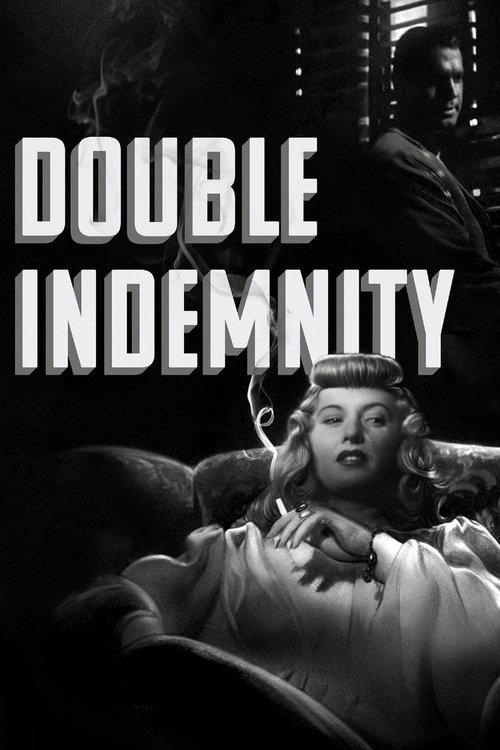
Double Indemnity
1944 · Billy Wilder
For a late-night watch when you want to be seduced by people you shouldn't trust — sharp, dark entertainment that goes down easy and bites anyway. A comfort watch for anyone whose comfort is doom.
What it's about
A slick Los Angeles insurance salesman makes a house call and meets a bored, dangerous housewife — and an anklet he can't stop thinking about. Together they cook up a scheme built around her husband's life insurance and its double-indemnity clause, a plan he's smart enough to design and too far gone to walk away from. His own colleague, a bloodhound of a claims investigator, starts circling the case.
The experience
Cool, fast, and fatalistic — told as a confession, so you know from the first minutes it ends badly, and the pleasure is watching exactly how. The dialogue crackles, the tension is procedural and erotic at once, and it's surprisingly funny in a poisoned way.
Performances
Barbara Stanwyck is the femme fatale against whom all others are measured — cold, magnetic, unrepentant — Fred MacMurray weaponizes his nice-guy ease as the salesman, and Edward G. Robinson nearly walks off with the film as the rumpled investigator who's smarter than both of them.
The craft
Billy Wilder and Raymond Chandler's script is a masterclass — the hard-boiled banter, the voiceover confession, the clockwork plotting — and the shadowy black-and-white photography of venetian blinds and dark bungalows defined a whole visual language. It sounds as good as it looks; the dialogue alone rewards full attention.
Why it matters
It's the cornerstone of film noir — the movie that proved Hollywood could put the audience inside the killer's head — and its confessional structure, lighting, and fatal-woman archetype echo through crime cinema to this day.
Snapshot
A dying insurance salesman dictates his confession into a Dictaphone in the dark hours before dawn, narrating the story of how a pair of ankles and a double-indemnity clause destroyed him. Double Indemnity is the paradigmatic American crime film: the first major Hollywood production to place the murder plot entirely inside the point of view of the killer, to strip the femme fatale of any redemptive sentiment, and to make the protagonist's doom legible from the opening scene. Its screenplay — adapted by Billy Wilder and Raymond Chandler from James M. Cain's 1935 novella — remains a defining document of Hollywood craft: the confessional voiceover, the baroque hard-boiled diction, the alternation of icy procedural logic and erotic fatalism. Where earlier crime films maintained moral insulation between audience and perpetrator, Double Indemnity abolished it.
Industry & production
James M. Cain's novella, serialized in Liberty magazine in 1935 and published in book form the following year, was considered unfilmable throughout the late 1930s. The Production Code Administration — under Joseph Breen — had blocked earlier adaptation attempts on grounds that the story glamorized murder for profit and depicted adultery without adequate punishment. Several studios passed. Billy Wilder, then rising at Paramount after the success of Five Graves to Cairo (1943), pressed the project with producer Joseph Sistrom. To secure Code approval, Wilder and Chandler constructed the narrative around an inevitable and legible doom: Neff is already dying when the film begins; his crime is already discovered; punishment is built into the story's architecture from the first shot.
Wilder's choice of Raymond Chandler as co-writer was a calculated gamble. Chandler had published The Big Sleep and Farewell, My Lovely but had no screenwriting credits of consequence. The two men were placed in adjoining offices at Paramount and worked through the screenplay in close quarters over several months. By most accounts the collaboration was miserable. Chandler found Wilder overbearing and their working styles incompatible; Wilder found Chandler difficult and temperamental. Chandler later documented his grievances in correspondence. Yet the screenplay they produced is among the most precisely engineered in classical Hollywood — every scene advancing plot and character simultaneously, the insurance procedural woven through the erotic thriller with unusual discipline.
Barbara Stanwyck was cast against her glamour-girl image; the bleached wig and flat affect she brought to Phyllis Dietrichson were reportedly her own choices, emphasizing the character's artificiality. Fred MacMurray, widely known as a light comedian, was cast against type as Neff — a choice Wilder insisted upon to destabilize audience expectations. Edward G. Robinson, usually cast as gangsters, played the relentless claims investigator Barton Keyes as a man of moral intelligence rather than brute force.
Technology
John F. Seitz, the cinematographer Wilder brought from Five Graves to Cairo, shot Double Indemnity on standard 35mm with lenses and lighting configurations that prioritized hard shadows, compressed space, and facial texture over the lustrous studio glamour typical of the period. One well-documented technique involved dusting the set floors with aluminum powder to scatter light in ways that complicated clean illumination, creating an ambient dinginess that resisted the polished studio look. The Dietrichson house — built on a Paramount soundstage — was dressed and lit to feel simultaneously prosperous and decaying, its high ceilings and Venetian blinds transformed into instruments of visual entrapment.
The Dictaphone that frames the narrative was a practical narrative device but also a production one: voiceover had been used in Hollywood before (notably in Laura, released the same year), but Wilder's use of it here was structural rather than decorative. Neff speaks to Keyes throughout, addressing his confession to a specific listener — a formal decision that shapes every scene in the film.
Technique
Cinematography
Seitz's lighting design for Double Indemnity is among the most studied in American cinema. The Venetian blind motif — slanted horizontal shadows printed across the faces and bodies of characters — functions as a visual leitmotif for entrapment, the shadows literalizing the bars of a cell the characters have not yet entered. This technique was not invented here, but Double Indemnity systematized it into the grammar of what would come to be called film noir.
The film is consistently lit from below or from side angles, rejecting the three-point studio standard in favor of compositions where shadow dominates. Close-ups of Stanwyck emphasize geometric light patterns rather than flattering beauty. MacMurray's face in the confession sequences is frequently half-obscured, or lit from below to suggest moral degradation. Interior spaces — the Dietrichson house, the supermarket, the office — are deep but dark, with pools of light isolating figures against unlit backgrounds.
Editing
Doane Harrison's editing enforces the film's clockwork structure. The flashback construction means the audience possesses foreknowledge throughout; the editing never exploits suspense about outcome, only about mechanism. Scenes are cut tight, with little ellipsis: the planning scenes have the same pace as the murder scene, refusing to treat the act as formally distinct from the preparation. Harrison's collaboration with Wilder extended across much of Wilder's Paramount period; his contribution was significant enough that Wilder credited him as an unofficial creative partner.
The train sequence — in which Neff must impersonate a man he has already killed, then arrange the body on the tracks — is edited to sustain a procedural tension quite different from conventional thriller suspense: the audience follows a scheme they already know will succeed, and the editing maintains a near-bureaucratic rhythm that makes the murder feel banal.
Mise-en-scène / staging
Wilder stages most of the Dietrichson house scenes with characters at angles to each other rather than face-to-face, blocking that registers the transactions of manipulation beneath the dialogue's surface. The staircase is used repeatedly to position Phyllis above Neff, a visual grammar of dominance that reverses in the film's final reel. The supermarket — where Neff and Phyllis conduct their planning under the cover of ordinary commerce — is deliberately prosaic: Wilder chose the setting to emphasize the banality of the conspiring, the way murder plots interleave with everyday consumption.
The anklet receives dedicated staging attention throughout. It is introduced in Phyllis's first scene from Neff's point-of-view as he tracks it from foot to face, Wilder constructing the male gaze as an object of critique as much as identification. The anklet recurs as a visual rhyme throughout the film — the camera returning to it to mark Neff's continuing subjection.
Sound
Miklós Rózsa's score was one of the first major Hollywood orchestral works to import the harmonic language of twentieth-century European modernism — particularly Bartókian dissonance — into a studio crime film. The score avoids romantic sweetening and refuses to provide ironic detachment from the violence; it treats the material with the seriousness of concert music. Rózsa's work here, alongside his score for Spellbound (1945), helped establish the sonic palette that would define film noir: minor-keyed brass, dissonant string clusters, a general refusal of resolution.
Wilder's use of silence is also notable. Key moments — the murder itself, the drive to dispose of the body — are stripped of score, forcing the ambient sounds of the physical environment into prominence.
Performance
Barbara Stanwyck's Phyllis Dietrichson remains the template against which femme fatale performances are measured. Her choice to play the character with visible flatness — an emotional opaqueness that registers as menace rather than vulnerability — was deliberate and against the grain of conventional melodrama, in which the sexually dangerous woman was typically passionate. Phyllis has no redemptive interior; her stillness is terrifying precisely because it refuses to explain itself.
MacMurray's performance is structured around complicity: Neff is not a weak man seduced into evil but an intelligent man who chooses it, and MacMurray sustains this reading without asking for audience sympathy. Robinson's Keyes — the film's moral center — gets the film's most celebrated speech, a monologue about his instinctive suspicion of fraudulent claims, which he calls "a little man" who moves in his stomach. Robinson plays it as comedy and menace simultaneously, the scene demonstrating how much of the film's moral freight runs through the Keyes-Neff relationship rather than the Neff-Phyllis one.
Narrative & dramatic mode
Double Indemnity operates in proleptic mode throughout: the frame device forecloses outcome before the narrative begins. This is a deliberate formal choice that relocates dramatic interest from suspense (will he succeed?) to tragic irony (watching him fail in ways he cannot yet see). The confessional structure is spoken in the second person — Neff addresses Keyes — which means the film is simultaneously a crime drama and a love story between two men, the heterosexual plot serving as the occasion for the primary emotional bond to be revealed.
Cain's hard-boiled mode — the clipped declarative syntax, the procedural attention to how the fraud works, the absence of sentimentality — passes through Chandler's more literary idiom and emerges in the screenplay as a distinctive hybrid voice: Cain's plot machinery in Chandler's diction. The result is tighter than either writer typically managed alone.
The insurance mechanism — the double-indemnity clause, which pays twice the face value for accidental death on a train — is the film's central structuring metaphor: human desire running against statistical probability, with the insurance actuary (Keyes) as a figure of Fate, reading the actuarial tables that Neff's desire has refused to consult.
Genre & cycle
Double Indemnity is regularly identified as the film that consolidated the conventions of film noir — a term coined by French critics Nino Frank and Jean-Pierre Chartier in 1946 to describe a cycle of American crime films they found strikingly darker in moral tone than pre-war Hollywood production. Wilder and his contemporaries did not use the term; it was a retroactive critical construction. Nevertheless, Double Indemnity is among the handful of films (along with Laura, Murder, My Sweet, and Phantom Lady, all 1944) that established what would become a recognizable cycle through the decade.
As genre, the film belongs to the crime melodrama lineage — it is at bottom a story about passion, transgression, and punishment — but it refuses the genre's usual consolations. The moral order is restored at the end, but without conviction: Keyes is not triumphant, and Neff is not redeemed. The ending enforces punishment but not meaning.
Authorship & method
Billy Wilder came to Hollywood as part of the wave of Central European émigrés displaced by the rise of National Socialism. Trained in Berlin journalism and then as a screenwriter in Weimar Germany, he carried both the Expressionist visual inheritance and the cynical tradition of German-language Kulturkritik into his American work. Double Indemnity is his first fully realized statement of what would become his mature mode: moral pessimism disguised as genre entertainment, formally classical but tonally subversive.
John F. Seitz, the cinematographer, had shot silent films before his sound career and brought a depth of technical resource to the collaboration. His contribution to the visual language of Double Indemnity — and to the broader noir aesthetic he developed across the 1940s — is substantial and somewhat underacknowledged in auteurist accounts of the film.
Miklós Rózsa was a Hungarian-born composer who had worked with Alexander Korda in Britain before arriving in Hollywood; his score connects Double Indemnity to a European modernist musical tradition.
Raymond Chandler resented his Hollywood experience and wrote about it bitterly. His contribution to the screenplay's dialogue — the hard-boiled aphorisms, the metaphor-heavy narration — is extensive; his contribution to its structure is more debated. Whether the screenplay's formal elegance belongs primarily to Wilder's architectural instincts or to the collision between the two writers remains an open question in the scholarship.
Movement / national cinema
Double Indemnity sits at the intersection of two traditions: American hard-boiled fiction (Cain, Hammett, Chandler) and European, particularly German, Expressionist cinema. Wilder's European formation is legible in the film's visual design — the use of shadow and light as psychological instruments derives from Weimar cinema — and in its moral register, which is more disillusioned than the American crime film had typically permitted itself to be.
The émigré contribution to film noir was substantial and has been extensively documented: Fritz Lang, Robert Siodmak, Otto Preminger, Edgar Ulmer, and Wilder all brought Central European traditions of pessimism and visual sophistication to a cycle of American genre films. Double Indemnity is the most commercially successful and formally realized product of this confluence.
Era / period
Made in the middle of the Second World War, Double Indemnity is sometimes read against the period context: the anxious domesticity, the sexual anxiety around women who had entered the workforce, the suspicion of suburban prosperity as a cover for moral corruption. These readings are plausible but should be held carefully; Wilder's primary framework was the hard-boiled tradition rather than any explicit engagement with wartime social conditions. The film does encode a specific postwar tension — its version of Los Angeles is affluent and corrupt, a suburb built on bad faith — that would become a persistent concern of the noir cycle.
Themes
Entrapment and determinism are built into the film's formal structure: because Neff is already dying when the story begins, the entire narrative operates under the sign of fate. Wilder stages the film's locations — the Dietrichson house, the supermarket, the insurance office — as traps: spaces that appear open but close around their occupants.
The dark logic of capitalism. The insurance industry's actuarial rationalism is the film's central metaphor: Keyes can calculate the statistical probability of murder from accident better than the police can, because he thinks in populations and probabilities rather than individuals. The "double indemnity" clause is the film's governing irony — a provision designed to prevent fraud becomes the mechanism for fraud.
The femme fatale and the limits of desire. Phyllis Dietrichson has been read as a projection of misogynist anxiety and as a figure of genuine female agency exercised in a system with no legitimate outlets. The film does not resolve this ambiguity; it exploits it. What is clear is that Neff's desire is legible to himself as fatal from almost the first moment — he uses the language of helplessness, but the film's structure makes clear that he is choosing.
Homosocial bonds and masculine complicity. The film's emotional center is the relationship between Neff and Keyes, a bond the film frames as the deepest attachment in either man's life. Neff's betrayal of Keyes — not his murder of Dietrichson — is the crime the film treats as most consequential.
Reception, canon & influence
Influences on the film. The primary source is Cain's novella, itself drawing on a notorious actual case — the 1927 murder of Albert Snyder by his wife Ruth and her lover Judd Gray for insurance money. Wilder's visual design owes an acknowledged debt to Weimar Expressionism, particularly the work of F.W. Murnau and G.W. Pabst. Fritz Lang's American crime films of the late 1930s and early 1940s — particularly You Only Live Once (1937) — offered a direct precedent for the morally implicated American crime film. The hard-boiled prose tradition of Chandler and Cain shaped the screenplay's narrative voice at every level.
Contemporary reception. Double Indemnity was a significant commercial success for Paramount and received seven Academy Award nominations: Best Picture, Best Director, Best Actress (Stanwyck), Best Screenplay, Best Cinematography, Best Score, and Best Sound Recording. It won none — the year's awards went primarily to Leo McCarey's Going My Way — a result that has acquired a certain ironic weight in retrospect, given the respective canonical fates of the two films. Stanwyck's failure to win is particularly noted by historians of the period. Critical reception was strong; the film was recognized immediately as an unusually rigorous crime film, though the theoretical vocabulary to describe what it was doing would not arrive until the French critics applied it two years later.
Legacy and forward influence. The film's influence on subsequent cinema is pervasive and not fully mappable. It established the confessional flashback as the default structure for first-person crime narratives in Hollywood, a convention deployed in hundreds of films across the following decades. The femme fatale archetype as Stanwyck crystallized it — cold, calculating, unrepentantly predatory — became the genre template. The use of voiceover narration as a mode of ironic self-knowledge became a noir convention so thoroughgoing that its origins in Double Indemnity (and the contemporaneous Laura) are sometimes forgotten.
Lawrence Kasdan's Body Heat (1981) is the most explicit reworking: it transposes the story to a Florida setting, updates the language, and introduces a more explicit sexuality that the Code had foreclosed, but the structural homology is direct and acknowledged. The film is also legible throughout the neo-noir cycle of the 1970s and 1980s — in Roman Polanski's Chinatown (1974), in the insurance-fraud plotting of various genre films, and in the sustained ambivalence toward domesticity and desire that runs through American crime cinema from 1944 forward.
James Naremore's More Than Night: Film Noir in Its Contexts (1998) and Paul Schrader's influential 1972 essay "Notes on Film Noir" both locate Double Indemnity as foundational to the noir cycle. The AFI placed it at or near the top of its crime and thriller lists in various surveys. It is taught in virtually every serious film program as a specimen of classical Hollywood craft; its screenplay is among the most widely analyzed in academic and professional screenwriting contexts. Whatever qualifications one wishes to apply to canons and their construction, Double Indemnity has earned its place in this one through the accumulation of influence, analysis, and ongoing readability — a film that continues to generate interpretation because it generates genuine uncertainty about whether the trap it depicts is the woman, the man, or the world.
A Deleuzian reading
Open on a foot.
The full Deleuzian reading of Double Indemnity →
Reception
A hit with seven Oscar nominations in 1944 — and zero wins, swept aside by the feel-good Going My Way. Eighty years on, that looks absurd: it's now routinely called the definitive film noir, the template everything else gets measured against.
How Double Indemnity was received, from release to now →
Influences: the films it descends from and the films it influenced
- M (1931) — Lang's shadow-as-guilt visual grammar — cast shadow marking moral complicity before any act is committed — gave Wilder and Seitz the expressionist framework they systematized into the Venetian blind bar-shadow motif; Wilder absorbed this during his Berlin years.
- Pandora's Box (1929) — Pabst's Lulu destroys men through erotic opacity and indifference rather than active scheming; Stanwyck's flat-affect Phyllis Dietrichson — constructed as a surface the camera cannot penetrate — descends from this conception of female destructiveness as blankness rather than psychology.
- The Blue Angel (1930) — Sternberg staged Dietrich as an affectless object whose power over men derived from her refusal of interiority — the staging protocol Wilder adapted for Phyllis Dietrichson, whose emotional blankness Stanwyck chose to emphasize by design, bleached wig and all.
- Stranger on the Third Floor (1940) — The first Hollywood crime film to systematically import German Expressionist low-angle, hard-shadow lighting into a contemporary American setting, establishing the visual grammar — isolated pools of darkness, figures half-consumed by shadow — that Seitz codified into noir's photographic standard.
- The Maltese Falcon (1941) — Huston demonstrated that hard-boiled prose diction could be transferred to screen without softening into exposition, and that a film could hand the femme fatale to the police without redemptive qualification — the two formal precedents Double Indemnity extended and darkened.
- Citizen Kane (1941) — Welles' proleptic narrative architecture — protagonist's doom established in the opening frame, the investigation proceeding backward to explain what is already known — gave Wilder the structural template for Neff's Dictaphone confession: dramatic tension residing in mechanism, not outcome.
- Dishonored (1931) — Inherits the Garmes-lineage chiaroscuro studio style — venetian-blind slat lighting and the calculating self-possessed woman — that flowed from the Sternberg cycle into film noir.
- Remember the Night (1940) — Deliberately inverts the Stanwyck–MacMurray pairing minted here — recasting their established screen geniality and easy warmth as predatory noir menace, weaponizing the audience's prior affection for the couple.
- Daybreak (1939) — Builds noir on the same confessional flashback-to-doom architecture — a trapped man reconstructing how he got here — and Wilder later made Trauner his own designer, closing the craft circuit.
- Mildred Pierce (1945) — Curtiz borrowed Double Indemnity's specific narrative architecture wholesale — confession opens the film, flashback excavates the crime, official investigation frames the structure — for another James M. Cain adaptation, demonstrating the template's immediate portability within the studio system.
- The Postman Always Rings Twice (1946) — Adapting the same source author's adultery-murder plot with an identically flat femme fatale, Garnett's warmer staging and romantic complicity reveals Double Indemnity's formal choices as deliberate austerity: Wilder's procedural chill and Seitz's refusal of flattering light are decisions, not defaults.
- Out of the Past (1947) — Tourneur extended Neff's Dictaphone confession into a full structural and moral template: Jeff Bailey's retrospective voiceover narrates his own destruction with foreknowledge, transferring Wilder's proleptic architecture into a sustained tone of fatalistic retrospection that became the confessional noir's dominant mode.
- Sunset Boulevard (1950) — Wilder extended his own Dictaphone device to its logical extreme: the narrator is already dead when he speaks, the proleptic confession structure made literally posthumous, the address to Keyes replaced by an address from beyond the grave — the same formal grammar pushed past the boundary of life.
- Chinatown (1974) — Polanski replaced Double Indemnity's insurance bureaucracy with water rights bureaucracy while preserving the identical formal logic: a systemic mechanism whose procedural fine print encodes inevitable doom, and an investigator whose competence cannot outrun the institution.
- Body Heat (1981) — Kasdan reproduced the Venetian blind shadow motif as explicit visual citation, cast his protagonist against light-comedic type (William Hurt), and structured the plot around an estate-insurance mechanism — a conscious technical homage that catalogs which specific formal devices Double Indemnity had made canonical.
- Blade Runner (1982) — Jordan Cronenweth's venetian-blind shadow striping — the defining lighting motif of Blade Runner's interiors — is a direct quotation of John Seitz's technique for Wilder; the theatrical cut's hardboiled voiceover procedural deploys the same confessional-retrospective narration device Wilder used to open his film, placing the detective as a man already defeated by the case he is recounting.
- The Apartment (1960) — The casting of Fred MacMurray as Sheldrake is only operative against his Walter Neff in Double Indemnity; Wilder deploys audience memory of MacMurray's earlier complicit guilt as preloaded dramatic shorthand, making the against-type effect work retroactively rather than in the immediate performance.
- Dial M for Murder (1954) — Wilder codifies the inverted-mystery structure — the murder conspiracy disclosed in full to the audience before execution — as the engine of dramatic irony over whodunit suspense; Dial M's entire dramaturgy builds on this architecture, including the financial-inheritance motive driving a cold-blooded husband.
- Psycho (1960) — The noir structure in which stolen money functions as MacGuffin — driving all initial action but dissolving in moral weight once the protagonist's death spiral begins — is the direct structural template for Marion's $40,000 theft, which Psycho abandons as irrelevant the moment her body hits the shower floor, stranding the audience in a film about something else entirely.
- The Usual Suspects (1995) — The retrospective voiceover confession narrated to an authority figure who doesn't yet know the truth—Neff talking into a dictaphone for Keyes—is the direct structural blueprint Singer adopts: Verbal's entire testimony is a confessional performance delivered to an investigator who systematically misreads its evidence.
- All About Eve (1950) — Establishes the confessional first-person noir flashback with a self-knowing, morally compromised narrator addressing the audience retrospectively from the moment of his doom — the precise narrative register and tonal authority that Addison DeWitt's voiceover inherits.
- Laura (1944) — Preminger's concurrent development of first-person investigative voiceover as crime film architecture appeared in the same production season; both films codified the device independently, but where Preminger's narration is retrospective and elegiac, Wilder's is proleptic and prosecutorial.
- The Woman in the Window (1944) — Lang, as a fellow German émigré, simultaneously applied the expressionist doom grammar — a man destroyed by an accidental woman, institutional mechanism as inescapable trap — to an American studio crime film, revealing a shared emigre methodology rather than direct influence.
- Phantom Lady (1944) — Siodmak's jazz club sequence uses low-key lighting, angled shadow, and spatial compression to construct sexual menace through exactly the emigre-expressionist-into-noir visual grammar Seitz was developing at Paramount; its parallel deployment by another UFA-trained director in the same year confirms a shared emigre methodology.
- Shadow of a Doubt (1943) — John Seitz's chiaroscuro cinematography and the suburban California domestic setting construct the noir-melodrama hybrid space Shadow inhabits from its Gothic angle—both films place ordinary American architecture under Expressionist shadow to reveal the premeditated violence it conceals, with insurance and domestic routine as cover for murder.
- Obsession (1943) — Drawn from the same Cain idiom of lust-driven murder conspiracy, it codifies the femme-fatale/weak-man dynamic that Ossessione builds instead from sweat, heat, and physical desire.
- Ace in the Hole (1951) — Wilder/Doane-Harrison noir architecture — a doomed first-person protagonist and fatalistic inverse-motion structure — that Ace repurposes by draining the romance and leaving only the predation.
- Bound (1996) — Establishes the noir template Bound queers wholesale: a scheming lover and a partner conspiring to murder a controlling man for money, with the crime's precise clockwork and the femme-fatale voice driving the plot.
- Sullivan's Travels (1941) — Shot by John Seitz, who carries the low-key, shadow-drenched lighting he pioneered in Sullivan's chain-gang sequences into the full grammar of film noir.
- Murder, My Sweet (1944) — The same-year template for retrospective first-person confession: a doomed narrator's voice-over frames the whole film as flashback testimony, foregrounding a fatal romantic obsession exactly as Paxton's structure does.
- Scarlet Street (1945) — The parallel 1944 noir that fixed the same craft vocabulary — venetian-blind low-key lighting and a doomed ordinary man lured by a femme fatale — but resolved through confession, throwing Lang's uniquely unpunished murder into relief.
- The Miracle of Morgan's Creek (1944) — Shares cinematographer John F. Seitz, whose clean deep-focus method gives both films their stable, precisely-composed visual ground beneath very different tonal registers.
- Leave Her to Heaven (1945) — Contemporary sibling in noir's flashback-confession architecture and the fatal-woman archetype, proving noir is defined by fatalism and the deadly woman — the argument Leave Her to Heaven wins in color.
Similar films
- Sunset Boulevard (1950) — influence & lineage · same viewing thread
- Chinatown (1974) — influence & lineage · often watched together
- The Woman in the Window (1944) — influence & lineage
- Laura (1944) — influence & lineage
- The Postman Always Rings Twice (1946) — influence & lineage
- Out of the Past (1947) — influence & lineage
- The Maltese Falcon (1941) — influence & lineage
- Rear Window (1954) — same viewing thread · often watched together
All the films related to Double Indemnity →
Watch it with: curated runs of related films
- The Golden Age of Suspense — A run of immaculate mid-century crime pictures — Hitchcock plus his sharpest rivals — where guilt, obsession, and dangerous romance are staged in gorgeous black-and-white; watch them close together and the shared DNA of the perfect-murder plot lights up.
Film essays and courses that include it
- The Unreliable Eye: Cinema's First Person
- Fade In to Fracture: The Screenplay from Architecture to Anarchy
- Guilty by Design: The Art and Architecture of Film Noir
- The Grammar of Shadow: Black & White Cinema from Caligari to Raging Bull
- Put the Blame on Her: Eight Decades of the Femme Fatale
- Premeditated: Cinema's Century of the Kill
- The Vow and Its Violation: A Century of Marriage on Screen
- The Investigator's Eye: From Sam Spade to Zodiac
- Eros Unrepressed: Cinema's Century of Desire
- The Dream at the End of the Road: Los Angeles & California
- Wanted: The Erotic Triangle from Film Noir to Now
- Name Your Price: Cinema's Anatomy of the Dark Deal
- The Shadow That Outlived the Light
- The Cynic Who Believed
- The Style That Knew It Was Doomed