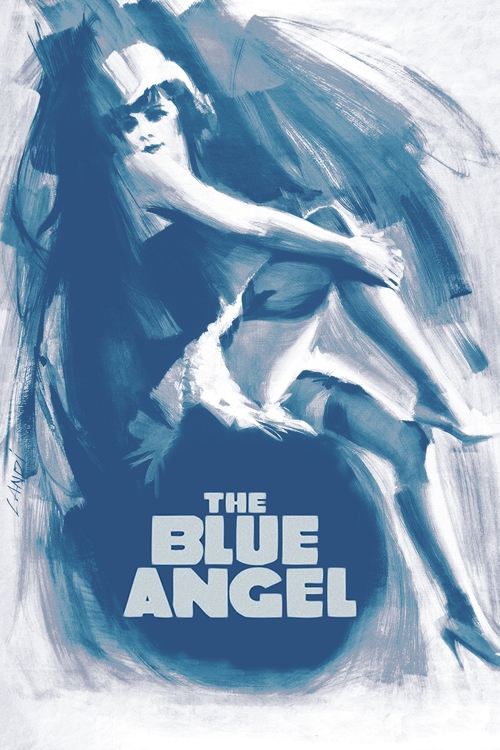
The Blue Angel
1930 · Josef von Sternberg
For when you want glamour with a knife in it — a black-and-white classic to surrender an evening to. More challenge than comfort; it stings.
What it's about
A starched, ridiculed secondary-school professor discovers his students sneaking off to a cabaret called The Blue Angel and goes there to catch them — only to be caught himself by Lola Lola, the singer on its tiny stage. His obsession pulls him out of the classroom and into her traveling world, where the rules of his old life count for nothing.
The experience
Smoky, seductive, and then quietly cruel: the pleasure of the cabaret curdles into the discomfort of watching a proud man's dignity come apart. It casts an old-fashioned dark spell that's hard to shake.
Performances
Emil Jannings makes the professor's unraveling painfully physical, while Marlene Dietrich, in the role that launched her, is pure insolent magnetism — draped over a chair, singing like she's already bored of your desire.
The craft
Josef von Sternberg packs every frame with clutter, smoke, and hanging light until the cabaret feels like a trap you can smell. As one of Germany's first major sound films it uses song and stage noise as weapons, and Dietrich's numbers still land like events.
Why it matters
It sent Dietrich to Hollywood stardom overnight and gave Jannings his most famous tragedy, becoming a cornerstone of early sound cinema and the mold for the femme fatale.
Snapshot
The Blue Angel (Der blaue Engel) is the film on which two careers pivoted in opposite directions: it crowned Emil Jannings, the reigning titan of German screen acting, with one of cinema's most abject roles, while launching the unknown-to-most Marlene Dietrich toward Hollywood stardom on the strength of a single performance. Directed by the Vienna-born, American-trained Josef von Sternberg for Germany's premier studio, UFA, it adapts Heinrich Mann's 1905 satirical novel Professor Unrat into a tragedy of erotic humiliation: a starched secondary-school professor, Immanuel Rath, is undone by his obsession with the cabaret singer Lola Lola and degraded by stages until he dies, broken, at the desk where he once held authority. As one of the first major German sound films, it sits at the technological frontier of its moment; as a study of bourgeois respectability annihilated by desire, it has become an emblem of Weimar cinema's last creative flowering before the catastrophe of 1933. Its iconography — Dietrich astride a chair in top hat and bared legs, singing "Falling in Love Again" — entered the permanent visual vocabulary of the twentieth century.
Industry & production
The film was a UFA production, made at the studio's Neubabelsberg facilities near Berlin and overseen by producer Erich Pommer, the most powerful and discerning production chief in German cinema and the executive behind such landmarks as The Cabinet of Dr. Caligari, Die Nibelungen, and Metropolis. The project's genesis lay with Jannings, who had returned to Germany after a celebrated Hollywood run (he had won the very first Academy Award for Best Actor) and sought a major sound vehicle. It was reportedly at Jannings's and Pommer's instigation that Sternberg was brought from Paramount in the United States to direct, lending the production transatlantic prestige at a moment when UFA, under the control of the nationalist press magnate Alfred Hugenberg, was both commercially ambitious and politically conservative.
In the standard practice of the very early sound era — before dubbing and subtitling were perfected — the film was shot in two simultaneous language versions, German and English, with the principal actors performing scenes in both tongues. The German version is universally regarded as the definitive one; the English version, long comparatively neglected and at times thought lost in good prints, is generally considered weaker in pacing and performance. The picture premiered in Berlin on 1 April 1930, the day after which Dietrich departed for the United States to begin her Paramount contract — a piece of timing that has become part of the film's legend.
Technology
The Blue Angel belongs to the brief, technically fraught window of the sound transition. It was made as a synchronized sound-on-film talkie at the very start of Germany's conversion, when recording technology was new, microphones were fixed and unforgiving, and the camera — to silence its mechanical noise — was confined in soundproofed booths or "blimps" that severely limited mobility. The German sound-film industry of this period was also shaped by the patent-pooling Tonbild-Syndikat (Tobis-Klangfilm) apparatus that governed sound systems in Europe; the precise recording system used on the production is a technical detail on which popular accounts are thin, and it should not be asserted casually. What matters for the film's character is that Sternberg, an inventive visual stylist, was working within the new medium's constraints while also exploiting its possibilities — above all the diegetic use of song and the layering of cabaret noise, applause, and tolling clocks.
Technique
Cinematography
The photography is credited to Günther Rittau — a UFA veteran whose credits include effects and camerawork on Metropolis and Die Nibelungen — working with Hans Schneeberger. Sternberg, himself an obsessive manipulator of light who frequently operated and lit beyond his official credit, imposed his characteristic aesthetic: a dense, atmospheric chiaroscuro in which faces emerge from and recede into shadow. The visual world divides into two lighting regimes — the cold, ordered classroom and the professor's lodgings versus the smoky, cluttered, sensuous half-light of the cabaret — and the film charts Rath's fall as a migration from one to the other. While The Blue Angel is more restrained than the gauze-veiled, light-saturated style Sternberg would perfect in his subsequent Paramount films with Dietrich, the seeds are visible: the fascination with reflective surfaces, nets, dolls, and clutter; the sculpting of Dietrich's face and legs by directed light; the sense of the frame as a saturated, tactile space.
Editing
The film's construction is largely classical and unobtrusive, organized around the recurrent return to the cabaret and to the schoolroom, with the tolling of clocks and the crowing of a rooster threading the narrative as motifs of time and humiliation. The specific editing credit is one of the production details poorly documented in widely available English-language sources, and it would be irresponsible to assign it with false precision; what can be said is that the cutting serves a measured, accumulating tragic structure rather than the rapid montage associated with Soviet cinema or the kinetic city symphonies of the same years.
Mise-en-scène / staging
This is the film's richest dimension. The Blue Angel nightclub is a marvel of designed clutter — a cramped, vertically stacked warren of dressing rooms, fishing nets, painted backdrops, and bric-à-brac through which Rath stumbles like a trespasser. Sternberg stages the professor's degradation spatially: he descends into Lola's basement dressing room, is repeatedly tangled in the physical disorder of her world, and is finally costumed as a clown. The recurrent image of Lola perched above him — on a stage, on a barrel, on a chair — visualizes the inversion of authority. Production design renders Weimar's milieu of provincial respectability and tawdry showbusiness with documentary density.
Sound
As an early talkie, the film treats sound thematically as well as technically. The cabaret songs by Friedrich Hollaender are performed on screen, diegetically, making music an instrument of seduction rather than non-diegetic score. The aural world is built from applause, a wheezing barrel-organ, the schoolroom's disciplinary silence, the chiming of the town clock's carillon, and — most devastatingly — the rooster's crow, "kikeriki," which Rath is forced to perform as a clown's catchphrase and which becomes the sound of his total collapse. Sound here is not decorative but structural: the contrast between the professor's command of silence in the classroom and his enslavement to the cabaret's noise traces his entire arc.
Performance
Two performances anchor the film. Jannings, a master of the grand, physically expansive silent style, delivers a study in disintegration — from rigid, pompous authority to grotesque, broken abjection, culminating in the clown's breakdown and the final return to the empty classroom. It is among the great screen portraits of humiliation. Dietrich's Lola Lola is its opposite and its cause: cool, indolent, amused, sexually self-possessed, neither malicious nor sentimental but simply indifferent to the destruction she occasions. Her relaxed, ironic register — singing directly to camera, surveying Rath with bored appraisal — was something genuinely new, and the contrast between Jannings's expressionist excess and Dietrich's modern underplaying is itself part of the film's meaning.
Narrative & dramatic mode
The dramatic mode is tragedy in a naturalist key — the methodical, inexorable destruction of a man by a passion he cannot govern. The structure is a descent: established order, fatal encounter, infatuation, marriage, and then a long, unsparing degradation as the once-imperious professor is reduced to selling Lola's photographs, performing as a stage clown, and finally enduring a public humiliation in his own hometown before crawling back to die at his old desk. The narrative withholds melodramatic consolation; Lola is not punished, the world does not right itself, and Rath's end is squalid and lonely. This refusal of redemption aligns the film with the disillusioned, clear-eyed temper of Weimar's late-1920s culture.
Genre & cycle
The Blue Angel sits at the intersection of several German cycles. It carries the imprint of the Kammerspielfilm — the intimate "chamber" drama of ordinary, often petit-bourgeois lives and their psychological ruin — and of the "street film" tradition in which respectable men are lured to destruction by the erotic and criminal demimonde. It also belongs to the broader European backstage/cabaret drama and, by virtue of its songs, stands among the earliest German musical-inflected sound films. Through Sternberg's later career it becomes the foundational entry in a distinct cycle of its own: the seven Sternberg–Dietrich collaborations, of which this is the first and the only one made in Germany.
Authorship & method
The film is the product of a charged convergence of strong authors. Josef von Sternberg is its presiding sensibility — a director for whom cinema was the orchestration of light, texture, and the photographed female face, and who later claimed near-total authorship of Dietrich's screen image. His method was painterly and controlling, building meaning through atmosphere rather than dialogue. Erich Pommer as producer supplied the institutional intelligence and resources of UFA at its height. The screenplay, adapting Heinrich Mann's novel, is credited to Carl Zuckmayer (a major Weimar dramatist), Karl Vollmöller, and Robert Liebmann; their adaptation notably softened Mann's pointed political satire of Wilhelmine authoritarianism and reframed the material as a tragedy of erotic obsession, shifting the emphasis from social critique to individual ruin. The composer Friedrich Hollaender (later, in Hollywood, Frederick Hollander) wrote the songs, including "Ich bin von Kopf bis Fuß auf Liebe eingestellt," known in English as "Falling in Love Again," which became Dietrich's signature for the rest of her life. The cinematography of Günther Rittau and Hans Schneeberger executed Sternberg's visual program. The question of who "discovered" Dietrich — she was already a working stage and screen actress in Berlin, not an unknown — has been mythologized, often at her own and Sternberg's prompting; what is undisputed is that Sternberg cast her in the role that made her an international star, reportedly over resistance.
Movement / national cinema
The film is a touchstone of Weimar cinema in its final phase, made at the moment when the silent expressionist and Kammerspiel traditions were giving way both to sound and to the sober, observational Neue Sachlichkeit (New Objectivity). It belongs to the UFA system that had defined German prestige filmmaking through the 1920s, and it captures, in its very subject — the collapse of authority before sensual disorder — a culture poised on the edge of political dissolution. Within three years the Nazi seizure of power would scatter this cinema's talent into exile: Sternberg was already in Hollywood, Dietrich followed permanently, Hollaender and others emigrated, and Heinrich Mann would flee Germany. The Blue Angel thus reads in retrospect as both a high point and a valediction of Weimar film culture.
Era / period
Produced at the turn of the decade, the film is doubly transitional: technologically, it straddles the silent-to-sound divide; historically, it stands at the threshold between the relative stability of the mid-Weimar years and the crisis that followed the 1929 crash and culminated in 1933. Its world — provincial schoolmasters, touring cabarets, the moral codes of the German bourgeoisie — is rendered with a specificity that makes it a period document, even as its drama of obsession and humiliation reaches beyond its moment.
Themes
At its center is the destruction of bourgeois respectability by sexual desire — the spectacle of authority, learning, and self-discipline overwhelmed by an appetite the professor never knew he had. Allied themes proliferate: humiliation and masochism (Rath seems almost to seek his own degradation); the inversion of power between the sexes and between the respectable and the disreputable; performance and spectatorship (the professor begins as a voyeur peering into the cabaret and ends as the thing being watched, a clown); and the cruelty of time, marked by the recurring clocks and the mocking crow of the rooster. Lola embodies a modern, unsentimental, transactional eroticism — she sings, in effect, that men swarm to her like moths and that this is simply her nature, beyond blame or remorse. The film offers no moral correction to this; its bleakness lies precisely in its refusal to make the destroyer answer for the destruction.
Reception, canon & influence
The Blue Angel was a substantial success on release and made Dietrich an immediate international sensation, though specific contemporary box-office figures are not something to be cited with confidence and are omitted here rather than invented. Its critical standing has only grown: it is routinely included among the essential works of German cinema and of the early sound era, and it is the cornerstone of the Sternberg–Dietrich legend.
Looking backward, the film draws on Heinrich Mann's novel and on the German theatrical and cinematic traditions of the Kammerspiel, the cabaret milieu, and the cautionary "fallen man" narrative; Jannings's performance extends the grand silent-acting style into sound, while Sternberg imports a Hollywood-honed command of glamour and light. Looking forward, its influence is immense and concentrated above all in Dietrich. The Lola Lola persona — androgynous tailoring, top hat, cool erotic irony, direct address to the audience — became the template that Sternberg and Dietrich would elaborate across Morocco, Dishonored, Shanghai Express, Blonde Venus, The Scarlet Empress, and The Devil Is a Woman, and that radiated outward into the iconography of the femme fatale and the cabaret performer for generations. "Falling in Love Again" became a standard. The film's imagery has been endlessly invoked, parodied, and homaged, and its central situation — the dignified man ruined by an unattainable, indifferent object of desire — echoes through later cinema. A 1959 American remake exists but is remembered chiefly as a measure of the original's irreproducibility. More than any single line of influence, The Blue Angel endures as the moment a national cinema at its peak, a new technology, a great tragedian, and a star being born all converged in a single, unsparing image of desire and downfall.
A Deleuzian reading
Watch where the light goes.
The full Deleuzian reading of The Blue Angel →
Reception
A sensation on release — it made Marlene Dietrich an overnight international star — and it never really fell out of favour: it's since hardened into the cornerstone of Weimar-era cinema and the founding text of the Dietrich myth.
How The Blue Angel was received, from release to now →
Influences: the films it descends from and the films it influenced
- The Last Laugh (1924) — Establishes the Kammerspielfilm arc Jannings reprises here — a proud man's dignity stripped away charted almost entirely through posture, costume, and milieu rather than intertitle, the visual-descent grammar The Blue Angel inherits and gives sound to.
- Varieté (1925) — Jannings as the besotted performer destroyed by jealousy in a music-hall world, with subjective expressionist camera and cabaret-stage staging that The Blue Angel transposes from trapeze tent to nightclub.
- The Street (1923) — Founding Straßenfilm template — the respectable bourgeois lured from the safety of home into nocturnal sexual degradation — which is the structural engine driving Professor Rath out of his classroom and into Lola's orbit.
- The Docks of New York (1928) — Sternberg's pre-Dietrich mastery of fog, net, smoke, and waterfront chiaroscuro — the layered atmospheric textures he carries directly into the gauzy, clutter-screened space of Lola's stage.
- The Last Command (1928) — Sternberg already directing Jannings in the fall of a once-powerful man into abject humiliation; The Blue Angel completes that director-tragedian collaboration in the new medium of sound.
- Morocco (1930) — Directly extends the Lola Lola persona — Dietrich in white tie and tails delivering cool, ironic, audience-addressed cabaret — refining the androgynous tailoring and erotic detachment first minted here.
- Shanghai Express (1932) — Elaborates the two-lighting-regimes treatment of Dietrich's face into a full veil-and-shadow program, photographing the face as sculpted landscape the way Sternberg first isolated Lola in light.
- Blonde Venus (1932) — Builds the self-contained diegetic cabaret number ('Hot Voodoo') as an erotic set-piece that interrupts narrative for pure performance, the device pioneered by 'Falling in Love Again.'
- The Scarlet Empress (1934) — Escalates the designed-clutter staging to delirium — grotesque sculpture, gauze, candle haze packing every plane of the frame — the maximalist endpoint of the props-and-screens density of Lola's dressing room.
- The Devil Is a Woman (1935) — The apotheosis of the Blue Angel situation: the indifferent, capricious woman serially ruining the man enthralled to her, restaged amid Spanish carnival as Sternberg's farewell to the Dietrich cycle.
- Of Human Bondage (1934) — Transposes Rath's masochistic ruin into English melodrama — a dignified professional man enslaved by obsession with a coarse, indifferent woman who degrades him — the humiliation-and-masochism dynamic stripped to its core.
- Gilda (1946) — Inherits the Lola Lola template into film noir: the femme fatale's diegetic nightclub song ('Put the Blame on Mame') performed as weaponized erotic address to an onscreen-and-cinema audience.
- The Damned (1969) — Restages the Blue Angel cabaret literally — Helmut Berger performing in Dietrich drag, top hat and stockings — as the emblematic image of Weimar decadence curdling into Nazism.
- Cabaret (1972) — Revives the Weimar nightclub as a moral stage where diegetic song narrates social rot, with Sally Bowles as Lola Lola's granddaughter — the chanteuse fusing erotic performance and indifference.
- Lola (1981) — An explicit reworking that names its source: a cabaret singer corrupts a scrupulous public official, Fassbinder inverting the Blue Angel's tragedy of bourgeois respectability destroyed by desire into postwar German satire.
- Blue Velvet (1986) — Reanimates the diegetic-song-and-thrall nexus through Dorothy Vallens, the nightclub chanteuse whose performances anchor a masochistic erotic bondage that destabilizes the respectable man drawn into it.
- Double Indemnity (1944) — Sternberg staged Dietrich as an affectless object whose power over men derived from her refusal of interiority — the staging protocol Wilder adapted for Phyllis Dietrichson, whose emotional blankness Stanwyck chose to emphasize by design, bleached wig and all.
- Pandora's Box (1929) — Lulu as the amoral, indifferent erotic force who ruins her men without malice; Lola Lola is her cabaret cousin, both fusing direct erotic address to camera with a fatal passivity that does the destroying.
Similar films
- Shanghai Express (1932) — influence & lineage
- Cabaret (1972) — influence & lineage
- Pandora's Box (1929) — influence & lineage
- The Scarlet Empress (1934) — influence & lineage
- The Last Laugh (1924) — influence & lineage
- Lola (1961) — shared sensibility
- M (1931) — shared sensibility
- Lola Montès (1955) — shared sensibility
All the films related to The Blue Angel →