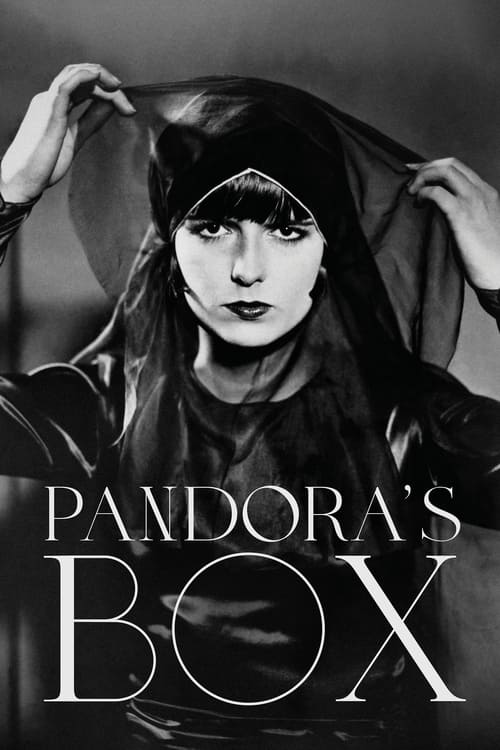
Pandora's Box
1929 · G.W. Pabst
For a night when you want to fall under a spell — a moody, sophisticated classic to watch late and think about after. It asks a little patience with silent-film rhythm and repays it completely.
What it's about
Lulu is a young Berlin woman whose easy, unselfconscious allure pulls everyone into her orbit — lovers, patrons, hangers-on — and turns them reckless. The film follows her rise through kept luxury and marriage and her slide toward ruin, as the desire she inspires curdles into jealousy and violence around her. She never schemes; she simply is, and the world can't handle it.
The experience
Cool, sleek, and quietly devastating — a silent film that feels startlingly modern, with an erotic charge and a moral chill that most talkies still can't match. You watch with mounting dread as charm becomes catastrophe.
Performances
Louise Brooks as Lulu is one of the most magnetic performances ever filmed — no theatrical silent-movie gesturing, just a direct, natural, almost documentary presence and that iconic black bob. She doesn't act desire; she causes it, and you understand every character's downfall on sight.
The craft
Pabst directs with cool psychological precision, building the film around faces, glances, and social texture rather than melodramatic flourish. The camera treats Brooks like a discovery, and the film's frank, unmoralizing view of sex and money still feels bracing.
Why it matters
Condemned and censored in its day, it was rediscovered decades later as a masterpiece of late silent cinema, and Brooks's Lulu became one of film's permanent icons — the template for a century of dangerous, unknowable screen women.
Snapshot
Pandora's Box (Die Büchse der Pandora) is a late-silent German feature directed by Georg Wilhelm Pabst and adapted from Frank Wedekind's two "Lulu" plays, Erdgeist (Earth Spirit, 1895) and Die Büchse der Pandora (1904). It follows Lulu, a beautiful, guileless, and destructively erotic young woman, from her life as a Berlin kept woman through marriage, a killing, flight, prostitution in London, and death at the hands of Jack the Ripper. The film is inseparable from its star, the American actress Louise Brooks, whose helmeted bob and unaffected sensuality made Lulu one of the enduring faces of Weimar cinema. Coolly amoral where earlier melodrama would have moralized, and psychologically exact where expressionism had been stylized, the film is a touchstone of German New Objectivity and one of the most influential character studies of the silent era. Coolly received on release, it was rehabilitated decades later into a canonical work.
Industry & production
The film was produced by Nero-Film AG, the Berlin company run by Seymour Nebenzahl, one of the more adventurous independent producers of the late Weimar period and later a backer of Fritz Lang's M and The Testament of Dr. Mabuse. By 1928–29 Pabst was among Germany's most respected directors, coming off The Joyless Street (1925), the psychoanalytic Secrets of a Soul (1926), and The Love of Jeanne Ney (1927). His decision to cast an unknown-in-Europe American ingénue as the quintessentially German Lulu was controversial within the industry and the press; Wedekind's play was national cultural property, and Brooks was resented as an interloper. Pabst reportedly considered Marlene Dietrich before settling on Brooks — an account Brooks herself later dramatized in her essays. The two films Pabst made with Brooks in quick succession — Pandora's Box and Diary of a Lost Girl (1929) — bracket the moment when Weimar cinema was at once at its artistic height and on the cusp of the transition to sound.
The production is also a case study in censorship. Wedekind's material was already scandalous, and the film was cut and altered for various markets. The character of Countess Geschwitz's open desire for Lulu — among the earliest frankly lesbian characterizations in narrative cinema — was softened or excised in some releases, and the ending was rewritten in certain territories to blunt its bleakness (in some versions the Salvation Army finale was recut so that Lulu is redeemed rather than murdered). The film circulated for decades in compromised prints; the fuller version familiar today is the product of later restoration.
Technology
Pandora's Box is a silent film made at the very end of the silent era, released as The Jazz Singer (1927) and the first talkies were already reshaping the international market. It was shot on orthochromatic black-and-white stock and screened with live musical accompaniment rather than a recorded soundtrack; there is no single "original" score, and the film's timing to music was left to exhibitors, as was standard. The choice to make an ambitious, expensive silent in 1929 was already slightly out of step with the industry's direction, a fact that contributed to its uneasy commercial position. Modern restorations have been paired with newly commissioned or reconstructed scores — the Criterion edition, for instance, presented multiple accompaniment options — but these are later interventions and should not be mistaken for a 1929 original.
Technique
Cinematography
The cinematography is credited to Günther Krampf, a distinguished lighting cameraman of the German industry (his other credits include The Hands of Orlac and, earlier, work associated with Nosferatu). Krampf's lighting for Pandora's Box rejects the hard, angular chiaroscuro of full expressionism in favor of a softer, more sculptural modeling that flatters Brooks and lends the interiors a plush, worldly texture. The camera privileges the human face: Brooks is repeatedly framed in close and medium shots that let her micro-expressions carry meaning. The visual register shifts across the film's movement from Berlin's affluent apartments and backstage theatrical spaces to the gambling ship and finally the fog-choked London garret, the imagery growing progressively darker and more claustrophobic as Lulu descends.
Editing
Editing is where Pabst's contribution is most theorized. He is a central figure in the development of what came to be called "invisible" or continuity editing, and Pandora's Box is one of its signal demonstrations. Pabst favored the technique of cutting on movement — timing a cut to a gesture, a turn, or an eyeline so that the splice is masked by the action and the spectator's attention flows unbroken across it. The effect is a fluid, psychologically continuous style that binds actors and spaces into a seamless dramatic present, opposed to the emphatic, discontinuous montage being developed contemporaneously in the Soviet cinema. The murder of Dr. Schön and the intimate two-shots of Lulu with her various men are often cited as models of this method. (Credits for the film's editor as such are not consistently documented, and Pabst was famously hands-on in the cutting room; I flag this rather than assign the work to a name I cannot verify.)
Mise-en-scène / staging
The sets were designed by Andrei Andreiev (Andrej Andrejew), a leading Weimar production designer, and they trade expressionist distortion for a detailed, socially legible realism: the bourgeois apartment, the theater's wings, the courtroom, the emigrant ship, the London slum. Staging is organized around Lulu as a magnetic center; other characters continually orient their bodies and gazes toward her, so that the blocking itself dramatizes her gravitational pull. Pabst stages in depth and keeps his groupings dynamic, using doorways, staircases, and crowded backstage traffic to choreograph desire and jealousy.
Sound
The film is silent. It carries no synchronized dialogue or recorded score; meaning is conveyed through performance, image, editing, and a relatively sparing use of intertitles. Its expressiveness without speech is part of what later critics prized in it, arriving as it did just before the medium's grammar was reorganized around the microphone.
Performance
Louise Brooks's Lulu is the film's engine and its enduring achievement. Working against the broad pantomime common in silent acting, Brooks plays with a startling naturalism and stillness — Lulu is not a scheming femme fatale but an almost pre-moral creature of appetite and instinct, radiating charm without calculation. Around her, the cast works in a more conventional register: Fritz Kortner brings weight and torment to Dr. Ludwig Schön; Francis Lederer plays his infatuated son Alwa; Carl Goetz is the disreputable old Schigolch; Gustav Diessl appears as Jack the Ripper; and Alice Roberts plays Countess Geschwitz, whose desire for Lulu Roberts reportedly found difficult to perform — a discomfort that has become part of the film's production lore. The contrast between Brooks's modernity and the others' more theatrical style is itself expressive of Lulu's apartness.
Narrative & dramatic mode
The film is a tragedy of descent structured as a sequence of episodes, each stripping away a layer of Lulu's world. It opens in comfort and ends in destitution and death, moving from Berlin to the ship to London in a downward arc that recalls both the "fallen woman" melodrama and Wedekind's original dramaturgy. Yet Pabst withholds the moralizing frame such stories usually supply. Lulu is neither punished for wickedness nor redeemed by suffering; catastrophe simply accumulates around her innocence, driven by the desires of the men and women she attracts. The dramatic mode is thus closer to fatalistic naturalism than to melodrama, with irony supplied by the gap between Lulu's blithe unawareness and the ruin she leaves. The famous ending — Lulu drawn to a kindly stranger on Christmas Eve who is Jack the Ripper, her death coinciding with a Salvation Army procession outside — fuses tenderness and horror without editorial comment.
Genre & cycle
Pandora's Box sits at the intersection of several cycles. It belongs to the German "street film" (Straßenfilm) tradition of social-realist urban melodrama that Pabst had helped define with The Joyless Street, and to the broader "fallen woman" cycle that runs across international silent cinema. As a study of a magnetic, destructive woman it is a landmark in the prehistory of the femme fatale and, by extension, of film noir's later iconography — though Lulu's guilelessness distinguishes her from the calculating noir archetype. It is also, in embryo, a serial-killer film, closing with Jack the Ripper two years before Lang's M placed a child-murderer at the center of German cinema.
Authorship & method
The dossier's principal author is Pabst, working in his characteristic mode of psychological realism and fluid editing. His method depended on close collaboration with performers and on shaping meaning in the cut. The screenplay adaptation of Wedekind's plays is credited to Ladislaus Vajda, a frequent Pabst collaborator, who compressed and restructured two dense stage works into a single cinematic through-line centered on Lulu. Cinematographer Günther Krampf supplied the soft, face-forward lighting; designer Andrei Andreiev the socially precise sets; producer Seymour Nebenzahl the backing and the latitude for a difficult subject. Above all, Pabst's authorship is legible in his casting of Brooks and in his willingness to build the entire film around her presence — a wager on a single performer that defines the work. There was no original composer, the film being silent.
Movement / national cinema
The film is a central document of Weimar cinema in its late phase and of the Neue Sachlichkeit (New Objectivity) tendency — the sober, observational, socially attentive style that succeeded expressionism in the mid-to-late 1920s. Where expressionism externalized psychology through distorted sets and stark light, New Objectivity turned toward material reality, social milieu, and psychological nuance; Pabst was its most important cinematic exponent. Pandora's Box thus belongs to the same national moment as Lang's and Murnau's work but occupies its realist rather than its fantastical wing.
Era / period
Made in 1929, the film stands at a hinge in film history and in German history alike. Aesthetically it is a culmination of silent technique on the eve of sound. Politically it belongs to the last years of the Weimar Republic, and its frank treatment of sexuality, money, and social decay reads in retrospect as a portrait of a society approaching crisis — though the film itself is not overtly political. Within a few years the German industry would be transformed by both the talkies and the Nazi seizure of power, which scattered much of the talent that had made films like this possible.
Themes
The film's governing theme is desire as a destructive force — erotic magnetism that ruins others and, finally, its bearer. Lulu functions as a screen onto which every character projects longing: paternal, filial, sapphic, mercenary, murderous. Related themes include the commodification of the female body (Lulu is repeatedly bought, sold, and trafficked, from kept woman to near-sale on the emigrant ship to prostitution in London); the collapse of bourgeois respectability under the pressure of appetite; and the innocence of instinct set against a corrupt social order. The Countess Geschwitz strand makes the film an early landmark in the screen representation of same-sex desire. And the recurrent motif of Christmas and the Salvation Army against the Ripper's knife stages a final, unresolved collision of grace and slaughter.
Reception, canon & influence
On release the film was met coolly. German critics and audiences were resistant to an American Lulu, some reviews faulting Brooks for supposedly lacking the character's depravity — precisely the quality of unassuming naturalism later admirers would celebrate. Censorship and re-editing further compromised how the film was seen, and it circulated for years in truncated prints. Precise commercial figures are not something I can responsibly quote; the record on its box-office performance is thin, though it is generally described as a commercial disappointment.
Its influences run backward to Frank Wedekind's Lulu plays, to the German street-film and fallen-woman traditions, and to Pabst's own prior experiments in psychological realism and continuity cutting. Wedekind's Lulu also fed Alban Berg's opera Lulu, developed in the same years, so the film sits within a broader modernist fascination with the character.
Its forward legacy is large and belated. Beginning in the 1950s, the film and Brooks were championed by cinephiles and archivists — Henri Langlois and the Cinémathèque française are central to the story of her rediscovery — and Brooks, who had left Hollywood and lived in obscurity, was reframed as an icon of screen modernity, later authoring perceptive essays collected as Lulu in Hollywood. Her image became one of the most reproduced faces of the silent era and a lasting reference point in fashion and design. Critically, Pandora's Box has become a fixture of the canon, routinely cited in histories of Weimar cinema, of editing technique, and of the representation of women and sexuality on screen. Its Lulu stands as a crucial ancestor of the cinematic femme fatale, and its cool, unmoralizing gaze at desire and destruction anticipates strains of realist and noir filmmaking that would flower in the decades after sound arrived.
A Deleuzian reading
Start with the smile.
The full Deleuzian reading of Pandora's Box →
Reception
A flop in 1929 — German critics savaged Pabst for casting an American, and censors abroad butchered it — the film was all but forgotten until Henri Langlois and the Cinémathèque française championed it in the 1950s ('There is no Garbo, there is no Dietrich, there is only Louise Brooks!'). It's now a fixture of the silent canon.
How Pandora's Box was received, from release to now →
How to watch Pandora's Box: what to notice on a first viewing
- Watch how still Brooks stays while everyone around her reacts. Where the rest of the cast emotes in the broad silent-era style, Brooks holds a calm, natural stillness that reads as pure, unguarded pleasure. Her stillness is the whole performance, a feeling held rather than acted out.
- Watch how every other body in the room turns toward Lulu. Pabst and his designer keep orienting the other characters' bodies and gazes toward her, so the blocking itself dramatizes her pull on everyone present. The staging makes her magnetism a fact of geometry, not just a line of dialogue.
- Notice the soft, sculpted lighting on Brooks's face. Krampf avoids the hard expressionist shadows common at the time, using a gentler modeling that flatters her and lets tiny expressions register. The lighting is built to let you read her face rather than to make a statement of its own.
- Notice cuts timed to a glance, a turn, a gesture. Pabst masks his splices inside the actors' movement, so the cutting almost disappears and scenes feel like one continuous present. You are pulled through the story without ever feeling the seams that are doing the pulling.
- Notice the settings growing plainer and darker as the film goes on. The film moves from a comfortable Berlin apartment and theater wings toward rougher, darker rooms. Each new setting strips away a little more comfort, and you feel the descent before anyone explains it.
The whole guide to watching Pandora's Box, with the keys for a rewatch →
Influences: the films it descends from and the films it influenced
- Erdgeist (1923) — The first screen adaptation of Wedekind's Lulu plays, with Asta Nielsen fixing the theatrical Lulu that Vajda and Pabst then compressed and restructured into a single cinematic through-line.
- The Street (1923) — Founded the Strassenfilm grammar — the street as a legible moral danger-zone where a respectable figure is drawn to ruin — the exact social-realist milieu Pandora's Box inherits and channels through Lulu.
- The Joyless Street (1925) — Pabst's early laboratory for psychological realism staged inside a socially precise street/economic milieu, the same observational, unmoralizing gaze on female desperation he refines around Lulu.
- Variety (1925) — Modeled the fatalistic tragedy-of-descent built on sexual jealousy and a performer's magnetism, using mobile, subjective framing of the desired body that Pabst echoes in his face-forward centering of Brooks.
- Secrets of a Soul (1926) — Developed Pabst's method of externalizing interior psychology through editing and composition rather than intertitles, the cut-driven meaning-making he applies to Lulu's unspoken drives.
- The Love of Jeanne Ney (1927) — Where Pabst perfected cutting-on-movement — hiding the splice inside a gesture or glance to make continuity invisible — the editing signature that structures Pandora's Box.
- M (1931) — Extends the New Objectivity of socially legible realism and cutting-on-movement into sound, treating deviant desire with the same clinical, unjudging observational eye Pabst turns on Lulu.
- Double Indemnity (1944) — Codified the noir femme fatale as Lulu's direct heir — an amoral object of desire whose casual sensuality dooms the men around her, filmed without the earlier melodrama's condemnation.
- Gilda (1946) — Builds an entire film around a single performer's face and body the way Pabst wagered on Brooks, using glamour close-ups and face-forward framing to make Hayworth the destructive locus of male desire.
- Vivre sa vie (1962) — Karina's cropped Louise Brooks bob, face-forward close-ups, and a twelve-episode tragedy of a woman's descent into prostitution consciously reanimate Pabst's cool, unmoralizing gaze at Lulu.
- Cabaret (1972) — Revives the Weimar demimonde of destructive desire and dresses Sally Bowles in the Louise-Brooks silhouette, treating amoral sexuality with the same observational, non-condemning frankness Pandora's Box pioneered.
- Sunset Boulevard (1950) — Pabst's late Weimar cinema — shooting performance through fragmentary close-ups and expressionist spatial compression — is the specific context in which Gloria Swanson's silent-era physicality was itself forged, making her casting a direct invocation of this tradition.
- Shanghai Express (1932) — Fixed the template of the enigmatic woman lit as a luminous, unreadable surface (Louise Brooks), where the camera contemplates her as icon rather than psychology — the 'woman-as-icon' staging Dietrich inherits.
- Dishonored (1931) — Weimar template of the self-possessed fallen woman lit in expressionist contrast (Louise Brooks), the German visual culture and feminine-sovereignty persona Sternberg imported into the Dietrich cycle.
- Scarlet Street (1945) — Codified the amoral, guileless femme fatale who destroys men without malice — the template for Joan Bennett's Kitty, whose casual cruelty (not scheming villainy) is what makes the entrapment lethal.
- Mädchen in Uniform (1931) — Pabst's method of cutting on the glance and directing an untrained-seeming naturalism out of Louise Brooks — plus Countess Geschwitz as a woman whose desire is filmed without caricature — is the performance and editing practice Sagan extends to Thiele and Dorothea Wieck.
- Diary of a Lost Girl (1929) — Pabst and Brooks reunited the same year on another fallen-woman descent, again building the film's entire moral logic around Brooks's naturalistic, unperforming presence and soft face-forward lighting.
- Asphalt (1929) — A contemporaneous Ufa street-film whose seductress derails an upright man, staging desire through the same socially legible sets and blocking-around-the-woman that organizes Lulu's scenes.
- Prix de beauté (1930) — Brooks's immediate follow-up (story worked on by Pabst-circle collaborators), extending her face as the film's compositional center into the sound era with another fatalistic tragedy-of-descent ending.
- The Blue Angel (1930) — The Weimar destructive-desire film's other pole — a cabaret femme fatale annihilating a respectable man — sharing Pandora's cool refusal to moralize the woman who causes ruin.
Similar films
- M (1931) — influence & lineage · same viewing thread
- Cabaret (1972) — influence & lineage · often watched together
- The Blue Angel (1930) — influence & lineage
- Gilda (1946) — influence & lineage
- The Prowler (1951) — same viewing thread
- The Testament of Dr. Mabuse (1933) — same viewing thread
- Vivre Sa Vie (1962) — influence & lineage · often watched together
- The Night Porter (1974) — often watched together
All the films related to Pandora's Box →
Watch it with: curated runs of related films
- The Long Shadow of M — A run from Lang's Weimar crime films through their noir and neo-noir children — killers, con men, masterminds, and manhunts — where you can watch expressionist menace mutate step by step into the modern thriller.