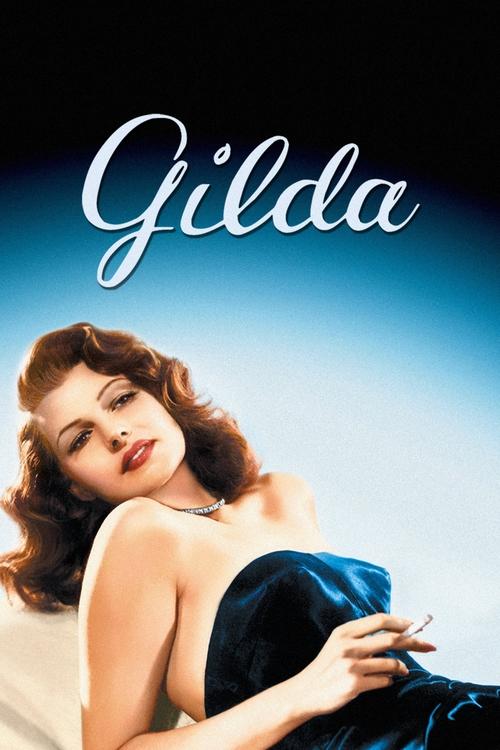
Gilda
1946 · Charles Vidor
For a late night when you want old-Hollywood glamour with a dangerous edge — a martini movie about love that's more like a grudge. Comfort viewing on the surface, but it leaves a bruise.
What it's about
A drifting American gambler lands a job running a casino in Buenos Aires, only to discover that his boss's glamorous new wife is the woman he once loved and walked away from. What follows is a three-way tangle of jealousy, loyalty, and barely suppressed desire, played out across gaming tables and nightclub floors where everyone is performing for someone. It's a love story with claws, wrapped inside a shady-business thriller.
The experience
Watching it feels like standing too close to two people who can't decide whether to kiss or destroy each other — charged, cruel, and glamorous all at once. The mood is smoky and slow-burning, with sudden flashes of venom, and Rita Hayworth's musical numbers land like electrical storms in the middle of it.
Performances
Rita Hayworth gives the performance that made her a legend — magnetic, wounded, and knowingly theatrical, especially in the 'Put the Blame on Mame' number, one of the most famous scenes in American film. Glenn Ford matches her with a tight-jawed bitterness that keeps the whole thing simmering.
The craft
This is studio-era craftsmanship at full power: sculpted black-and-white lighting, gowns and sets built to make one woman unforgettable, and dialogue so barbed it doubles as flirtation. The staging of the musical numbers is deceptively simple and devastatingly effective. It rewards a dark room and your full attention.
Why it matters
Gilda turned Rita Hayworth into a cultural myth — the image of her in that black dress became shorthand for Hollywood allure itself — and the film remains a cornerstone of the noir canon, endlessly discussed for what it says about desire and power.
Snapshot
Gilda is the film that crystallized Rita Hayworth into a myth. Released by Columbia Pictures in the spring of 1946, it presents a love triangle set in Buenos Aires among a casino owner, his enigmatic American wife, and his newly hired enforcer — a man who turns out to be her former lover. The film operates in the register of film noir while bending toward Hollywood melodrama, and it has generated a century's worth of critical argument about desire, power, and what the camera does to a woman's body. Its central set piece — Hayworth performing "Put the Blame on Mame," peeling a single glove from her arm — became one of the most analyzed images in American cinema. The film is simultaneously a product of the Hollywood studio system at the height of its machinery and a text that exceeds what that system intended to say.
Industry & production
Columbia Pictures in the mid-1940s was a second-tier studio fighting upward, and Rita Hayworth was its most valuable asset. Studio chief Harry Cohn had spent years building her into a star, and Gilda was designed as a showcase — the film that would capitalize on her wartime prominence as America's most reproduced pin-up. (Her image had already appeared on the nose cones of fighter planes; in July 1946, months after Gilda's release, the U.S. military would attach her photograph to the nuclear device detonated at Bikini Atoll, an act she reportedly found appalling and over which she had no say.)
The project's producer was Virginia Van Upp, one of the very few women to hold executive producing authority at a major Hollywood studio. Van Upp served as something of a creative advocate for Hayworth within a system dominated by Cohn's frequently brutal management style; her fingerprints on the screenplay are widely acknowledged by film historians, though the extent of her uncredited contribution is difficult to verify with precision. The official screenplay credit belongs to Marion Parsonnet, working from a story by E.A. Ellington. The script passed through at least one earlier draft; the exact division of labor between the credited and uncredited contributors is not definitively established in the surviving studio record.
Charles Vidor directed under circumstances of considerable institutional friction. His relationship with Cohn was adversarial; he would eventually sue Columbia over working conditions, a lawsuit that brought him a suspension. Gilda emerged from this tension — a director of genuine craft working in a studio environment that prized product over auteurism. The Argentina setting, reflective of wartime Hollywood's displaced European sophistication and its appetite for exotic locale, was constructed entirely on Columbia's Gower Street soundstages. Nothing in the film was shot on location.
The production carries a buried political subtext that was topical in 1946: Ballin Mundson's criminal operation involves former Nazis attempting to control the global tungsten supply. This element was not incidental — it placed Gilda among a cluster of postwar films (Notorious, 1946, chief among them) that processed anxieties about fascism, complicity, and what came next. In Gilda's case this subplot is somewhat awkwardly integrated with the romantic triangle, and critics have long noted that it functions more as atmospheric menace than fully developed narrative thread.
Technology
Gilda was shot in black and white at standard studio gauge, using the established range of Columbia's in-house technical resources in 1945–46. There are no notable experiments in film stock or format. The film's technical achievements lie not in innovation but in refinement — specifically in the calibration of light for a single performer. Cinematographer Rudolph Maté brought a European approach to the optics of faces that distinguishes Gilda's visual texture from most of its Hollywood contemporaries.
Technique
Cinematography
Rudolph Maté arrived in Hollywood as one of the most distinguished cinematographers in European film history. He had shot Carl Theodor Dreyer's The Passion of Joan of Arc (1928) and Vampyr (1932) — the former a masterwork of close-up portraiture, the latter an experiment in diffuse, dreamlike exposure — and had worked with René Clair and Alexander Korda before emigrating. By the time he photographed Gilda he had already shot Alfred Hitchcock's Foreign Correspondent (1940) for Walter Wanger. His visual sensibility was formed by a tradition that treated the human face as a primary terrain.
On Gilda, Maté's key contribution is the way he photographs Hayworth: with a softness of focus at the edges of the frame, a care for the direction and temperature of light falling on her face, and a compositional intelligence that places her body in relation to shadow without rendering her simply as spectacle. The casino scenes exploit the noir vocabulary of diagonal shadow and partial illumination, but Maté consistently maintains Hayworth's legibility — her expressions, her reactions — within that atmospheric darkness. The famous performance sequence uses shallow depth of field to isolate her against the crowd, making her appear at once exposed and unreachable.
Editing
Charles Nelson edited Gilda with a rhythm calibrated to the film's oscillation between glamour and dread. The intercutting during the "Put the Blame on Mame" number is particularly studied: Nelson cuts between Hayworth's performance, Glenn Ford's face registering something between fury and desire, and George Macready's controlled, unreadable watching. The editing makes the erotic charge triangular rather than directed outward at the audience alone. Elsewhere, the film occasionally staggers — the transition into the ending has been widely noted as abrupt, a structural consequence of Production Code requirements that forced a reconciliatory resolution onto material that did not organically support one.
Mise-en-scène / staging
Vidor stages the film's central spaces — the casino floor, the back offices, the dressing room — as territories of power with legible topography. Who enters whose space, who is watched from a distance, who crosses a threshold uninvited: the blocking makes these geometries of control visible. The staging of Hayworth is repeatedly theatrical — she enters rooms like an entrance, she is watched like a performance — and Vidor leans into that theatricality rather than attempting to naturalize it. Jean Louis designed Hayworth's costumes, most memorably the black strapless satin gown of the "Mame" sequence; the costume itself became a cultural object, circulating in fashion culture well beyond the film's release.
The triangular arrangement of Mundson, Johnny, and Gilda is staged so that the two men's scenes together carry a charge of their own, a tension that has attracted sustained analysis. Vidor positions Macready and Ford in configurations of proximity and dominance that read, in retrospect, as sexually ambiguous — a reading that was certainly not foregrounded by the filmmakers but which the staging accommodates.
Sound
The two principal songs, "Put the Blame on Mame" and "Amado Mio," were written by the songwriting team of Doris Fisher and Allan Roberts, who contributed several songs to Columbia productions during this period. Musical direction was under Morris Stoloff, Columbia's longtime head of music. A persistent question in Gilda scholarship concerns Hayworth's singing voice in the film: the historical record indicates that her vocals were dubbed, as was common studio practice for actress-performers whose primary identity was non-musical, though the precise attribution of the dubbing voice has been variably reported and should be treated with some caution. What is not in question is that the visual performance — the physicality, the timing, the eye contact — is entirely Hayworth's, and that is what the film communicates. The gap between the performed body and the playback voice is invisible within the scene's rhetoric; it only becomes legible from the outside.
Performance
Rita Hayworth's performance is the film, in a way that few star vehicles make quite so naked. Gilda is both a role and a document of a specific performer at the peak of her cultural saturation. What Hayworth does within the role is more nuanced than the film's reputation sometimes allows: her Gilda is not simply the femme fatale of noir taxonomy. She is also a woman who has been lied about, misread, and punished by a man whose hatred of her is transparently a form of desire, and Hayworth registers this — the exhaustion of being misidentified, the bravado as armor — in ways that the script does not fully articulate. Glenn Ford, in an early career-defining performance, gives Johnny Farrell a smoldering opacity that makes his cruelty toward Gilda feel genuinely threatening rather than conventionally melodramatic. George Macready's Mundson — precise, slightly formal, with an edge of sadism made visible by the sword-cane he carries — provides the film's most controlled performance, and in retrospect the most unsettling.
Narrative & dramatic mode
The film operates in the mode of retrospective narration — Johnny Farrell is the nominal protagonist and nominal point-of-view, and the opening passages are inflected by his voice-over. But the narrative's center of gravity shifts toward Gilda once she enters, and the film never fully recovers its initial alignment with Johnny's perspective. This displacement is generative: it opens the text to multiple interpretive frames. The denouement, in which Mundson returns from a faked death to attempt murder before being killed himself, and in which Gilda and Johnny are reconciled, has been consistently criticized as a formal contrivance. The Breen Office required a moral resolution; what the film was dramatizing did not conform naturally to one. The happy ending reads as exactly what it was: an imposition.
Genre & cycle
Gilda belongs to the cycle of American film noir that ran from the early 1940s through the early 1950s, but it occupies an unusual position within that cycle. Most noir femmes fatales are definitively destructive; Gilda resists that structure. She is the figure upon whom destruction is projected — by Johnny, by Mundson, and to some extent by the film's own narrative apparatus — but she is not, at bottom, guilty of the things she is accused of. This makes Gilda a more complicated object in the genre's gender politics than it is sometimes credited as being.
The Latin American setting situates the film within a distinct Hollywood subgenre of the 1940s: the exotic-locale thriller, which used non-U.S. environments to create moral ambiguity and permit transgressions that a domestic American setting would have complicated. Buenos Aires in 1946 carried specific geopolitical weight — Argentina's wartime neutrality and its role as a refuge for fascist figures gave Mundson's cartel subplot a particular resonance for contemporary audiences.
Authorship & method
Charles Vidor was a Hungarian-born director whose career at Columbia was marked by competence, occasional distinction, and chronic conflict with Cohn. He was a craftsman of the studio system rather than an auteur in any strong sense; his filmography is varied and does not sustain a consistent thematic signature. What he brought to Gilda was a capacity to manage spectacle without smothering performance — a quality visible in his earlier Hayworth vehicle Cover Girl (1944) — and an instinct for the theatrical staging that the material required.
The more interesting authorial figure in the film's production is Rudolph Maté, whose cinematographic intelligence gives Gilda its visual coherence. Virginia Van Upp's producing role — and her probable creative contributions to the script — constitutes a second layer of largely unacknowledged authorship. Hayworth herself, in shaping and embodying the performance, is a third.
Movement / national cinema
Gilda is American studio cinema of the classical period, and belongs specifically to the Columbia production program of the mid-1940s. Its visual and narrative DNA is substantially European: the expressionist lighting tradition imported by émigré cinematographers like Maté, the Continental sensibility of the exotic-locale thriller. The film is a product of Hollywood's absorption of European talent, particularly in the technical crafts, driven by the displacements of the 1930s and early 1940s.
Era / period
The film appeared in the first year of the postwar period, a moment of profound cultural disorientation in American life. The men returning from combat encountered a domestic world that had reorganized in their absence; the anxiety about women's agency and sexuality that runs through postwar noir has often been read in relation to this disruption. Gilda is one of the key texts in this reading, though its construction of female subjectivity is more ambivalent than the standard account of the femme fatale implies.
Themes
Power and its erotic dimension: the film insists that desire and domination are not separable. Johnny's control over Gilda — the surveillance, the restriction, the deliberate humiliation — is explicitly framed as the expression of desire rather than its suppression. Mundson's authority over both of them adds a third vertex.
Misreading and false accusation: the film's plot turns on Gilda being blamed for something she did not do (infidelity), and a significant portion of its dramatic tension derives from the audience's gradual understanding that Johnny's version of events is wrong. This is a gender-political theme the film handles with more sophistication than it usually receives credit for.
Performance and identity: Gilda is always performing — for the casino crowd, for Mundson, for Johnny, for the camera. The film is self-aware about this. The "Mame" sequence is a performance within a performance, and its staging makes legible the question of who Gilda is when no one is watching — which the film implies is someone quite different from the woman on display.
Reception, canon & influence
Backward (influences on the film): Gilda inherits from the pre-Code Hollywood melodrama its frankness about sexual power, and from the European expressionist tradition its visual grammar of shadow and moral atmosphere. The femme fatale figure draws on theatrical antecedents including the "bad girl" of stage melodrama. The Buenos Aires setting follows a line of Hollywood exotic-locale productions. Hayworth's own constructed star persona — built through Columbia's publicity machinery across the early 1940s — is as much an influence on the film as any cinematic antecedent; the role is designed around what the audience already believed about her.
Contemporary reception: Gilda was a substantial commercial success upon its release, cementing Hayworth's position as Columbia's premier star. Critical reception at the time treated it primarily as a star vehicle and genre entertainment; the more complex readings that would come later were not part of the initial discourse. The Production Code, while not preventing the film's release, shaped the final cut in ways that the film's admirers have long found regrettable.
Forward (legacy): The film's influence operates on several registers. Most immediately, it consolidated the postwar image of the femme fatale in American popular culture; Hayworth's Gilda became the reference point against which subsequent iterations were measured. The "Mame" number entered the iconographic inventory of cinema — it is one of a handful of sequences that someone who has never seen the film can nonetheless visualize.
Frank Darabont's The Shawshank Redemption (1994) makes Gilda's influence explicit: the poster of Hayworth as Gilda is the emblem of freedom and beauty in the film's prison world, and the tunnel behind the poster becomes the route of escape — a literalization of the screen image as opening onto elsewhere.
Pedro Almodóvar has acknowledged Hayworth's influence on his construction of femininity, and Gilda's visual register — the theatrical staging of the female body, the gap between surface glamour and interior suffering — can be felt across his work.
The film's homoerotic subtext, identified and developed in the writing of scholars including Richard Dyer, became significant in the emergence of queer film studies in the 1980s and 1990s. The Mundson-Johnny relationship, read through that lens, makes Gilda one of the central texts in analyses of homosexuality's coded presence in classical Hollywood cinema.
Hayworth herself remained ambivalent about the film's legacy. She reportedly remarked that men went to bed with Gilda and woke up with her — a formulation that captured the rift between persona and person that the film's extraordinary success had inscribed into her life. Whether the precise phrasing is accurately attributed is uncertain; what is not uncertain is that the sentiment was real, and that Gilda was the film primarily responsible for creating the problem she was describing.
A Deleuzian reading
One black satin glove, peeled slowly off an arm in a room full of men.
The full Deleuzian reading of Gilda →
Reception
A box-office smash in 1946 that critics largely shrugged off as glossy melodrama, it's since been canonized as one of the definitive film noirs — with later generations finding it richer and stranger than its first reviewers ever did.
How Gilda was received, from release to now →
Influences: the films it descends from and the films it influenced
- The Passion of Joan of Arc (1928) — Rudolph Maté, Gilda's cinematographer, shot this film for Dreyer and developed here his foundational technique of extreme close-up portraiture — high-contrast sidelighting that renders the human face as the primary terrain of expression, isolating it from background; he applies that same methodology directly to Hayworth's close-ups throughout Gilda.
- Vampyr (1932) — Maté's diffuse, edge-softened exposure style — lenses partially veiled to produce a halated, dream-adjacent quality — was developed with Dreyer on this film; it is what gives Gilda's casino sequences their soft-focus glamour that simultaneously marks and isolates Hayworth within the noir shadow architecture rather than simply consuming her in it.
- Shanghai Express (1932) — Von Sternberg and cinematographer Lee Garmes (schooled in Rembrandt-diagonal lighting) established the template of using shallow focus and diagonal shadow to construct a female star as mythic image rather than naturalistic person — a specifically European-émigré approach to Hollywood portraiture that Maté, equally European-trained, applies and extends for Hayworth in Gilda.
- Foreign Correspondent (1940) — Maté shot this Hitchcock thriller five years before Gilda, developing the high-contrast chiaroscuro shadow architecture and diagonal-line interior staging that he carries directly into Gilda's noir visual grammar; the specific technique of illuminating a face from one acute angle while leaving the surrounding space in deep shadow is a throughline between the two films.
- Double Indemnity (1944) — Gilda's retrospective male voiceover — a man confessing his entrapment by a woman whose power the narration can name but not neutralize — directly inherits Double Indemnity's Walter Neff confession device, including the structural irony that the voice of masculine authority recounting the story is already revealed as insufficient to contain what it describes.
- To Have and Have Not (1944) — Hawks's staging of Bacall's theatrical entrance and performance number as a deliberate test of male composure — the woman who controls the room entirely before she speaks — is the direct template for Vidor's staging of Hayworth's entrances and for the structural logic of 'Put the Blame on Mame' as an act of power directed at specific watching men rather than a generalized audience.
- Laura (1944) — Preminger's staging of triangulated male desire around a woman who exists first as image and legend before appearing in person establishes the power-topography framework — the woman's entrance as interruption of male myth-making — that Vidor and Maté deploy for Hayworth's arrivals; the male competition over the woman's body as a site of projected meaning is structural in both films.
- Dishonored (1931) — Noir descendant of the glamorous performing woman lit as luminous spectacle against shadow — the cabaret-as-masquerade and 'self-determining woman' persona routed through Dishonored's iconography.
- The Blue Angel (1930) — Inherits the Lola Lola template into film noir: the femme fatale's diegetic nightclub song ('Put the Blame on Mame') performed as weaponized erotic address to an onscreen-and-cinema audience.
- Pandora's Box (1929) — Builds an entire film around a single performer's face and body the way Pabst wagered on Brooks, using glamour close-ups and face-forward framing to make Hayworth the destructive locus of male desire.
- The Lady from Shanghai (1947) — Welles cast Hayworth specifically to activate and deconstruct the Gilda persona; the film extends Gilda's triangular-intercutting dynamic to its formal limit in the mirror-hall finale, where the image of the woman is literally multiplied and shattered, making explicit the critique of the male gaze that Gilda's Production Code context forced to remain subterranean.
- In a Lonely Place (1950) — Also a Columbia Pictures noir, also featuring a female protagonist whose sustained performance of composure before a dangerous man echoes Gilda's staging of Hayworth's watchfulness; Ray extends Vidor's power-topography by inverting the threat's source — the danger emanates from the apparent hero — and Gloria Grahame's restricted framings echo Maté's technique of placing Hayworth between observing men.
- Sunset Boulevard (1950) — Wilder extends Gilda's retrospective male voiceover to its structural limit by having the narrator already dead, and the female star whose self-presentation as glamour-image has consumed her actual self — Norma Desmond as the system that made Gilda into myth, turned inside out — is the formal and thematic consequence of the performance-identity theme Gilda established.
- Vertigo (1958) — Hitchcock extends Gilda's shallow-depth-of-field isolation of the female figure as image-over-person into a systematic formal investigation of male-directed performance: Novak's Madeleine/Judy, reconstructed by a man from his own fantasy, is the explicit elaboration of what Maté and Vidor's camera does to Hayworth — the woman consumed by the image a watching man has constructed of her.
- Chinatown (1974) — Polanski revisits the noir femme fatale to reveal her as the structure's victim rather than its agent, completing the critique that Gilda's Production Code imposition suppressed; John Alonzo's shallow-focus close-ups of Dunaway under interrogation echo Maté's Hayworth close-ups in both technique and in the implication that a detective's prolonged gaze at a woman's face is itself an act of violence.
- Mulholland Drive (2001) — Lynch's staging of the 'Llorando' performance number — a woman's lip-synced performance that stops the film to make the audience witness their own act of watching — directly extends the formal logic of 'Put the Blame on Mame,' and the film's central theme of a woman's performed identity consuming and destroying her real self is the psychological fulfillment of Gilda's performance-identity subversion.
- Gentlemen Prefer Blondes (1953) — Cole's staging of Hayworth's 'Put the Blame on Mame' as a single-woman-and-chorus number, using glove-peel gesture and glamour-frontal framing, is the direct precedent for the 'Diamonds' number's construction.
- Notorious (1946) — Both films, released within months of each other in 1946, use a woman's body as an instrument deployed by male handlers against a Nazi-adjacent criminal network, and both impose a Production Code reconciliation — the woman redeemed through heterosexual love — onto a story whose actual dramatic logic requires either her destruction or liberation, not her domestication.
- The Killers (1946) — Siodmak employs the same triangular intercutting structure — cutting between Gardner's performance, the watching male protagonist, and the third-party power figure — and the same femme fatale who functions as a mirror of male violence; Gardner's Kitty Collins was constructed as a direct contemporary parallel to Hayworth's Gilda within the same production season and the same noir formal vocabulary.
- Carmen Jones (1954) — Preminger cast Dorothy Dandridge and dubbed her singing voice (with Marilyn Horne) using precisely the production-system logic that dubbed Hayworth's vocals in Gilda — the star's face as spectacle, the voice supplied by a less visible body — and both films stage a woman performing desire within a system that then destroys her for the feelings she provokes in men who cannot control themselves.
- Out of the Past (1947) — A contemporaneous sibling crystallizing the femme fatale as erotic trap, the deadly woman whose allure is inseparable from the protagonist's ruin.
Similar films
- Notorious (1946) — influence & lineage
- Sunset Boulevard (1950) — influence & lineage
- Double Indemnity (1944) — influence & lineage
- The Killers (1946) — influence & lineage
- The Postman Always Rings Twice (1946) — shared sensibility
- Mildred Pierce (1945) — shared sensibility
- The Killing of a Chinese Bookie (1976) — shared sensibility
- The Big Sleep (1946) — shared sensibility
All the films related to Gilda →