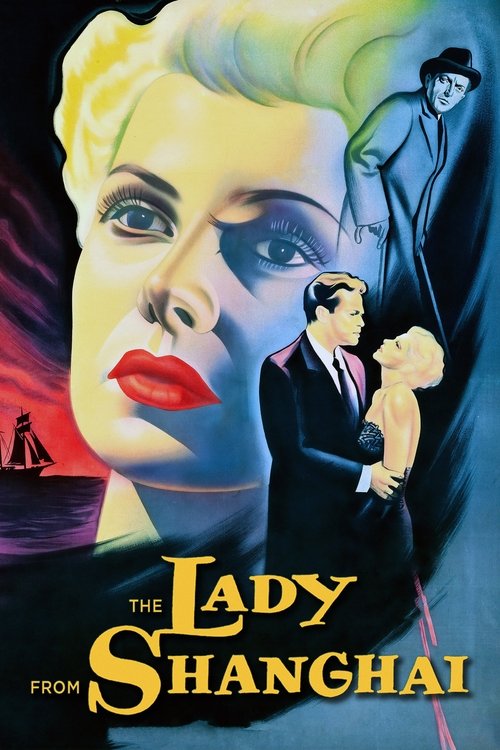
The Lady from Shanghai
1947 · Orson Welles
When you want something stylish and strange rather than tidy — a film to chew on, best watched late with your skepticism switched on. For viewers who like their thrillers with a touch of fever dream.
What it's about
A drifting Irish sailor falls hard for a wealthy man's glamorous wife and signs on for a yacht voyage with her husband, a brilliant and poisonous lawyer. Somewhere between San Francisco and open water he's drawn into a scheme where everyone is lying, and the deeper he gets, the less anything — or anyone — is what it seems.
The experience
Dreamlike and off-kilter — a noir that feels like it's melting as you watch it, seductive one minute and nightmarish the next. It moves fast, talks strange, and keeps you deliciously unsure of your footing all the way to a finale you won't forget.
Performances
Rita Hayworth, shorn blonde and playing against her image, is mesmerizing and unreadable, while Orson Welles gives the sailor a rueful, storyteller's charm. Everett Sloane's crippled, needling lawyer is one of noir's great grotesques.
The craft
Welles shoots every scene from an angle nobody else would choose — aquariums, courtrooms, and funhouses become expressionist theater — and it builds to one of the most famous visual set pieces in movie history. Butchered by the studio and still dazzling, it rewards the biggest screen you can find.
Why it matters
A commercial disaster that ended Welles's welcome in Hollywood and was later reclaimed as one of the most formally daring films of the studio era; its climactic imagery has been imitated ever since.
Snapshot
One of Hollywood cinema's most aggressively destabilizing genre exercises, The Lady from Shanghai deploys the conventions of film noir — femme fatale, insurance fraud, courtroom spectacle, waterfront menace — only to corrode them from within. Its hall-of-mirrors finale, in which reflections multiply and shatter as gunshots find their marks, literalizes what the film has been arguing all along: that identity, motive, and moral legibility are themselves optical illusions. Produced under duress, re-edited against the director's will, and initially rejected by audiences who found its star unrecognizable, it has since been reclaimed as one of the most formally inventive films in the American studio era.
Industry & production
The film's origin is bound up in the chaos of Orson Welles's Broadway career. In 1946 Welles was producing a sprawling stage adaptation of Around the World in 80 Days that was hemorrhaging money; he needed a cash infusion urgently. He approached Columbia Pictures head Harry Cohn with an offer to direct a picture essentially for free in exchange for an advance — reportedly reached by telephone with little premeditation — and the property he offered was Sherwood King's 1938 pulp novel If I Die Before I Wake. Cohn agreed, partly because Columbia's biggest star, Rita Hayworth, was at the time Welles's wife, and the casting of the two together carried commercial logic even by Hollywood standards.
What followed was a production marked by mutual frustration. Welles wrote a screenplay that departed substantially from King's plot while preserving its core of a naive man entangled in an elaborate murder scheme. Principal photography took place across an unusually wide geography: the decks of Zaca, the yacht belonging to Errol Flynn (whom Welles rented the vessel from), as the production moved along the Mexican coast and into Acapulco; the streets and waterfront of San Francisco; the Steinhart Aquarium; and Columbia's studios. The location work gave the film a sun-bleached, documentary texture alien to most studio noir of the period.
The most publicized production decision was Hayworth's transformation: at Welles's direction she had her famous auburn hair cut short and dyed platinum blonde. Cohn, who had built much of the studio's marketing around Hayworth's image as "the Love Goddess," was said to be furious. The transformation was not merely cosmetic; it alienated audiences accustomed to Hayworth's persona and contributed to the film's difficult commercial reception. Columbia exercised its editorial control, and Welles's cut — reportedly considerably longer — was trimmed and restructured by the studio before release. The film was held back from release until 1948 in the United States, though the year of production and copyright is recorded as 1947.
Technology
The film is shot on standard 35mm with the studio's available equipment, but Welles and cinematographer Charles Lawton Jr. pushed aggressively against normalizing convention. Wide-angle lenses were used throughout, producing the mild anamorphic distortion and extended depth of field that had become a Wellesian signature after Citizen Kane. The hall-of-mirrors sequence required building a purpose-designed set on the Columbia lot, with mirrors mounted at angles to produce overlapping reflections — a practical-effects problem solved through careful planning of sightlines and camera placement, since the apparatus of film production could not be allowed to appear in the reflections. The aquarium scene presented a different technical challenge: shooting through large glass tanks under available light conditions produced a murky, subaqueous quality that would have been difficult to replicate on a conventional set.
Technique
Cinematography
Lawton's work here is less celebrated than Gregg Toland's collaboration with Welles on Kane, partly because Lawton's career before and after the film was largely conventional. Nevertheless, the visual language of The Lady from Shanghai is startling. The Acapulco sequences are shot with a brightness and spatial openness that feel almost deliberately incorrect for noir — sun on water, open sky, bodies at leisure — so that the corruption developing beneath the surface is rendered all the more perverse. As the film moves to San Francisco and the interiors tighten, the palette deepens and the angles grow more vertiginous. The aquarium scene, in which O'Hara and Elsa meet amid illuminated tanks of fish, achieves a quality of estrangement — faces lit from below by the tanks, fish drifting at the margins — that has few precedents in studio filmmaking of the era. The mirror finale is the formal climax of this progression: space itself becomes ungovernable, as the camera can no longer distinguish original from reflection.
Editing
The editing as released is, by most accounts, not fully Welles's. Columbia's recutting removed material, reordered some sequences, and tightened the narrative in ways that occasionally render the plotting abrupt. The trial sequence — a sustained piece of courtroom absurdism in which Welles's O'Hara essentially conducts his own defense and manages to produce chaos — is generally thought to survive closer to Welles's intentions; its anarchic momentum suggests a deliberate compositional choice rather than studio intervention. Welles was drawn to editing as a medium of rhythm and disorientation rather than transparent continuity, and what remains, even in its compromised state, bears traces of that sensibility.
Mise-en-scène / staging
Welles's staging retains its characteristic preference for deep, populated space and for actors positioned at different depths in the frame so that blocking itself carries dramatic weight. The yacht sequences arrange characters along the deck in ways that make the geometry of their alliances and tensions legible. The courtroom is staged as controlled pandemonium. The hall-of-mirrors climax is the film's staging tour de force: characters and their reflections multiply until the concept of stable selfhood dissolves. When the mirrors begin to shatter under gunfire, Welles cuts to medium shots that make it briefly unclear who is shooting, who is hit, and which images are real — a question the film has been raising since its first scene.
Sound
The film uses sound selectively and sometimes disconcertingly. Welles's voiceover narration, in an Irish accent that critics of the period found unconvincing, frames the story retrospectively — the device of a man describing his own entrapment, already aware it ended badly. The score by Heinz Roemheld is serviceable studio work, but Welles interpolates musical moments with more care: Hayworth's performance of "Please Don't Kiss Me" (dubbed by Anita Ellis) is staged as a seduction within the narrative, and the song's almost innocent melody against the surrounding menace is a characteristically Wellesian irony. The courtroom sequence plays stretches in near-silence, with crowd noise swelling and subsiding in ways that feel constructed rather than naturalistic.
Performance
Welles performs O'Hara as a man whose naivety is the engine of the plot — he cannot read what the audience can see. The Irish accent has been debated; it sits uneasily but may be deliberate, marking O'Hara as permanently out of place. Everett Sloane as Arthur Bannister — the crippled, brilliant attorney who is Elsa's husband — gives the film's most unsettling performance, all thin-lipped intelligence and barely suppressed contempt. Sloane makes Bannister's enjoyment of his own cuckolding almost palpable, as though the whole scheme is a game he has already won by seeing through it. Glenn Anders's Grisby is played at a register of frenzied campness that tips into something like expressionist performance. Hayworth, stripped of her recognizable screen image, plays Elsa with a controlled blankness that the film asks us to read as either inscrutability or emptiness — an ambiguity the narrative never fully resolves.
Narrative & dramatic mode
The film is structured as a retrospective confession: O'Hara narrates from after the fact, telling us he was a fool. This forecloses suspense in the conventional sense but creates a different kind of dread — we watch a man walk into what we know is a trap, and the film's pleasure is not discovery but the detailed observation of how corruption closes around its victim. The plot involves a staged-murder insurance scheme so labyrinthine that the film itself seems only intermittently interested in keeping it coherent. Welles's script is less concerned with the mechanics of the crime than with the moral atmosphere it generates: a world in which everyone has an angle, in which legal procedure is a performance, in which beauty is instrumentalized, and in which the one honest man is the most helpless figure in the room.
Genre & cycle
The Lady from Shanghai belongs to the cycle of American film noir that flourished roughly from the early 1940s through the late 1950s, drawing on hard-boiled literary traditions, German Expressionist cinematographic influence, and the post-war cultural mood of anxiety and disillusionment. Within this cycle it occupies a self-aware position: it uses noir's grammar fluently while simultaneously exposing the grammar. The femme fatale is the genre's central figure; here that figure is given a reading that refuses either simple condemnation or redemption. The film is also a courtroom drama, a yacht-cruise thriller, and a chase film in sequence — Welles cycles through genre modes as though none can fully contain the story.
Authorship & method
Welles functions here as writer-director-star, a concentration of creative function that was already becoming unusual in Hollywood. His screenplay borrows selectively from King's novel but is substantially his own construction. His working method on location involved improvisation and rapid compositional decision-making that was not always welcomed by the studio structure around him. Charles Lawton Jr. executed Welles's visual ideas faithfully, though his contribution has been historically underacknowledged. Heinz Roemheld's score is competent but was not among the elements Welles controlled closely. The film's shape as released is genuinely collaborative in the sense that Columbia's editorial interventions are structurally present — making it one of those films whose authorship is complicated by the legible traces of institutional interference.
Movement / national cinema
The film is American studio cinema at the moment of its greatest formal ambition and most acute internal contradiction: the major studios were financing, and occasionally releasing, films that challenged the aesthetic norms on which the studio system's popular appeal depended. Welles was the most obvious instance of this contradiction, repeatedly given resources and then subjected to disciplinary recutting. The Lady from Shanghai is also a film of unusual geographic openness for a Hollywood production — its locations in Mexico and San Francisco give it a relationship to space that is less contained than the studio-bound mode that dominated the era.
Era / period
The film arrives in the immediate post-war period, when American cinema was processing the moral disturbances of the war through the displaced medium of crime, corruption, and erotic menace. The legal system's failure to be an instrument of justice — dramatized with gleeful absurdism in the courtroom sequence — reflects a period anxiety about institutions. The film's vision of wealth as a vehicle for depravity rather than security (the Bannister yacht, the law firm, the leisured cruelty of Grisby's scheme) speaks to a specific post-war suspicion of the American upper class.
Themes
Appearance and reality is the film's organizing theme, worked through every level of its construction: the platinum transformation of Hayworth; the fraudulent murder scheme; the unreliable narration; and finally the mirrors that multiply and shatter the visible world. Coupled with this is the theme of helplessness before beauty — O'Hara's victimization is entirely voluntary, and he tells us so — which the film treats not as romantic weakness but as a species of willed self-destruction. Legal corruption and the performance of justice are treated with a satirical ferocity that is almost Swiftian in the courtroom scenes. Underlying everything is a vision of America's beautiful surfaces as masking mechanisms for systematic moral rot.
Reception, canon & influence
The film drew on earlier literary and cinematic traditions: the American hard-boiled novel in the Hammett-Chandler line; German Expressionist visual rhetoric that had already been absorbed into Hollywood cinematography by émigrés of the 1930s; and Welles's own previous work, particularly Kane and The Magnificent Ambersons, in which institutional corruption destroys individuals who cannot read its mechanisms.
On release, critical and popular response was largely negative. Audiences resistant to Hayworth's transformation, and critics puzzled by the plot's opacity, gave the film little traction. It was considered a commercial and reputational setback for Welles, compounding the difficulties that had already accumulated around The Magnificent Ambersons and his subsequent projects.
The reassessment came gradually, accelerating as the concept of auteurism provided a critical vocabulary for treating Welles as an artist whose films merited formal analysis rather than merely commercial judgment. By the 1970s and 1980s, the hall-of-mirrors sequence had become one of the most frequently cited set pieces in histories of cinema, reproduced in textbooks and invoked as shorthand for the capacity of cinematic space to carry philosophical meaning. The film's influence on subsequent filmmakers is diffuse but real: the staging of betrayal within visually destabilized space recurs across neo-noir; Brian De Palma has spoken of Welles as a foundational influence on his own visual strategies; and the self-knowing deployment of genre conventions against their own grain anticipates much of what later decades would call postmodern cinema. The transformation of Hayworth — using a star's own image as a destabilizing device — left a template for the way directors would subsequently recast their performers' public personae as material to be manipulated. The film is now considered a major work in both Welles's career and the broader canon of American noir, though the question of what Welles's own cut looked like remains unresolved.
A Deleuzian reading
Start with the room that breaks.
The full Deleuzian reading of The Lady from Shanghai →
Reception
Columbia boss Harry Cohn hated it, the studio recut it drastically, and it flopped on release in 1948 — critics were baffled and it reportedly lost money. Today it's canonized as one of the great film noirs, its hall-of-mirrors finale taught in every film school.
How The Lady from Shanghai was received, from release to now →
Influences: the films it descends from and the films it influenced
- Citizen Kane (1941) — The Welles–Toland practice of staging dramatic confrontations at multiple depths in a single wide-angle, deep-focus shot is the direct optical grammar Welles imports into Lady from Shanghai, reproduced by Lawton under location conditions.
- The Magnificent Ambersons (1942) — RKO's removal of approximately fifty minutes against Welles's wishes is the precise institutional precedent for Columbia's intervention; both films are read as compromised texts, and both share the deep-space ensemble staging of interior confrontations at varying frame depths.
- The Cabinet of Dr. Caligari (1920) — Wiene's expressionist architecture externalizes subjective moral unreliability through distorted space — the environment itself lies as the narrator lies — which Welles literalizes in the hall-of-mirrors sequence, where geometry collapses into moral illegibility.
- M (1931) — Lang's climactic kangaroo tribunal — a criminal court conducted by criminals that dissolves into chaos while the accused becomes the unexpected agent of disorder — is the direct formal precedent for Welles's courtroom sequence, where O'Hara's defense collapses into spectacle.
- Double Indemnity (1944) — Wilder's retrospective voiceover-confession structure — a man narrating his own criminal undoing from a point of fatal knowledge — provides the exact narrative template Lady from Shanghai adopts and then renders absurd by stripping its narrator of any real comprehension of what he recounts.
- Gilda (1946) — Released the preceding year with the same star, Gilda uses Hayworth's diegetic performance of 'Put the Blame on Mame' to anchor her persona as magnetic and transgressive; Welles inverts this precisely, deploying 'Please Don't Kiss Me' as the pivot at which her star persona is systematically destroyed rather than celebrated.
- The Circus (1928) — Welles's mirror-maze shootout is the canonical inheritance of Chaplin's funhouse chase — multiplied bodies, an antagonist unable to locate the real target among reflections, and a resolution achieved only by shattering the images rather than by hitting the man.
- Touch of Evil (1958) — Welles extends Lady from Shanghai's location-documentary wide-angle grammar into a border-town setting, again uses deep-focus to distort and populate space, and again exists in a studio-conflicted version — the 1998 reconstruction from his memo makes it the clearest continuation of Lady from Shanghai's production history as a form of authorship.
- Vertigo (1958) — Hitchcock rebuilds Lady from Shanghai's central mechanism — a woman's hair bleached and cut to unmake her public identity — as explicit plot architecture, with Scotty remaking Judy into Madeleine enacting the same logic of persona erasure through physical transformation that Welles performed on Hayworth.
- Night of the Hunter (1955) — Laughton employs both the expressionist performance register Welles used — Mitchum's preacher operating in a key of theatrical unreality — and subaqueous lighting in the underwater shots of Shelley Winters's corpse, directly echoing the Steinhart Aquarium sequence's technique of illuminating faces through glass from below.
- Last Year at Marienbad (1961) — Resnais extends the hall-of-mirrors formal logic into a complete narrative structure: the château's mirror-lined corridors literalize an epistemology in which identity, memory, and event cannot be distinguished from their reflections, expanding Lady from Shanghai's terminal image into the film's entire method.
- F for Fake (1973) — Welles turns the writer-director-star collapse of authorship — first performed in Lady from Shanghai — into explicit subject matter, asking whether the artistic persona he constructed across his career is itself a forgery in the same sense as Elmyr de Hory's paintings.
- The Long Goodbye (1973) — Altman uses a diegetic theme song reprised in continuous variations to undercut genre romance exactly as Welles deploys 'Please Don't Kiss Me,' and systematically dismantles the Chandler detective figure by inhabiting noir conventions only to expose their internal incoherence.
- Chinatown (1974) — Polanski uses wide-angle location cinematography in sun-bleached California — the visual language of openness made to carry a narrative of corruption — directly echoing Lady from Shanghai's Acapulco sequences, and ends the retrospective confession structure in the same impossibility of moral resolution.
- Blood Simple (1984) — The Coens build their plotting entirely on the gap between what characters believe they have seen and what actually occurred — the appearance/reality mechanism that Lady from Shanghai encodes visually in its hall of mirrors distributed as procedural logic across an entire film.
- Mulholland Drive (2001) — Lynch uses structural persona erasure through identity doubling — Betty and Diane each inhabiting the other's projected image — to extend Lady from Shanghai's formal argument that selfhood is a constructed optical effect, with the narrative's collapse mirroring the mirror sequence's shattering of stable identity.
- Mad Detective (2007) — Welles's mirror-maze shoot-out is the direct formal template for Mad Detective's finale: practical reflections multiply figures across space so that spatial coherence and identity coherence collapse simultaneously through mise-en-scène alone, without optical effects.
- Nightmare Alley (2021) — Welles's spider-woman — whose sexual power is inseparable from professional manipulation, encoded in a silver-white chromatic palette against which the male protagonist's warm darkness reads as susceptibility — is the direct template for del Toro's Blanchett/Lilith and the film's chromatic moral coding of femme fatale danger.
- Performance (1970) — Its hall-of-mirrors climax — fractured identity rendered through multiplying reflections and shattered glass — is the precedent for Performance's reflective surfaces dissolving the boundary between Chas and Turner.
Similar films
- Chinatown (1974) — influence & lineage
- Touch of Evil (1958) — influence & lineage
- Citizen Kane (1941) — influence & lineage
- Gilda (1946) — influence & lineage
- Double Indemnity (1944) — influence & lineage
- Vertigo (1958) — influence & lineage
- The Big Sleep (1946) — shared sensibility
- Othello (1951) — shared sensibility
All the films related to The Lady from Shanghai →