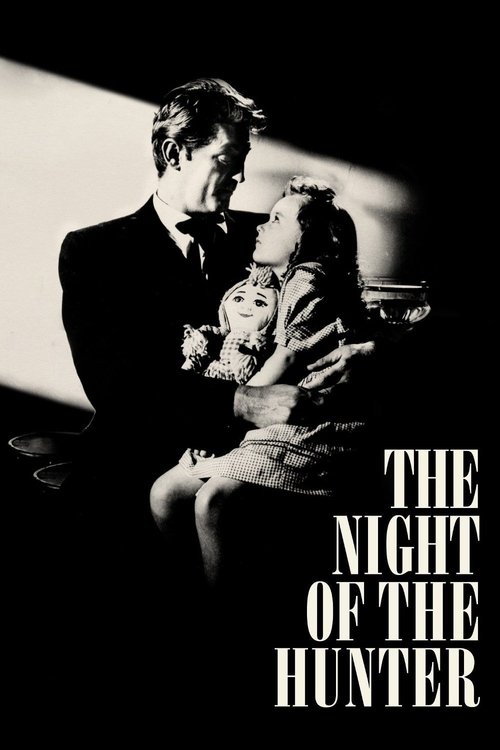
The Night of the Hunter
1955 · Charles Laughton
For when you want an old film that still unsettles — a beautiful nightmare rather than a jump-scare machine. Perfect for a quiet, spellbound night when you want cinema that feels like a dark fairy tale.
What it's about
In Depression-era West Virginia, a self-appointed preacher with LOVE and HATE tattooed across his knuckles charms his way into a widow's home — because her two young children know where a stash of stolen money is hidden. What follows is a fable-like chase down the river, two kids fleeing a smiling predator who quotes scripture, in a world where the adults can't see what the children see.
The experience
Genuinely eerie — a dark storybook where lullaby calm and creeping dread live in the same frame. It moves like a dream: slow, moonlit, and strange, with images that lodge in your memory and a villain whose singing voice in the distance is scarier than most monsters.
Performances
Robert Mitchum's preacher is one of the great screen villains — all silky charm over bottomless menace, the LOVE/HATE sermon on his knuckles delivered like a parlor trick. Lillian Gish, a legend of the silent era, is his unforgettable counterweight: gentle, unbudging goodness with a shotgun on her lap.
The craft
Actor Charles Laughton directed only this one film, and it looks like nothing else from 1950s Hollywood: stark silhouettes, storybook compositions, and shadows straight out of German Expressionism, all in luminous black and white. The river journey is pure visual poetry — this one truly rewards the biggest, darkest screen you can find.
Why it matters
Ignored on release, it's now considered one of the greatest American films of its decade — a one-and-done masterpiece whose imagery has been borrowed by generations of filmmakers, especially anyone putting menace in a preacher's clothes.
Snapshot
The Night of the Hunter is the only film directed by the actor Charles Laughton, a Depression-era fable of predation and deliverance that fuses the iconography of American silent cinema with the shadow-grammar of German Expressionism. Robert Mitchum plays Harry Powell, an itinerant preacher and woman-killer with LOVE and HATE inked across his knuckles, who marries and murders a widow to get at money her late husband hid with their two children. The film's reputation is a study in delayed canonization: dismissed or ignored on release in 1955, it has since become one of the most admired American films of the decade, routinely cited in critics' polls and treated as a singular object — a director's first and last feature that arrived fully formed and without obvious successors in his hands. Its stylization (storybook tableaux, a hunted river idyll, a final-act morality contest between Mitchum's false shepherd and Lillian Gish's true one) places it outside the realist mainstream of 1950s Hollywood and closer to allegory, hymn, and nightmare.
Industry & production
The film originated with producer Paul Gregory, who had built a successful partnership with Laughton staging touring theatrical readings (including Don Juan in Hell and The Caine Mutiny Court-Martial). Gregory acquired the rights to Davis Grubb's 1953 novel, a critical and commercial success, and brought Laughton on to direct — an unusual gamble on a celebrated actor with no directing credits. It was produced through Gregory's company and released by United Artists, the studio whose distribution model favored independent producers.
By the consistent account of those involved (most fully documented in Preston Neal Jones's oral history Heaven and Hell to Play With), the production was a creative high-wire act sustained by Laughton's theatrical sensibility and Grubb's close involvement — the novelist supplied numerous sketches that informed the film's compositions. The picture was not a success on first release; it is generally described as a commercial disappointment and received mixed-to-poor notices. I will avoid citing specific box-office figures, which are not reliably documented. Whatever the precise numbers, the outcome was decisive for Laughton: he never directed another film, and the unmade follow-up he and Gregory discussed (an adaptation of Norman Mailer's The Naked and the Dead) did not come to fruition under him. That single-film career is inseparable from how the work is now read — as an isolated masterpiece rather than the opening of an authorial body.
Technology
The Night of the Hunter was made in black-and-white on 35mm in the standard Academy-derived ratio, at a moment when the industry was aggressively pushing color, widescreen (CinemaScope), and stereophonic sound to differentiate theatrical moviegoing from television. The film's commitment to monochrome and a non-widescreen frame was already, in 1955, a slightly retrograde aesthetic choice, and it is essential to the film's effect: the high-contrast, deep-shadow image depends on black-and-white tonality, and the boxier frame supports the painterly, centered, almost iconic compositions. Cinematographer Stanley Cortez used the available tools of studio black-and-white craft — directional lighting, hard shadow, controlled fog and water effects, in-studio construction of exteriors — rather than any novel apparatus. The technology story here is less about innovation than about deliberate archaism: Laughton and Cortez reached back toward the look of 1920s cinema at the precise historical moment Hollywood was racing in the opposite direction.
Technique
Cinematography
Stanley Cortez's photography is the film's most celebrated technical achievement and one of the canonical examples of Expressionist lighting in American studio cinema. Cortez, who had earlier shot Welles's The Magnificent Ambersons, built images out of stark chiaroscuro: Powell's silhouette thrown enormous on a bedroom wall, the conical shadow of his hat, pools of light isolating figures in surrounding blackness. The most famous single image is the underwater shot of the murdered Willa seated in a submerged Model T, her hair streaming with the river weeds — a composition of eerie, almost beatific stillness that converts horror into something hymnal. The children's nighttime flight downriver is rendered as a sequence of stylized vignettes, with foreground animals (a frog, a rabbit, an owl, a spider's web) framing the tiny skiff in the distance, deliberately recalling the artifice of silent-era nature inserts and storybook illustration. Throughout, Cortez favors deep, theatrical staging and compositions organized around strong verticals and diagonals, so that the image reads as designed tableau rather than captured reality.
Editing
The editing, credited to Robert Golden, serves the film's shifts of register rather than calling attention to itself with rapid cutting. Its most discussed effect is rhythmic and tonal: the river journey unfolds in a lulling, lyrical cadence of dissolves and held compositions that suspends ordinary narrative time, while the murders and pursuits are handled with abrupt economy. The film moves confidently between modes — naturalistic domestic scene, expressionist set-piece, comic-grotesque interlude — and the cutting modulates these transitions so the changes feel like movements in a piece of music rather than ruptures.
Mise-en-scène / staging
Laughton's background as a stage director and dramatic reader is everywhere in the staging. Many scenes are blocked with a frontal, presentational clarity — figures arranged as if on a proscenium, gestures held and legible — that aligns the film with allegory and fairy tale. The production design moves pointedly between registers: the cramped, shadowed interiors of the Harper home and the town under Powell's spell, versus the idyllic, almost pastoral spaces around Rachel Cooper's farm. Recurring visual motifs (the contrast of upright and fallen figures, doorways and thresholds, the river as a path to safety) give the film the structure of a moral diagram. The artifice is intentional and total; the film never pretends to documentary reality.
Sound
Walter Schumann's score is woven tightly into the film's design, alternating menacing motifs with folk-hymn material. The single most important sonic element is the hymn "Leaning on the Everlasting Arms," which Powell sings as a leitmotif of approaching menace — most powerfully in the scene where his off-screen singing in the dark is answered and overpowered by Rachel, the two voices duetting across the night in a contest between false and true faith. The use of voice and song as moral signifier — Powell's mellifluous, weaponized preaching versus the plain conviction of Rachel — makes sound a primary carrier of the film's theme rather than mere atmosphere.
Performance
Robert Mitchum's Harry Powell is among the most influential villain performances in American film: charming, sing-song, physically languid and then explosively violent, equally persuasive as seducer and predator. Mitchum plays the preacher's piety as performance-within-performance, which is precisely the point — the danger lies in how readily the community believes him. Shelley Winters, as the lonely, guilt-ridden widow Willa, embodies the film's critique of repressive religiosity, her need for absolution making her Powell's perfect victim. Lillian Gish, as the shotgun-toting guardian Rachel Cooper, supplies the film's moral counterweight; her casting is itself a statement, carrying the authority of silent cinema into the film's conclusion. The two child performers, Billy Chapin (John) and Sally Jane Bruce (Pearl), anchor the story's point of view; the film is in large part told from a child's-eye understanding of adult terror.
Narrative & dramatic mode
The film operates as fable and cautionary tale rather than psychological realism. Its dramatic engine is a chase — Powell pursuing the children for the hidden money — but the telling is structured as moral allegory, built on stark binaries: love and hate, the false shepherd and the true, the predatory adult world and the endangered innocence of children. The narrative is bifurcated: the first movement is a domestic tragedy in which Powell insinuates himself into the Harper household and destroys it; the second is a pursuit-and-deliverance arc in which the children escape downriver and find sanctuary with Rachel. Point of view is crucial — much of the film is filtered through John's wary, watchful consciousness, which licenses the heightened, dreamlike stylization. The tone is deliberately unstable, sliding among horror, lyricism, and grotesque comedy in a way that resists the period's dominant realist conventions.
Genre & cycle
The Night of the Hunter sits athwart several categories. It is often discussed in relation to film noir, and it shares noir's expressionist shadow-work and its predatory criminal — but its rural Depression setting, its child protagonists, and its overt religious allegory pull it away from noir's urban fatalism toward something closer to gothic fairy tale and American folk myth. It can be read as a thriller and a horror film (Powell is effectively a fairy-tale ogre), and as a Depression-era social tableau in the lineage of 1930s populist storytelling. Its refusal to settle into one cycle is part of why it had no easy commercial slot in 1955 and part of why it has aged into singularity.
Authorship & method
The authorship question is unusually layered. Laughton is the decisive creative intelligence — an actor-director shaping every performance and the film's overall theatrical-allegorical conception — yet the film is a genuine collaboration. The screenplay is credited to James Agee, the critic-novelist then near the end of his life; by the widely reported account of the production, Agee delivered an enormous, unwieldy draft and Laughton substantially reworked the material into the shooting script, so the precise division of authorial credit is contested and cannot be cleanly resolved from the record. Davis Grubb, the novelist, contributed sketches and remained closely consulted, giving the film an unusual fidelity to its source's imagery. Stanley Cortez's cinematography and Walter Schumann's score are not decorative but constitutive of the film's meaning. Robert Golden edited. The result is a work whose "author" is best understood as Laughton presiding over a tight circle of strong collaborators — which makes its status as a one-off all the more poignant, since the method was never repeated.
Movement / national cinema
Though an American studio-distributed production, the film is the clearest mid-century American absorption of German Expressionism — the Caligari lineage of distorted, shadow-built worlds — channeled through Hollywood craft. Equally important is its deliberate homage to American silent film, and specifically to D. W. Griffith: the casting of Gish, a Griffith icon, the storybook nature inserts, and the sentimental-pastoral treatment of endangered innocence all reach back to the 1910s–20s. The film thus stands at a crossroads of two cinematic traditions rather than belonging to a contemporaneous movement, which is one reason it felt out of step in 1955 and has since been claimed by cinephile culture as a uniquely personal, almost stateless work of art.
Era / period
The film is set in Depression-era West Virginia, and the economic desperation of the 1930s is not mere backdrop: the hidden money, the vulnerability of a widow and her children, and the community's susceptibility to a charismatic preacher all draw on the social fabric of hard times. Made in 1955, the film also speaks obliquely to its own moment — an era of religious conformity and surface piety in American life — through its portrait of a pious community fatally unable to see the evil dressed as faith in its midst. The period setting allows the film to function simultaneously as historical fable and as a quiet critique of the spiritual complacency of its present.
Themes
At its center is the opposition of love and hate, literalized on Powell's knuckles and elaborated in his pulpit parable of the warring hands — a sermon the film both stages and ultimately refutes when Rachel proves that love endures. The film is a sustained meditation on false versus true faith: Powell weaponizes scripture and the trappings of religion, while Rachel embodies a practical, protective, unsentimental Christianity. Innocence and its endangerment is the emotional core, with the children's-eye perspective making adult corruption monstrous and strange. Further threads run through it: the gullibility of communities before charismatic authority, the persistence of guilt and the hunger for absolution (Willa), and the river as an image of both flight and grace. The closing emphasis on the resilience of children ("They abide, and they endure") states the film's final, hard-won faith in survival.
Reception, canon & influence
On release the film was, by general account, a commercial disappointment met with mixed or unappreciative reviews, an outcome that effectively ended Laughton's directing career. Its critical fortunes reversed over the following decades: championed in retrospect by critics and filmmakers, it climbed into the established canon of American cinema and now appears regularly in critics' and directors' polls of the greatest films. The reappraisal has made it a textbook case of a work too unusual for its moment.
Influences on the film run backward to German Expressionism and to American silent cinema, above all Griffith — debts Laughton made deliberately visible through Cortez's lighting, the storybook staging, and the casting of Gish. Davis Grubb's novel and Agee's screenwork supplied the narrative and much of the imagery.
Its influence forward has been broad and durable. Mitchum's Harry Powell became an archetype of the charismatic religious predator, and the LOVE/HATE knuckle tattoos passed into the wider culture — most famously reworked by Spike Lee in Do the Right Thing through the character Radio Raheem. Filmmakers associated with stylized menace and American gothic — the Coen brothers, David Lynch, and others working in heightened, fable-like registers — are frequently discussed as inheritors of its tone, and its expressionist, dreamlike treatment of childhood terror set a template that later directors have repeatedly invoked. The specific reach of any single homage can be overstated, so claims of direct lineage should be treated case by case; what is not in doubt is that the film moved from neglected curiosity to foundational reference, an isolated masterpiece whose singularity is precisely its legacy.
A Deleuzian reading
You remember the shadow before you remember the man.
The full Deleuzian reading of The Night of the Hunter →
Reception
A critical and commercial flop in 1955 — audiences didn't know what to make of it — it's now routinely ranked among the greatest American films ever made, a rehabilitation so total it's become the textbook flop-to-classic story.
How The Night of the Hunter was received, from release to now →
Influences: the films it descends from and the films it influenced
- Sunrise: A Song of Two Humans (1927) — Murnau's German-Expressionist marsh-and-moonlight chiaroscuro and moving-camera dream space supplied the visual grammar Cortez echoes in the river idyll and the moralized fairy-tale staging.
- The Cabinet of Dr. Caligari (1920) — Its painted, anti-naturalist sets and presentational tableau staging license Laughton's deliberately storybook spaces and flattened, frieze-like compositions over realism.
- Nosferatu (1922) — Murnau's predatory silhouette and looming-shadow framing of Orlok is the template for Powell rendered as a black cut-out advancing on the children's bedroom.
- Broken Blossoms (1919) — Griffith's Victorian melodrama of endangered innocence and soft-focus pictorialism — plus the literal casting of his star Lillian Gish — is the silent-cinema lineage Laughton made visible.
- Way Down East (1920) — Gish imperiled on an ice-bound river feeds directly into the lyrical downstream drift of the children's escape and Gish's recasting as protective matriarch.
- M (1931) — Stanley Cortez's cinematography explicitly cites Weimar expressionist grammar — silhouetted pursuit sequences, high-contrast architectural enclosure — reproducing M's hybrid register; and Laughton inherits M's staging of violence through displacement: Pearl's corpse visible at the river's bottom is the same elision device as M's rolling ball and snagged balloon, the aftermath substituted for the act.
- The Lady from Shanghai (1947) — Laughton employs both the expressionist performance register Welles used — Mitchum's preacher operating in a key of theatrical unreality — and subaqueous lighting in the underwater shots of Shelley Winters's corpse, directly echoing the Steinhart Aquarium sequence's technique of illuminating faces through glass from below.
- Key Largo (1948) — Stanley Cortez channels the German Expressionist chiaroscuro lineage (Murnau → Freund → American noir) into its most radical Hollywood application; Mitchum's silhouette against the window is the visual grammar of Key Largo's shadow-as-moral-pressure pushed to its expressive limit.
- Faust (1926) — Stanley Cortez's stark Expressionist chiaroscuro and the literal good-vs-evil moral allegory descend from the Murnau/UFA light grammar Faust epitomizes.
- L'Atalante (1934) — Laughton stages a river journey as oneiric fairy tale, deploying water-as-symbol and dreamlike non-naturalism in the lyrical-realist register Vigo pioneered.
- Nightmare Alley (1947) — Applies Stanley Cortez's expressionist chiaroscuro — the same Garmes-lineage sculpting of light — to a charismatic con-man preacher, extending noir's apparatus of religious deception.
- The Wind (1928) — Laughton recalls Gish to anchor a film that revives silent-era pictorialism and turns the river landscape into an expressionist moral force in the Sjöström manner.
- Do the Right Thing (1989) — Radio Raheem's LOVE/HATE brass knuckles directly reprise Powell's knuckle-tattoo sermon, importing the film's good-versus-evil emblem as character iconography.
- The Naked Kiss (1964) — Cortez again wields baroque chiaroscuro and presentational tableau to stage a hypocrite-predator in a hymn-singing American small town.
- Cape Fear (1962) — Mitchum redeploys the soft-spoken sexual-religious menace he forged as Powell, extending the charismatic-predator archetype the earlier film created.
- Blue Velvet (1986) — Lynch inherits the small-town gothic where heightened innocence and serene menace coexist in expressionist register, the child's-eye unease made adult nightmare.
- The Night of the Hunter's heirs — Raising Arizona (1987) — The Coens lift the fable-like American-gothic tone, presentational framing, and a relentless biblical pursuer chasing endangered children across a stylized landscape.
- The Spirit of the Beehive (1973) — Erice builds an entire film from the child's-eye subjective dread of a monstrous adult world, the lyrical-uncanny POV Laughton pioneered.
- The Reflecting Skin (1990) — A prairie-gothic fairy tale filtered through a child's terrified misreading of a predatory adult, with expressionist landscape and moral-allegory framing.
- Charles… Dead or Alive / Mitchum's sermon line — Cape Fear (1991) — Scorsese's remake explicitly tattoos and scriptures its villain and casts Mitchum and Gregory Peck in homage, transmitting the Powell preacher-predator iconography forward.
- To Kill a Mockingbird (1962) — Stanley Cortez's low-angle, deep-shadow monochrome—children navigating Gothic darkness under adult menace—directly precedes Harlan's cinematographic strategy; the child-height camera as instrument of terror and wonder is nowhere more systematically developed in American cinema before Mockingbird's Radley sequences.
- Eraserhead (1977) — Stanley Cortez's cinematography here — silhouetted figures dissolving into deep blacks, illumination used to sculpt psychological dread rather than reveal narrative space — is the most direct precedent for the extreme tonal contrast Frederick Elmes and Lynch developed across Eraserhead's five-year shoot, where light is treated as a carving instrument on darkness rather than a source of visual information.
- Down by Law (1986) — Stanley Cortez's black-and-white photography renders the Louisiana bayou as abstracted expressionist landscape—Spanish moss, fog, and dark water reduced to tonal fields of deep gray—anticipating the precise visual mode Müller uses when the three escapees move into the swamp, treating Southern Gothic geography as material for graphic composition.
- Fanny and Alexander (1982) — Laughton establishes the grammar of the punitive religious patriarch who weaponizes architectural space against children: Mitchum's preacher uses staircases, cellar confinement, and doorframe framing as instruments of dominion, a geometric logic Bergman transplants directly to the bishop's palace sequences.
- The Spiral Staircase (1946) — Stanley Cortez's deep-shadow, child/woman-in-peril expressionism in a gothic house is the same cinematographer working the same menace-through-lighting register.
- Hawkins Pursued (The 5,000 Fingers of Dr. T) (1953) — A child's-eye nightmare-fable with overscaled, theatrical dream sets — sharing the period's attempt to film a fairy-tale subjectivity from inside a frightened child's perception.
- The Curse of the Cat People (1944) — A Val Lewton fable rendering a child's interior fantasy-and-fear world through shadow and suggestion, parallel to Laughton's poeticized childhood terror.
- Killer of Sheep (1978) — Burnett's black-and-white poetic-realist treatment of children adrift in a harsh American landscape extends the lyrical, hymn-scored child's-eye lyricism over plot.
- Strangers on a Train (1951) — Laughton's expressionist chiaroscuro river sequences and the sinister-festive grammar of Robert Mitchum's hymn-singing villain — sacred melody turned threatening, social charm masking psychopathy — directly parallel Bruno Anthony's fairground performance; both films exploit the technique of making the charismatic villain's performed pleasure the precise vehicle for menace.
- Sling Blade (1996) — Southern Gothic moral fable built on stark frontal tableau staging, where children menaced by a predatory adult can only be saved by an answering protective violence.
- Suddenly, Last Summer (1959) — Sibling in expressionist Southern gothic, using high-contrast monochrome and a predator stalking the innocent to expose the horror beneath mid-century respectability.
- The Outsiders (1983) — Its expressionist, fairy-tale tableaux of imperiled children supply the heightened pictorial mode Burum and Coppola push toward in the film's painterly compositions.
- The Big Combo (1955) — Stanley Cortez builds whole sequences from pure silhouette against a single source, proving alongside Alton that in 1955 an American film could still stage narrative information as black shape rather than lit face.
Similar films
- Cape Fear (1962) — influence & lineage · same viewing thread
- Nosferatu (1922) — influence & lineage
- M (1931) — same viewing thread · often watched together
- The Prowler (1951) — same viewing thread
- Kiss Me Deadly (1955) — same viewing thread
- Laura (1944) — same viewing thread
- The Cabinet of Dr. Caligari (1920) — influence & lineage · often watched together
- Do the Right Thing (1989) — influence & lineage · often watched together
All the films related to The Night of the Hunter →
Watch it with: curated runs of related films
- The Long Shadow of M — A run from Lang's Weimar crime films through their noir and neo-noir children — killers, con men, masterminds, and manhunts — where you can watch expressionist menace mutate step by step into the modern thriller.
Film essays and courses that include it
- The Grammar of Shadow: Black & White Cinema from Caligari to Raging Bull
- The Grammar of Shadow: Chiaroscuro from Expressionism to Digital Noir
- Portrait of a Killer: How Cinema Learned to Inhabit the Monster
- The Grammar of Dread: Twelve Films That Built Cinema's Language of Unease
- The Painted Frame: Cinema's Conversation with the Canvas
- The Silence of God: Cinema's Argument with the Divine
- The Corrupting Vein: Cinema's Century with Greed
- The Wages of Wanting: Noir's Cinema of Appetite and the Fall
- Devil at the Crossroads: The Gothic Roots of Vampire-Blues Cinema
- What the Darkness Knows: The Occult Procedural and Its Investigators
- Land and Memory: Cinema's American South